
















Barcelona cathedral: what to see inside and how to get a ticket with a time slot
Barcelona Cathedral has stood in the Gothic Quarter since the late 13th century.
In summer, the line at Pla de la Seu stretches across the entire square. Many tourists walk around the facade, take a photo, and leave. Meanwhile, inside there is a cloister with white geese, choir stalls with knights' coats of arms, and the Chapel of Christ of Lepanto.
This guide will help you plan your visit. We have put together the practical details: what to see inside, when admission is paid, where to find tickets, and how to get there. The cathedral is dedicated to the Holy Cross and Saint Eulalia (as of 09/2026, Wikipedia).
Ad: this article contains affiliate links, we earn a commission if you book through them, at no extra cost to you.
The main attraction of the Gothic Quarter
💡 In short:
- The cathedral stands on Pla de la Seu, in the heart of the Gothic Quarter.
- Inside, see the choir, the crypt of Saint Eulalia, and the cloister with geese.
- Admission is paid, and the line is shorter in the morning on weekdays.
- Facts and dimensions: 09/2026, cross-checked with the cathedral's Wikipedia entry.
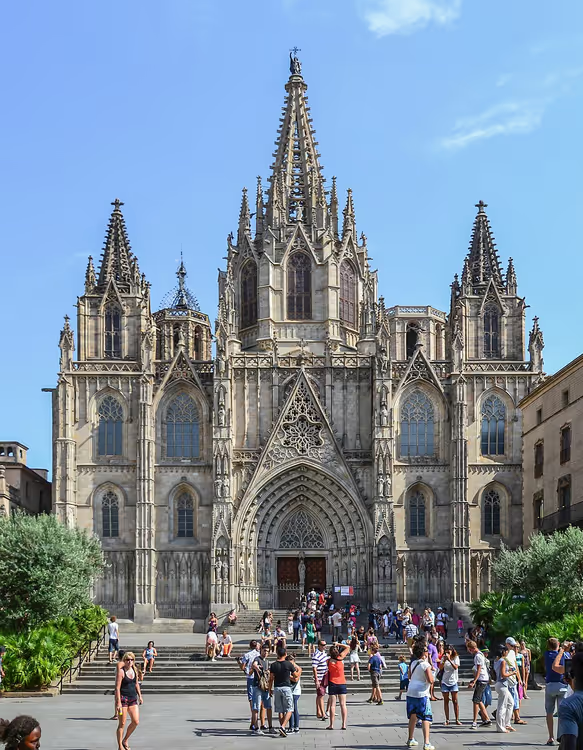 © Mromanchenko · CC BY-SAPhoto: Mromanchenko, CC BY-SA (https://creativecommons.org/licenses/by-sa/3.0), Wikimedia Commons
The cathedral is considered the religious center of the Catalan capital. Its towers are visible from the quarter's narrow streets long before you reach the square. On holidays and weekdays alike, tourists and locals mingle at the entrance.
Catalonia lives with a sense of its own distinct history, and the cathedral has long been its symbol. City processions and the archdiocese's main masses begin here. If you have only an hour for the Gothic Quarter, start with this square. The stone streets around it lead to the Roman walls and the city history museum, so the route is easy to continue on foot.
Construction history
The first temple on this site appeared back in the Roman era. According to Wikipedia, an early Christian complex from the 4th to 7th centuries stood here. In 985, it was heavily damaged by the troops of Al-Mansur.
In 1046, Count Ramon Berenguer I of Barcelona and his wife Almodis began building a Romanesque cathedral church. It was consecrated in November 1058. Its crypt survives beneath the current building, and fragments of the old masonry are sometimes shown on tours.
The Gothic church was laid later. The first stone was placed on May 1, 1298, under King James II. Construction proceeded from east to west, and the plain western facade was finished in 1417. The cloister was completed in 1448, 150 years after work began (construction timeline on Wikipedia).
The cathedral is dedicated to Saint Eulalia, the city's patron saint. Her relics are kept in the crypt beneath the main altar. According to tradition, the girl was martyred at age 13. You will see this number again in the inner courtyard.
The nave and walls took the longest to build. Medieval craftsmen worked without modern equipment, so the masonry is uneven in places. These traces of handwork are worth examining up close at the side portals.
Different generations of architects changed the plans. The original design drew on French Gothic, but over time Spanish features were added. That is why strict forms and decorative details coexist in a single building.
The work was finally completed in the 20th century. The western wall and dome were finished by 1913, and the cathedral's silhouette has not changed since. For you, this means you see the church in the form envisioned by restorers, not medieval builders.
Architecture
The neo-Gothic facade you see today was built in the late 19th century. The project was prepared by architect Josep Oriol Mestres, based on 15th-century drawings, and completed by August Font i Carreras in 1913. Before that, the western wall looked far more modest.
The cathedral's dimensions are impressive: 93 meters long and 40 meters wide (cathedral dimensions on Wikipedia). Inside there are five naves, with the side ones divided into chapels. The eastern end finishes in an apse with nine radial chapels and an ambulatory.
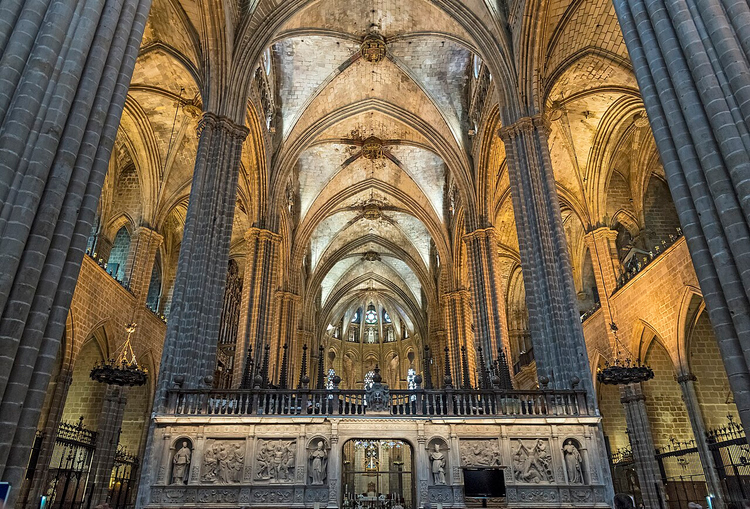 © Didier Descouens · CC BY-SAPhoto: Didier Descouens, CC BY-SA (https://creativecommons.org/licenses/by-sa/4.0), Wikimedia Commons
Not only saints rest beneath the vaults. In the southern part of the hall stands the sarcophagus of Count Ramon Berenguer I and his wife Almodis. Its lid is decorated with painting worth examining up close. Bishops Berenguer de Palou II and Arnau de Gurb are also buried here, and Saint Raymond of Penyafort rests nearby.
Important: part of the interior is closed during services. If you arrive during a mass, you will have to postpone touring the visitor area.
Who it's for: those who want to see Catalan Gothic in the center of the old city. Not for: those expecting free admission and a quick 10-minute visit.
Interior
The cathedral choir is famous for its stone and wood carving. The gilded coats of arms of the knights of the Order of the Golden Fleece survive on the seat backs. The order held its first meeting in Spain here in 1519, under Charles V.

A separate chapel is dedicated to Christ of Lepanto. The image is believed to have accompanied the fleet at the Battle of Lepanto in 1571. Saint Olegarius, bishop of Barcelona, is also buried here.
The cathedral's stained glass is considered among the finest examples of Gothic in Catalonia. Look up: light through the colored glass changes the nave's appearance throughout the day.
The Chapter House can be reached through the cloister. An old crucifix is kept here, and the chapter meets here. The room's design is austere, without excess decoration.
Also see the Chapel of Santa Llúcia. It is considered one of the oldest rooms in the complex. Next to it begins the passage to the inner courtyard, where tour routes lead.
Unusual residents
The cathedral's inner courtyard, the cloister, is surrounded by a gallery and chapels. The courtyard is enclosed, but you can enter through the Portal de Santa Eulàlia or the Portal de Santa Llúcia.
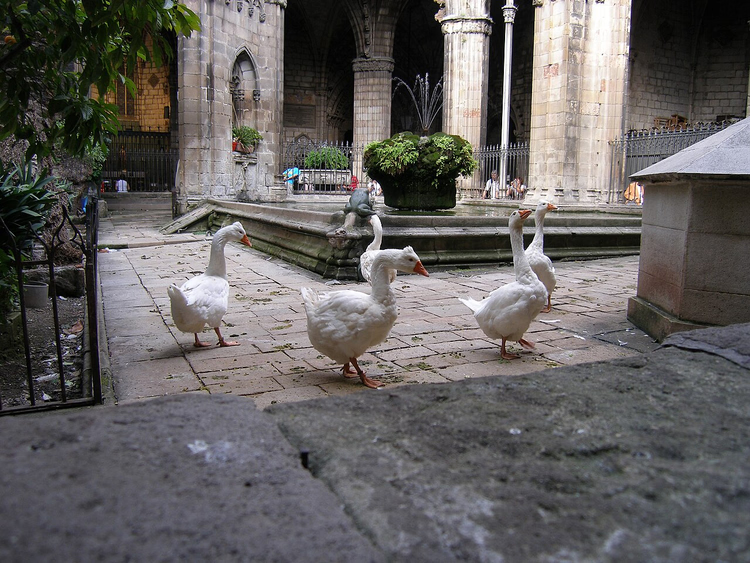
The cloister's main curiosity is its 13 white geese. They have lived around the Well of the Geese (Font de les Oques) since the 15th century. The number of birds matches Saint Eulalia's age at the time of her execution (about the 13 geese on Wikipedia). Do not feed or pet the geese.
The oldest entrance to the cathedral opens onto Carrer dels Comtes. Townspeople entered the church through it as far back as the Middle Ages. If you are coming from the Gothic Quarter, you will see this facade first.
A historic monument
In 1929, the cathedral was declared a national monument of Spain, protection number RI-51-0000338 (protected status on Wikipedia). This status protects the building from alterations and commercial use.
Above the main entrance, a Gothic rose window is visible. Narrow columns continue into the spires of the two side towers. This combination creates the recognizable silhouette you can easily spot in photos of Barcelona.
 © Jose María Ligero Loarte · CC BY-SAPhoto: Jose María Ligero Loarte, CC BY-SA (https://creativecommons.org/licenses/by-sa/4.0), Wikimedia Commons
The roof offers a view of the old city. You will see the boundary between the Gothic Quarter and the regular grid of Eixample. Access to the viewing terrace is arranged separately from cathedral admission; check details on the official website.
Tickets and opening hours
Admission to the cathedral is paid. Check the exact price and schedule on the official website: the museum section closes earlier than the evening mass. In high season, go in the morning, when the line is shorter.
Tours and tickets in Barcelona
Guided tours, skip-the-line tickets and activities — most offers can be cancelled free of charge.
See offers on TiqetsThe widget loads once you give your consent.
Barcelona Cathedral on the map
The cathedral stands on Pla de la Seu. From Jaume I metro station (line L4) to the entrance is about 300 meters, a 4-5 minute walk (per the map). From La Rambla it is about 400 meters. Both points work well if you are exploring the center without a car.
⁉️🤔 Frequently asked questions
Do I need to buy tickets in advance?
Yes, in high season morning slots go quickly. An online ticket saves you from the line at Pla de la Seu. If you are only attending mass, entry is usually free, but the visitor area and roof require a ticket. Check the exact conditions on the cathedral's official website.
How long does a visit take?
Allow 45 minutes to an hour and a half. The main points are the choir, the crypt, the chapels, and the cloister with geese. If you go up to the roof, add about another half hour. In high season, some time goes to the security check at the entrance.
How many geese live in the cloister and why?
Thirteen white geese, matching Saint Eulalia's age at the time of her martyrdom. The birds have lived around the Well of the Geese since the 15th century. They are used to visitors but remain a living symbol of the cathedral, not an attraction. Do not feed or pet them.
Can I go up to the roof?
Yes, the viewing terrace is visited separately from the church. From there you can see the boundary between the Gothic Quarter and Eixample. Plan the climb for the morning or closer to evening. Check current conditions and prices on the official website before your visit.
How is the cathedral different from Sagrada Familia?
These are two different churches and two different periods. Sagrada Familia is Gaudí's original project; the cathedral is Catalan Gothic from the 13th to 15th centuries in the center of the old city. The line is shorter here and the atmosphere is different. If Gothic is what matters to you, start with the cathedral.
In short: what to book
If you are coming for Gothic architecture, the cathedral will show it to you in the center of the old city. If you have half a day, combine the visit with the Barcelona History Museum in the neighboring quarter. For families, the main draw is the 13 geese in the cloister. For a first introduction to the city, an hour in the morning on a weekday is enough.
A ticket with a time slot saves your morning: book Barcelona tickets on Tiqets.

A small editorial team writing guides for independent travel. We travel ourselves, but we haven’t been everywhere, so we check prices, opening hours and how to get there against official sources.