
















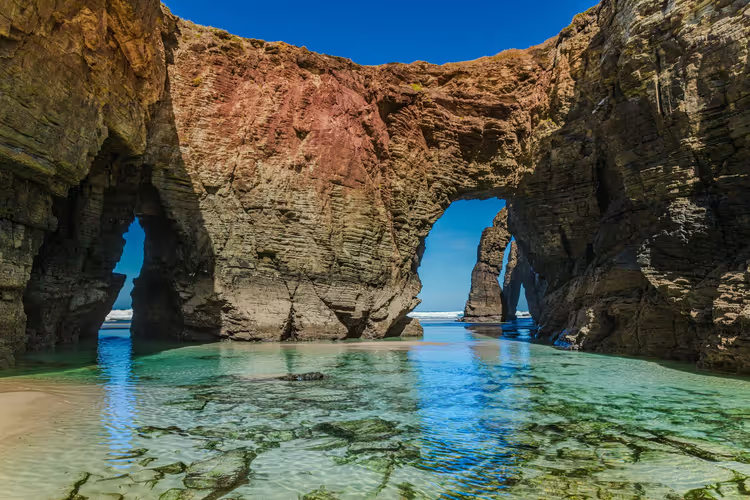
Cathedrals beach: when is low tide and do you need to book entry
Cathedrals Beach is located in northern Spain, in Galicia. It lies about 10 km from Ribadeo, on the shore of the Cantabrian Sea (on the map). The sand and stone arches are only exposed at low tide, and the sea returns very quickly.
In high season, a free reservation is required to go down to the water. Outside the season, entry is free. Below we've gathered everything to help you plan your visit without rushing or making unnecessary mistakes.
How the beach was formed
💡 In short:
- You should only go down to the water around low tide.
- In season, a free reservation is required on the Xunta website.
- Access and visitor management: 09/2026, according to the official Xunta website.
The name Cathedrals Beach was coined by tourists. There are no Gothic cathedrals here, but there are rocks that resemble arches, columns, and buttresses of a cathedral. The official name of the place is different: Praia de Augas Santas, or Praia das Catedrais.
The sea carved these shapes out of soft rock. According to the Lugo province tourism office, the rock is slate and quartz. Waves and wind strip away the softer layers and leave behind the harder veins, so the appearance of the cliffs slowly changes.
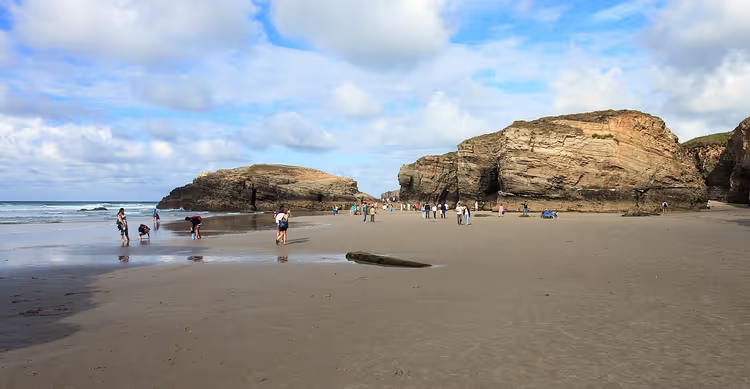 © Luis Miguel Bugallo Sánchez (Lmbuga) · CC BY-SAPhoto: Luis Miguel Bugallo Sánchez (Lmbuga), CC BY-SA (https://creativecommons.org/licenses/by-sa/3.0), Wikimedia Commons
The front line of the natural monument stretches for 2.2 km, and the cliffs rise 10-20 m (as of 09/2026, Galicia nature portal). The beach fully exists only at low tide. At high tide, the sea covers almost all of the sand, and the arch walls are visible only from the water.
At high tide, going down to the water is unsafe. Plan your visit around low tide, otherwise you'll only see the tops of the cliffs from the viewpoint trail. The natural monument is protected, so the number of visitors on the sand is limited.
The most beautiful spots
The most interesting section stretches for about 300 meters. It's worth walking through it slowly and taking in the details. We don't recommend spreading a blanket on the sand: the water returns quickly, and you may not have time to gather your things.
If you don't want to get your feet wet, view the beach from the cliff. A viewpoint trail with a low parapet runs along the top. From above you can see the entire bay, and at high tide this is the only safe viewpoint. The parapet also protects you from spray.
The cliffs are a favorite spot for seabirds. Gulls on the dark rock look striking, and such shots come out well even on a phone. Bring binoculars if you want to see nests and bird colonies on the ledges.
One of the most photographed places in the world
At the far end of the beach, three arches stand in a row. They look so perfectly formed that many people think they are man-made. The rocks behind the arches are covered with shells, which also make it into the frame.
Professional photographers come here for shots at sunrise and sunset. The place is often included in lists of the world's most beautiful beaches (according to the Lugo tourism office). In the morning the light is softer and there are fewer people on the sand.
What to see at low tide
The beach is worth walking from one end to the other. Look into the grottoes and caves: they are small, so you can't get lost. Inside, tidal pools often remain, where the water is noticeably warmer than in the open sea.
Don't climb on the rocks: the place is protected as a natural monument. Stay away from wet seaweed on the rocks.
If you don't want to go back to the stairs, keep walking along the shore. That way you'll reach Reinante beach. Beyond the arches the landscape is calmer, but there's more wildlife: you can observe sea creatures and swim at the end of the route.
Bring a swimsuit even in cool weather. The water in the Bay of Biscay is not warm, but it does warm up in the tidal pools and grottoes.
Practical tips for travelers
Keep an eye on the water level throughout your visit. Check the tide schedule so you can make it back to the stairs. A delay risks the water cutting you off from the shore.
Wear shoes with non-slip soles. Wet rock and seaweed are slippery.
- Who it's for: photographers, nature lovers, families with older children.
- Not for: those who want to lie on the sand all day and swim in warm water.
- The catch: the low-tide window is short, and at high tide going down to the water is unsafe.
Natural monument of Galicia
In 2005, the beach was declared a natural monument of Galicia. This was confirmed by a separate regional decree (as of 09/2026, official Xunta gazette). Later, a conservation plan was also approved for the site.
The status explains the restrictions. Visitor numbers are regulated to prevent trampling the sand and damaging the fragile arches. The place has become widely known, and thousands of tourists come here.
Every low tide reveals a new view. The sea recedes, and people find themselves among scenery created by nature. Here it's especially clear how powerful the combination of water, stone, and light can be.
When to go and what to consider
Galicia lies in northwestern Spain, so the weather here is changeable even in summer. The warmest time is July and August.
Book your seasonal access permit in advance: free slots on popular dates may run out.
How to get to the beach
The nearest airport is in Asturias. The airports of A Coruña, Vigo, and Santiago de Compostela also work. There are almost no direct flights to Galicia; you usually fly with a connection in Madrid or Barcelona. From there, renting a car is the most convenient option.
From Ribadeo, the Bus Praia shuttle runs to the beach from the bus station (according to the Ribadeo tourism office). With a ticket for this bus, access is guaranteed, and you don't need a separate reservation. If you're staying in Ribadeo, ask for a permit at the hotel front desk.
Season | Is a reservation required | How to arrange it |
|---|---|---|
Holy Week and July 1 to September 30 | yes, free | |
October-June, except Holy Week | no | free entry |
Any season | descent only around low tide | tide schedule |
Cars are left in the parking lot at the top of the cliff; a staircase leads down. Go down at the start of the low-tide window so you have time to walk the beach.
 © Fernando Losada Rodríguez · CC BY-SAPhoto: Fernando Losada Rodríguez, CC BY-SA (https://creativecommons.org/licenses/by-sa/4.0), Wikimedia Commons
What else to see in Galicia
Galicia attracts those who love nature and culture. Santiago de Compostela, the regional capital, serves as a pilgrimage center and is considered one of the most beautiful cities in Spain. The Camino de Santiago routes lead to its cathedral.
 © Jorge Franganillo · CC BYPhoto: Jorge Franganillo, CC BY (https://creativecommons.org/licenses/by/4.0), Wikimedia Commons
Lugo has preserved Roman walls that are listed as a UNESCO World Heritage Site. The historic quarters of Pontevedra are also worth seeing. Rural and gastronomic tours are popular in the region.
Cathedrals Beach on the map
It's convenient to set the point in your navigation. Enter Praia das Catedrais or As Catedrais Beach; the parking lot is marked at the top of the cliff. Check the low tide for the day of your trip on the Xunta portal.
Cathedrals Beach in Spain
Places on the map
- Cathedrals Beach Arch rocks in Galicia, visible only at low tide
⁉️🤔 Frequently asked questions
Do I need a reservation to enter the beach?
Entry is free all year round. A permit is only required during Holy Week and from July 1 to September 30. Arrange it on the official Xunta website. For those staying in Ribadeo, a permit is often issued directly at the hotel.
When is the best time to visit considering the tides?
The beach is only accessible around low tide. Check the tide schedule for the day you want and arrive at the start of the window. At high tide, going down to the water is unsafe. The viewpoint trail at the top is always open and doesn't depend on the water.
Can I get to the beach without a car?
Yes, the Bus Praia shuttle runs from the Ribadeo bus station, as noted by the Ribadeo tourism office. With a ticket for it, access to the beach is guaranteed. The ride is short, so you won't be stranded without a car.
Is the beach suitable for swimming?
The water in the Cantabrian Sea is cool even in summer. For swimming, the tidal pools between the rocks are more comfortable: the water warms up more there. Bring a swimsuit. At high tide, going down to the water is unsafe.
Why does the beach have this name?
Officially it's Praia de Augas Santas, or Praia das Catedrais. The nickname "Cathedrals Beach" was given for the arches and columns that resemble a Gothic cathedral.
In short: what to book
Cathedrals Beach is worth adding to your Galicia itinerary. If you're going in summer or during Holy Week, first get a free permit on the Xunta website, then choose your date. If you're going in autumn or winter, just check the tide.
If you have one day, combine the viewpoint trail from above with the descent at low tide: these are two different views of the same place.

A small editorial team writing guides for independent travel. We travel ourselves, but we haven’t been everywhere, so we check prices, opening hours and how to get there against official sources.