
















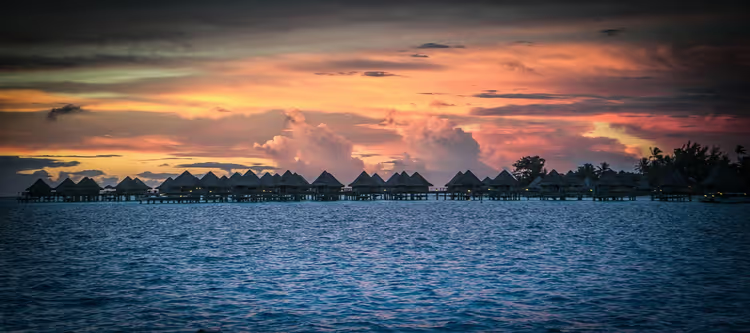
Bora Bora for a digital nomad: visa, housing and internet
Bora Bora sells a picture, not a desk. The island in French Polynesia runs on one ring road, a lagoon, and bills that are several times higher than in Asia. There are no coworking spaces here, and a month of housing costs as much as a full trip around Europe.
For a remote worker, the island still works. Internet is provided by one stable operator, the visa is sorted out in advance, and logistics come down to a flight via Tahiti. Below we break down what you need to know before booking: climate, visas, housing, connectivity, and risks.
Ad: this article contains affiliate links, we earn a commission if you book through them, at no extra cost to you.
How the island is set up
💡 In short:
- Budget by Western standards: housing and food eat up the most.
- Connectivity is handled by one operator, VINI, and an
eSIMfor the island is set up before departure. - EU citizens enter visa-free, Switzerland has its own length-of-stay limit.
- As of 13.09.2026, checked on the VINI website.
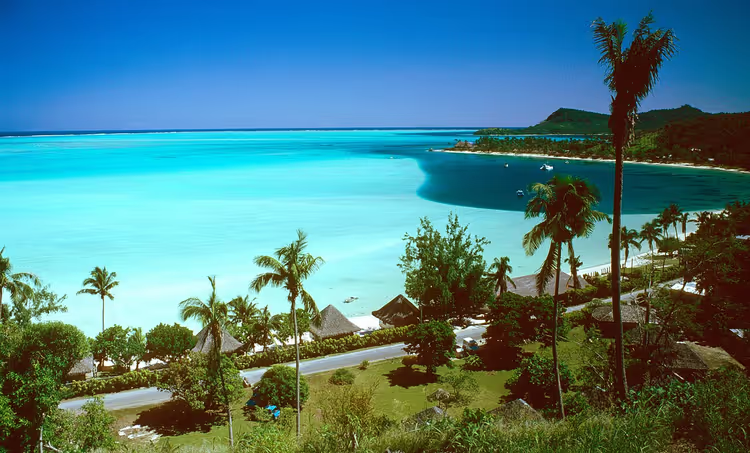
Bora Bora lies in the Society Islands archipelago and is an atoll with an extinct volcano in the center. The main island stretches 8 kilometers north to south and 5 kilometers west to east, and all the land together with the motus fits into 39 square kilometers (as of: Wikipedia).
The island's population is just over 10,600 people according to the 2017 census (as of: Wikipedia). Almost everyone lives on the coast, and the main settlement, Vaitape, sits on the western shore opposite the only pass into the lagoon.
For you, this means one simple thing: everything you need for work and daily life is concentrated in Vaitape and along the ring road. You can drive around the island in one relaxed hour. If you live on a small motu, check the boat schedule in advance, because it depends on the resort.
Climate: when to go
The climate here is tropical, and the year splits into two seasons. The dry period usually runs from May to October, while the wet season arrives in November and lasts through April (as of: Wikipedia). Short rains happen even in the dry months.
Temperatures stay warm year-round, and the ocean breeze takes the edge off the humidity. There are no ideally cool months on the island, so don't count on light relief for sleeping.
The wet season brings high humidity, downpours, and cyclone season. On the plus side, the island turns green, and housing prices sometimes dip. Rainy days are better spent on quiet work from your room than on long hikes.
Visas and long stays
French Polynesia remains an overseas territory of France, but it has its own entry rules. EU citizens enter visa-free.
Swiss citizens have their own visa-free stay limit. The exact duration should be confirmed with the consulate before buying tickets.
If you plan to stay longer than short-term entry allows, you're looking at a long-stay visa. It is arranged in advance and for a specific purpose. The document package will be confirmed by the French state services in Polynesia; the official portal keeps current links.
There is no separate permit for digital nomads here, so remote work does not replace a visa. Work only with legal status, otherwise you risk closing the door on entry for years.
Housing: from guesthouse to villa
Housing is the most expensive line item in your budget. Resorts with overwater villas hold four-figure nightly rates, and judging by guest names, the crowd here is not coming to save money.
A cheaper option is staying in guesthouses run by locals. A night there costs an order of magnitude less than a villa, but you get a simple room and a shared yard. It's an honest trade-off: you pay for the island, not for marble.
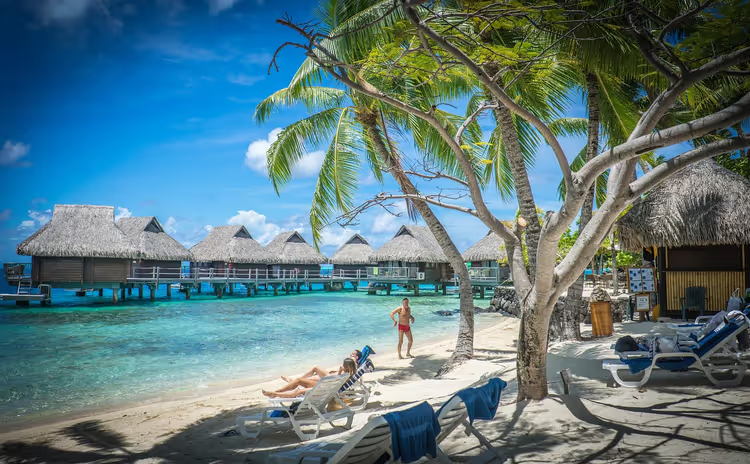
Monthly housing is found in two ways. The first: Airbnb and local agents, where you'll be offered studios with a combined bedroom, kitchen, and living room. The second: a standalone villa with two bedrooms, a kitchen, and often a pool.
A villa for a month runs into a large sum in dollars, and the price depends on the area, size, and condition of the renovation. A studio is noticeably cheaper, but the selection on the island is small, so it's better to book early.
For a nomad, one detail matters. Long-term options are almost never listed on search engines; they get snapped up through local groups. Check the internet in the house before signing the contract, not after.
You can check prices and availability in advance: check prices for Bora Bora hotels.
Find hotels in Bora Bora
Compare prices across booking sites and filter for rooms with free cancellation.
Compare prices on Trip.comThe widget loads once you give your consent.
Transport: how to get there and how to get around
Getting to Bora Bora is harder than the pictures suggest. International flights land on Tahiti, in Papeete, and from there you take a local airline or a ferry.
The flight to the island takes about an hour, and it's the most reliable option. The ferry takes longer and depends on the weather, so don't make it the last leg on your departure day.
There is almost no public transport on the island. One scheduled bus runs along the ring road, and locals mostly get around by bicycle, moped, and small electric vehicles. All of these are available for rent.
Taxis exist, but there are few of them and they are expensive. If you plan evening trips to restaurants, count that as a separate expense item.
It is convenient to compare flights to Papeete in advance: find flights on Kiwi.com. The earlier you look at dates, the wider the choice of connections.
Internet and connectivity
Mobile and home internet on the island is provided by the operator VINI. For a Pacific island, the quality is surprisingly consistent, and outages happen less often than on the mainland.
You can buy a local SIM card at VINI stores in Vaitape. Data packages are designed for tens of gigabytes, and if you run out, you can top up your traffic. Check current rates on the operator's website.
This is enough for remote work. Video calls and file uploads work fine, but the channel is more congested in the evening, so schedule important meetings for the morning.
The fastest way to get connected is via eSIM before you even fly. You can set it up in advance and activate it right at the airport: find an eSIM for Polynesia.
Food: from food trucks to Bloody Mary's
The island's cuisine is simple and honest: seafood, coconut, and fruit. Resort restaurants serve French and Polynesian classics, while street vendors feed you from mobile trucks.
 © Balou46 · CC BY-SAPhoto: Balou46, CC BY-SA (https://creativecommons.org/licenses/by-sa/4.0), Wikimedia Commons
The trucks, called roulottes here, park in busy spots and operate in the evening. This is the most budget-friendly way to get a hot meal, and portions are usually generous.
Format | What it is | Typical bill |
|---|---|---|
Roulotte truck | Hot seafood to go | Lowest |
Cafe in Vaitape | Simple dishes and breakfasts | Mid-range |
Resort restaurant | French and Polynesian cuisine | Highest |
Grocery store | You cook yourself | Saves the most |
Among restaurants, three places are worth knowing. Lagoon at St. Regis Bora Bora maintains a high standard and a view of the lagoon, while Bora Bora Yacht Club serves local dishes right by the water.
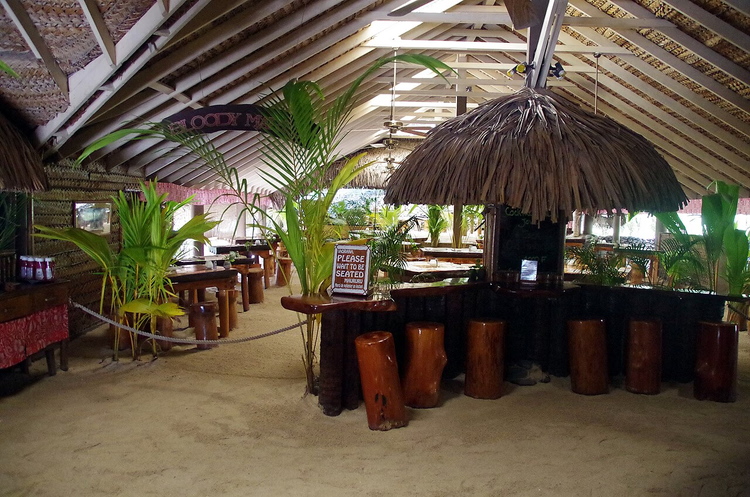
The third option: Bloody Mary's, the island's fish restaurant with history. Marlon Brando, Jane Fonda, and Diana Ross have all been here, and plaques on the walls commemorate the famous guests.
One change matters for your trip. A new project is developing on the restaurant's site: the boutique hotel Bloody Mary's Hotel with 53 rooms is slated to open in October 2026 (as of 13.09.2026, official website). Check before your visit what remains of the former restaurant.
If you cook for yourself, supermarkets and small shops await. Imported products are expensive, while fish, coconuts, and local fruit are noticeably cheaper.
Prices for basic products are partially regulated by the government, but the basket still comes out higher than in Europe. Vegetables, milk, and meat are brought from far away, so those are what hit your budget hardest.
Medicine and insurance
Healthcare in French Polynesia is better organized than a tourist might expect. A major hospital is located on Tahiti and covers almost all specialties, and in serious cases patients are transported by plane or helicopter.
On Bora Bora itself, there are medical stations that serve both locals and tourists. Many hotels have English-speaking doctors on duty, so the language barrier won't stop you.
Get international medical insurance before your flight. Check whether it covers evacuation to Tahiti: compare insurance options.
Bring a first aid kit with you. You can find familiar medications on the island, but the selection is limited, and substitutes don't always match the original formula.
Safety on the island
Bora Bora lives off tourism, so order is carefully maintained. Aggressive vendors and beggars are almost nonexistent on the streets, and shops quote final prices upfront.
Tipping isn't customary here, which simplifies your budgeting. You don't need to leave coins on the table; staff aren't used to it.
Petty theft happens, but no more often than in any small town. The rules are simple: keep your bag in front of you, don't flash large amounts of cash, and carry your documents with you.
Be especially careful near the free pier, at beach restaurants, and while shopping. Those are the places with the most people and the least attention paid to your belongings.
 © LecomteB · CC BY-SAPhoto: LecomteB, CC BY-SA (https://creativecommons.org/licenses/by-sa/4.0), Wikimedia Commons
Natural risks here outweigh street-level ones. Cyclone season falls during the wet months, and tsunamis arrive after strong earthquakes off the coasts of Chile and Samoa. You should familiarize yourself with the warning system in advance.
Remember the main rule. After a tsunami warning, you immediately head to higher ground, toward the slopes in the center of the island, and don't stay near the water.
A separate local hazard: coconuts. A coconut weighs several kilograms, and falling from height is dangerous for your head. During ripening season, don't stand under palm trees unnecessarily.
Leisure and work by the lagoon
There is essentially one public beach on the island: Matira Point in the south. Most of the shoreline belongs to resorts, so free access to the water is more valuable here than it seems.
The lagoon gives you everything people come to Bora Bora for. Snorkeling and diving reveal reefs and rays, while a yacht trip opens up the island from the water.
Beyond the ocean, the island itself is worth seeing. Vaitape has preserved historic buildings and a small maritime museum, and fruit orchards grow on the slopes.
For climbs, choose the slopes of Mount Otemanu (727 meters) and Mount Pahia (661 meters) and go with a guide (as of: Wikipedia). From above you'll see the lagoon, ancient grottoes, and sites with rock carvings.
Lagoon excursions and climbs are best booked in advance: tour options on GetYourGuide. That way you won't have to find a guide on the spot.
 © The original uploader was Sba2 at English Wikipedia . · CC BYPhoto: The original uploader was Sba2 at English Wikipedia ., CC BY (https://creativecommons.org/licenses/by/2.5), Wikimedia Commons
⁉️🤔 Frequently asked questions
Will there be enough internet for video calls?
Yes, speeds are sufficient for calls and working with files. The VINI operator covers the island evenly, but the channel is more congested in the evening than in the morning. Get a plan with extra data and keep a second SIM card as a backup channel in case of outages.
How much money do you need for a month?
Housing and food determine everything; the rest is secondary. A studio with a kitchen and groceries from the store cost noticeably less than a villa and restaurants every evening. Calculate both scenarios in advance and add a buffer for inter-island flights and transfers.
In short: what to book
For a short trip, take a guesthouse near Vaitape and one lagoon tour. For a longer stay, consider a studio with a kitchen, because restaurants eat up the budget quickly. Save the overwater villa for a special occasion, when you want impressions rather than savings.
If saving money matters to you, take a studio and cook for yourself. If the view matters, look at an overwater villa. If you want experiences, plan snorkeling, a yacht trip, and a climb up Mount Otemanu.
Start with one step and compare dates and prices: compare hotels on Trip.com. The rest of the itinerary will come together on its own.

A small editorial team writing guides for independent travel. We travel ourselves, but we haven’t been everywhere, so we check prices, opening hours and how to get there against official sources.