
















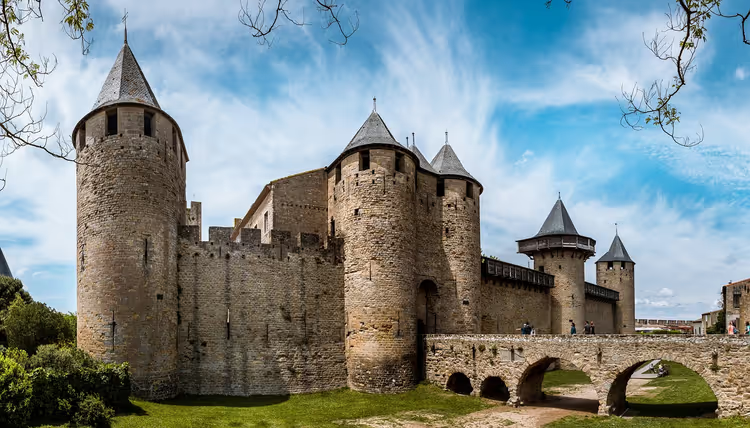
Carcassonne castle: how much does entry cost and how to get there from Toulouse
The Château de Carcassonne stands on a rock above the Aude River. It is one of the largest surviving fortresses in Europe. We checked the opening hours and entry procedures on the château's website on 09/15/2026.
Below you'll see what lies behind the double wall, where the boundary between the Upper and Lower Town runs, and how long the trip from Toulouse takes.
Ad: this article contains affiliate links, we earn a commission if you book through them, at no extra cost to you.
How the Carcassonne fortress is laid out
💡 In short:
- The Upper Town (Cité) stands on the right bank of the Aude, the Lower Town (Bastide) on the left.
- It's convenient to plan half a day for the château and the walls.
- Prices and opening hours: 09/2026, verified on the official website.
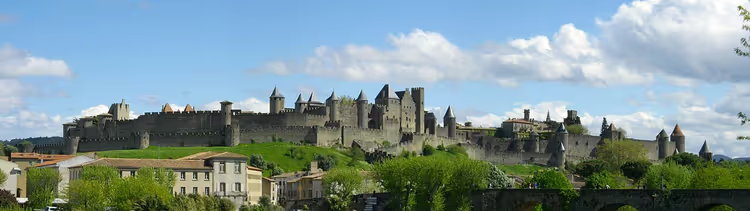
The citadel occupies the right bank of the Aude River, while the Lower Town, or Bastide, lies on the left. Since 1997 the fortified town has been a UNESCO World Heritage Site, as reported by the Carcassonne city hall. You cross between the two parts of town via bridges.
 © Jondu11 · CC BY-SAPhoto: Jondu11, CC BY-SA (https://creativecommons.org/licenses/by-sa/4.0), Wikimedia Commons
Carcassonne's wall is double. It is about 3 km long, with 52 towers around the ring (according to the city hall). From outside it is a formidable line of battlements and conical roofs. Inside the walls you see arches, humpbacked bridges, and wooden galleries between the towers.
A small town lives behind the walls: narrow streets, shops, hotels, and cafés. Around 3 million people come here every year (according to the tourism office). Near the church you'll notice chimeras on the façade and old stone slabs on the floor.
Souvenir shops sell bronze sundials with a blue crystal, replicas of ancient weapons, and clay figurines of saints. All these items are styled to evoke the Middle Ages.
The legend of Lady Carcas
 © Yax3 · CC BY-SAPhoto: Yax3, CC BY-SA (https://creativecommons.org/licenses/by-sa/3.0), Wikimedia Commons
A legend tied to the fortress tells of Lady Carcas, who saved the town from a siege. Charlemagne's army approached the walls, and the town ran out of food. The inhabitants were ready to surrender.
Lady Carcas then ordered the last pig to be slaughtered and stuffed with the remaining grain. The carcass was thrown from the wall straight into the enemy camp. Charlemagne concluded that the besieged were throwing away food, meaning they had no shortage. The army lifted the siege.
A second version of the legend says the lady ordered life-size dolls to be sewn and placed on the walls. The enemy saw a large army and retreated.
The town's name is also linked to this story. According to one version, after the enemy left, the lady ordered the bells to be rung, and the townspeople shouted "Carcas sonne," meaning "Carcas rings." That is supposedly where the word Carcassonne came from.
There is no documentary evidence for the legend. It is an urban myth that any tour guide will tell you.
What to see inside the citadel
 © Diego Delso · CC BY-SAPhoto: Diego Delso, CC BY-SA (https://creativecommons.org/licenses/by-sa/4.0), Wikimedia Commons
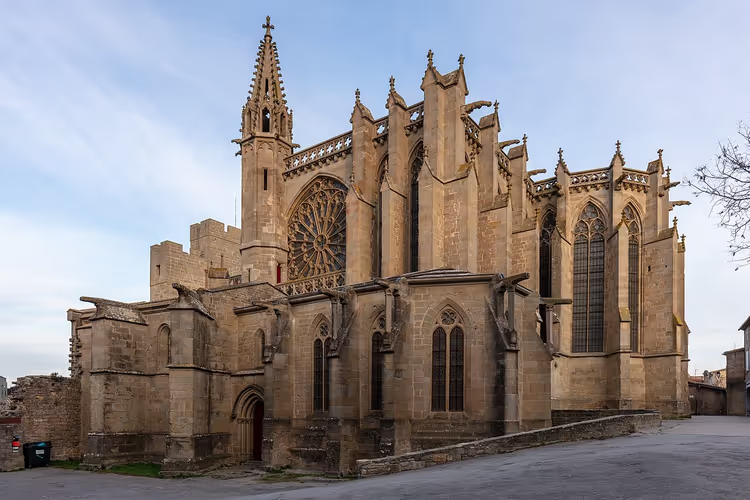
The main church inside the walls: the Basilica of Saints Nazarius and Celsus (Basilique Saint-Nazaire). This Gothic building has tall stained glass windows, considered among the finest in southern France (Carcassonne tourism office). Inside you'll see statues of Our Lady, paintings, and sculptures.
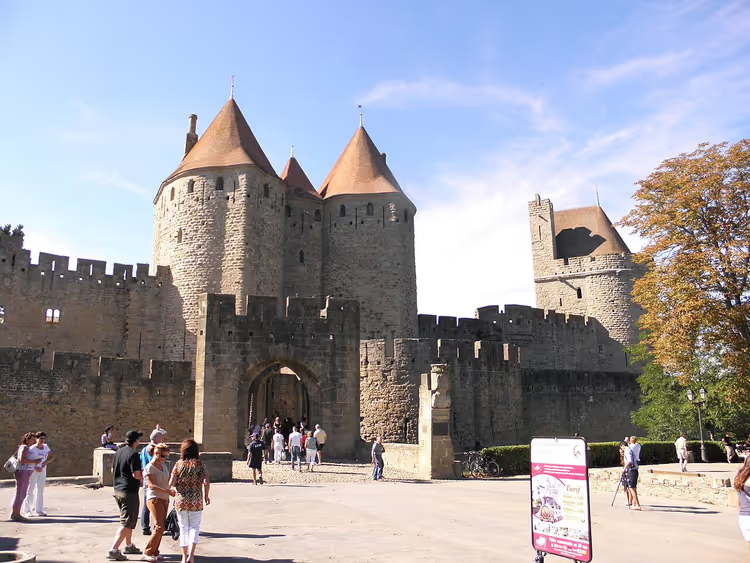
You enter the Upper Town through the Porte Narbonnaise. This is the main gate with a drawbridge. In the Lower Town stands the Gothic Cathedral of Saint-Michel, which is often mistakenly attributed to the Citadel itself.
A separate story: Château Comtal, the castle inside the fortress. You'll tour it with a separate ticket, covered below. From the wall you get a view of the tiled roofs and the Aude valley.
The fortress is easy to recognize from film. It was used in Luc Besson's "The Messenger: The Story of Joan of Arc" and Kevin Costner's "Robin Hood: Prince of Thieves." The towers also appear in Disney animated films.
Tickets and opening hours
Opening hours (as of 09/2026, official castle website):
Period | Hours | Last entry |
|---|---|---|
April 1 to September 30 | 10:00-18:30 | 17:45 |
October 1 to March 31 | 9:30-17:00 | 16:15 |
The castle is closed on January 1, May 1, and December 25. A full tour of the castle and the wall takes about 2 hours.
Entry to the Citadel itself is free. You only pay for Château Comtal and the inner section of the wall. Check the exact price and free entry conditions in the visiting terms. Free entry is available on the first Sunday of the month from November to March.
To visit without waiting in line, you can get a ticket with a time slot.
Tours and tickets in Carcassonne
Guided tours, skip-the-line tickets and activities — most offers can be cancelled free of charge.
See offers on TiqetsThe widget loads once you give your consent.
How to get to Carcassonne
You can reach Carcassonne by train. Direct TER trains run from Toulouse in about an hour, and there are direct connections from Narbonne and Perpignan (SNCF Connect). The station is in the north of the Lower Town, about a 30-minute walk to the walls.
By car, you take the motorway between Toulouse and Narbonne, exiting toward Carcassonne. In summer, the parking lot at the foot of the fortress fills up by midday. After that, finding a spot can be difficult.
The city has Salvaza Airport, served by budget airlines from the UK and Ireland. Schedules change, so check flights before your trip.
Carcassonne castle on the map
The fortress stands on the right bank of the Aude, southeast of the station. Open it on the map to plan your route.
⁉️🤔 Frequently asked questions
Do you have to pay to enter Carcassonne?
Entry to the Citadel itself is free. You can freely walk the streets, go into shops and the church. You only pay for Château Comtal and access to the inner wall. Get your ticket in advance: during the season, slots at convenient times sell out. That way you won't waste time on site.
How long does a visit take?
Allow about 2 hours for the castle and the wall (as of 09/2026, castle official website). If you want to walk the entire Citadel and have lunch inside, add another couple of hours. With children, the visit goes more slowly.
When is the best time to arrive?
It is best to come in the morning, right at opening. Then you will have easy access to the wall and the views over the city and the valley. In summer, by midday it gets crowded inside. In the evening there are also noticeably fewer visitors.
Can you get there without a car?
Yes. Direct trains run from Toulouse (according to the SNCF timetable). From the station to the Citadel you can walk or take a city bus. You do not need a car for a day trip.
What else is worth seeing nearby?
In the Lower Town there is the Saint-Michel Cathedral and the market on Place Carnot. The Canal du Midi runs very close by. Wine lovers head to the neighboring Minervois wine region. All of this can be seen in one day.
In short: what is worth booking
Carcassonne is easy to see in one day from Toulouse. You can visit the castle with a single ticket.
- If you have one day: take a morning train and go first to the wall, then to the basilica.
- If you are with children: plan for Château Comtal, it is less tiring than the full circuit.
- If you are driving: arrive at opening, before the parking lot at the foot of the fortress fills up.
- If you want a guided tour: see Carcassonne tours on GetYourGuide.

A small editorial team writing guides for independent travel. We travel ourselves, but we haven’t been everywhere, so we check prices, opening hours and how to get there against official sources.