




Jungfraujoch: how to get to the Top of Europe and how much it costs in 2026
Jungfraujoch is called the Top of Europe, and it holds that title by right. At 3,454 m, the highest railway station in Europe operates here (official Jungfrau Railways website, as of 09/2026). The train disappears into the rock through a tunnel, and at the top you are greeted by snow on any day of the year.
The ticket up here is expensive, and that is the main question for most travelers. To make the trip memorable, set aside a full day for Jungfraujoch, not just a couple of hours before an evening train.
A short answer for those who have little time to read. Yes, it is worth going up if you have a day and at least half a day of clear weather. If your budget is tight, choose Grindelwald-First or Schynige Platte instead; they cost several times less, and we will cover them too.
At the top you pay once, for the ascent. The Eispalast, Alpine Sensation, Jungfrau Panorama cinema, and Gletscherplateau are included in the train ticket. You only pay extra for the Snow Fun Park and for reserving a seat on a specific train.
In summer, the route to Mönchsjochhütte, the highest inhabited hut in Switzerland, is added to the list. From May to October, the Snow Fun Park operates on the glacier with sleds, tubing, and skis. So the season does not end with the warm weather in the valley.
Jungfraujoch suits almost everyone. The ascent is by train and elevator, you do not need to be in athletic shape, and the passages between the halls are covered and warm. Even with children, you will complete the entire route comfortably and will not get cold.
Below we break it down in order: what this saddle is, how the route works, what to see at the top, how much tickets cost in 2026, and where to stay nearby. We verified all prices and rules on the official Jungfrau Railways website.
Ad: this article contains affiliate links, we earn a commission if you book through them, at no extra cost to you.
What Jungfraujoch and Top of Europe are
💡 In short:
- Take the first train up: in the morning there are fewer people at the top, and the view often opens up before the clouds roll in.
- Set aside a full day; the trip from Interlaken to the top is long.
- Bring a warm jacket, a hat, and sunglasses: snow lies at the station year-round.
- Tickets and prices: 09/2026, verified on the carrier's website
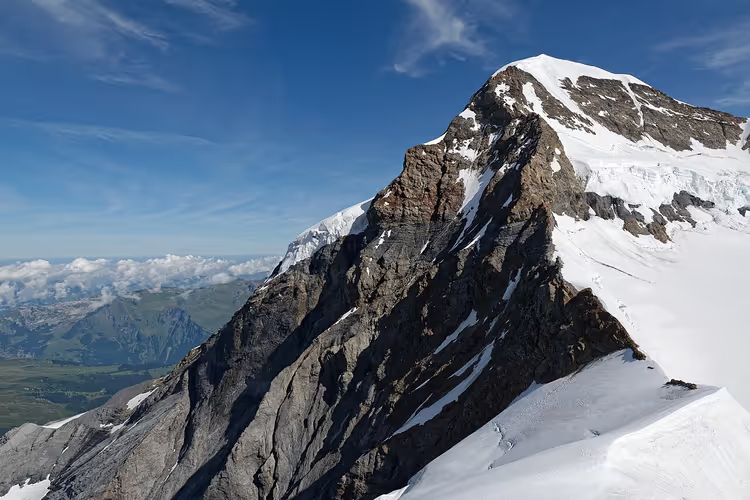
Jungfraujoch is called the saddle between the peaks of Jungfrau and Mönch. The saddle lies at the lowest point of the pass between two four-thousanders. You stand between two walls of rock and ice.
The saddle reaches an elevation of 3,466 m, while the station itself lies slightly lower, at 3,454 m (station page on jungfrau.ch, as of 09/2026). This entire area is part of the UNESCO World Heritage site Swiss Alps Jungfrau-Aletsch.
The official name of the place is Top of Europe. It is called that because of the highest railway station on the continent. The Jungfrau peak itself is higher than the station, but it is the saddle that tourists from all over the world come to.
How the railway to Jungfraujoch was built
The idea of driving a tunnel to a glacier at an altitude of more than 3.5 km appeared back in the 19th century. Swiss entrepreneur Adolf Guyer-Zeller proposed laying tracks right up to the Sphinx rock. In those years, such a project seemed like science fiction.
Construction began in 1896 and stretched over 16 years. Due to the difficult terrain and funding, the line was completed slightly below the intended summit, and the project's author died before it opened (history of the line on the official website, as of 09/2026).
The line has been operating for more than a hundred years and still holds the title of the highest railway in Europe. Inside the rock, you travel through 7 km of tunnel and see the wall of eternal ice through viewing windows.
 © Bybbisch94 · CC BYPhoto: Bybbisch94, CC BY (https://creativecommons.org/licenses/by/4.0), Wikimedia Commons
Where Jungfraujoch is and how to get there
Jungfraujoch lies in the Bernese Alps, between Interlaken and Grindelwald. You can only go up by train, so you leave your car in Interlaken, Lauterbrunnen, or Grindelwald and continue by rail.
The journey takes different amounts of time depending on your starting point. Here are reference points for planning your day (carrier's schedule and fares, as of 09/2026):
Where you are coming from | Time to Jungfraujoch | Transfer |
|---|---|---|
Interlaken (Ost) | about 2.5 hours | Grindelwald Terminal |
Grindelwald | 1.5 hours | Kleine Scheidegg |
Lauterbrunnen | 1.5 hours | Kleine Scheidegg |
Wengen | about 1 hour | Kleine Scheidegg |
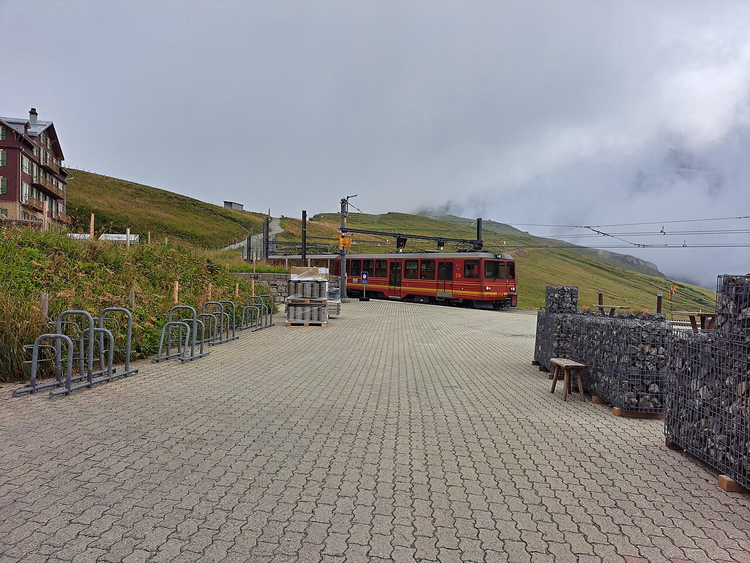
The route is simple. From Grindelwald or Lauterbrunnen you travel to Kleine Scheidegg, where you transfer to the Jungfraubahn train and enter the tunnel to the top. The last section takes about half an hour.
The fastest way up is via the Eiger Express, a gondola from Grindelwald to the Eiger Glacier station. From there you transfer to the train and have a fifteen-minute ascent. The catch: in strong winds the cable car is closed, so the train via Kleine Scheidegg remains more reliable in any weather.
Reserve your seat on the train in advance, separately from the ticket. From May 1 to October 31, 2026, reservation is mandatory (Good Morning Ticket page, as of 09/2026). If you travel in high season and have not reserved in advance, you may not be allowed onto the train you need.
From Zurich, Lucerne, or Interlaken, it's convenient to go with a group. Day tours to Jungfraujoch include transportation, tickets, and a guide, so all you have to do is look out the window.
If you're traveling with kids, get a Junior Travel Card at any major station. Children aged 6-16 with this card ride free when accompanied by a parent (SBB, as of 09/2026). Children under 6 ride free without a card. For a family of three, that's already significant savings against the overall cost of the trip.
It's worth deciding in advance where you'll start from. From Interlaken, the train goes via Grindelwald; from Lauterbrunnen, the route runs along the other side of the valley; and from Wengen, you get up the fastest. Both routes meet at Kleine Scheidegg.
If you're driving, there are parking lots in Grindelwald and Lauterbrunnen. Beyond that, the road is closed to private vehicles, and you switch to the train. Wengen has no cars at all: the village is completely car-free.
You can vary the return trip. Many people go up on the Eiger Express gondola and come down by train via Kleine Scheidegg to see different scenery. That way you get two different views in one trip.
One more practical point: the last train down leaves fairly early. Check the schedule for your date so you don't get stuck up top in the evening. In high season, trains fill up completely, and without a reservation you may wait over an hour for the next one.
What to see at Jungfraujoch
At Jungfraujoch you don't get just one viewing platform, you get an entire underground city inside the mountain. Your ticket gives you access to several different spots, and it easily takes a full day to see them all. Below we'll go through each one in order so you know in advance what matters most to you.
The usual route is: first the elevator up to the Sphinx platform, then down through Alpine Sensation, then Eispalast and the cinema. You head out to the snow plateau near the end, and in summer you can add the hike to the hut.
What's included in the train ticket:
Spot | What makes it interesting | Season |
|---|---|---|
Sphinx viewing platform | views of the Aletsch Glacier and three peaks | year-round |
Eispalast | ice halls inside the glacier | year-round |
Alpine Sensation | 250 m museum corridor | year-round |
Jungfrau Panorama | 360-degree cinema | year-round |
Gletscherplateau | open-air snow area | year-round |
Snow Fun Park | sledding, tubing, skiing, zip line | May-October |
Mönchsjochhütte | hut at 3,657 m on the glacier | March-October |
1. Sphinx viewing platform and the Aletsch Glacier
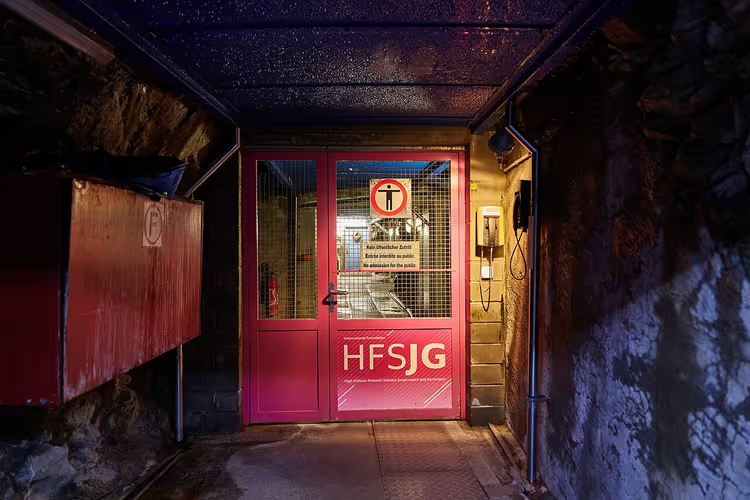
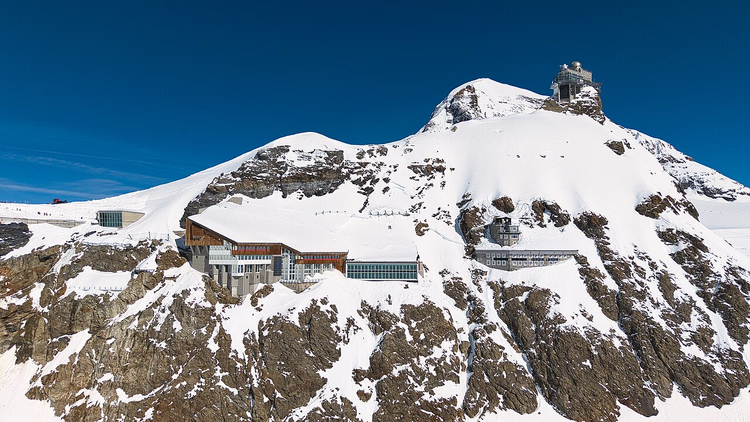
The Sphinx Observatory sits on a rock and operates as a research station. You can't go inside, but the open viewing platform is accessible to everyone. This is where you get the main Jungfraujoch view.
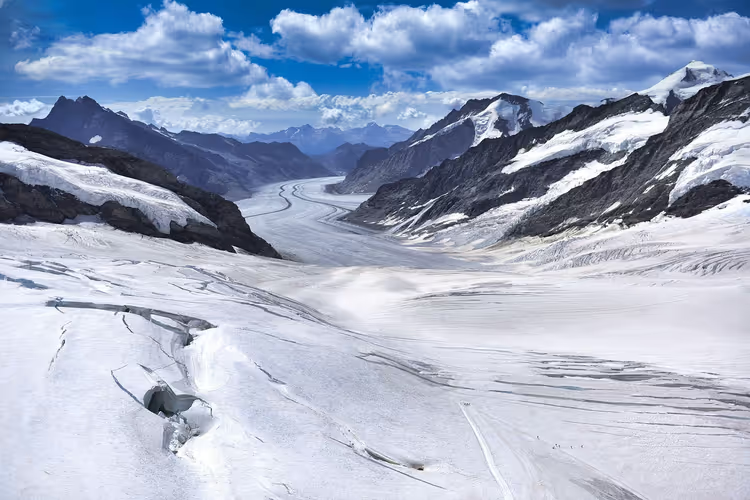
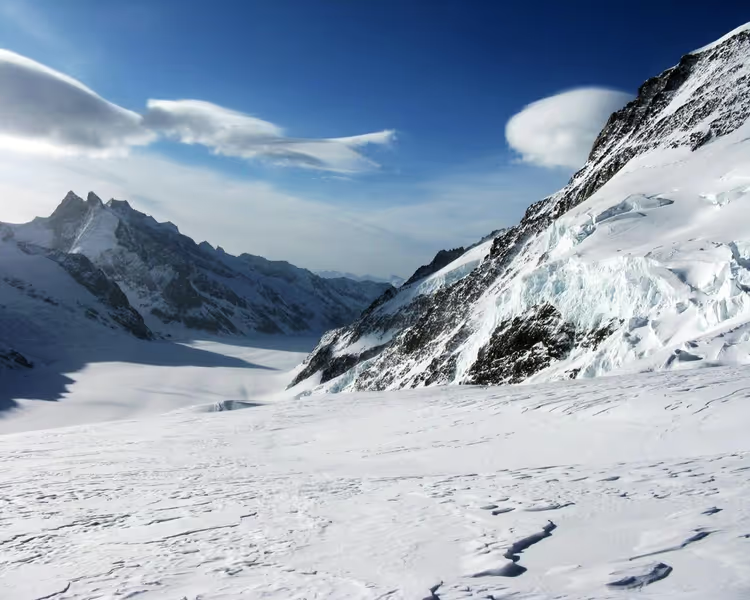
The Aletsch Glacier stretches for 22 km and is nearly a kilometer thick (Jungfraujoch main page, as of 09/2026). On a clear day you stand above the clouds and see a sea of snow all the way to the horizon. There's no better spot for your first photo at the top.
From the platform you can see the Eiger, Mönch and Jungfrau at the same time. There aren't many points like this in the Alps: from here you take in three famous Bernese Alps peaks in a single glance. In clear weather the panorama opens up for dozens of kilometers in every direction.
The ascent takes seconds: a fast elevator lifts you 108 m in 25 seconds. The catch: on clear days a line forms at the elevator, so head to the platform right after your train arrives.
 © Marie-Lan Nguyen · CC BYPhoto: Marie-Lan Nguyen, CC BY (https://creativecommons.org/licenses/by/4.0), Wikimedia Commons
Even at this altitude, birds live here. In winter the temperature drops to minus 20 °C, and you'll still meet them on the platform. Watch your step and don't feed them.
2. Eispalast
Eispalast is carved directly inside the glacier. The tunnel runs beneath a thick layer of centuries-old snow, and you walk through it among ice halls. It leaves an impression even on people who have seen many caves.
Inside there are animal sculptures and scenes that change every few seasons. Today you'll see a bear, in a year the exhibit will be different, so you can't predict it. That's what makes the hall interesting.
The ice in the tunnel never melts, so the sculptures stand here for years. The lighting is built into the walls, and photos come out well even in low light.
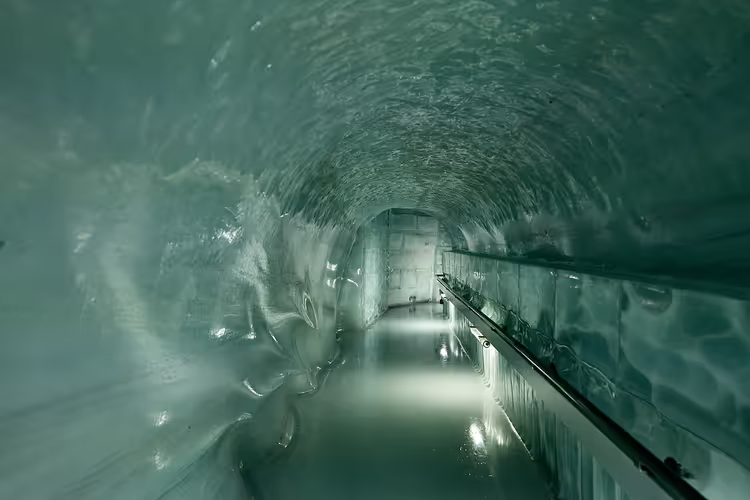
The next hall continues with similar ice figures lit from within. The catch: the tunnel stays around freezing all year, so walking through it without a jacket and gloves is uncomfortable. Wear shoes with non-slip soles.
3. Alpine Sensation
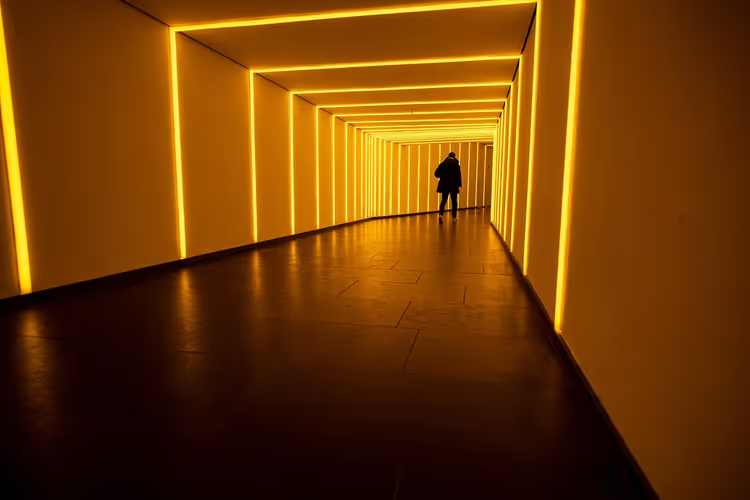
Alpine Sensation connects the Sphinx hall and Eispalast. The corridor is about 250 m long and is dedicated to the miners who blasted the tunnel through the rock more than a hundred years ago. Essentially the corridor is a museum walkway between two attractions.
Light, sound and moving screens make the passage feel alive and moving. You're not walking through a boring tunnel, you're stepping inside the story of the construction. The corridor connects to the platform elevator, so it's easy to walk through on your way down, no need to look for a separate entrance. The catch: in the flow of tourists, people move through the corridor quickly and almost without stopping.
4. Jungfrau Panorama
Jungfrau Panorama is a cinema hall with a 360-degree panoramic film. It shows the surroundings as they look on a clear day from every angle. The film runs for just a few minutes.
On cloudy days the film saves the day. If the mountains are hidden by clouds, you'll still see the panorama around the station and understand the scale of the place. The film runs on a loop, so you can walk in at any moment and watch as much as you want. The catch: the film is included in the ticket, but it doesn't replace the live view from the platform.
5. Gletscherplateau
Gletscherplateau lies under the open sky. There's guaranteed snow here 365 days a year, and from here you get views of the Jungfrau and Silberhorn. The area is considered the most photogenic spot in the complex.
If you want to step onto real snow, this is the place. The snow doesn't melt even in July, so the plateau is open for walks in any month. A short walkway leads from the station to the area, and you're outside within a couple of minutes. The catch: it's always windy on the plateau, so a hat will come in handy even in July.
6. Snow Fun Park
Snow Fun Park operates only outside the ski season, roughly from mid-May to mid-October (Snow Fun Park page, as of 09/2026). Here you can go sledding, tubing and skiing right on the glacier.
For the brave there's the Flying Fox, a zip line flight over the glacier. The feeling is unusual because you're flying over the glacier at an altitude of more than 3,000 m. A day pass is more convenient than single rides, since you can go several times in a day. The catch: the park requires a separate ticket and isn't included in the train price, and single-ride tickets for individual runs are expensive.
The money tip is simple: get a day pass, it includes all activities and equipment rental. For kids this is the most loved spot at the entire station.
7. Mönchsjochhütte
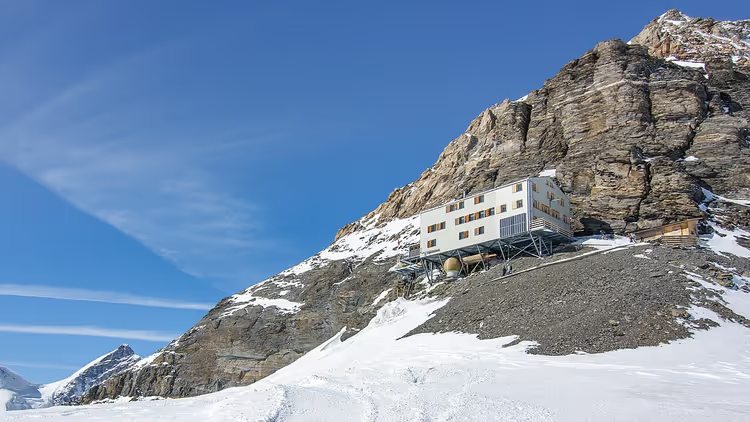
In summer you can hike to Mönchsjochhütte, the highest inhabited hut in Switzerland. It sits at 3,657 m and is open roughly from mid-March to mid-October (hut page, as of 09/2026).
The trail starts right at the station and follows a marked route across the glacier. The walk takes about 45 minutes one way, and it's not difficult if you stay on the route. Inside the hut you can rest and eat, and it's the highest point of your walk. The catch: leaving the marked trail on the glacier without a guide is dangerous, so stick strictly to the tracks and wear trekking shoes.
 © 2015 Michael 2015 · CC BY-SAPhoto: 2015 Michael 2015, CC BY-SA (https://creativecommons.org/licenses/by-sa/4.0), Wikimedia Commons
8. Lindt Chocolate Heaven
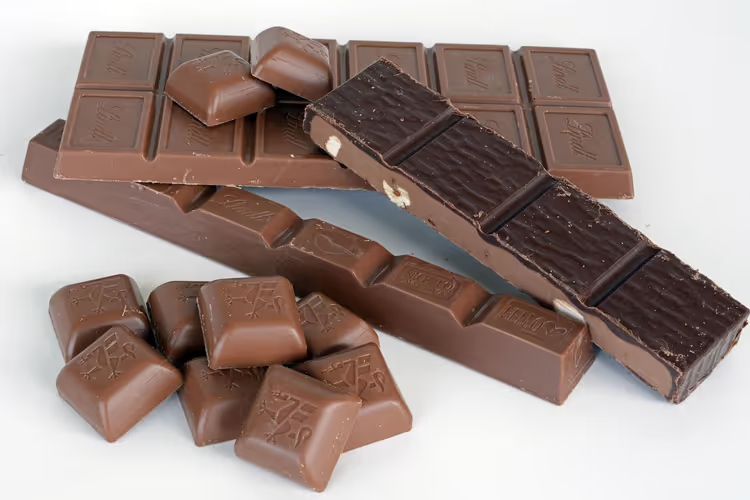
In Switzerland it's hard to walk past chocolate, and Jungfraujoch is no exception. Lindt Chocolate Heaven isn't just a shop. There's a small interactive area about chocolate making, where you'll see the old production process and taste the finished product.
Kids usually linger here longer than adults. The place is small but warm and cozy, a great pause between viewing platforms. The packaging here features Jungfraujoch branding, a popular souvenir that's easy to bring home.
9. Restaurants and shops
You'll spend the whole day at the top, so it matters that there's somewhere to eat. There's a self-service option and an a la carte restaurant with glacier views. At the Crystal Restaurant portions are generous by Swiss standards, and the windows look out onto the glacier.
The shops sell chocolate, souvenirs, Swiss knives and clothing. If you're cold, you can pick up a hat and gloves here. Prices are high, as everywhere at the station, so souvenirs are cheaper to buy down in the valley. The catch: at lunchtime there can be a line at the restaurants.
 © Reustli · CC BY-SAPhoto: Reustli, CC BY-SA (https://creativecommons.org/licenses/by-sa/4.0), Wikimedia Commons
A full tour of the complex takes three to five hours, and the rest of the time goes to the train ride and lunch. So a day at Jungfraujoch really does end up being a full one.
How much a Jungfraujoch ticket costs
The ticket is expensive, and the price depends on the season and the departure station. In high season, an adult round-trip ticket from the nearest station costs about 240 CHF (Jungfrau Railways price list, as of 09/2026). Check the official fare brochure for the exact amount on your date.
Here is how the ticket options differ in 2026 (Jungfrau Railways price list, as of 09/2026):
Ticket | Price | What you get |
|---|---|---|
Full round-trip ticket | about 240 CHF | train to the top and back, all halls included |
Good Morning Ticket | from 190 CHF | 20% discount, only the first or second morning train |
Child under 6 | free | no card needed |
Child 6-16 with Junior Travel Card | free | with a parent, card issued at an SBB station |
Child 6-16 without a card | half price | valid on the entire line |
Seat reservation | surcharge | mandatory from May 1 to October 31 |
The Good Morning Ticket gives a 20% discount, but with conditions. You can only take the first or second train up, and you must descend by 13:17 (Good Morning Ticket terms, as of 09/2026). It is available from May 1 to October 31, 2026 and cannot be combined with other discounts.
You can buy tickets online in advance. Jungfraujoch tickets with seats on the official website are booked together with a reservation, which saves you time at the station. For price comparisons and ready-made tours, there are options on Tiqets.
Tours and tickets in Jungfraujoch
Guided tours, skip-the-line tickets and activities — most offers can be cancelled free of charge.
See offers on TiqetsThe widget loads once you give your consent.
Holders of the Swiss Travel Pass get a discount on the section to the top. Before buying, compare it with the Good Morning Ticket. For a family, this can make a difference of several dozen francs.
Is Jungfraujoch worth the money
Price is the main question here, and we answer it directly. If you have a day and the budget, go up: few places in the Alps compare to Jungfraujoch in uniqueness. Almost all the halls and viewing platforms inside the station are already included in the train ticket.
The only thing against it is the price. For the same money, you could see several peaks in the region or spend two days in the valley with more comfort. So the decision depends on what you value more.
If your budget is limited, there are cheaper alternatives. Grindelwald-First, Schynige Platte, Mürren, Mount Titlis, and Pilatus near Lucerne cost noticeably less and still give you Alpine views (ticket prices on the official website, as of 09/2026).
A separate note about the weather. If it is foggy at the top, you will still see the halls, the cinema, and the ice sculptures, but the main glacier view may be closed. So before buying a ticket, check the station webcam: it will show whether the panorama is open today.
For families with children, the trip almost always pays off. There are enough activities for half a day, and the ascent requires no physical fitness. If you are visiting Switzerland for the first time and have only one free day in the mountains, Jungfraujoch gives you the most impressions in a single trip. For a repeat visit, it makes sense to choose a cheaper peak.
How to visit Jungfraujoch for less
There are six working ways to save, and all of them are verified on the official Jungfrau Railways website.
1. Buy a regional pass. The Jungfrau Travel Pass for 3 days or more reduces the ascent price to about a third (Jungfrau Railways fares, as of 09/2026). It also gives you a discount in the station shops.
2. Take the first train. The Good Morning Ticket is 20% cheaper (Good Morning Ticket, as of 09/2026). In the morning there are almost no people at the top.
3. Choose the low season. In winter and the shoulder season, a ticket is about 25 CHF cheaper, with prices peaking in June and August (current fares on jungfrau.ch, as of 09/2026).
4. Get a Swiss Travel Pass. With it, you travel free to Grindelwald or Wengen, and from there you get a 25% discount on the ascent (discount terms for the Swiss Travel Pass, as of 09/2026).
5. Put a group together. With 10 people you get a group discount of about 30% (Jungfrau Railways group fares, as of 09/2026). This option is easiest if you are traveling with a large group.
6. Book a package tour. Day tours to Jungfraujoch from major cities are often cheaper than going on your own because of group fares. You do not need to book the train and seats separately.
Combine these approaches. A rail pass plus an early train gives you the maximum savings, while a group tour covers both the journey and the tickets in one go. Before buying, compare the price for your date: discounts vary by season and route.
Check exactly what your discount includes. A rail pass lowers the train price but does not cover the Snow Fun Park, and the Good Morning Ticket is valid only in the morning. If you are traveling as a couple or a family, price out both options: sometimes two separate tickets with the Swiss Travel Pass work out cheaper than the group fare.
Practical tips for the trip
- The station operates 365 days a year (official Jungfraujoch website, as of 09/2026). Even if it is raining in the valley, it is often sunny at the top.
- Allow a full day for the trip. On the way you can get off in Wengen or take a walk near Kleine Scheidegg.
- Leave your car in Interlaken or Lauterbrunnen. From there you travel only by train.
- Buy tickets in advance and online: in high season there are long lines at the station.
- Bring warm clothes and sunglasses. At 3,454 m there is snow all year round, and the sun reflects off it very brightly.
- Bring snacks and water: prices in the restaurants at the top are high.
- Keep your ticket on your phone, it is checked several times along the way.
- Do not cancel your trip because of the forecast. The valley is often cloudy while it is clear above the clouds, and the weather changes within ten minutes.
- Check the weather at the station via webcam before leaving your hotel.
- Plan your descent in advance: the last trains leave strictly on schedule.
 © Tallin · CC BY-SAPhoto: Tallin, CC BY-SA (https://creativecommons.org/licenses/by-sa/3.0), Wikimedia Commons
Where to stay near Jungfraujoch
Jungfraujoch can be visited as a day trip from many Swiss cities, but the region has plenty to see beyond it. So it is worth staying in the valley for two or three days.
The closest hotel to the summit, Hotel Bellevue des Alpes, sits right at the Kleine Scheidegg station. A night here is expensive, but you are at altitude from early morning. The catch: there are almost no restaurants nearby, and the choice at this altitude is minimal.
A popular base for exploring the region is Wengen. The village is car-free, and from there it is easy to head both up the mountain and into the neighboring valleys. Here are options at different price levels:
- Grand Hotel Belvedere, a historic hotel after renovation in the center of Wengen (prices on Trip.com)
- Beausite Park Hotel & Spa, a large hotel with an extensive range of amenities (see prices)
- Hotel Jungfraublick, a budget option with mountain views (rooms on Trip.com)
Another option: Grindelwald, on the other side of the mountains. A direct train to Kleine Scheidegg runs from here, and a cable car to Eiger Glacier operates as well. Most tourists from other countries choose this side.
- Bergwelt Grindelwald, an Alpine Design hotel (prices on Trip.com)
- Eiger Selfness Hotel, a town hotel in the center of Grindelwald (see prices)
- Sunstar Hotel & SPA, a large hotel with a pool and spa (rooms on Trip.com)
Both options are connected to the summit by train, so the logistics are straightforward. Just check whether the hotel operates in winter and whether there is a shuttle from the station. If you are going for several days, book accommodation in the center of Wengen or Grindelwald: that way you can walk to the station and won't depend on bus schedules.
Whatever you choose, book your accommodation in advance. In summer and during ski season, available rooms in the valley disappear several months ahead.
⁉️🤔 Frequently asked questions
What is the difference between Jungfrau and Jungfraujoch?
Jungfrau is the name of the mountain itself, at 4,158 m. Jungfraujoch is the saddle between it and the Mönch. The station, the highest in Europe, sits on that saddle (station page, as of 09/2026). You don't go up to the summit, you go up to the pass between two four-thousanders. And the view of the Jungfrau from there is excellent.
Is Jungfraujoch worth visiting?
Yes, if you have a day and the money. It's expensive, but inside the station you get several attractions at once: the Aletsch Glacier, the Eispalast, a cinema, and the snow plateau. If your budget is tight, the region has plenty of cheaper peaks. Compare the ticket price with the price of the experience.
Why is the Jungfraujoch ticket so expensive?
The station sits at 3,454 m, and maintaining a railway in permanent snow is very costly. Trains run through a single-track tunnel, so only a limited number of trains can go up per day (carrier fares, as of 09/2026). Demand exceeds supply, hence the price.
When is Jungfraujoch open for visitors?
The station operates year-round, 365 days, with no days off. There is snow up top in any month, so in winter you'll see the same plateau as in summer. Individual activities depend on the season: the Snow Fun Park and the trail to Mönchsjochhütte are only available in the warmer months.
What time of year is best for the trip?
Summer offers more options: the Snow Fun Park is open, the trail to Mönchsjochhütte is accessible, and there are hiking routes around. In winter it's quieter up top and the ticket is cheaper, but some activities are closed. If the view matters most, pick a clear day in any season rather than a specific month.
Is the Jungfrau Travel Pass worth buying?
The pass pays off if you're staying in the region for at least three days and using trains and cable cars every day (official Jungfrau Railways fares, as of 09/2026). In that case it gives you full freedom to change plans during the day. For a single trip up, you don't need it.
In short: what to book
Jungfraujoch requires preparation: it's best to buy your ticket in advance, reserve a seat on the train separately, and find accommodation a few months before your trip. Everything else you can sort out on the spot.
- If you have a day and clear weather: get a full ticket and go up on the first train.
- If your budget is tight: get a Good Morning Ticket or a regional pass and compare prices.
- If you're coming from Zurich or Lucerne without a car: book a ready-made tour that includes transport and tickets.
- If you want to stay in the valley: look at hotels in Wengen or Grindelwald well in advance.
Choose a Jungfraujoch tour through GetYourGuide, where you can also see available dates and spots for the coming days. Get train tickets on the official Jungfrau Railways website, and look for accommodation early.

A small editorial team writing guides for independent travel. We travel ourselves, but we haven’t been everywhere, so we check prices, opening hours and how to get there against official sources.