
















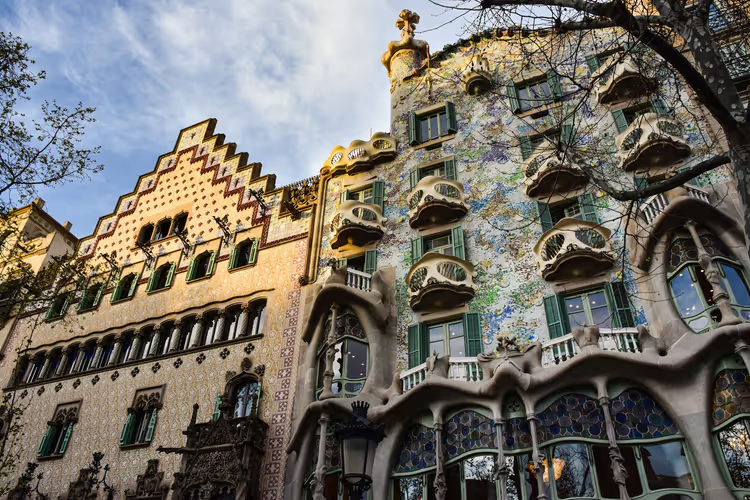
Casa Batlló: how to buy a ticket with a time slot and when to go without queues
Casa Batlló has stood on Passeig de Gràcia for over a century, and its facade is impossible to confuse with anything else. Tickets sell out in advance, and the line without a reserved time slot stretches for hours.
We have put together practical information for your visit: opening hours, prices, and how to get there from the metro. Admission starts at 29 € (as of 09/2026, prices on the official website), and children under 12 enter free.
Ad: this article contains affiliate links. We earn a commission if you book through them, at no extra cost to you.
History of construction and renovation
💡 In short:
- In 1877, an apartment building appeared on this site, which Gaudí later completely rebuilt (according to the history of the house on the museum website).
- The work took only two years, from 1904 to 1906, and in 2005 the house was added to the UNESCO list.
In 1877, an ordinary apartment building appeared on the boulevard, designed by architect Emili Sala. The building was later purchased by textile manufacturer Josep Batlló i Casanovas (according to the Casa Batlló website).
Two striking houses belonging to competitors already stood nearby, Casa Lleó i Morera and Casa Amatller, and the rivalry between the owners gave the block its second name, Illa de la Discòrdia, or the "block of discord." Batlló had no intention of losing this race.
He invited the young Gaudí and asked him to build a house like no other. The master proposed not demolishing the building but completely rebuilding it, and the work took place from 1904 to 1906 (according to the Casa Batlló website).
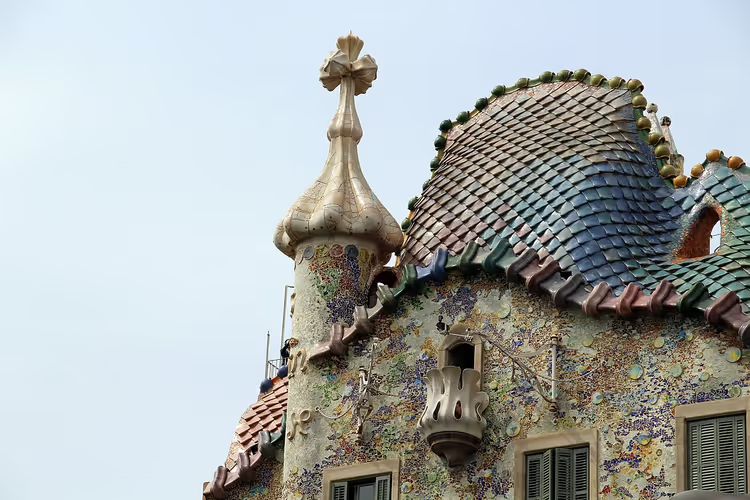 © Fred Romero · CC BYPhoto: Fred Romero, CC BY (https://creativecommons.org/licenses/by/2.0), Wikimedia Commons
The result made it into textbooks during the author's lifetime. In 2005, Casa Batlló, along with other works by Gaudí, was added to the UNESCO World Heritage list.
From 2018 to 2026, the building underwent a major restoration, and restorers opened the third floor, the family's last residential apartment (according to the Casa Batlló website). If you love architecture, this block is worth a dedicated walk.
A showcase of Gaudí's boldness and talent
The house has two facades, exterior and interior. Gaudí turned the enclosed stairwell into a light well with a ceramic panel, and its windows resemble yellow snake eyes.
Curved lines are everywhere here, and only the floors and door jambs on the hinge side remain straight. The master hid zoomorphic motifs even in interior details, and you will not notice them right away.
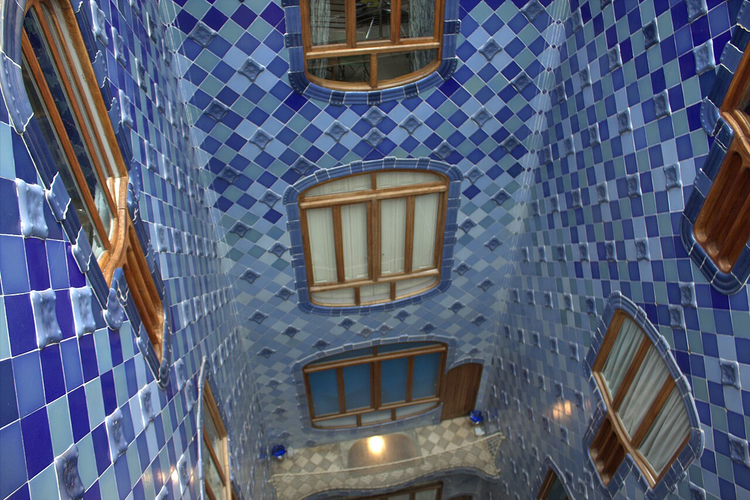 © FrancoisLagunas · CC BY-SAPhoto: FrancoisLagunas, CC BY-SA (https://creativecommons.org/licenses/by-sa/3.0), Wikimedia Commons
Gaudi was the first to use the glass block as an element of masonry, light, and decoration all at once. The pieces were commissioned from glassblowers and ceramicists who traveled to Mallorca for samples, and the designs comprised thousands of individual elements.
The master designed the furniture for the house himself, and part of the set is now displayed in the Gaudi museum in Park Guell. He shaped the balconies like carnival masks, and locals call the wavy roof the "dragon's back."
The main facade shimmers with multicolored tiles like bursts of fireworks, and the window shapes resemble a cave carved out by water. The attic roof has not a single break in it.
Architectural features
After the renovation, the house gained a grand staircase, a bel etage with halls, and an attic floor. From the attic terrace you can see Montjuic mountain, and the rough layered stones of Montjuic decorate the house both inside and out.
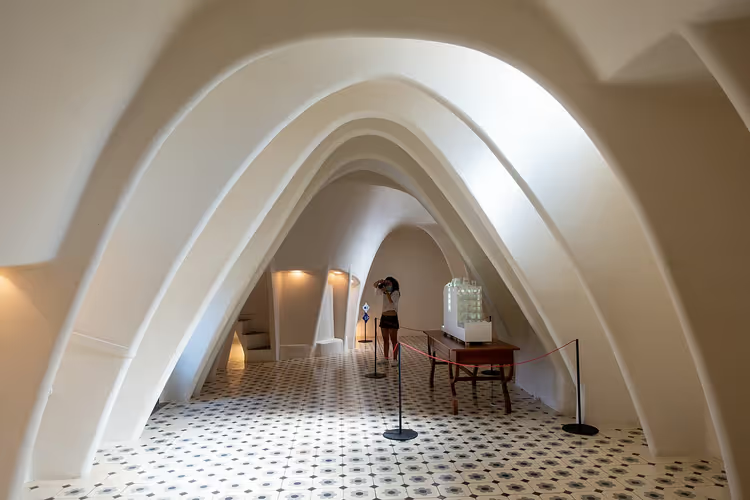 © Kent Wang from Barcelona, Spain · CC BY-SAPhoto: Kent Wang from Barcelona, Spain, CC BY-SA (https://creativecommons.org/licenses/by-sa/2.0), Wikimedia Commons
Gaudi ordered all non-load-bearing walls torn down. Small windows were built into the partitions to let light through while keeping heat out, and the glass was made ribbed and faceted, with no single motif.
Functional details became decoration: the chimneys look like elf houses, and the air ducts are pressed into the wall like coral. On the grand staircase, wooden half-spheres shaped like lotus petals stand in place of balusters. Even the woodshed is designed so that you will want to sit down.
Interior
In the halls you will see whimsical totem columns that adorn more than just the facade. The walls are covered with sandstone of a special composition: a mesh pattern was pressed into the wet plaster, making the surface resemble skin. The ochre of the sandstone blends softly with the blue glass of the stained-glass windows.
The elevator in the house still works, and its cabin is made in the form of a wooden Chinese box with a lantern-like lid.
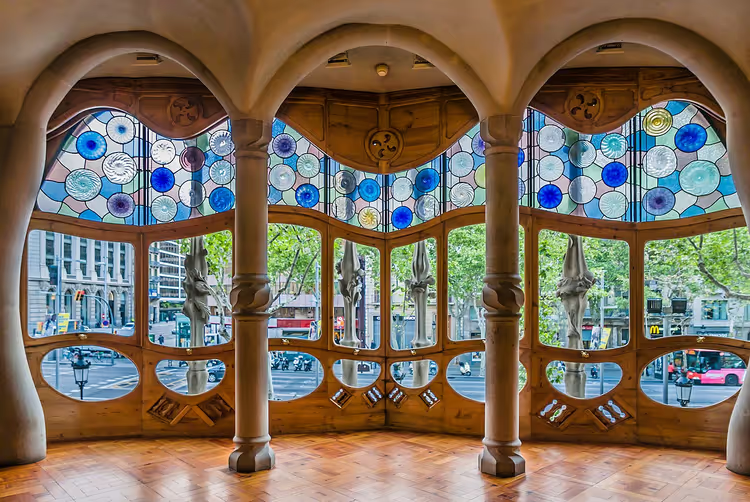 © Sara Terrones · CC BY-SAPhoto: Sara Terrones, CC BY-SA (https://creativecommons.org/licenses/by-sa/4.0), Wikimedia Commons
The glass parapets on the staircase look like an element from the future. The ceiling of the large living room is crowned by the "Sun" chandelier, and the swirls of light in the halls resemble the set of a modern animated film.
In the rooms, Gaudi included neither valances nor drapes: the role of fabric here is played by bent wooden pediments around the windows. For its time, the solution was bold.
Because of the shape of the facade and balconies, the house is called the "house of bones."
Opening hours and ticket prices
Casa Batllo operates as a museum seven days a week. It is open daily from 8:30 to 22:30, with the last entry at 21:30 (as of 09/2026, visit page), and a visit takes about an hour and fifteen minutes.
An adult ticket costs from 29 € online (as of 09/2026, ticket page), and children under 12 enter free. Schoolchildren, students, and seniors get a discount.
Besides the regular visit, there are night visits (as of 09/2026, night visits) and a temporary exhibition. The audio guide is available in 15 languages, and free Wi-Fi works throughout the house (according to the Casa Batllo website).
Tickets are sold for specific time slots, so you are better off booking a slot in advance. Casa Batllo tickets with slots on Tiqets.
Tours and tickets in Casa Batllo
Guided tours, skip-the-line tickets and activities — most offers can be cancelled free of charge.
See offers on TiqetsThe widget loads once you give your consent.
Where it is and how to get there
Casa Batlló is easy to find: it stands right on the boulevard, among other Modernista buildings.
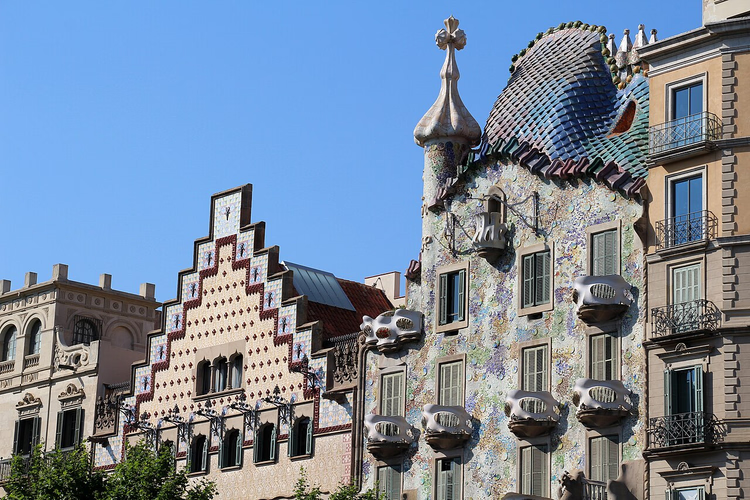 © Fred Romero · CC BYPhoto: Fred Romero, CC BY (https://creativecommons.org/licenses/by/2.0), Wikimedia Commons
The address is simple: Passeig de Gràcia, 43, in the Eixample district (as of 09/2026, address on the museum website). The closest metro is Passeig de Gràcia, lines L3 and L4, and it is a couple of minutes on foot from the exit to the entrance.
From Plaça de Catalunya station it is about a 10-minute walk, which is convenient if you are strolling around the center. Buses 7, 22 and V15 stop at Pg de Gràcia-Aragó (according to the Casa Batlló website).
At rush hour Passeig de Gràcia gets jammed, so the metro is faster than a taxi, and you will not have to look for parking.
Casa Batlló in Barcelona on the map
Below is a map with the exact address. Save it, it will help you find the entrance on the boulevard side.
⁉️🤔 Frequently asked questions
How much does a Casa Batlló ticket cost?
An adult ticket costs from €29 when bought online (as of 09/2026, ticket prices online). You do not need a separate audio guide: it is already included in the price. At the ticket office the ticket costs a few euros more.
Do I need to buy a ticket in advance?
Yes, visits run in timed slots, and in high season available slots sell out several days ahead. An online ticket is also cheaper than one at the ticket office (as of 09/2026, tickets page). If you are going in summer, book at least a week ahead.
How do I get to Casa Batlló?
The easiest way is by metro to Passeig de Gràcia station, lines L3 and L4 (according to the Casa Batlló website). From the exit to the museum it is a couple of minutes on foot. You can also walk from Plaça de Catalunya, about 10 minutes along the boulevard.
When is it least crowded?
Early morning, so take the very first slot of the day (according to the Casa Batlló website). Weekdays are quieter than weekends.
Can I visit with children?
Yes, the house is family-friendly. Children under 12 enter for free, and a portable stroller is provided for toddlers. Inside, there are elevators for people with reduced mobility (according to the Casa Batlló website).
In short: what to book
If this is your first time in Barcelona, go for the classic visit with a morning time slot, and if you want photos without the crowds, choose the very first slot. If you're interested in contemporary art, add the exhibition on the second floor.
Time slots sell out quickly, so book your ticket together with a tour in advance: see Barcelona tours.

A small editorial team writing guides for independent travel. We travel ourselves, but we haven’t been everywhere, so we check prices, opening hours and how to get there against official sources.