
















Castel Sant'Angelo in Rome: a route through six levels and tickets
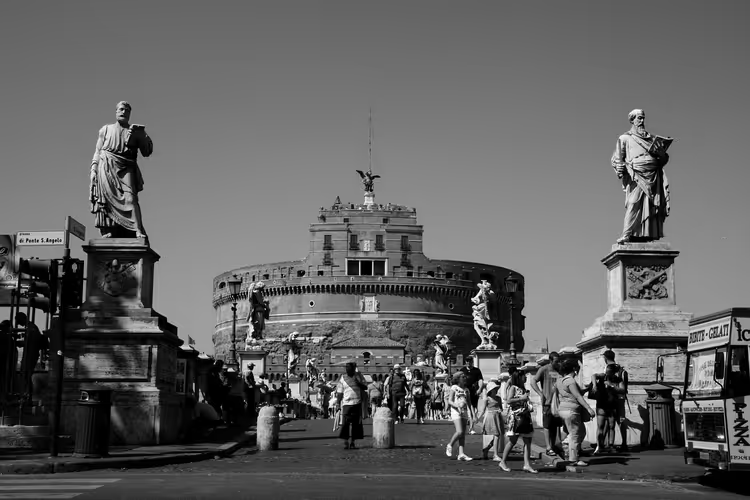
Castel Sant'Angelo stands on the bank of the Tiber next to Ponte Sant'Angelo. It began as the mausoleum of Emperor Hadrian, and since 1906 it has housed a museum. The terrace at the very top offers a view of St. Peter's Basilica and the domes of the Vatican.
Inside, six levels await you: Hadrian's burial chamber, the papal apartments, the treasury, and the observation deck. Below you'll find practical details: when to come, what to see in order, how much a ticket costs, and how to get there from the metro.
💡 In short:
- Buy your ticket online in advance: in summer the ticket office has a long line.
- Come at opening time at 9:00 or after 17:00, when the halls are nearly empty.
- Allow 2-3 hours for the route through the six levels.
- Prices and opening hours: as of 09/2026, verified on the Musei Italiani website.
Ad: this text contains affiliate links, we earn a commission from them, the price for you stays the same.
History of Hadrian's mausoleum
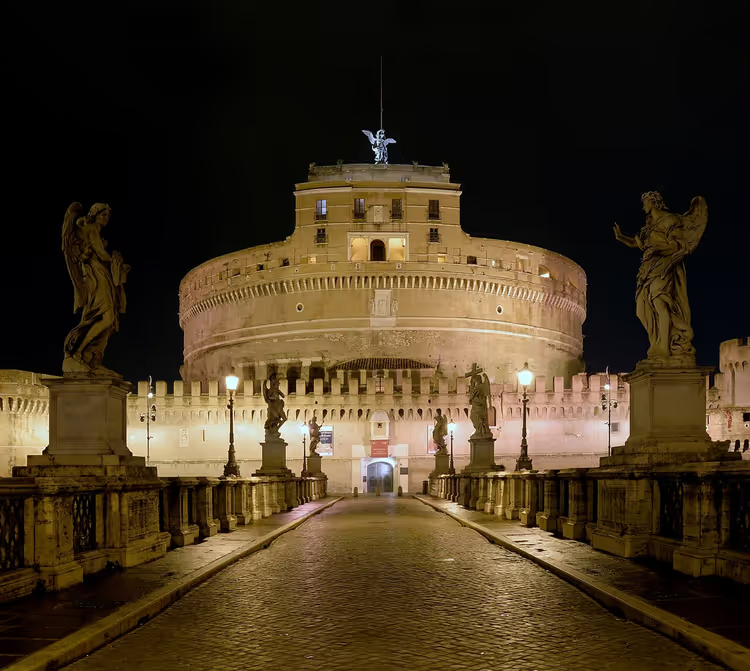
The castle's history begins in the 2nd century AD, and you'll see its traces on every level. Emperor Hadrian decided to build a family mausoleum on the bank of the Tiber. The site was not chosen by chance: people had been buried near the river since ancient times. Construction took sixteen years, and Hadrian himself did not live to see it finished (according to Musei Italiani).
 © Livioandronico2013 · CC BY-SAPhoto: Livioandronico2013, CC BY-SA (https://creativecommons.org/licenses/by-sa/4.0), Wikimedia Commons
The work was completed by Antoninus Pius. He stripped the mausoleum of its family status and made it a state monument, and until 217 the urns with the ashes of all deceased emperors of Rome were placed here.
The building was constructed in the style of an Etruscan tumulus: three blocks stacked one on top of another. At the top stood a statue of Hadrian dressed as the sun god, driving a bronze chariot with four horses. The walls were faced with marble and decorated with statues, and a decorative garden was laid out on the roof.
In the early 5th century the mausoleum was turned into an outpost. Its location on the bank of the Tiber made it a convenient defensive point, and the castle protected Rome from the north during the Gothic invasion. Later it became a fully impregnable fortress.
The castle got its name in 590. Rome was then gripped by a plague epidemic, and Pope Gregory the Great had a vision of the Archangel Michael. He stood on the roof of the mausoleum, sheathing his sword, signaling the retreat of the disease.
Fortress, popes, and escapes
As the Vatican's power grew, the castle passed to the popes. Pope Nicholas III ordered a covered corridor to be built between the fortress and St. Peter's Basilica. This passage was named Passetto di Borgo: through it the popes could leave the Vatican for shelter. Leo IV built high walls around it.
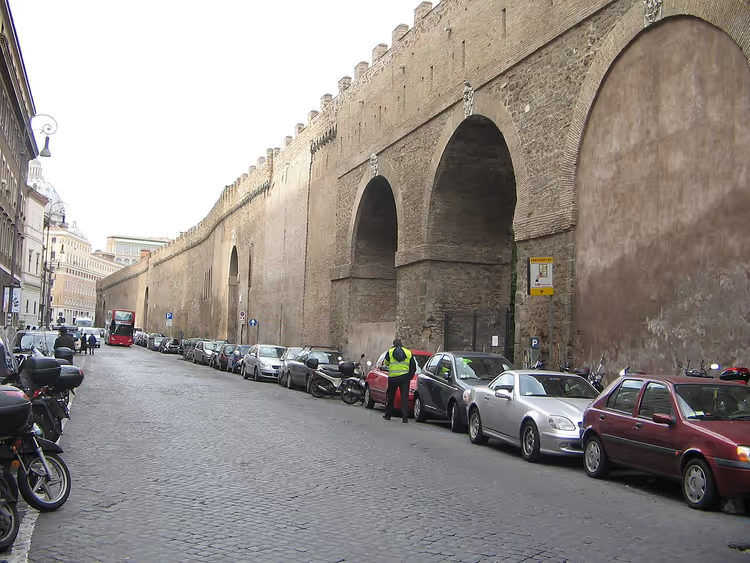
In the Middle Ages, the most powerful families of Rome fought for control of the castle. The dispute was settled when the papal court returned from Avignon. Pope Urban V considered the keys to the fortress the main guarantee of his power in Rome. Once he had to defend the walls against rebelling citizens with the help of French soldiers. Things became calmer under Boniface IX.
The castle remained a fortress with supplies of water and food in case of a long siege. When threatened, the popes moved from the Vatican to the castle along the covered passage. Alexander VI of the Borgia family took refuge here from the troops of Charles VIII. The most famous escape was made by Clement VII: in 1527, during the Sack of Rome, he reached the fortress under fire from the troops of Charles V.
The fortress was so reliable that a Sala del Tesoro was set up inside. A huge chest was placed in the hall and deliberately made wider than the doorway: this way thieves could not carry it out. In the early 16th century Alexander VI rebuilt the castle. Four bastions, a moat, comfortable apartments for the popes, and halls for receiving guests appeared.
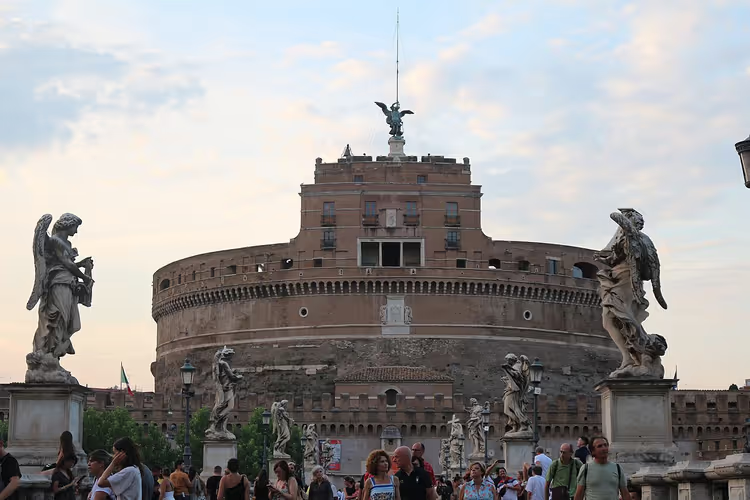
Most of the old military structures were dismantled under Urban VIII to make way for new fortifications. From 1667 to 1669, the bridge leading to the castle was decorated with statues of angels. They were created from a design by the sculptor Gian Lorenzo Bernini and his students, and you'll see these angels on your way from the metro.
Conditions inside were brutal. Those who fell out of favor were beheaded, and their heads were hung on the walls as a warning to others. Those accused of heresy were tortured in the damp dungeons. Today only the walls remain from those times: the castle has become one of the most visited historical sites in Italy.
Prison and famous prisoners
Next to the papal apartments were the dungeons and torture chambers. The fortress walls remember many prisoners, and here are the most famous.
- Benvenuto Cellini, sculptor and goldsmith, creator of the ceremonial salt cellar of Francis I.
- Giordano Bruno, philosopher, held in the castle before his trial by the Inquisition.
- Beatrice Cenci, a young Roman woman executed for killing her father.
- Giuseppe Balsamo, known as Count Cagliostro, adventurer and alchemist.
You'll see the prisoners' cells on the second level as you make your way up the route.
Architecture: a cylinder on a square base
 © Emanuele Serraino · CC BY-SAPhoto: Emanuele Serraino, CC BY-SA (https://creativecommons.org/licenses/by-sa/4.0), Wikimedia Commons
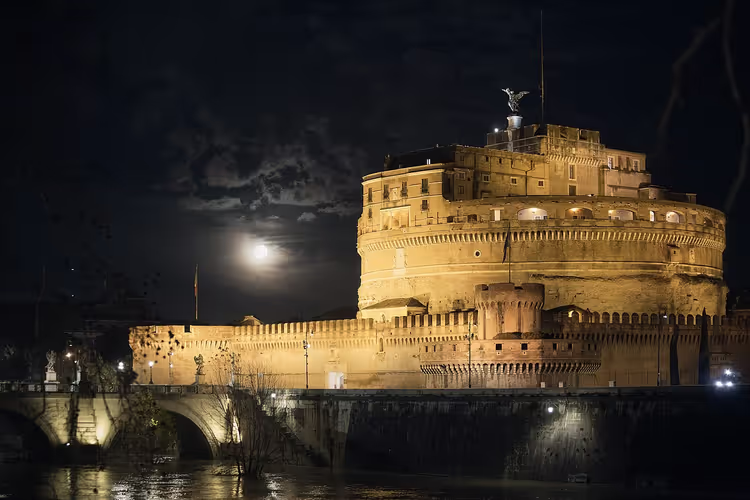
Castel Sant'Angelo is a massive cylindrical building on the bank of the Tiber. In past centuries it was considered one of the tallest structures in the Eternal City. The marble walls and rich decoration of Hadrian's time have not survived: over the centuries the castle was rebuilt many times. But the original design is still visible today: you'll notice the cylinder on a square base right away.
Miraculously, the brickwork, the entrance made of stone blocks, the ramp to the upper floors, and the burial chamber in the cylindrical section have come down to us. A restoration in the late 19th century put the interiors in order, and in 1906 a museum opened inside.
The ensemble is completed by Ponte Sant'Angelo. The pedestrian bridge leads straight to the entrance, and on it stand stone angels holding the instruments of the Passion.
Museum: how the mausoleum became a museum
 © DiegoBonacina1997 · CC BY-SAPhoto: DiegoBonacina1997, CC BY-SA (https://creativecommons.org/licenses/by-sa/4.0), Wikimedia Commons
The museum in the castle opened in 1906 after a long restoration. The work was led by Mariano Borgatti, assisted by Luigi de la Penna. Initially they wanted to create a museum of military equipment.
During the restoration, many valuable artifacts were found: ceramics, weapons, and old photographs. A separate exhibition was assembled from the finds. By 1911 the collection had grown, and the Ministry of Education and Culture took over the museum. The castle was named a national museum in 1925. You will see some of the exhibits in the halls along the route.
First level: the tomb and Cortile dei Condannati
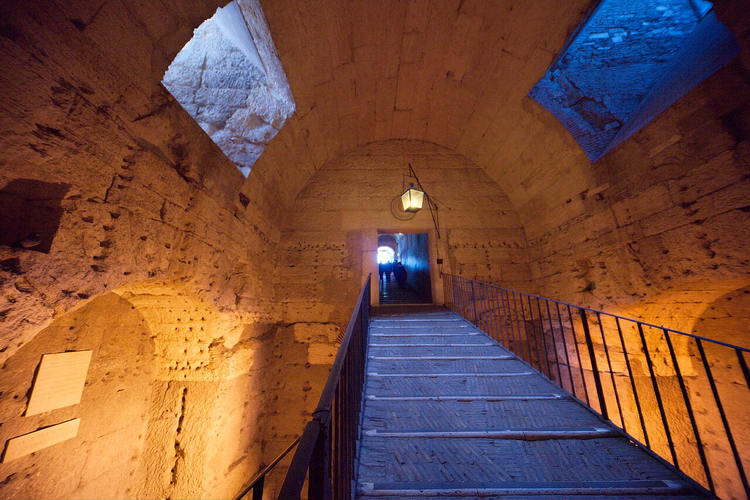
The ascent begins along a spiral ramp that has survived from Roman times. At the entrance you are greeted by a marble bust of Jesus Christ, sculpted in the 15th century.
 © Cm9462 · CC BY-SAPhoto: Cm9462, CC BY-SA (https://creativecommons.org/licenses/by-sa/4.0), Wikimedia Commons
The circular corridor leads to the Cortile dei Condannati. Death sentences were carried out here. Through a large arch you enter the room where Hadrian's mausoleum originally stood. From the tomb hall, a tunnel leads to the next level.
Second level: Sala delle Urne
On the second level you enter the Sala delle Urne. The urns with the ashes of Hadrian and his family stood here. Nearby are the Sala della Giustizia and the prisoner cells. Excavations showed that the niches on this level were used to store food and water supplies in case of a siege.
 © User:MatthiasKabel · CC BY-SAPhoto: User:MatthiasKabel, CC BY-SA (http://creativecommons.org/licenses/by-sa/3.0/), Wikimedia Commons
Third level: Cortile dell'Angelo and the papal apartments
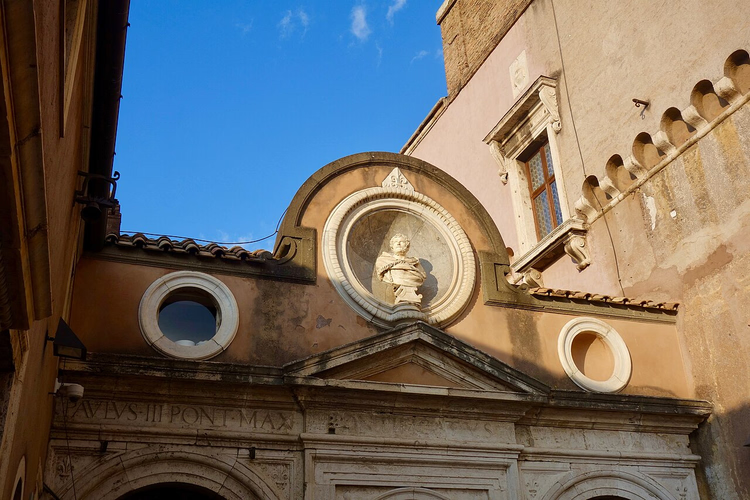
The third level opens with the Cortile dell'Angelo, a square courtyard. It contains a partially ruined statue of an angel that once decorated the roof of the castle. From here you enter the papal apartments, where you will see the quarters of the Vatican rulers. Their interiors were partly decorated by Michelangelo, Giulio Romano, and Giovanni da Udine.
 © Sonse · CC BYPhoto: Sonse, CC BY (https://creativecommons.org/licenses/by/2.0), Wikimedia Commons
Fourth level: the gallery and Sala Paolina
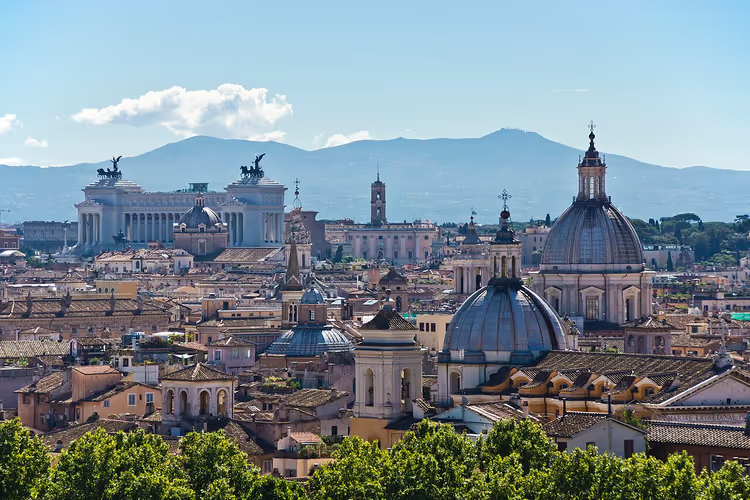
On the fourth level there is a covered gallery, as well as the apartments of Popes Pius IV and Paul III. Several ceremonial halls are also here, which you pass through in order. In the Sala di Perseo the walls are painted with scenes from the myth of Perseus. In the Sala di Amore e Psiche frescoes on the story of Cupid and Psyche have survived. The Sala Paolina was used for receiving guests for a long time.
 © Bert Kaufmann from Roermond, Netherlands · CC BY-SAPhoto: Bert Kaufmann from Roermond, Netherlands, CC BY-SA (https://creativecommons.org/licenses/by-sa/2.0), Wikimedia Commons
Fifth level: the treasury and library
On the fifth level you see the treasury. Papal treasures and church archives were kept here. A library was set up nearby.
Sixth level: the Angel Terrace and views
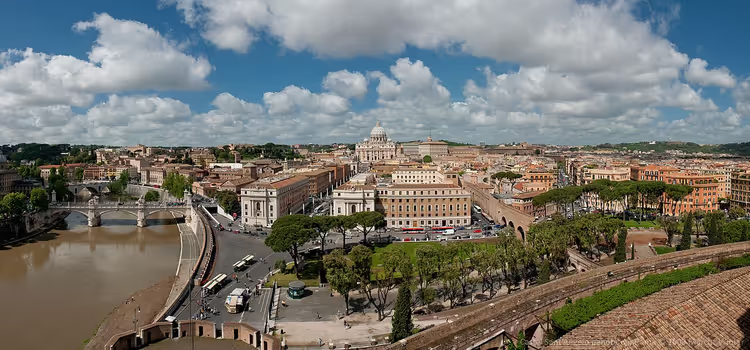
The sixth level completes the route. From the Terrazza dell'Angelo you will see a panorama of the Tiber and St. Peter's Basilica. From here there is a passage to the Sale dei Fasci e delle Colonne, the halls of flags and columns.
 © Marcus Winter from Potsdam, Germany · CC BY-SAPhoto: Marcus Winter from Potsdam, Germany, CC BY-SA (https://creativecommons.org/licenses/by-sa/2.0), Wikimedia Commons
- Who it's for: those who want to see Rome from above and walk through the halls of the papal castle.
- Not for: if you find it difficult to climb stairs and ramps, the ascent will not be easy.
Tickets, hours and entry
Hours and prices are worth checking before your trip. The museum is open Tuesday through Sunday, from 9:00 to 19:30. Last entry is at 18:30, and the ticket office closes at 18:00 (as of 09/2026, official museum website).
Monday is usually a day off. There is one exception: the first Monday of the month. On that day the castle is open from 14:00 to 20:00, last entry is at 19:00, and a special ticket costs 5 € (as of 09/2026, museum listing on Musei Italiani).
A full ticket costs 18 € (as of 09/2026, CoopCulture). Discounts are available for teenagers and EU students, and there are free categories for children. Check the exact price and the list of discounts on the official website before your visit.
It is more convenient to buy tickets online in advance: you pick a time slot and go straight to the entrance without waiting in the ticket office line.
Tours and tickets in Castel Sant'Angelo
Guided tours, skip-the-line tickets and activities — most offers can be cancelled free of charge.
See offers on TiqetsThe widget loads once you give your consent.
How to get to the castle
Address: Lungotevere Castello, 50, 00193 Rome. The entrance is on the Lungotevere Castello side, next to the Ponte Sant'Angelo.
The easiest way by metro is line A. Get off at Ottaviano or Lepanto station. From Ottaviano it is about a 15-minute walk, from Lepanto a little less (according to the map). From St. Peter's Basilica to the entrance is about 10-15 minutes along Via della Conciliazione.
The castle sits between the Vatican and the historic center, so it is easy to include in a regular walk around Rome. From the Pantheon it is about a 20-minute walk (according to the map).
⁉️🤔 Frequently asked questions
How much time do you need for Castel Sant'Angelo?
Allow 2-3 hours for the route through the six levels. If you go up to the terrace and linger for the view, set aside half a day. A quick visit without stops takes about an hour.
When is the best time to come to avoid the line?
Come at opening time at 9:00 or after 17:00. On weekdays there are fewer people than on weekends, and in summer the lines are longest. A ticket with a time slot lets you go to the entrance without waiting in the ticket office line.
Does Castel Sant'Angelo belong to the Vatican?
No, it is a separate museum that is part of Italy, although the castle stands next to the Vatican and is connected to it by the historic Passetto di Borgo corridor. From St. Peter's Basilica to the entrance is about a 15-minute walk.
Is the castle open on Monday?
Monday is usually a day off. There is one exception: the first Monday of the month, when the museum is open in the afternoon with a special ticket. Check the exact monthly schedule on the official website.
Can you go up to the observation deck?
Yes, the terrace on the sixth level is included in the regular ticket. From there you can see the Tiber and the dome of St. Peter's Basilica. The route goes up stairs and ramps, so wear comfortable shoes.
In short: what is worth booking
Castel Sant'Angelo is worth visiting even on a short trip. It is a mausoleum, fortress, museum, and observation deck with a view of the Vatican all at once.
If you have two hours: buy a ticket online with a time slot and head straight to the terrace. If you want to understand the history: set aside half a day and go through the rooms in order. If you are in Rome for the first time: combine the castle with a walk around the Vatican, they are close to each other.
Before your trip, it is worth comparing travel insurance options.

A small editorial team writing guides for independent travel. We travel ourselves, but we haven’t been everywhere, so we check prices, opening hours and how to get there against official sources.