
















Charlottenburg palace in Berlin: what to see and how to plan your visit
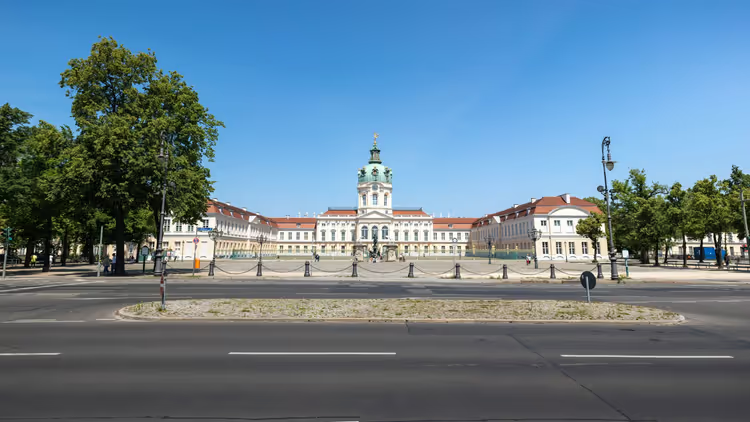
Charlottenburg Palace stands in the west of Berlin. From the center it takes about 15 minutes by S-Bahn. It is the largest Hohenzollern residence in the city and the only Berlin palace that was almost fully restored after World War II.
Inside you will see gilded rococo halls, a collection of Chinese and Japanese porcelain, and the largest gallery of Antoine Watteau paintings in Germany. Outside, a baroque park with a fountain, sculptures, and a pond awaits you. A full ticket to the Old Palace costs about €12, and the charlottenburg+ combination ticket costs around €19 (as of 09/2026, official SPSG website).
Let's break down what to see first, how much time to allow, and how to get there without a car.
Ad: this article contains affiliate links, we earn a commission if you book through them, at no extra cost to you.
Construction history
💡 In short:
- The palace is open Tuesday through Sunday; Monday is closed.
- In summer, ticket offices are open until about 5:30 PM; in winter they close earlier; last entry is 30 minutes before closing.
- The charlottenburg+ combination ticket (about €19) includes the Old Palace, the New Wing, and all pavilions in the park.
- Prices and opening hours: 09/2026, verified on the official SPSG website.
 © abbilder · CC BYPhoto: abbilder, CC BY (https://creativecommons.org/licenses/by/4.0), Wikimedia Commons
The palace grew out of Queen Sophie Charlotte's summer residence. In 1694, she received a plot of land on the banks of the Spree, seven kilometers from Berlin, from her husband. At the time it was a quiet spot: the only thing nearby was the village of Lietzow. In June 1695, architect Johann Arnold Nering began building a small two-story house (as of: palace history on the SPSG website).
Nering died in October of that same year, and Martin Grünberg continued the work. After Frederick I's coronation in 1701, the residence was expanded; at that point it was still called Lietzenburg. The queen died in 1705 at age 36, and her husband renamed the palace Charlottenburg in her honor.
The west wing was built by Eosander von Göthe. Between 1709 and 1712, the central part of the building received a dome and was made taller. Each successive owner added something (as of: palace description on the SPSG website).
After World War I, the palace passed to the Administration of Palaces and Parks. In 1945, the building was almost completely destroyed, and in the late 1940s city authorities planned to demolish it. The residence was saved by Margarete Kühn: she fought for the palace and became its director. From the 1950s onward, the building was restored according to the original drawings.
Architecture
The palace combines German Baroque and Rococo. The main building, with eleven axial windows, is flanked by two wings that together form a large ceremonial courtyard. The facade is 505 meters long. The walls are yellow, with gray contrasting details (as of: SPSG architecture description).
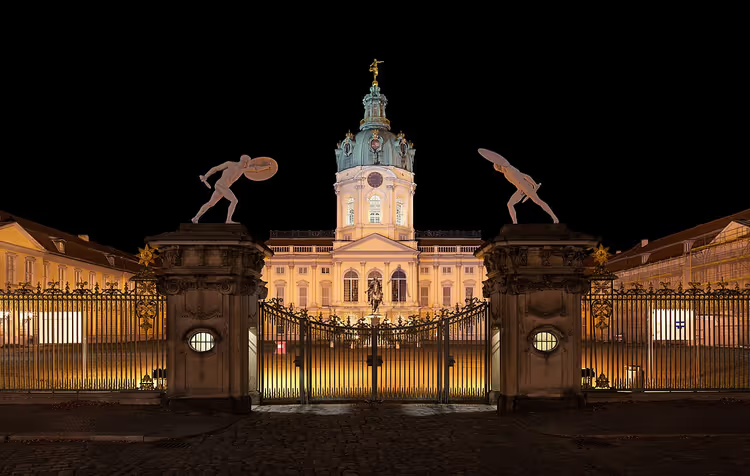
In front of the palace stands a fence of tall spikes topped with eight-pointed stars, the emblems of the Order of the Black Eagle. On the gates you will see sculptures of two discus throwers facing each other. In front of the main entrance, a bronze statue of the Great Elector rises on a marble pedestal. The rider and horse are cast as a single monolith.
Above the central part of the facade rises a 48-meter tower with a green dome. The balustrade is decorated with allegorical figures symbolizing the sciences. A gilded statue of the goddess Fortuna stands frozen on the spire.
Interior
 © Rüdiger Stehn from Kiel, Deutschland · CC BY-SAPhoto: Rüdiger Stehn from Kiel, Deutschland, CC BY-SA (https://creativecommons.org/licenses/by-sa/2.0), Wikimedia Commons
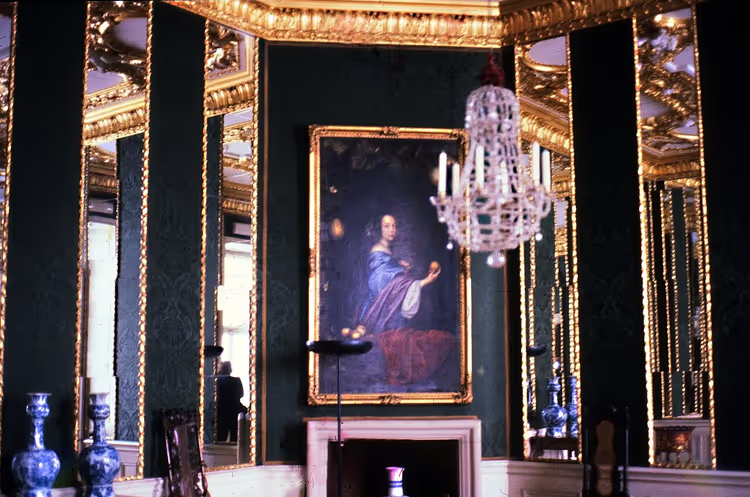
Inside, the same Baroque and Rococo style continues: elaborate stucco work, statues, gilded panels. The walls are finished in both rich and soft pastel tones. The halls and private chambers are furnished with carved and inlaid furniture (SPSG interior description).
The ceilings are covered with monumental paintings and frescoes. Crystal chandeliers and candelabras provide the lighting, and the floors feature parquet and ceramic tile. Many halls are decorated with handmade tapestries and large mirrors in gilded frames.
The famous Amber Room was originally intended for Charlottenburg.
What to see
The main building includes the rooms of the old palace and the new wing added to the east in 1740-1742. The imposing central entrance is emphasized by double columns and a balcony. Today it displays the monarchs' furniture, gold snuffboxes, tableware made of gold, silver and porcelain, sculpture and painting. One of the galleries houses Germany's largest collection of paintings by Antoine Watteau (what to see on the SPSG website).
Main wing
 © Thomas Wolf , www.foto-tw.de · CC BY-SAPhoto: Thomas Wolf , www.foto-tw.de, CC BY-SA (https://creativecommons.org/licenses/by-sa/3.0/de/deed.en), Wikimedia Commons
The centerpiece of the main wing is the round vaulted reception hall with gilded relief sculpture and niches containing marble figures. Arched windows look out onto the park. Beyond lie the emperor's winter bedroom and the chapel: beneath the oak pulpit stands the original altar table, with the royal box opposite. Angels hold a crown and the Prussian eagle. The enfilade ends with the tapestry hall and the porcelain cabinet.
Golden Hall
The Golden Gallery serves as a ballroom and is considered one of the most beautiful Rococo salons in Europe. The doors and green-pastel walls and ceilings are covered with precious stucco decoration. Cherubs, fruit and intertwined branches gleam with gilding. The elongated room, 42 meters long, astonishes with crystal and mirrors.
White Hall
The White Hall is executed in a classical style, not Rococo. Here too a crystal chandelier sparkles, and the pilasters are finished in gold. The white walls and simple arched windows give Frederick the Great's former dining room a restrained character. The original ceiling by Antoine Pesne has not survived. The hall is now adorned with a ceiling panel featuring an abstract design that echoes the motifs of the lost painting.
Porcelain Cabinet
 © Bärwinkel,Klaus · CC BY-SAPhoto: Bärwinkel,Klaus, CC BY-SA (https://creativecommons.org/licenses/by-sa/4.0), Wikimedia Commons
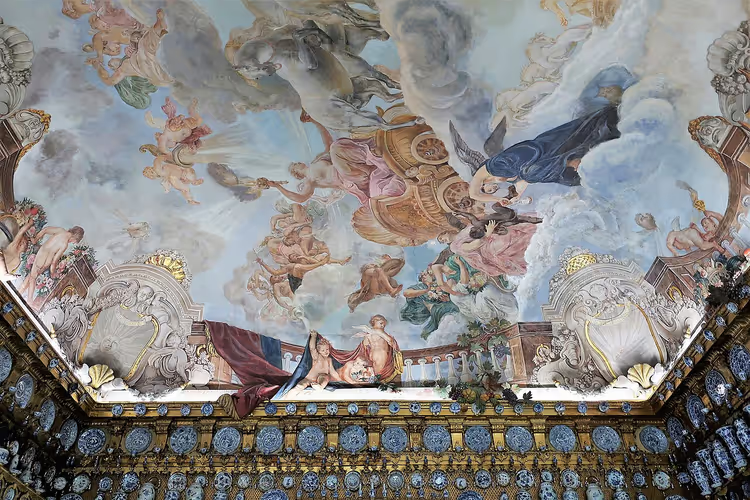
On the ground floor there is a room with walls of large mirrors in gold frames. This is the porcelain cabinet, created in 1706 by Baron von Göthe. Sophie Charlotte loved Eastern art, and the king gave her a salon with a collection of more than 2,700 blue-and-white Chinese and Japanese pieces. Every item is hand-painted (SPSG porcelain collection). The ceiling is decorated with a panel of allegorical figures: the seasons, the continents and the signs of the zodiac.
Great Orangery
In the western part stands the Great Orangery, covering 1,156 m². It was built between 1709 and 1712. In the cold months, around two hundred orange and lemon trees wintered here. In summer, the orangery served as a venue for court festivals and balls. In 1943 the building was reduced to ruins, and it was restored 19 years later. Today it hosts receptions, dinners and concerts.
Charlottenburg today
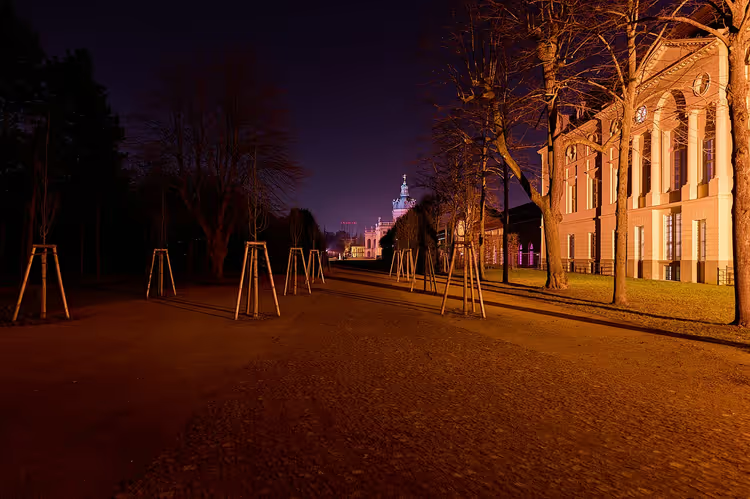
Today the former Hohenzollern estate operates as a museum and a center of the capital's cultural life. The Great Orangery hosts concerts by the Berlin Residence Orchestra. The musicians perform in Baroque-era costumes and play works from the 18th century. You can also arrange a children's birthday party here with costumes and refreshments.
The cafe in the courtyard welcomes guests daily, usually from 11:00 to 19:00 (as of: SPSG visitor information). During Advent, the four weeks before Catholic Christmas, a market operates in front of the palace with mulled wine, grilled sausages and handmade souvenirs.
The park
 © JoJan · CC BYPhoto: JoJan, CC BY (https://creativecommons.org/licenses/by/3.0), Wikimedia Commons
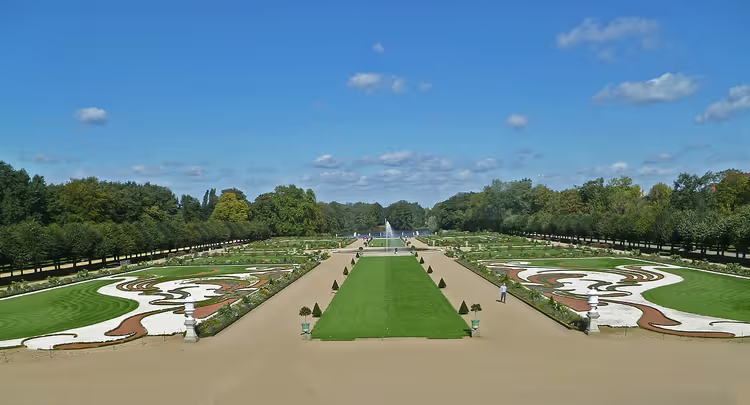
The palace is surrounded by a large park. In 1697, Sophie Charlotte invited Simeon Godeau, a pupil of the Versailles gardener André Le Nôtre. He created the first French Baroque garden on German soil. The garden opened two years later with a grand celebration. The queen hosted not only festivals with music and theater here, but also conversations with the philosopher Gottfried Wilhelm Leibniz (Charlottenburg Park on the SPSG website).
At the end of the 18th century, part of the garden was redesigned in the fashionable English landscape style. After the destruction of World War II, the Baroque atmosphere was restored.
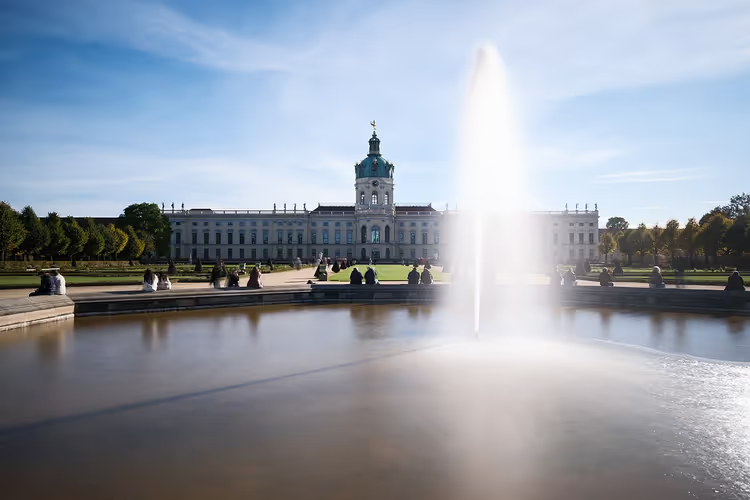
Today the layout is defined by strict geometric lines. Four paths, separated by lawns, lead away from the palace. They are flanked by parterre flowerbeds and border shrubs. In the center is an octagonal pool with a fountain. Sculptures and a ten-meter marble obelisk complete the decor.
In the northern section, a wide staircase leads down to a body of water. In Charlotte's time, it was connected to the River Spree and served as a port for gondolas. The queen used them to travel from the city palace to her country residence. Today it is the rectangular Carp Pond with a humpbacked bridge.
Belvedere
 © Dosseman · CC BY-SAPhoto: Dosseman, CC BY-SA (https://creativecommons.org/licenses/by-sa/4.0), Wikimedia Commons
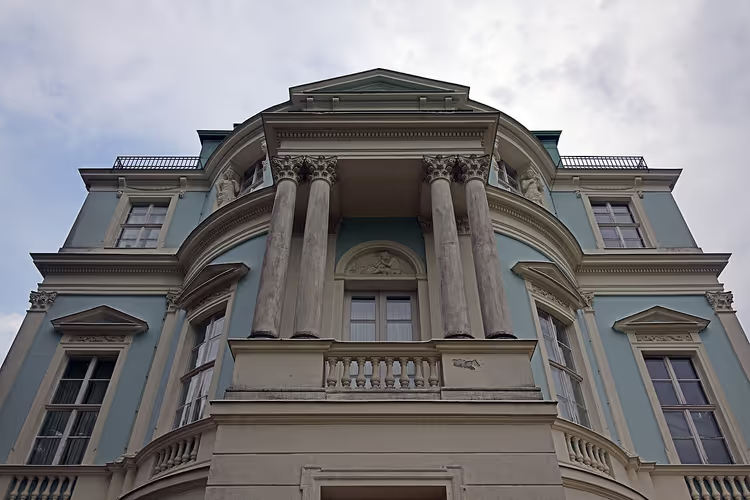
On the banks of the Spree, among avenues of linden trees, stands the Belvedere. It was built by Carl Gotthard Langhans in 1788 as a viewing pavilion and tea house. It also hosted the "spirit conjuring" rituals of the Rosicrucian society, to which Frederick William II belonged. Today the Belvedere houses the world's largest collection of the Royal Porcelain Factory Berlin, founded in 1763.
New Pavilion
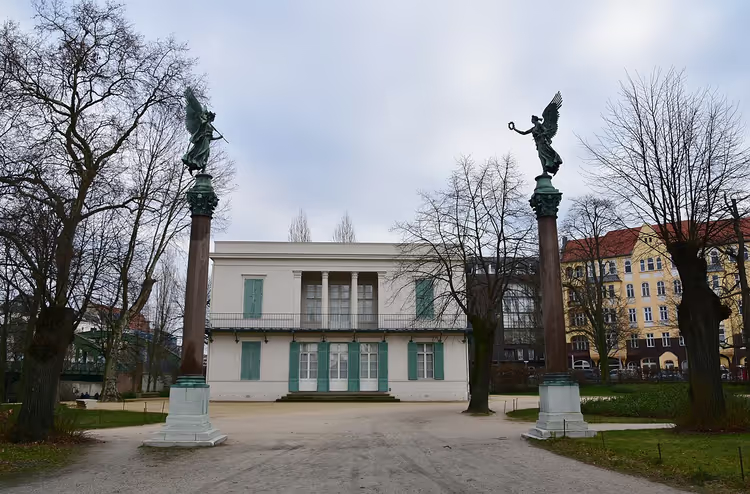
The New Pavilion, east of the palace, was built by Karl Friedrich Schinkel in 1824-1825. The building, in the style of a Neapolitan villa, served as the monarch's summer residence. The pavilion was destroyed in World War II and rebuilt in 1957-1960. After restoration in 2011, it opened as an art gallery.
 © Richard Mortel from Riyadh, Saudi Arabia · CC BYPhoto: Richard Mortel from Riyadh, Saudi Arabia, CC BY (https://creativecommons.org/licenses/by/2.0), Wikimedia Commons
Three rooms on the ground floor are furnished with original furniture. The adjacent halls display German portrait painting. Upstairs, drawings by Schinkel and paintings by his contemporaries are shown: Caspar David Friedrich, Eduard Gaertner, and Carl Blechen.
Mausoleum
 © Kpt vernunft · CC BY-SAPhoto: Kpt vernunft, CC BY-SA (https://creativecommons.org/licenses/by-sa/4.0), Wikimedia Commons
In the northwestern part of the garden stands the Mausoleum with the tombs of the Hohenzollerns. In 1810, after the death of Queen Louise, Frederick William III ordered the construction of a small temple. The ideas came from the king, the project was led by architect Heinrich Gentz, and Schinkel served as consultant. The altar, crucifix, and biblical inscriptions on the walls make the building resemble a chapel (as of: SPSG description of the Mausoleum).
In 1840, the space was expanded to accommodate the sarcophagus of the third Prussian king. In 1888, the building was enlarged again after the death of Kaiser Wilhelm I and his wife Augusta. Beneath the memorial hall are buried Frederick William III's second wife, Auguste von Harrach, and Prince Albrecht.
Tickets and opening hours
 © Jean-Pierre Dalbéra from Paris, France · CC BYPhoto: Jean-Pierre Dalbéra from Paris, France, CC BY (https://creativecommons.org/licenses/by/2.0), Wikimedia Commons
The palace is open Tuesday through Sunday. Ticket offices are located next to the main entrance. In summer, from April to October, the doors stay open until about 5:30 pm; in winter they close earlier. The last visitor is admitted 30 minutes before closing. The palace is closed on December 24 and 25, and on December 31 it closes after 2:00 pm (opening hours on the SPSG website).
The park is open year-round from 8:00 am until sunset, and admission is free. The ticket price includes an audio guide in German and English. For €3 you get a permit for photography without flash or tripod.
The charlottenburg+ combination ticket gives you one visit to all galleries and pavilions in the park. It costs about €19, with discounts for schoolchildren and eligible groups (as of: 09/2026, charlottenburg+ tickets). Children under 7 are entitled to free admission.
Timed-entry tickets are sold online, so in high season you don't stand in the ticket line. Charlottenburg timed-entry tickets on Tiqets.
Tours and tickets in Charlottenburg Palace
Guided tours, skip-the-line tickets and activities — most offers can be cancelled free of charge.
See offers on TiqetsThe widget loads once you give your consent.
Location and how to get there
The palace complex is in the west of Berlin, in the Charlottenburg-Wilmersdorf district. Exact address: Spandauer Damm 10-22, 14059 Berlin. GPS coordinates: 52°31'15.4"N 13°17'44.3"E (SPSG address and contacts).
- By car: about 0.8 km from the A100 autobahn. There are 120 parking spaces in front of the Great Orangery. The nearest 24-hour parking lot is at Spandauer Damm 10.
- By bus: routes M45 and 309 to the Schloss Charlottenburg stop, route 109 to Luisenplatz/Schloss Charlottenburg.
- By S-Bahn: lines S41, S42 and S46 to Westend station, then about a 13-minute walk along Spandauer Damm.
- By U-Bahn: the most convenient options are Richard-Wagner-Platz or Sophie-Charlotte-Platz.
Check routes and schedules on the BVG website. On weekdays public transit is more convenient: parking in front of the orangery is paid.
Charlottenburg on the map
The palace occupies the block between Spandauer Damm and the Spree riverbank; the main entrance is marked on the map below.
⁉️🤔 Frequently asked questions
How much time do you need for Charlottenburg?
Allow 1.5 to 2 hours for the Old Palace: the enfilade of rooms follows one after another, with no long walks in between. If you get the combined ticket, add another 2 to 3 hours for the New Wing, Belvedere and Mausoleum. You can walk through the park in an hour, or an hour and a half if you stop at the fountain.
When is the best time to visit to avoid crowds?
Come at opening time, 10:00, on a weekday. On weekends and in high season from May to September the ticket line is longer, so get a timed-entry ticket in advance. In winter there are fewer visitors, but some pavilions in the park may be closed.
How much do tickets cost?
A full ticket to the Old Palace costs about 12 €, and the charlottenburg+ combined ticket is roughly 19 € (as of 09/2026, SPSG combined ticket prices). The price includes an audio guide, and flash-free photography costs extra, about 3 €. The park itself is free.
Can you get there without a car?
Yes. From Westend S-Bahn station it's about a 13-minute walk to the palace along Spandauer Damm. Buses M45 and 309 stop right at the entrance. Parking in front of the orangery is paid, so on weekdays public transit is more convenient and cheaper.
Is the palace open on Mondays?
No, Monday is a closing day. The palace is open Tuesday through Sunday. It is also closed on December 24 and 25, and on December 31 it is open only until 14:00. The park is open every day from 8:00 until dusk, with free admission.
In short: what to book
If you're short on time: get a ticket for the Old Palace only and walk through the park. If you want to see everything: the charlottenburg+ combined ticket pays for itself after just three sites. If you're visiting with kids: come in the morning and leave time for the park by the fountain.
A timed-entry ticket saves you the ticket line. Charlottenburg tours on GetYourGuide.

A small editorial team writing guides for independent travel. We travel ourselves, but we haven’t been everywhere, so we check prices, opening hours and how to get there against official sources.