






Diwali 2026: when the festival of light in India and where to celebrate it
India lights up with millions of lights in late autumn. Diwali is the main Hindu festival, the festival of lights. In 2026 it falls on Sunday, November 8 (according to the drikPanchang calendar).
For five days straight, people decorate their homes with lamps, give gifts, and set off fireworks. Light here means the victory of good over evil. We have put together what Diwali is, how it is celebrated across regions, and where to experience the festival so you can plan your trip in advance.
Diwali in one minute
💡 In short:
- Diwali is a Hindu festival of lights, celebrated for one to five days.
- In 2026 the main day falls on November 8; the dates shift every year according to the lunar calendar.
- Best places to visit: Varanasi, Jaipur, Amritsar, and Ayodhya.
- In Delhi and the surrounding area, only "green" firecrackers are allowed, and only during narrow evening hours.
- Dates and firecracker rules: 09/2026, according to the drikPanchang reference and Deccan Herald.
What Diwali is and what it symbolizes
The word "Diwali" comes from the Sanskrit Deepavali and means "a row of lights." The festival symbolizes the victory of light over darkness, good over evil, and knowledge over ignorance. For Hindus it is one of the main events of the year. In significance it is often compared to Christmas in the West.
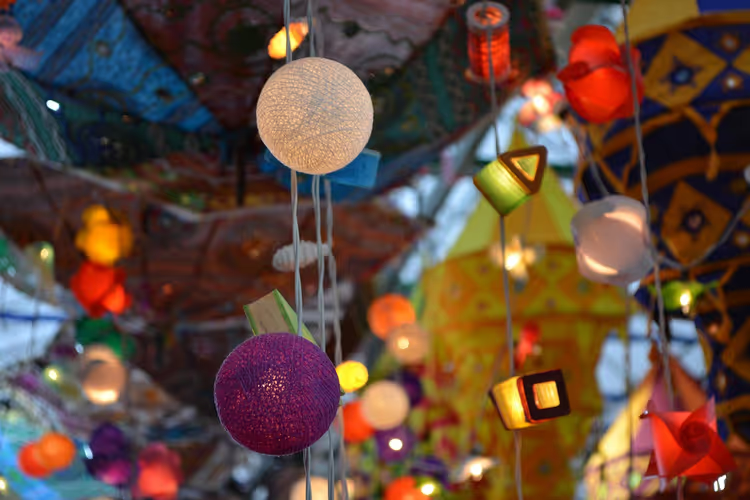
Light is the center of the whole festival. Streets and homes are brightly lit, and a real light show unfolds across the country. In the past, light came from oil lamps (diyas) and candles. Today electric garlands and floodlights have joined them, turning night into day.
Fireworks and firecrackers also play a big role. The banging and flashing often starts several days before the festival itself, much like New Year's Eve in the West. In Gujarat in western India, Diwali also marks the transition to the new year.
When Diwali is in 2026 and beyond
Diwali follows the Hindu lunisolar calendar, so the date is different every year. The main day, Lakshmi Puja, falls on the new moon of the month of Kartika. The festival begins with Dhanteras two days before the new moon and lasts up to five days.
Below are the main day dates for the coming years. Depending on the region, shifts of one day are possible.
Year | Main day of Diwali | Day of the week |
|---|---|---|
2026 | November 8 | Sunday |
2027 | October 29 | Friday |
2028 | October 17 | Tuesday |
In 2026 the full cycle runs from Friday, November 6 (Dhanteras) through Tuesday, November 10 (Bhai Dooj), according to the drikPanchang portal. Plan to arrive a day or two before the main date. That way you can settle in and see the decorated markets without rushing.
The five days of the festival in order
Diwali rarely fits into a single evening. In most regions people celebrate for one to five days, and each day has its own role.
Day 1, Dhanteras. People tidy up their homes and decorate them. On this day it is customary to buy gold, jewelry, and new kitchen utensils: it is believed to bring good luck.
Day 2, Naraka Chaturdashi. People get up before dawn and take a ritual bath with aromatic oils. Then they put on new clothes, light small lamps throughout the house, and draw patterns on the floor with colored powder (rangoli). In the evening they set off fireworks.
Day 3, Lakshmi Puja. This is the main day, especially in the north. Families gather for a prayer to the goddess Lakshmi, followed by a lavish festive dinner. Lakshmi is the goddess of fortune, so the day is considered auspicious for games of luck: people take part in lotteries. Merchants tidy up their shops and open new account books.
Day 4, Govardhan Puja. In many regions this is the first day of the new year. Friends and relatives visit each other with gifts.
Day 5, Bhai Dooj. It is called the day of brother and sister. Sisters welcome brothers with a festive table and bless them with lights. Both sides promise to take care of each other.
How Diwali is celebrated in different regions
Diwali is celebrated by Hindus all over the world, and the differences can be significant. The legend and the main hero of the festival change from place to place.
North India. Here people honor the god Rama, who defeated the demon Ravana. Together with his wife Sita, Rama returned from exile to his home city of Ayodhya, and the residents greeted him with rows of lights.
South India. Here people celebrate Krishna's victory over the demon Narakasura and the freeing of the captives. The emphasis is on the morning ritual bath.
West, the state of Gujarat. Here people worship Lakshmi, Vishnu's wife and the goddess of wealth. According to mythology, on Diwali she celebrates her wedding day, and for merchants it is the start of the new financial year.
Where in India to experience the real Diwali
If you want to see Diwali in person, the choice is wide: the whole country celebrates on these days. Below are the places where the atmosphere is especially strong.
Varanasi. An ancient city on the Ganges. The evening Ganga Aarti ceremony on the ghats, thousands of lamps on the water, and lights over the river create an almost unreal picture.
Jaipur. The "Pink City" of Rajasthan. Palaces, forts, and markets are decorated with millions of lights; in the evening the city looks like one continuous illumination.
Amritsar. The spiritual center of the Sikhs. The Golden Temple (Harmandir Sahib) looks especially majestic in lights and in the reflection on the water.
Ayodhya. The birthplace of Rama and the site of the main "Diwali of legend." The city is known for the mass lighting of lamps on the riverbank.
Goa. Here Diwali is linked to the ritual burning of huge figures of the demon Narakasura early in the morning.
Mumbai and Delhi. In the megacities you can expect large-scale fireworks, illuminated skyscrapers, and decorated markets.
With a local guide you will better understand the meaning of the rituals at the ceremonies.
Firecrackers, "green" fireworks, and air
Fireworks are part of Diwali, but in major cities the rules have been tightened because of air pollution. In the Delhi and NCR area in 2025, the court allowed only certified "green" firecrackers with a QR code and the CSIR-NEERI logo, and only during narrow evening hours (according to Deccan Herald).
What this means for your trip. The air in Delhi in late autumn can be heavy, especially after the festive night. If you have sensitive airways, plan Diwali further south or in places near water, such as Varanasi. Check the current firecracker rules before your trip: they change almost every year.
⁉️🤔 Frequently asked questions
When is Diwali in 2026?
The main day falls on November 8. The full festival runs from November 6 to 10: from Dhanteras to Bhai Dooj.
How many days does Diwali last?
The classic cycle consists of five stages: Dhanteras, Naraka Chaturdashi, Lakshmi Puja, Govardhan Puja, and Bhai Dooj.
Where is the best place to experience Diwali in India?
The atmosphere is strongest in Varanasi with its ceremony on the Ganges, in Jaipur with the illumination of palaces, and in Amritsar at the Golden Temple. Ayodhya is known for the mass lighting of lamps. In Goa they burn demon figures, and in Mumbai and Delhi they set off large-scale fireworks.
Can you set off firecrackers in Delhi during Diwali?
Not freely. In the Delhi and NCR area, only certified "green" firecrackers are allowed, and only during limited evening hours. The rules are set by the court and change almost every year because of air pollution, so check the current restrictions before your trip.
What does Diwali symbolize?
The victory of light over darkness and good over evil. That is where the lamps, candles, and garlands come from: they are the main image of the festival.
In short: how to catch the real Diwali
Diwali is not one evening, but five days of light, prayers, and fireworks. The meaning is the same everywhere, but the legend and the emphasis change from north to south.
If you want a spiritual atmosphere: choose Varanasi or Amritsar.
If you want palaces and illumination: choose Jaipur.
If clean air matters: plan the festival further south, not in Delhi.
Arrive a day or two before the main date, check the local firecracker rules, and save an evening for the lights on the water.

A small editorial team writing guides for independent travel. We travel ourselves, but we haven’t been everywhere, so we check prices, opening hours and how to get there against official sources.