
















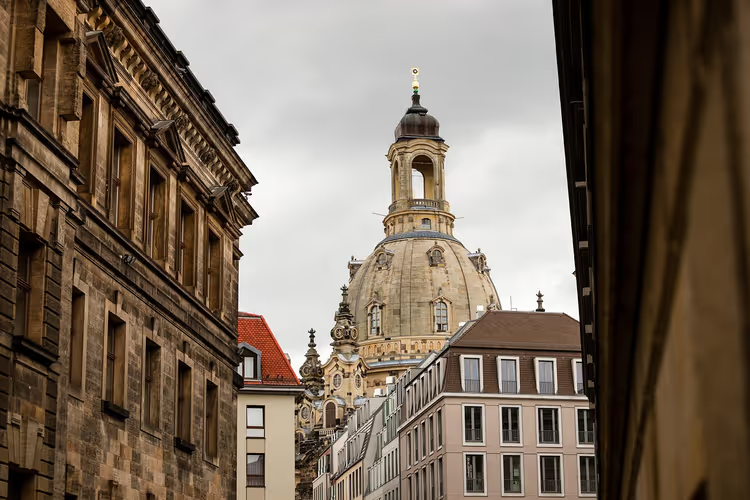
What to see in Dresden: 10 main places and how much tickets cost
Dresden is more compact than the guidebooks make it seem. The city's ten main sights stand on both banks of the Elbe, and most of them you can cover on foot.
Much of the Old Town was rebuilt after 1945, so authentic Baroque sits side by side with careful replicas. A relaxed visit to all ten sights takes two days.
Below are the prices and honest catches for each sight, so you don't waste time at the ticket office. All information was verified on 09/03/2026 on the official websites of the museums and the park.
Ad: this article contains affiliate links, we earn a commission if you book through them, at no extra cost to you.
💡 At a glance:
- Come to the Old Town in the morning, and save the right bank of the Elbe for the second day.
- Buy your ticket to the Zwinger online: on weekends the ticket office has a line at the entrance.
- Prices: 09/2026, verified on the official SKD website.
1. Zwinger: a Baroque palace complex
 © Txllxt TxllxT · CC BY-SAPhoto: Txllxt TxllxT, CC BY-SA (https://creativecommons.org/licenses/by-sa/4.0), Wikimedia Commons
The Zwinger was built as a palace ensemble for festivals and knightly tournaments. Pavilions, fountains, and sculptures fill an entire city block, and you'll need at least an hour to walk around the courtyard.
On the west side, facing Ostra-Allee and the Zwingerteich pond, stands the Crown Gate (Kronentor) with its gilded crown.
The courtyard is surrounded by pavilions with evocative names: the Nymphs' Bath, the French Pavilion, the German Pavilion. Sculptures and vases line the edges, and a fountain plays in the center. From the gate you can see the domes and spires of the Old Town, so this is a good spot for photos in the soft morning light.
Four museums operate inside the Zwinger, and one combined ticket is cheaper than buying individual entries (as of: 09/2026, Staatliche Kunstsammlungen Dresden).
What to see | Full ticket | Reduced | As of |
|---|---|---|---|
Zwinger, combined ticket for four museums | 18 € | 13.50 € | 09/2026, SKD |
Individual museum, porcelain or instrument cabinet | 6 € | 4.50 € | 09/2026, Dresden State Art Collections |
Museum hours change by season, so check the special hours page for the day of your visit. Students up to age 20 pay 2 €, children under school age enter free (as of: 09/2026, official website).
2. Old masters picture gallery
 © Txllxt TxllxT · CC BY-SAPhoto: Txllxt TxllxT, CC BY-SA (https://creativecommons.org/licenses/by-sa/4.0), Wikimedia Commons
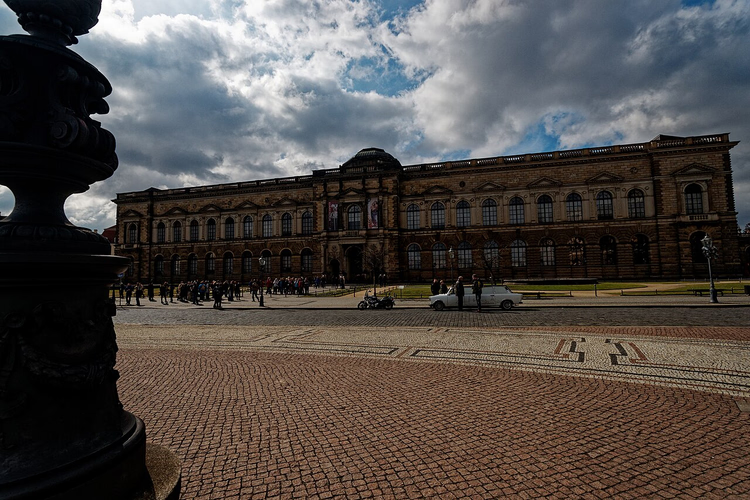
The Old Masters Picture Gallery occupies the north wing of the Zwinger, the Semperbau, and runs along Theaterplatz. Raphael's "Sistine Madonna" hangs here, alongside works by Rubens, Rembrandt, and Titian.
The exhibition spans two floors, and it makes sense to head straight to the "Sistine Madonna" first, then work your way down. Benches are placed between the rooms, so you can easily break up the visit. At the entrance you'll be asked to leave large backpacks in the cloakroom, and audio guides help you navigate the galleries.
- How much time: at least two hours, otherwise you will only see part of the galleries.
- The catch: on weekends there is a line at the Semperbau entrance, so book your gallery ticket on Tiqets in advance.
3. Dresden royal palace and the green vault
 © User:Kolossos · CC BY-SAPhoto: User:Kolossos, CC BY-SA (https://creativecommons.org/licenses/by-sa/3.0), Wikimedia Commons
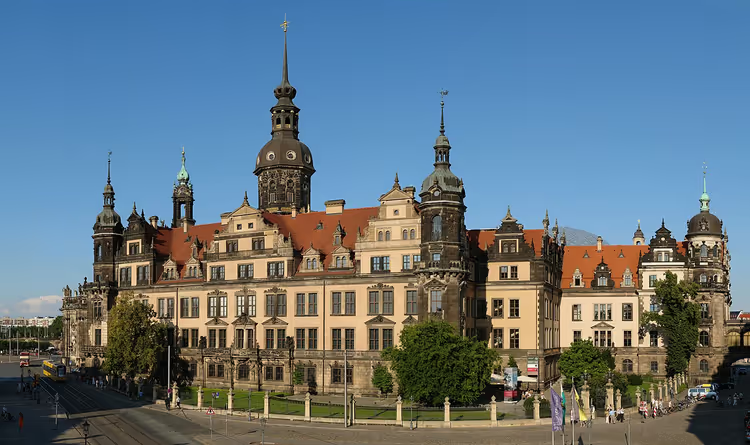
The Royal Palace is considered one of the city's most beautiful buildings, and the spire of the Hausmannsturm tower is visible from almost any district. Inside are collections of weapons, engravings, coins, and jewelry.
Fans of Neo-Renaissance and eclectic architecture will find plenty to look at outside as well. The facades were renovated over decades, so the details here are worth seeking out beyond the museums.
You can enter the inner courtyard for free, and from there you get a good view of the tower. It offers a panorama of the Elbe and the surrounding rooftops, but the climb up the narrow spiral staircase is not for everyone. A separate ticket to the Historic Green Vault costs 18 € (as of 09/2026, State Art Collections).
- Where to go: the Rüstkammer with its weapons and the New Green Vault with its jewelry.
- The catch: the Historic Green Vault admits visitors in timed slots, and tickets with a time slot sell out several days in advance.
4. Hofkirche: Saxony's main cathedral
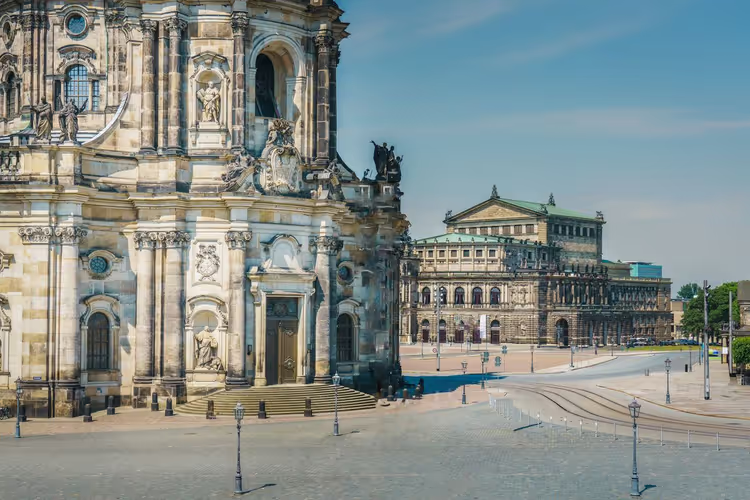
The Hofkirche remains the largest church in Saxony, and its shape resembles a ship. Inside is the burial vault of the rulers, and a copper capsule holds the heart of Augustus the Strong.
According to legend, the heart starts beating when a beautiful girl walks past. Augustus was famous for his love affairs, so even guides believe the legend.
Inside, take your time at the main altar and the organ, and also look closely at the delicate stone vaults. Figures of saints line the walls, and balconies for the princely family are visible under the ceiling. The church is connected to the palace by a gallery, so it is convenient to visit on the way between the Zwinger and the square.
The church is active, and admission is free. During services, tourists are asked to keep quiet and not disturb worshippers.
5. The "Procession of Princes" porcelain mural
 © Kora27 · CC BY-SAPhoto: Kora27, CC BY-SA (https://creativecommons.org/licenses/by-sa/4.0), Wikimedia Commons
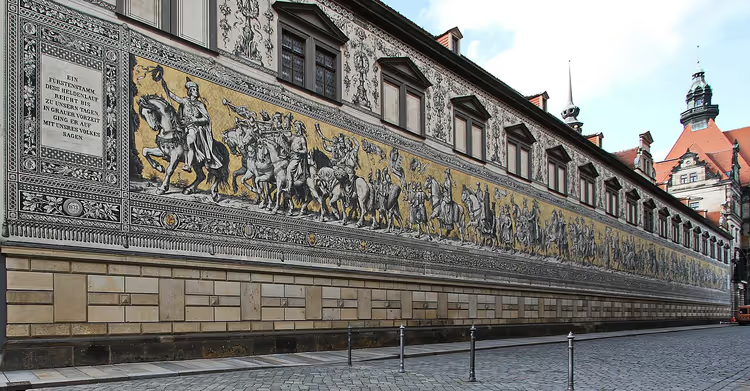
The "Procession of Princes" (Fürstenzug) mural stretches along the gallery wall on Augustusstraße. The mosaic is made of Meissen porcelain, assembled by hand, fragment by fragment, and it is more than a hundred meters long.
The mural depicts Saxon princes, craftsmen, scholars, children, and even animals. Try to find the only girl shown in the mural: it will take you a few minutes.
To see the details, step closer. The people in the mural are dressed in the fashion of their eras, from knightly armor to doublets, and the seams between the porcelain tiles are almost invisible. Street musicians usually perform nearby, so you will easily find the spot by the lively crowd.
It is best to come here in the morning. During the day, groups gather at the mural, and it becomes harder to make out the details.
6. Großer Garten: the park and the Parkeisenbahn
 © Bybbisch94-Christian Gebhardt · CC BY-SAPhoto: Bybbisch94-Christian Gebhardt, CC BY-SA (https://creativecommons.org/licenses/by-sa/4.0), Wikimedia Commons
Großer Garten is considered Dresden's largest park and occupies an entire district in the southeast. Lawns, avenues, centuries-old trees, and the Botanical Garden look like one big recreation area in summer.
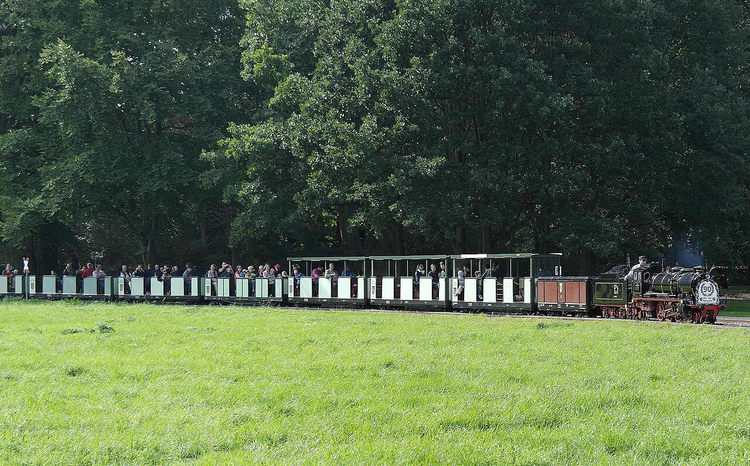
The Parkeisenbahn, a miniature railway, runs through the park: a full ticket costs 8 €, a child ticket 5 € (as of 09/2026, Schlösserland Sachsen). In the center of the park stands the Baroque Summer Palace, around which the park was originally laid out.
It is easy to spend half a day in the park: a long avenue leads from the entrance to the palace, and there is bicycle rental and a boat dock on the pond. In summer, whole families relax on the lawns, and in winter the avenues are used for walks. The park is a convenient way to reach the zoo, and from the gates it is easy to get back to the center by tram.
- Who it's for: families with children and anyone tired of museums.
- The catch: the park lies away from the center, so getting there takes extra time.
7. Altmarkt: Dresden's oldest square
 © LH DD/Dittrich · CC BY-SAPhoto: LH DD/Dittrich, CC BY-SA (https://creativecommons.org/licenses/by-sa/3.0), Wikimedia Commons
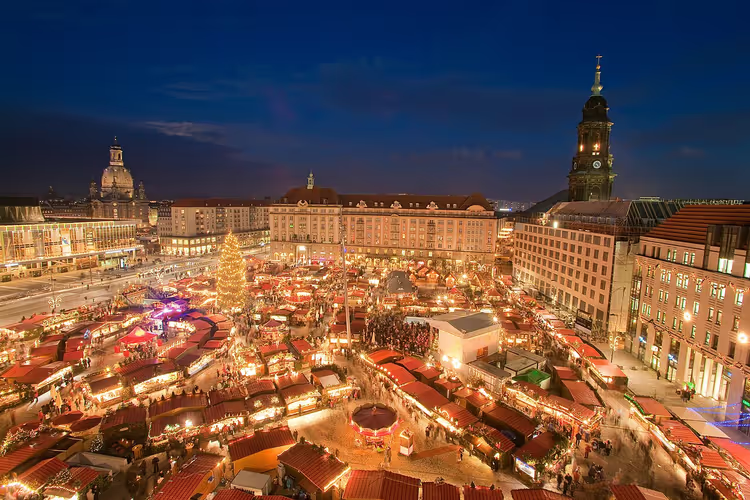
Altmarkt was laid out back in the 14th century, and it remains the city's main square to this day. Seasonal fairs take place here, and in winter a Christmas market with wooden stalls sets up.
In summer, a small Ferris wheel in bright colors operates on the square, and street musicians perform. The square's festive decorations have won city competitions more than once, so bring your camera.
Cafes, shops, and city churches form a tight ring around the square. Kreuzkirche (Church of the Holy Cross) and the shopping streets are just a stone's throw away, so Altmarkt is a convenient place to take a break between museum stops. In the evenings, the square is illuminated and turns into a calm strolling area.
8. Brühlsche Terrasse above the Elbe
 © Foto Fitti · CC BY-SAPhoto: Foto Fitti, CC BY-SA (https://creativecommons.org/licenses/by-sa/3.0), Wikimedia Commons
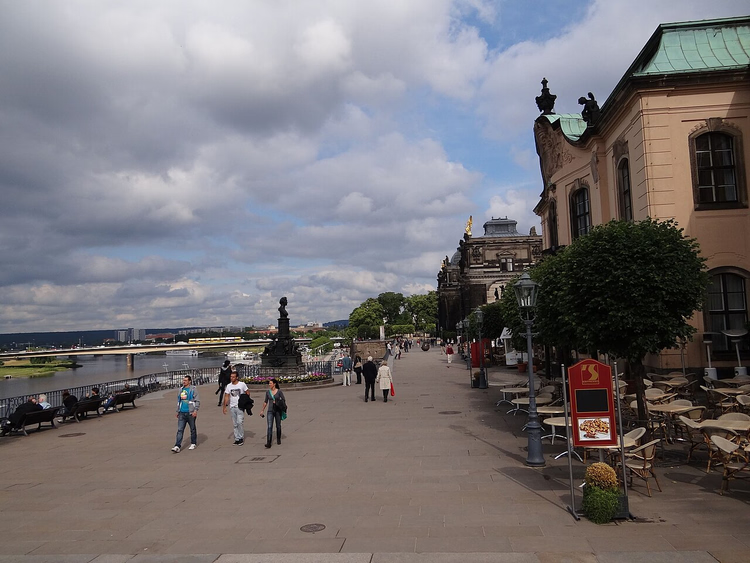
Brühlsche Terrasse is called the "Balcony of Europe," and it's the best free viewing platform in the city. From the terrace you can see the palaces of the Old Town on one side and a peaceful river landscape on the other.
In the evening, the lamps light up here, and the walk becomes especially pleasant. Come an hour before sunset, and you'll catch both the soft light and the city's illumination.
You can climb up to the terrace via a wide staircase from the castle side or come down from Augustus Bridge. Cafes and sculptures line the parapet, and sightseeing boats travel along the river. The promenade here is short, so it's easy to combine with a walk along the embankment.
9. Yenidze: a factory under a mosque dome
 © Hullbr3ach · CC BY-SAPhoto: Hullbr3ach, CC BY-SA (https://creativecommons.org/licenses/by-sa/2.5), Wikimedia Commons
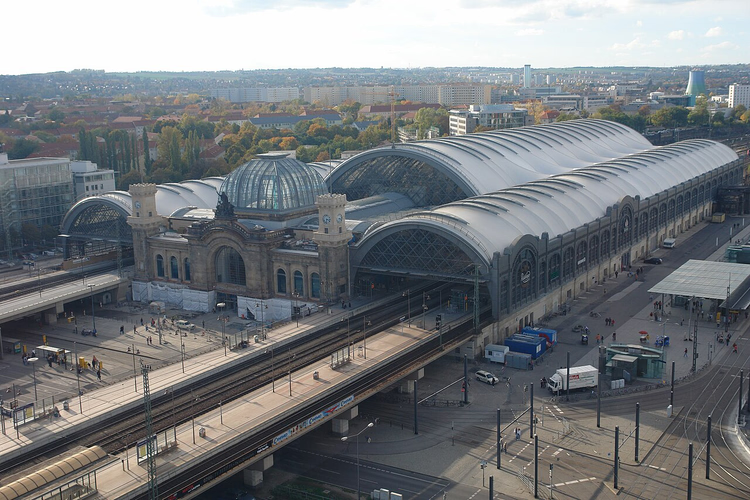
Yenidze was built as a tobacco factory, and from a distance the building is easy to mistake for a mosque. The smokestacks here are hidden inside decorative towers, which is what gives it that oriental silhouette.
Today the building houses offices, and under the dome there is a restaurant with a panoramic view of the city. You can see the building from the outside at any time, and it is worth going inside for the view from the restaurant.
The building stands away from the tourist center, but you can already see it from the bridge over the Elbe. A glass dome crowns the tower, and the windows echo oriental ornamentation. If you are not planning to go up to the restaurant, an exterior look is enough: the facades are more interesting to take in from a distance, as a whole.
- The catch: the view from the restaurant depends on your table, and it is better to book in advance.
10. Kunsthofpassage: five courtyards of art
 © User:Kolossos · CC BY-SAPhoto: User:Kolossos, CC BY-SA (http://creativecommons.org/licenses/by-sa/3.0/), Wikimedia Commons
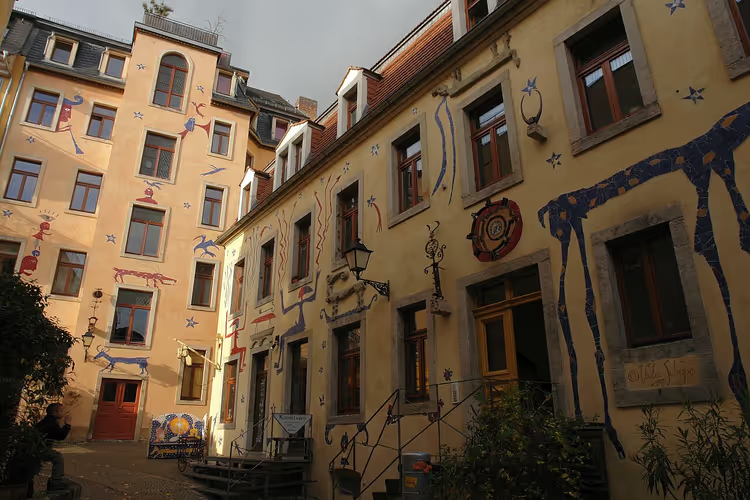
Kunsthofpassage consists of five inner courtyards, each with its own theme: fairy tales, the elements, metamorphoses, light, and animals. The courtyards are connected by passageways between residential buildings, and entry from the street is free.
In the courtyard of the elements, the facade of a blue building is hung with "musical" drainpipes. When it rains, they really do produce sounds resembling music.
The surrounding buildings house coffee shops, art stores, and workshops. After exploring, you will easily find a place to grab a coffee.
The courtyards are open during the day and require no ticket, so they are easy to fit in between other stops on your route. Some courtyards have plaques describing the artists' concept. Residents are relaxed about the flow of tourists, but you should not go into the building entrances.
Tours and tickets in Dresden
Guided tours, skip-the-line tickets and activities — most offers can be cancelled free of charge.
See offers on TiqetsThe widget loads once you give your consent.
⁉️🤔 Frequently asked questions
How many days do you need for Dresden?
Two days are enough for the ten places on this list. On the first day, walk through the Old Town: the Zwinger, the Old Masters Picture Gallery, the palace, the Hofkirche, and Brühlsche Terrasse. On the second day, cross to the right bank to Kunsthofpassage, then head to Großer Garten. If you are short on time, drop the park: it stands away from the center.
What does the Zwinger combined ticket include?
The combined ticket covers the Old Masters Picture Gallery, the Sculpture Collection, the Porzellansammlung, and the Mathematisch-Physikalischer Salon. The Historic Green Vault is not included; it requires a separate timed ticket. Children below school age enter free of charge.
Do you need to buy tickets in advance?
Yes, for museums with timed entry. The Historic Green Vault admits visitors by time slot, and weekend slots run out several days ahead. Zwinger tickets are also easier to buy online: that way you skip the ticket office.
What can you see in Dresden for free?
Admission is free to the Hofkirche, the "Procession of Princes" mural, Altmarkt, Brühlsche Terrasse, and Kunsthofpassage. These are open sites; you only pay for museums. Walk through them in the evening, when the Old Town is illuminated.
Is Großer Garten worth visiting with children?
Yes, if you have three extra hours. The park has the Parkeisenbahn, a miniature railway. The park is farther from the center than the other stops, but it is hard to drag children away from here.
Can you get around Dresden on foot?
Yes, all the stops except Großer Garten sit compactly on the two banks of the Elbe, and it is easy to walk between them. The route from the Zwinger to Kunsthofpassage in Äußere Neustadt on the right bank is easy to combine with a stroll along the embankment.
At a glance: what to book
If you have only one day, get the Zwinger combined ticket and do not spread yourself thin. It covers the gallery, the porcelain, and the instrument cabinet all at once.
If you are traveling with children, add Großer Garten with the Parkeisenbahn. If you want some quiet, come to Brühlsche Terrasse at sunset.
Look for museum tickets in Dresden with time slots on Tiqets, and book guided city tours on GetYourGuide.

A small editorial team writing guides for independent travel. We travel ourselves, but we haven’t been everywhere, so we check prices, opening hours and how to get there against official sources.