
















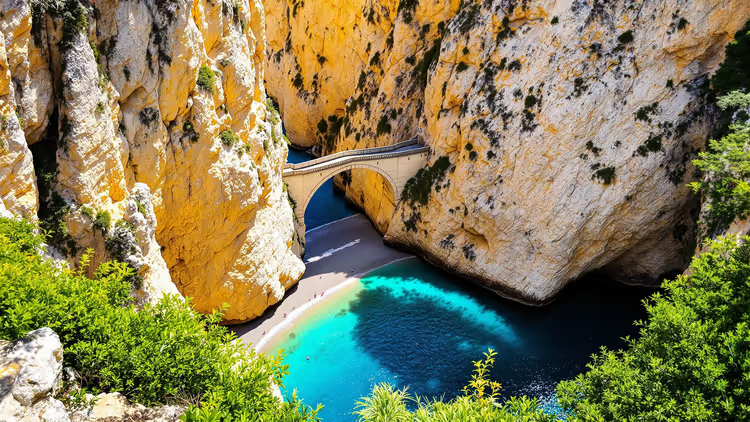
 AIIllustrative image: AI-generated
Furore: a village without a center and a fjord under a 30-meter bridge
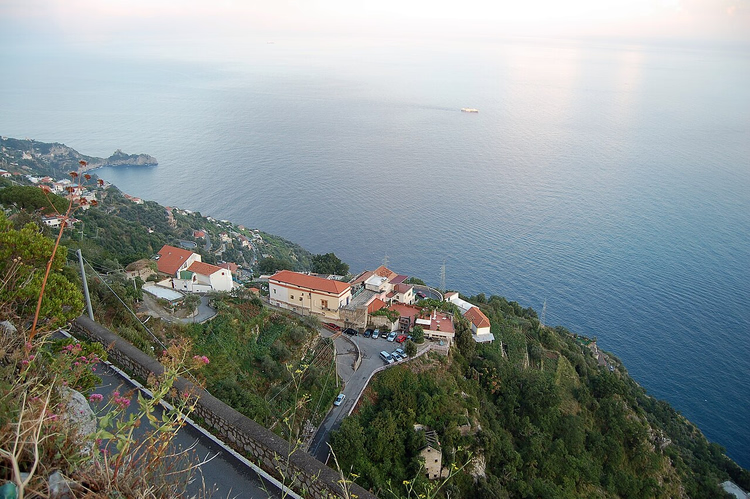
Furore is on the map of Italy, but the town itself is not there. The houses here are scattered across the cliffs rather than lined up along a street: the commune has about 810 residents, and some courtyards sit as high as 600 m above the sea (as of 09/2026, data from the I Borghi più belli d'Italia association). You will not find a typical piazza or waterfront here.
What you will find is the sea roaring below, and a 30 m high arch bridge hanging over the gorge (as of 09/2026, data from Amalfi Coast Travel). Two hundred steps lead down to the beach. We will tell you why Furore is called a "nonexistent" village, what to see in its painted walls, and how to reach the fjord without a car.
Ad: this article contains affiliate links, we earn a commission if you book through them, at no extra cost to you.
A village that is not on the map
💡 In short:
- Furore sits on the Amalfi Coast, between Amalfi and Positano.
- The main attraction: the Fiordo di Furore gorge with a free beach and a high arch bridge.
- The easiest way to get there is by SITA bus, the "Furore Fiordo" stop is right at the bridge.
Officially, Furore is listed as a commune, but you cannot really call it a town in the usual sense. The houses here do not stand in a row: they cling to rocky ledges and are scattered across the canyon slope. The village has no streets, squares, or "center," so you will find neither a waterfront nor a main street here.
That is exactly why Furore is called "the village that does not exist." From the sea, the settlement was long impossible to spot: the houses hid behind the rocks, and foreign ships sailed past without noticing it. Today, the houses scattered across the gorge have become the place's defining feature.
 © Michael Paraskevas · CC BY-SAPhoto: Michael Paraskevas, CC BY-SA (https://creativecommons.org/licenses/by-sa/3.0), Wikimedia Commons
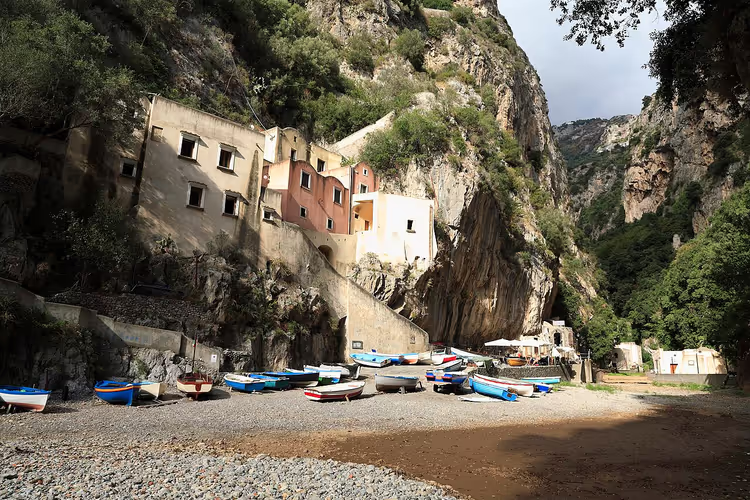
The canyon is divided into two parts. Down by the water stands the old fishing village, while residential Furore is spread higher up the slope. A winding road with hairpin turns connects them. This split creates the feeling that the village does not exist: you see individual houses, but not a unified town.
Another unusual corner of Italy: Gaiola, the cursed island.
How a fishing cove became Terra Furoris
The village's name comes from the old "Terra Furoris," meaning "land of fury" (as of 09/2026, website of the Borghi più belli d'Italia association). It was called that because of the roar of the sea water in the gorge. The first settlements here were founded by the Romans: in the late empire, fugitives fleeing from barbarians took refuge in these mountains. Because of the terrain, the handful of houses withstood even Saracen raids.
Back in the Middle Ages, the first settlement on the plateau formed around the church of San Giacomo. Later, Furore's history became part of the Republic of Amalfi. The fishing village by the fjord served as a shelter for boats: the sea is calmer in the cove, and fishermen could head into open water without being battered by waves.
Ruins are a reminder of the former economy. Inside the canyon, two old mills and two paper factories remain, which ran on water power (as of 09/2026, official portal of the association). Amalfi was the first in Europe to master paper production using Arab technology, and Furore was part of that system. Today the water is gone, but the walls of the buildings still stand.
 © Falk2 · CC BY-SAPhoto: Falk2, CC BY-SA (https://creativecommons.org/licenses/by-sa/4.0), Wikimedia Commons
Besides the factories, the village has four churches: San Giacomo, Sant'Elia, San Michele, and Santa Maria. Each has a painted bell tower dome, and in San Giacomo, frescoes from the school of Giotto have been uncovered. You can see them during a walk through upper Furore.
More about the country: Interesting facts about Italy.
Painted walls: why Furore is called the painted village
The village was painted by visiting artists. In 1980, Furore launched the "Muri d'Autore" project: since then, more than a hundred artist-designed walls, murals, and sculptures have appeared here (As of 09/2026, I Borghi più belli d'Italia). They are what turned Furore into a "painted village."
Every autumn, artists gather here for the "Muri in cerca d'Autore" event. Over several days, they paint the walls of residential houses, and the village becomes an open-air gallery.
The murals are unusual because artists paint directly on the walls of homes rather than in galleries. One of the most famous works greets visitors at the entrance to the village. The artists come from Italy and abroad, and a new wall is added here every year.
A walk through the murals takes about an hour. Start at the village entrance and climb up the stairways: you will see some of the works only from the viewing platforms. Wear comfortable shoes, the climbs here are steep.
The beach and Fiordo di Furore
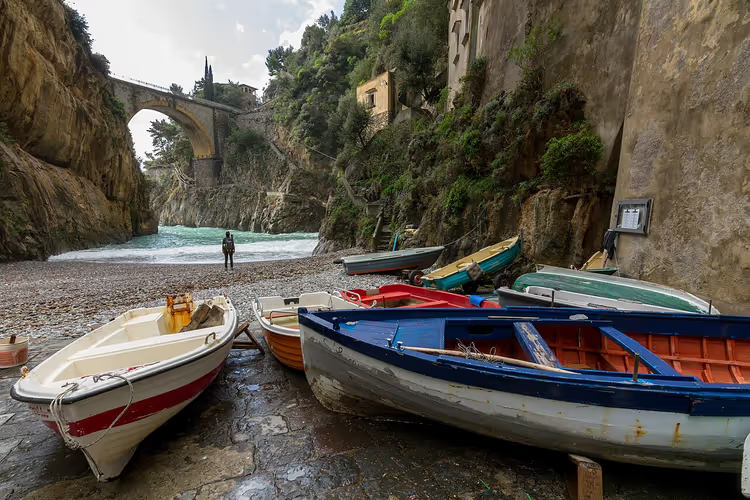
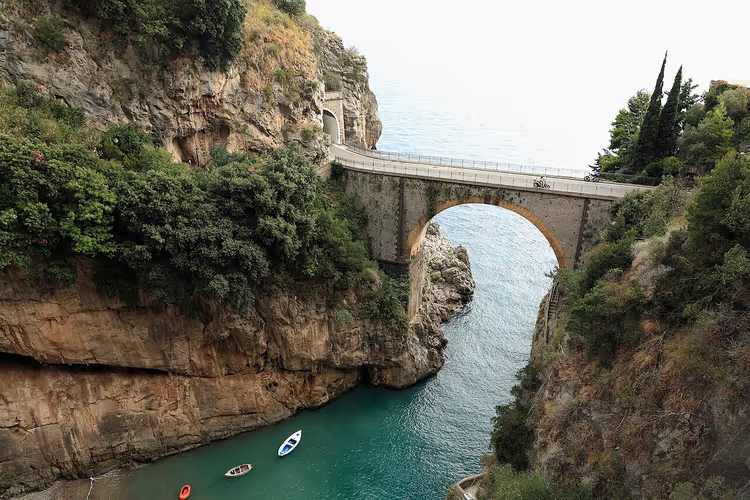
The most recognizable view on the coast: a narrow gorge with a beach under the bridge. Fiordo di Furore was formed by the Torrente Schiato stream: over millennia, it cut through the limestone and carried water to the sea. A narrow strip of pebble beach is hidden between the cliffs.
Beach access is free, but there are no facilities: no bar, no shower, no lounger rental (As of 09/2026, fjord overview on Amalfi Coast Travel). Bring water, food, and shoes for the rocks. Swimming is allowed, but the water here is cooler than on the open coast: the sun lights the bottom of the gorge for only a few hours a day.
Sunlight reaches the beach roughly from 11:00 to 14:30, about 3.5 hours a day (As of 09/2026, Amalfi Coast guide). By 11:30 the water turns turquoise, and photos come out best. Before and after that window, the fjord sits in shadow, and you will just be standing in the dark.
For snorkeling, there is plenty to see here: schools of sea bream stay near the underwater rocks, octopuses hide in the crevices, and the walls are covered with sea urchins. Bring a mask and fins. Because of the gorge's shape, the sound of waves reflects off the walls and turns into a deep echo.
 © Ugeorge · CC BY-SAPhoto: Ugeorge, CC BY-SA (https://creativecommons.org/licenses/by-sa/3.0), Wikimedia Commons
Bridge jumping: the MarMeeting competition
The bridge over the fjord has long been a platform for cliff diving. Every summer, usually in July or August, MarMeeting takes place here: an international high-diving competition (As of 09/2026, Amalfi Coast Travel). Athletes jump from 30 m above the water, and you can watch for free from the beach and the bridge.
The competition was born back in the 1970s and has only grown in popularity since.
Important: tourists are not allowed to jump from the bridge. The reason is the unpredictable currents at the entrance to the gorge, so jumping is permitted only for competition participants. View the bridge from above, and take the stairs down to the water.
 © Falk2 · CC BY-SAPhoto: Falk2, CC BY-SA (https://creativecommons.org/licenses/by-sa/4.0), Wikimedia Commons
How to get there and when to go
The easiest way to reach the fjord is by SITA bus on the Amalfi-Positano line. The stop is called "Furore Fiordo" and is right on the bridge (As of 09/2026, Amalfi Coast Travel transport guide). From Amalfi, the ride takes about 15-20 minutes, but in season the time depends on traffic.
By car or scooter, be prepared for a shortage of parking: there are few spots along the SS163, so arrive early in the morning. In July and August, free spaces near the bridge are gone by 9:30 (As of 09/2026, Amalfi Coast Travel guide). An alternative for those tired of the winding road: a water taxi from Amalfi or Praiano with direct access to the gorge.
The best time to visit: a weekday, reaching the beach by 11:00. The descent down 200 steps takes 10-15 minutes, and the climb back takes more effort, especially in the heat (As of 09/2026, Costa di Amalfi portal). Bring water and do not plan the climb for midday. Boat tours to the fjord on GetYourGuide will help you see the gorge from the sea if you do not want to climb the stairs.
Tours and tickets in Amalfi
Guided tours, skip-the-line tickets and activities — most offers can be cancelled free of charge.
See offers on GetYourGuideThe widget loads once you give your consent.
⁉️🤔 Frequently asked questions
Why is Furore called a village that doesn't exist?
The village has no typical center, square, or main street. The houses are scattered across the rocky ledges of the canyon, and from the sea they were hard to spot for a long time, so foreign ships sailed right past. That's how Furore got its nickname: "the village that doesn't exist."
How to get to Fiordo di Furore without a car?
Take the SITA bus on the Amalfi-Positano line and get off at the "Furore Fiordo" stop, right by the bridge. The ride from Amalfi takes less than half an hour. After that, you'll need to walk down a long staircase to the beach, and on the way back you'll face a climb uphill.
Can you swim in the fjord and how much does entry cost?
Swimming is allowed, and beach access is free. The water in the gorge is cooler than along the open coast because the sun only reaches it for a few hours a day. There are no facilities on the beach, so bring water, food, and shoes for the rocks.
What to see in the village of Furore itself?
Most visitors are drawn to the murals of the "Muri d'Autore" project: painted walls, murals, and sculptures throughout the village. It's also worth seeing the four churches with painted domes and the old paper mills in the gorge. Allow about an hour for the walk.
When is the best time to visit the fjord?
Pick a weekday and head down to the beach by 11:00. The sun lights up the bottom of the gorge until about 2:30 PM, after which the fjord falls into shadow.
In short: what's worth booking
Furore is best planned as a half-day stop. In the morning you go down to the fjord, swim in the cool water, and photograph the bridge, and in the afternoon you head up to the village to see the murals. The roads here are tight for cars, so the SITA bus or a boat is more convenient.
The sun only reaches the gorge from 11:00 to 2:30 PM, so plan your swim for that window.
- If you have one day: start with the fjord and the bridge, then the murals in the village.
- If you don't have a car: take the SITA bus to the "Furore Fiordo" stop.
- If you want to see the coast from the water: book a boat tour.
- If you have time: add the paper mills and churches on the upper slope.
Want to see the fjord from the sea, without stairs or buses? Compare boat tours on GetYourGuide.

A small editorial team writing guides for independent travel. We travel ourselves, but we haven’t been everywhere, so we check prices, opening hours and how to get there against official sources.