
















Angkor, Tonle Sap and Ta Prohm: 10 places in Cambodia worth traveling for
Cambodia rests on two pillars: the stone of Angkor and the water of Tonle Sap.
In a single trip you can see the largest religious complex on the planet and villages where schools, shops and hospitals stand directly on the water. The challenge is elsewhere: without a plan you lose days on transfers, and at the Angkor ticket office you stand in line.
We have put together ten places in Cambodia worth including in your itinerary. Here you will find ticket prices, distances, the season and honest catches.
A tour of the country of temples starts in Siem Reap. The city sits less than half an hour from Angkor Wat, and it is also home to markets, restaurants with Apsara shows and piers for Tonle Sap.
Ad: this article contains affiliate links, we earn a commission if you book through them, at no extra cost to you.
What attracts tourists to Cambodia
💡 In short:
- Buy the Angkor Pass online: there are few ticket offices in the park, and one ticket covers almost all Angkor temples.
- Stay in Siem Reap: from there you can reach both the temples and Tonle Sap lake in half an hour.
- Plan at least three days: the temples, floating villages and Apsara shows cannot fit into a single excursion.
- Logistics, season and distances: As of 09/2026, according to the official tourism portal of Cambodia.
Warm seas, the sandy south and coconut-milk cuisine keep a second stream of tourists here. But most people come for the temples of Angkor.
 © Luca Nebuloni · CC BYPhoto: Luca Nebuloni, CC BY (https://creativecommons.org/licenses/by/2.0), Wikimedia Commons
1. Angkor Wat
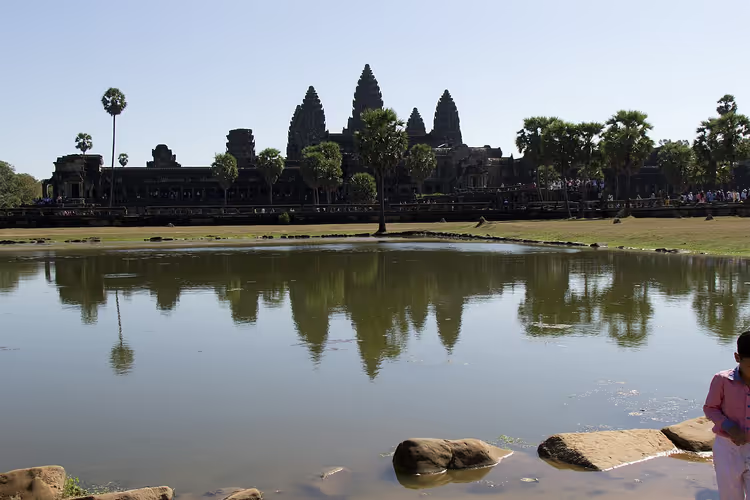
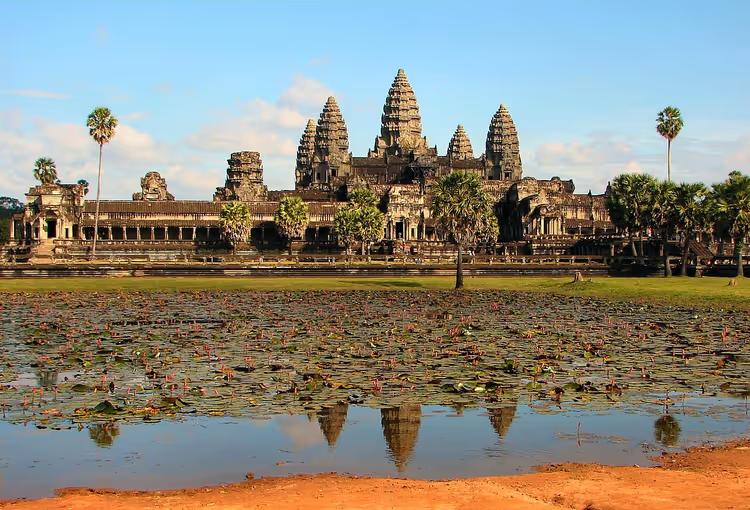
Angkor Wat was built in the twelfth century as the state temple of the Khmer Empire. Today it is the country's most recognizable structure and a UNESCO World Heritage site.
 © Bjørn Christian Tørrissen · CC BY-SAPhoto: Bjørn Christian Tørrissen, CC BY-SA (https://creativecommons.org/licenses/by-sa/4.0), Wikimedia Commons
From the western pond the temple is visible in full. Five towers rise above the wall, and long galleries stretch into the jungle. Come at dawn, before the tuk-tuks bring the groups.
Inside, the walls are covered with bas-reliefs depicting scenes from the epic. The reward awaits you on the upper level of Bakan: the line there is short only in the morning, and from the height you can see the entire complex and the surrounding forest.
- Who it's for: you want to see the country's main temple first and are willing to get up before dawn for it.
- The catch: in high season large groups gather at the western entrance, and after sunrise the sun hits you right in the eyes.
2. Bayon Temple
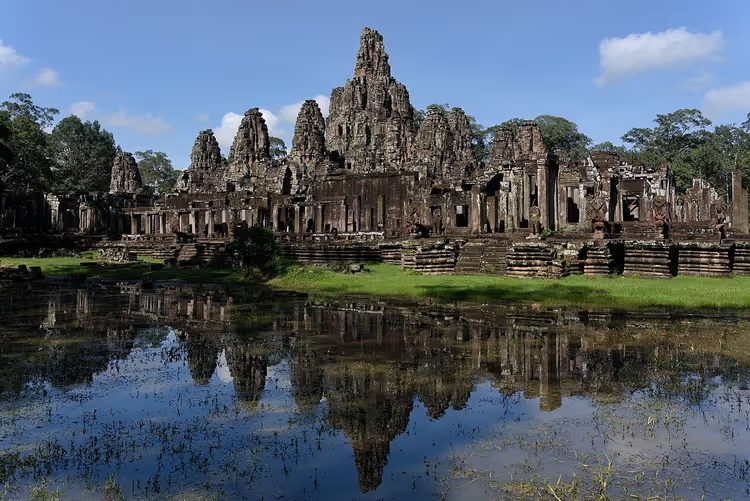
Bayon stands in the center of Angkor Thom and is considered the second most famous temple in the park. It was built in the same twelfth century and dedicated to Buddha.
 © Satdeep Gill · CC BY-SAPhoto: Satdeep Gill, CC BY-SA (https://creativecommons.org/licenses/by-sa/4.0), Wikimedia Commons
Bayon's main feature: towers with stone faces. They were carved on all four sides, so from any point you are looking at a dozen calm smiles at once. During the day the edges cast deep shadows, and the portraits of the faces look three-dimensional.
Inside there are three levels and wide terraces where it is easy to separate from another group. The lower level is walked around in a circle, and the upper level is reached by a narrow staircase.
- Who it's for: you care about the details of the carving, not the size of the structure.
- The catch: the central Buddha statue has not survived, only fragments remain.
3. Ta Prohm Temple
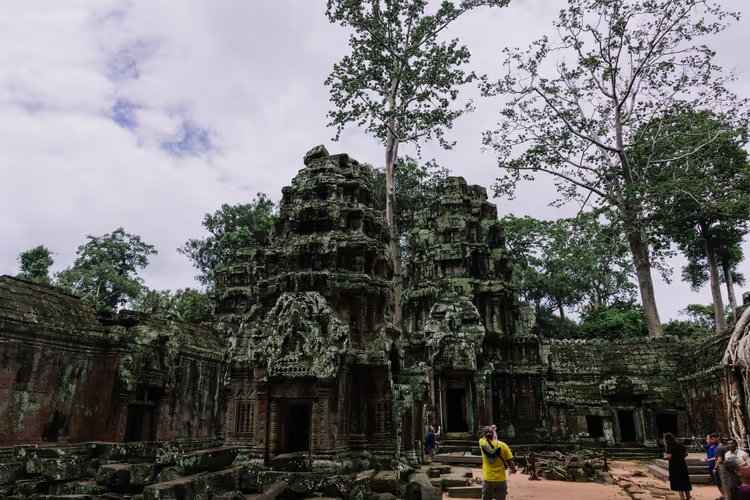
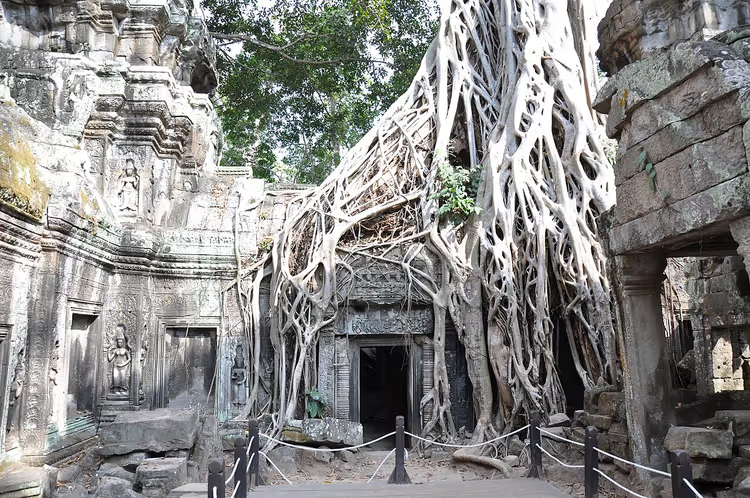
Ta Prohm looks as if it was abandoned yesterday. Tree trunks have wrapped around the galleries and hold the stone from collapse.
 © Jorge Láscar from Australia · CC BYPhoto: Jorge Láscar from Australia, CC BY (https://creativecommons.org/licenses/by/2.0), Wikimedia Commons
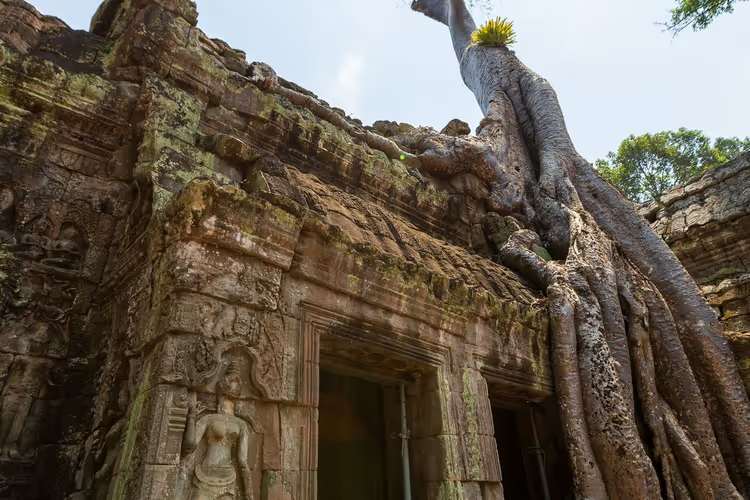
The temple was discovered in the twentieth century and is deliberately not cleared of jungle. The roots have become a frame for the stone, so along the narrow passages you walk between trunks and gaps in the roof. This is where some scenes from the Lara Croft film were shot, and in earlier centuries the monastery ran a school for novices.
- Who it's for: you take photos and want shots where greenery and stone have blended into one.
- The catch: after midday it gets crowded here, and some galleries are closed off with wooden walkways.
4. Angkor Thom City
Angkor Thom was the capital of the Khmer Empire. The first stones were laid in the twelfth century, and at its peak more than a million people lived here.
 © Marcin Konsek · CC BY-SAPhoto: Marcin Konsek, CC BY-SA (https://creativecommons.org/licenses/by-sa/4.0), Wikimedia Commons
Inside, temples and monasteries dedicated to Buddha have survived. After long wars with the Thais, the city was abandoned. The first Europeans to visit were the Portuguese in the sixteenth century.
It's convenient to plan your visit around the central square: Bayon and both terraces stand next to each other. The city gates are about 1.5 km from the square. You walk around the city in a loop and hardly ever backtrack.
- Who it's for: you're interested not in a single structure, but in an entire ancient city.
- The catch: the area is huge, you walk around the center on foot, and you take a tuk-tuk to the gates and the more distant temples.
5. Terrace of the Leper King
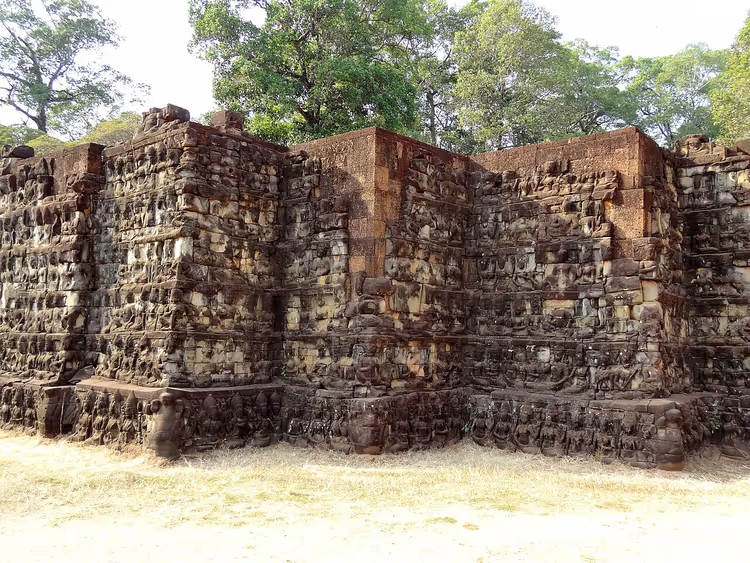
The terrace got its name from French researchers. According to the main theory, thick moss covered the king's statue, and from a distance it looked like diseased skin.
 © Olaf Tausch · CC BYPhoto: Olaf Tausch, CC BY (https://creativecommons.org/licenses/by/3.0), Wikimedia Commons
Cambodian scholars debate the figure's origin. According to one theory, the statue depicts not a king, but an ancient god of death, and the terrace itself served as a crematorium.
The terrace walls are covered with carved sea gods, animals, and nagas. Walk around it slowly: details hide in the shadows and reveal themselves only up close.
- Who it's for: you enjoy deciphering details and don't rush from one site to the next.
- The catch: there is still no reliable explanation for the name, and guides with a detailed story are rare here.
6. Terrace of the Elephants
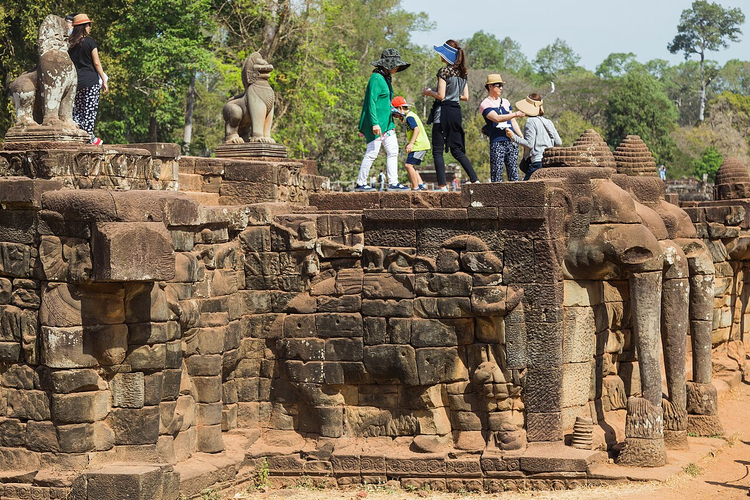
The terrace served as a reviewing stand for the army of King Jayavarman VII. According to legend, it was dedicated to war elephants, and parades on the square drew thousands of spectators.
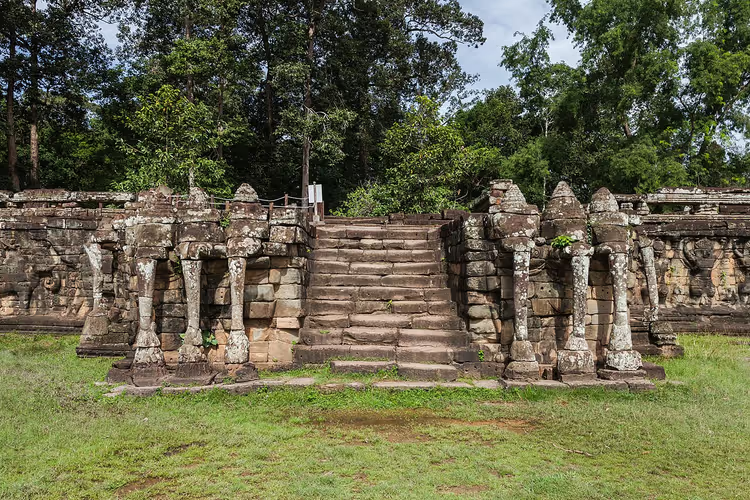 © Diego Delso · CC BY-SAPhoto: Diego Delso, CC BY-SA (https://creativecommons.org/licenses/by-sa/3.0), Wikimedia Commons
The terrace got its name later: the walls are decorated with statues and bas-reliefs of elephants almost life-size. From here you get a view of the square and the neighboring king's terrace.
- Who it's for: you're walking through the center of Angkor Thom on foot and want a short stop with a good view.
- The catch: photos depend on the weather and the angle; at midday the light makes the bas-reliefs look flat.
7. Tonle Sap Lake
Tonle Sap is considered the largest freshwater lake in Southeast Asia. In the dry season it shrinks to a narrow strip of water, and when the rains come it spreads for many kilometers and rises by about ten meters.
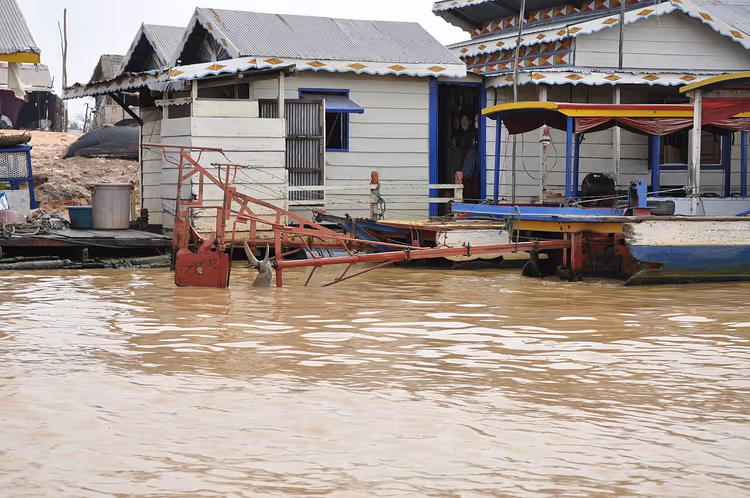 © Jorge Láscar from Australia · CC BYPhoto: Jorge Láscar from Australia, CC BY (https://creativecommons.org/licenses/by/2.0), Wikimedia Commons
The murky water is home to large fish, and locals make their living from fishing. Part of the catch goes to food, part to sale, and part to livestock feed.
- The catch: in the dry season the shore looks modest, and the lake doesn't make the impression it does in rainy season photos.
8. Floating villages
Houses here stand on rafts and stilts, and all of life is tied to the water. A school, shops, a hospital, and even a sports field are built on pontoons.
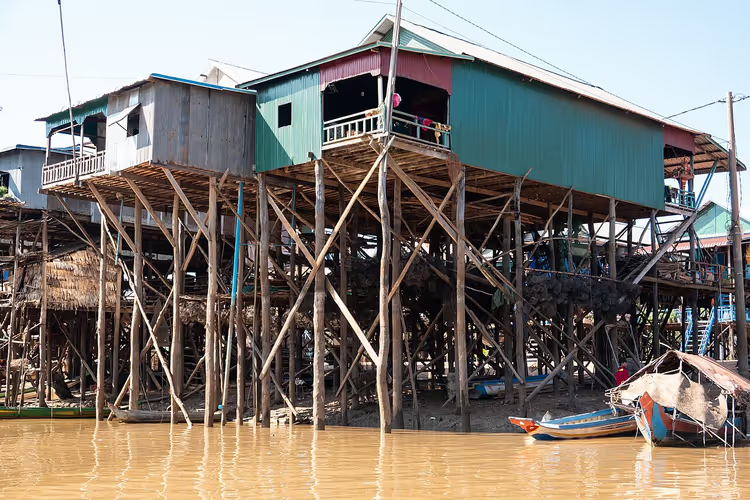 © PsamatheM · CC BY-SAPhoto: PsamatheM, CC BY-SA (https://creativecommons.org/licenses/by-sa/4.0), Wikimedia Commons
In the floating village of Chong Kneas, houses stand on rafts. In the dry season they rest on the muddy bottom, and when the water comes they rise with it. In the stilt village of Kampong Phluk, houses stand on tall stilts and don't move all year round.
Boats with guides wait at the piers, and it's best to fix the price before boarding. A private boat costs more than a group tour; the size of your party directly affects the price.
- Who it's for: you want to see life on the water, not just temples.
- The catch: the water level changes the whole picture, and in the dry season a stilt village looks different from the promotional photos.
9. Cambodia's national parks
The country has more than twenty national parks, and the closest to the Angkor temples is Phnom Kulen. It occupies a plateau above the jungle and is convenient for a day trip.
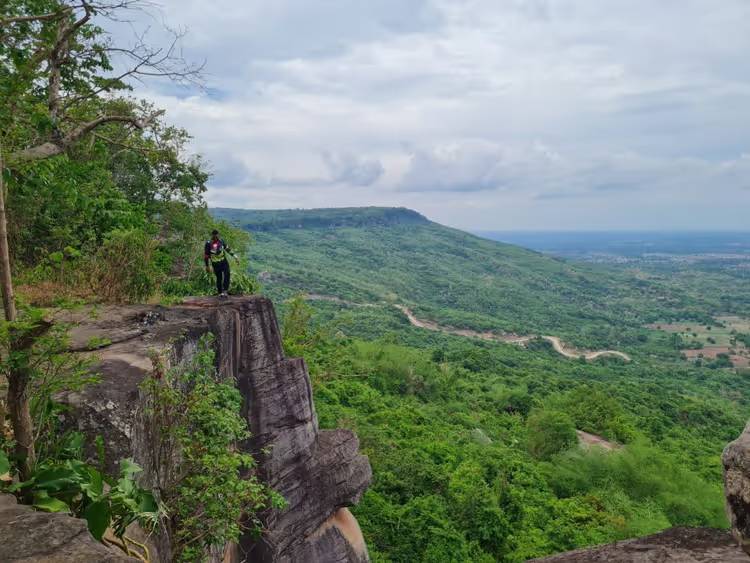
Bokor National Park is interesting for its tropical plants and old French buildings on the plateau. Kirirom is chosen as a short outing from Phnom Penh, and Ream combines forest with a sea coast.
Virachey in the northeast of the country is visited for multi-day treks and rare wildlife. You need a separate route to get there, and one stop isn't enough.
- Who it's for: you're willing to trade a day by the pool for forest and viewpoints.
- The catch: most parks can't be seen in half a day, the drive takes hours, and infrastructure is basic.
10. Apsara show
The apsara dance is believed to have come from the heavens, and in ancient times dancers were elevated to the rank of goddesses. The tradition was only reassembled in the twentieth century.
 © shankar s. from Dubai, united arab emirates · CC BYPhoto: shankar s. from Dubai, united arab emirates, CC BY (https://creativecommons.org/licenses/by/2.0), Wikimedia Commons
Today many Siem Reap restaurants stage an evening program. You have dinner at your table and watch several dances to live music, and the basics of the dance are also taught in local schools.
- Who it's for: you want an evening without travel, with dinner and a short immersion in the culture.
- The catch: it's a restaurant show for tourists, not an academic theater performance.
Tickets, hours and transport
You buy one ticket for the entire archaeological park complex. Prices for 2026: $37 for one day, $62 for three days and $72 for a week. The three-day pass is valid for ten days, the weekly pass for thirty days from the first entry (as of 09/2026, official Angkor Enterprise website).
Site | Included in Angkor Pass | Separate ticket |
|---|---|---|
Angkor Wat | yes | no |
Bayon | yes | no |
Ta Prohm | yes | no |
Angkor Thom and the terraces | yes | no |
Phnom Kulen | no | yes |
Beng Mealea | no | yes |
Koh Ker | no | yes |
From Siem Reap to the park, a tuk-tuk or a car with a driver takes you there. This option is more convenient than renting a car: you get more done in a day and don't need to look for parking.
Tours and tickets in Siem Reap
Guided tours, skip-the-line tickets and activities — most offers can be cancelled free of charge.
See offers on GetYourGuideThe widget loads once you give your consent.
⁉️🤔 Frequently asked questions
How many days should you set aside for Cambodia?
At least three days if you want to see both the temples and the water. In that time you can cover the small circuit of Angkor, take a trip to the floating villages and leave an evening for a show. Five days is enough to add a national park or the south of the country without rushing.
Do you need to buy a ticket for each temple separately?
No. One Angkor Pass covers Angkor Wat, Bayon, Ta Prohm, Angkor Thom and the terraces. Entry to Phnom Kulen, Beng Mealea and Koh Ker is sold separately, so plan those in advance and don't mix them with the main park sites.
When is the best time to visit Cambodia?
The dry season from November to March gives you clear skies and smooth roads to the temples. In the rainy season, water returns to the floating villages, and downpours come in short waves. For the temples, go early in the morning; walking on stone in the midday heat is tough.
How do you get to the floating villages?
From Siem Reap, a car takes you to the pier, and from there the route continues by water. A private boat is more convenient for a small group, and you should agree on the price before boarding. In the dry season, part of the route goes over mud rather than water.
Is the Apsara show worth going to?
If you have a free evening, yes. The program is short, with dinner and live music, and it explains the motifs you see during the day on the bas-reliefs of Angkor. Expect a restaurant format: the stage is set up for tourists, and that's the whole point of such evenings.
In short: what to book
If you have three days, get a three-day Angkor Pass and a hotel in Siem Reap so you don't waste your morning on travel. If you want to see the water, add a group tour to the floating villages. If you're traveling with kids, leave an evening for the Apsara show: it has dinner and a short program without a long journey.
Compare hotel prices in Siem Reap on Trip.com, tours and tickets on GetYourGuide and eSIMs for Cambodia before you fly. That way you'll have your accommodation, excursions and connectivity sorted in advance.

A small editorial team writing guides for independent travel. We travel ourselves, but we haven’t been everywhere, so we check prices, opening hours and how to get there against official sources.