
















Royal Palace of Madrid: tickets, hours and what to see
Ticket to the Royal Palace in Madrid costs 18 € (as of 09/2026, official website). In Spanish it is called Palacio Real de Madrid. Today it is the official residence of the Spanish crown and a museum where 50 rooms are open to you.
The royal family has not lived here since 1931. The palace serves as a venue for state receptions, so individual rooms are sometimes closed for ceremonies. In high season there are long lines at the entrance, and it is better to book a time slot in advance.
The palace is open almost every day, but it is closed on public holidays. Below you will find current prices, opening hours, the history of the rooms, and the route from Ópera metro station.
Ad: this article contains affiliate links. We earn a commission if you book through them, at no extra cost to you.
The palace at a glance
💡 In short:
- Ticket 18 €, discounts and free admission are described in the tickets section (as of 09/2026, Patrimonio Nacional ticket page).
- Entry is by time slot, the ticket office closes one hour before the end of the day.
- Ópera metro station (lines 2 and 5) is a 5-minute walk from the entrance.
- Prices and opening hours: 09/2026, verified on the official website.
History of the building
The first predecessor of the palace was a 9th-century Moorish fortress. The emirs of Córdoba built it in the settlement of Majirit, the future Madrid, to defend against Christian raids. You will see this site on the western edge of the old town.
In the 16th century, under the Habsburgs, the fortress was rebuilt into the Alcázar (Antiguo Alcázar). In 1561, Philip II moved the capital of Spain here. The dynasty lived in the Alcázar until 1734, when the building was destroyed by fire (as of 09/2026, Patrimonio Nacional).
In 1738, construction began on the site of the burned-down castle for a new palace for Philip V of the Bourbon dynasty. The king grew up at Versailles and wanted to surpass his grandfather's residence. Construction took 27 years and was completed in 1764 (as of 09/2026, official palace website).
Philip V did not live to see it. The first monarch to reside in the palace was Charles III. Interior decoration and park landscaping continued into the 20th century.
Architecture
 © Tim Adams · CC BY-SAPhoto: Tim Adams, CC BY-SA (https://creativecommons.org/licenses/by-sa/4.0), Wikimedia Commons
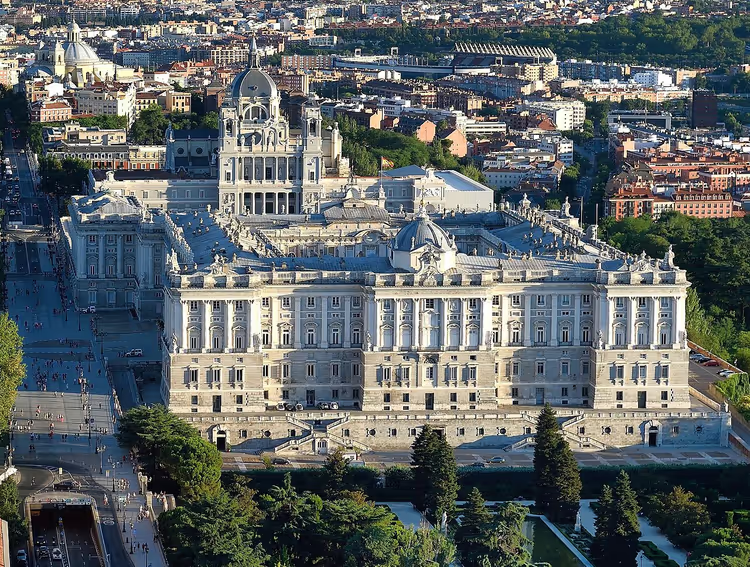
The late Italian Baroque design was prepared by Filippo Juvarra. He did not live to see construction begin: the architect died in 1736. The project was carried out by two of his countrymen, Giovanni Battista Sacchetti and Francesco Sabatini.
Take note of the scale. The palace covers 135,000 m² and stands 33 meters tall. Inside there are more than 3,000 rooms, 870 windows, 240 balconies, 110 doors, and 47 staircases (as of 09/2026, Patrimonio Nacional). In plan, the building forms a square with 130-meter sides.
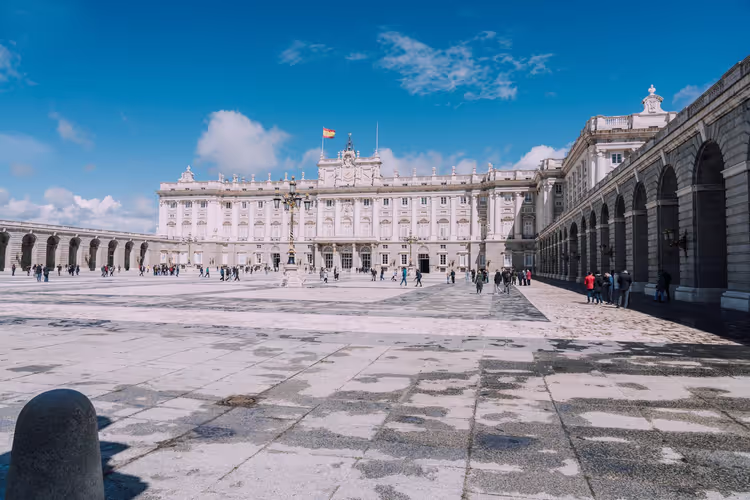
Inside the square is a spacious courtyard. It is surrounded by a gallery with numerous arches, and it is worth a look before you leave. Wood was almost entirely avoided in the construction due to fire concerns.
The walls are built of white stone and gray granite, with marble used in the finishes. The facade features Doric and Ionic pilasters, statues of crowned figures, and elegant balconies. The upper part of the facade is framed by a relief cornice with a balustrade.
The main entrance is on the south facade. Above it is an attic story with the Bourbon coat of arms and the sculpture "Triumph of Spain," with a tower clock below. In front of the entrance lies Plaza de la Armería with gilded lampposts. This is where you will see the ceremonial changing of the guard.
Interior and state rooms
 © Harvey Barrison from Massapequa, NY, USA · CC BY-SAPhoto: Harvey Barrison from Massapequa, NY, USA, CC BY-SA (https://creativecommons.org/licenses/by-sa/2.0), Wikimedia Commons
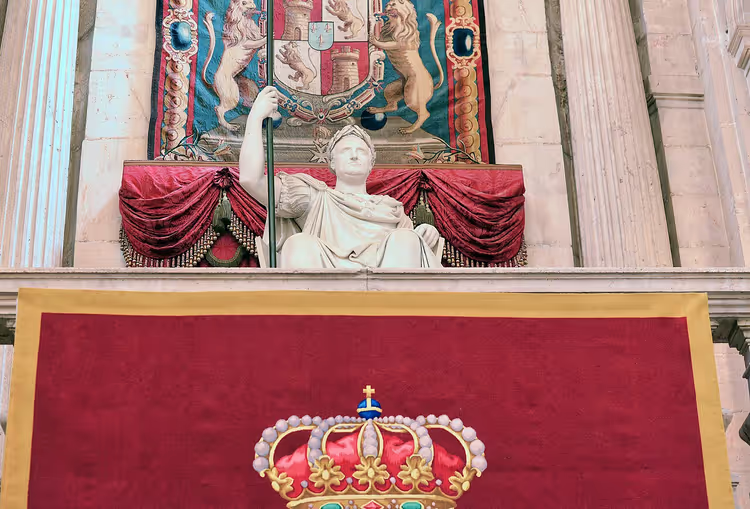
You are greeted by a grand marble staircase designed by Francesco Sabatini. Opposite stands a statue of Charles III in armor. The halls are decorated with frescoes by Flemish, Venetian, and Spanish masters, crystal chandeliers, mirrors, candelabra, and furniture in Empire and Rococo styles.
The Throne Room is also called the Hall of Ambassadors. Embassy delegations were received here, and today two gilded 18th-century thrones stand on a raised platform. They are surrounded by four bronze lions, and the ceiling was painted by the Venetian Giovanni Battista Tiepolo. The walls are upholstered in red and gold velvet, and the silver chandeliers are considered the most beautiful in the palace. Caravaggio's "Salome with the Head of John the Baptist" also hangs here.
The Porcelain Room is decorated with light green ceramic panels. They realistically depict wreaths, goblets, and garlands. In the Gasparini Room, the walls are covered in light silvery silk with floral ornamentation. The ceiling was painted by the German master Anton Raphael Mengs, and a portrait of Charles IV by Francisco Goya hangs here as well.
The Dining Room was built for banquets: more than 140 people could be seated at the long table. The interior features tapestries by 16th-century Flemish artists, frescoes by Antonio Vázquez, and 17th-century Chinese vases.
Museum treasures
 © Dmitry Dzhus from London · CC BYPhoto: Dmitry Dzhus from London, CC BY (https://creativecommons.org/licenses/by/2.0), Wikimedia Commons
The palace houses relics of the Spanish crown. Among the paintings and frescoes you will find works by Caravaggio, Francisco Goya, Diego Velázquez, and Giovanni Battista Tiepolo.
The Royal Armory (Real Armería) holds weapons and armor from the Middle Ages to the 19th century, including armor of Charles V, Philip IV, and Maximilian I. Nearby, the monarchs' jewelry is on display: tiaras and pendants with diamonds, emeralds, and topazes, as well as a crown and scepter with a crystal orb.
A separate collection is dedicated to the 18th-century court pharmacy. It preserves recipes, glass and porcelain vessels, herbaria, and a laboratory for making medicines. In total, the palace has more than 700 clocks, many of which play melodies. Music lovers will see string instruments from the Stradivari workshop, and the library occupies 24 rooms.
Gardens and parks around the palace
 © r0x sm · CC BY-SAPhoto: r0x sm, CC BY-SA (https://creativecommons.org/licenses/by-sa/2.0), Wikimedia Commons
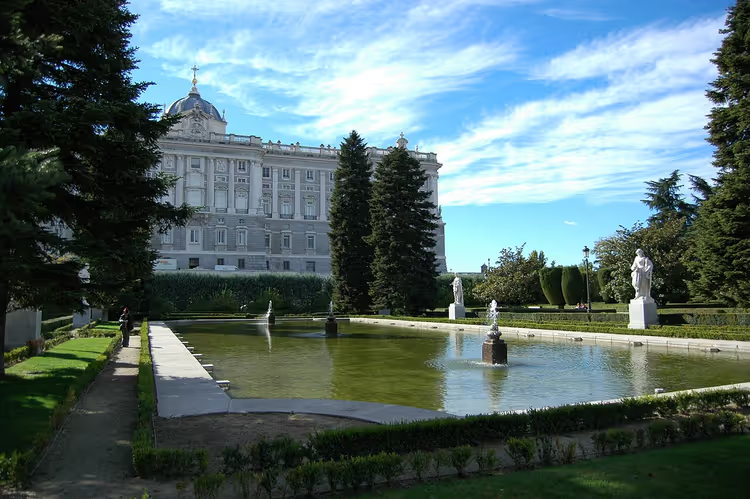
On the north side, a wide staircase descends into Jardines de Sabatini. The 2.5-hectare garden was laid out in 1933 on the site of the royal stables, based on a design by F. Mercadel. At its center lies a rectangular pond with mirror-like water, white statues of monarchs stand along the perimeter, and boxwood labyrinths surround the area. The garden opened to visitors in 1978.
To the west, Campo del Moro descends toward the Manzanares River, covering more than 20 hectares. The name recalls the Moorish camp that stood here in the 12th century. The park design was prepared by Narciso Pascual Colomer and carried out by Ramón Oliva. Royal children strolled here from 1844, and the park took its modern form by 1890.
Campo del Moro is home to centuries-old trees, palms, cedars, sequoias, and cypresses. Peacocks roam the lawns, and swans swim in the pond. Campo del Moro is open daily, and admission to both gardens is free (as of 09/2026, gardens page).
Tickets and opening hours
General admission to the halls costs €18, but discounts are available. Children aged 5 to 16, visitors over 65, and students up to age 25 pay €9. Children under 5 enter free (as of 09/2026, official tickets page).
Ticket type | Price | Who it's for |
|---|---|---|
General admission | €18 | adults without discounts |
Reduced | €9 | children 5-16, visitors 65+, students up to 25 |
Free | €0 | children under 5, May 18 |
Combo: palace and Galería de las Colecciones Reales | €24 | any visitor |
Opening hours depend on the season:
Season | Monday-Saturday | Sunday |
|---|---|---|
October-March | 10:00-18:00 | 10:00-16:00 |
April-September | 10:00-19:00 | 10:00-16:00 |
The ticket office and entrance close one hour before closing time. In 2026, the palace is fully closed on January 1 and 6, May 1, and December 25; on December 24 and 31 it is open until 15:00 (as of 09/2026, Patrimonio Nacional).
There are also free hours. Monday through Thursday from 17:00 to 19:00 (in winter from 16:00 to 18:00), you can enter without a ticket if you hold EU or Ibero-American citizenship. You will need a passport, and tickets are issued only at the ticket office.
It is more convenient to book tickets in advance by time slot. If you want a guide to take you through the palace and the city, check out Royal Palace tours.
Tours and tickets in Royal Palace of Madrid
Guided tours, skip-the-line tickets and activities — most offers can be cancelled free of charge.
See offers on TiqetsThe widget loads once you give your consent.
How to get to the palace
The palace stands on Plaza de Oriente, at calle de Bailén. Since August 20, individual visitors and groups enter through the esplanade by the Almudena Cathedral toward plaza de la Armería (as of 09/2026, entrance information).
The easiest way is to take the metro to Ópera station, lines 2 and 5. From there you can walk in about 5 minutes. Buses 3, 25, 39, and 148 stop nearby, at San Quintín. For Cercanías trains, the closest station is Príncipe Pío.
If you are coming straight from the airport with luggage, check Madrid airport transfers in advance.
Changing of the guard at the palace
On Wednesdays and Saturdays, the changing of the guard takes place at Puerta del Príncipe. Two foot guards and two mounted guards in ceremonial blue, white, and red uniforms are relieved every 30 minutes, while a drummer and a flutist play marches. It is free to watch (as of 09/2026, Madrid tourist office).
Times vary by season. For most of the year, the ceremony runs from 11:00 to 14:00, and in July and August from 10:00 to 12:00. It is canceled on days of official events and in bad weather, so check the website on the day of your visit.
Once a month, the solemn Relevo Solemne is held. It takes place on the first Wednesday of the month, except January, August, and September, at 12:00 and lasts about 50 minutes. The nearest date at the time of checking: October 7, 2026.
Royal Palace on the map
The palace faces Plaza de Oriente, next to the Almudena Cathedral. For a GPS, enter calle de Bailén, Madrid. Below is an interactive map with a marker.
⁉️🤔 Frequently asked questions
How much does a ticket to the Royal Palace in Madrid cost?
An adult ticket costs 18 €, a reduced ticket 9 € (as of 09/2026, Patrimonio Nacional price list). All reduced categories and the combined ticket are listed in the tickets section. The audio guide costs extra.
When can you visit the palace for free?
EU and Ibero-American citizens can enter for free in the evening hours from Monday to Thursday (as of 09/2026, free entry rules). Exact times by season are listed in the tickets section. Another free day is May 18, International Museum Day.
What days is the palace closed?
In 2026, the palace is fully closed on January 1 and 6, May 1, and December 25. On December 24 and 31, it is open until 15:00, and the ticket office closes at 14:00 (as of 09/2026, 2026 opening hours). Additional closures happen due to official ceremonies, so check the website on the day of your visit.
How long does a visit take?
A self-guided walk through the rooms takes about 45 minutes, according to the official website (as of 09/2026, tickets page). With the audio guide and the Royal Armory, most visitors spend one and a half to two hours. Arrive at opening time, and you will have the Throne Room almost to yourself.
When can you see the changing of the guard?
The changing of the guard takes place on Wednesdays and Saturdays at Puerta del Príncipe (as of 09/2026, esmadrid.com listings). Times depend on the season and are listed in the changing of the guard section. The solemn Relevo Solemne takes place once a month, on the first Wednesday.
Can you take photos inside?
Flash-free photography for personal use is allowed almost everywhere, except in certain rooms (as of 09/2026, photography rules). Tripods and selfie sticks are not allowed. Respect the privacy of other visitors and staff, and keep the flash off.
In short: what to book
If this is your first time in Madrid, book a morning slot: the rooms are less crowded before noon. Families with children can use the reduced tickets from the prices section.
Want to see the crown collections too? Pay the extra for the 24 € combined ticket with the Galería de las Colecciones Reales. If you are planning several days in the city, put the changing of the guard on a Wednesday, and leave Jardines de Sabatini and Campo del Moro for the evening: entry to them is free.
It’s more convenient to stay near Plaza de Oriente so you can walk to the palace: hotels in central Madrid on Trip.com.

A small editorial team writing guides for independent travel. We travel ourselves, but we haven’t been everywhere, so we check prices, opening hours and how to get there against official sources.