










Georgia 2026: real trip budget and where costs rose
Prices for Georgia online are outdated. Half the articles still cite 2019 figures, and since then Tbilisi has seen an influx of relocants and a noticeable rise in rent. We gathered prices for flights, accommodation, food, transport, and the new mandatory insurance, converted them into benchmarks using the official exchange rate as of 09/2026, and you can use them to calculate a weekly budget.
Ad: this article contains affiliate links, we earn a commission if you book through them, at no extra cost to you.
Georgia in a nutshell
💡 In short: Georgia remains an affordable destination, but the savings now come from food, transport, and free churches, not from accommodation.
- Budget from €25 per person per day in a hostel and from €120 in a comfortable option.
- In Tbilisi, accommodation is the biggest expense, not restaurants or tours.
- Check the exchange rate yourself before the trip: €1 ≈ 3.03 lari (as of 10.09.2026, official rate of the National Bank of Georgia).
- Prices and entry rules: 09/2026, verified on the Tbilisi city transport website and in the US Embassy in Tbilisi guidance.
Parameter | As of |
|---|---|
Population | about 3.9 million people (National Statistics Office of Georgia) |
Area | 69,700 km², about 57,200 km² under Tbilisi's control (official tourism portal of Georgia) |
Capital | Tbilisi, about 1.2 million residents |
Highest point | Mount Shkhara, 5,201 m (tourism portal of Georgia) |
Currency | Georgian lari (GEL), 1 lari = 100 tetri |
Exchange rate | €1 ≈ 3.03 lari (10.09.2026, National Bank of Georgia) |
Language | Georgian, with its own script and alphabet |
Time zone | UTC+4, two hours ahead of Germany in summer |
Entry | visa-free for almost a year, insurance mandatory from 01.01.2026 (embassy notice) |
Climate | four seasons: hot summers and cold winters |
The exchange rate makes calculations much easier. Divide the price in lari by three and you get euros, so you will barely need a calculator on the trip. The harder part is something else: old blogs still treat Georgia as cheap out of habit, and that logic no longer works for accommodation.
The season adds its own line to the budget. Tbilisi is hot in summer, the mountains are cold in winter, and both major expense categories, flights and hotel nights, depend on the month. If you come in July, be ready to pay at the upper end, while in November the same rooms cost noticeably less. Below we go step by step from flights to tips.
Short answer: how much a day in Georgia costs
Excluding flights, the daily budget splits into three ranges, and the difference between them is almost entirely in accommodation.
- Budget option, from €25 to €40. Hostel bed, local food, marshrutkas instead of taxis, minimal paid tours.
- Mid-range option, from €50 to €80. Your own apartment or a solid hotel, two restaurant meals a day, Bolt instead of long walks, one or two day trips outside the city per week.
- Comfortable option, from €120. A good hotel in the center, international restaurants, a private driver for excursions.
It is easier to think in shares. With a short apartment rental, accommodation takes about half of the daily budget, food another quarter, and the rest goes to transport, tickets, and souvenirs. In a hostel the proportion shifts: accommodation drops to a third, and food becomes the main expense.
What affects the final total most is not the country, but your choice of neighborhood and accommodation type. Below we break down each category separately, and in the budgets section we combine them into one table.
Flights to Georgia: what the journey costs
From Germany, flights go to three airports: Tbilisi (TBS), Kutaisi (KUT), and Batumi (BUS). The ticket price depends more on the arrival point than on the day of purchase.
Tbilisi handles most international flights, and direct flights from Berlin, Munich, and Frankfurt are operated by Wizz Air and Lufthansa (airports and destinations on the tourism portal of Georgia). The flight from Berlin takes about four hours. A round-trip ticket from Germany usually costs several hundred euros and depends heavily on the season: noticeably cheaper in November and more expensive in July.
Kutaisi serves as a Wizz Air base, and tickets here are often cheaper than to Tbilisi, dropping even lower during sales. However, the airport lies 230 km west of Tbilisi. The trip to the capital takes three to four hours and by bus or marshrutka usually costs around €10, depending on the carrier. If you are planning to visit the western part of the country, meaning Batumi, Svaneti, or Kutaisi itself, the airport is convenient. If you need Tbilisi, calculate the transfer in advance so the cheap ticket does not disappoint you.
The third airport, Batumi, receives seasonal flights and suits those heading to the Black Sea. From here it is easy to reach Kobuleti and Batumi itself, while a trip to Tbilisi takes about five hours by rail or marshrutka.
Compare dates before you buy. The difference between Tuesday and Friday sometimes reaches a hundred euros, and a flexible schedule saves you more than any sale. Before buying, compare direct flights and options with a layover: find flights to Tbilisi on Kiwi.com.
How to get from Tbilisi airport
Bus 337 runs from the terminal to the city center, the ticket costs 1 lari and gives you 90 minutes of free transfers to city transport (as of 09/2026, Tbilisi Transport Company fares). A taxi or Bolt costs about 12 €, the price depends on demand and time of day. With a suitcase and after a night flight, you will most likely choose a car. With a backpack, the bus saves you about 12 € for half an hour of travel.
Accommodation: the biggest expense
This is where old guidebooks are most wrong. A week in a good apartment in central Tbilisi costs almost as much as a month of rent for a local resident, and this is the main reason Georgia no longer looks like a cheap country.
A one-bedroom apartment in the center long-term costs about 1,800 lari per month, or about 600 € (based on user data from Numbeo, 09/2026). Short-term rental of the same apartment costs about 50-80 € per night depending on the season. The three- to four-fold gap is that very "invisible" tourist surcharge.
What else the market offers (benchmarks, prices depend on season and area):
Type of accommodation | Price per night |
|---|---|
Hostel bed, dorm room | about 5-15 € |
Simple hotel or guesthouse, double room | about 25-40 € |
Apartment in central Tbilisi | about 50-80 € |
Good mid-range hotel in the center | about 60-100 € |
Prices for specific dates are easier to check directly in search: compare hotel prices in Tbilisi on Trip.com. Check the neighborhood, not just the stars: in Tbilisi, 300 m to the metro changes your daily logistics more than the view from the window.
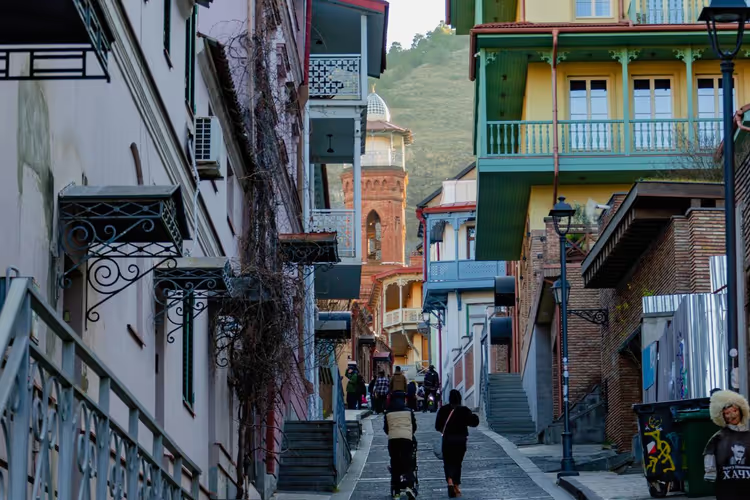
The neighborhood matters more than the category. Sololaki and Abanotubani are close to the old town and the thermal baths, Vake is quieter and greener, Saburtalo is cheaper and connected to the center by metro. The difference between two apartments in the same block can be noticeable, so look at the map, not just the photos.
Outside the capital, accommodation gets cheaper. In Kutaisi, Kakheti, or mountain villages, a guesthouse with breakfast usually costs from ~10 € per person. Batumi in July and August is more expensive than Tbilisi, but in winter the city half empties out, and prices fall along with the flow of vacationers.
In Svaneti and other mountain areas, choose your guesthouse more carefully. Winters there are cold, and not every house has heating, so clarify this point before booking, not upon arrival.
Hack for long trips: if you are staying longer than two weeks, ask for the monthly price directly. The gap between the weekly and monthly rate in Tbilisi is larger than in most cities, because the market is geared toward long-term rentals.
Food and drinks: where the money goes
Food in Georgia remains cheap if you eat where locals eat. The difference between a restaurant on Rustaveli and a khinkali place in a side street can be three or four times, while the cuisine is the same.
Approximate prices in Tbilisi are collected in the table, figures are rounded based on the user database Numbeo (as of 09/2026), a specific venue may have different prices:
Item | Price in lari | In euros |
|---|---|---|
Lunch at a simple restaurant | about 30 | about 10 € |
Three-course dinner for two, mid-range restaurant | about 100 | about 33 € |
Fast food combo | about 25 | about 8 € |
Cappuccino | about 9 | about 3 € |
Draft beer, 0.5 l | about 7 | about 2.3 € |
Bottle of wine at a supermarket | about 20 | about 6.7 € |
Water, 0.33 l | about 1.6 | about 0.5 € |
One khinkali | a few lari | less than 1.5 € |
Khinkali are ordered by the piece, usually at least five, and you get full for less than 10 €. Imeretian khachapuri usually costs within 10 € and easily feeds two as a side to the main dish.

Supermarkets hold the same level. A kilogram of tomatoes costs about 2 €, a liter of milk about 2 €, a dozen eggs about 2.4 € (based on user data from Numbeo, 09/2026). If you cook yourself, daily food fits into 10 € per person without losing quality.
Vegetarian menu
Georgia stands out from its Caucasus neighbors: Orthodox fasts have left a whole tradition of meatless dishes here. This is not a trendy fad, but a cuisine several centuries old.
Order lobio (stewed beans), badrijani nigvzit (eggplant with walnut paste), pkhali (vegetable pates with walnuts), and grilled vegetables. A practical bonus: vegetarian items are often the cheapest on the menu, so without meat you pay less.
Transport: metro, Bolt, and marshrutkas
Tbilisi is easy to get around on foot. The Old Town, Abanotubani, Rustaveli, and the bridges are within walking distance of each other, and for short distances you simply don't need a taxi.
If you need to go far, public transport remains symbolically cheap: a single ride costs 1 lari and gives you 90 minutes of free transfers between the metro and buses. A monthly pass costs 40 lari, that is about 13 € (as of 09/2026, Tbilisi Transport Company passes and fares).
For trips across the city, use Bolt rather than hailing a car on the street. A ride within Tbilisi at the app rate usually costs a few euros, while a driver at the curb will quote you double or triple the price: the fare here is negotiated on the spot, and you don't know the usual figures.
Route | Transport | Price |
|---|---|---|
Tbilisi, around the city | metro or bus | 1 lari (about 0.33 €, TTC) |
Tbilisi, around the city | Bolt | a few euros, at the app rate |
Tbilisi airport, city center | bus 337 | 1 lari (about 0.33 €, TTC) |
Tbilisi airport, city center | Bolt | about 12 €, depends on demand |
Tbilisi, Mtskheta | marshrutka, 20 minutes | a few lari |
Tbilisi, Kazbegi | marshrutka, 3 hours | less than 10 € |
Cable car to Narikala | cable car | 2.5 lari one way (TTC) |
Car rental | per day | from ~20 €, depends on the season |
Gasoline | per liter | 3.85 lari for Euro Regular, about 1.3 € (as of 09/2026, Gulf) |
Marshrutkas carry all intercity travel in the country. They leave without a schedule, as the van fills up, and cost several times less than organized tours. There is little comfort in them, but you won't find three hours to Kazbegi for less than 10 € at any agency.
People rent a car for mountain regions where minibuses run rarely: Kakheti, Svaneti, Tusheti. In Tbilisi itself, a car only gets in the way, because parking is paid and tight. Compare car rental prices in Georgia in advance, since the selection on the spot is smaller.
SIM card and internet
Local SIM cards are sold by Magti, Silknet, and Cellfie: there are stands both at the airport and in the city. A package with more than 10 GB of traffic costs about 34 lari (roughly 11 €) per month (based on user data from Numbeo, 09/2026).
An alternative for those who don't want to stand in line with a suitcase: activate an eSIM for Georgia before departure. You step off the plane already connected and don't have to look for a mobile shop on the first floor of the terminal.
Mobile internet in the country is fast and covers even mountain villages; by this measure Georgia is ahead of part of Western Europe. Home internet for a long stay costs about 50 lari (roughly 17 €) per month with unlimited traffic (based on user data from Numbeo, 09/2026).
Sights: what you pay for
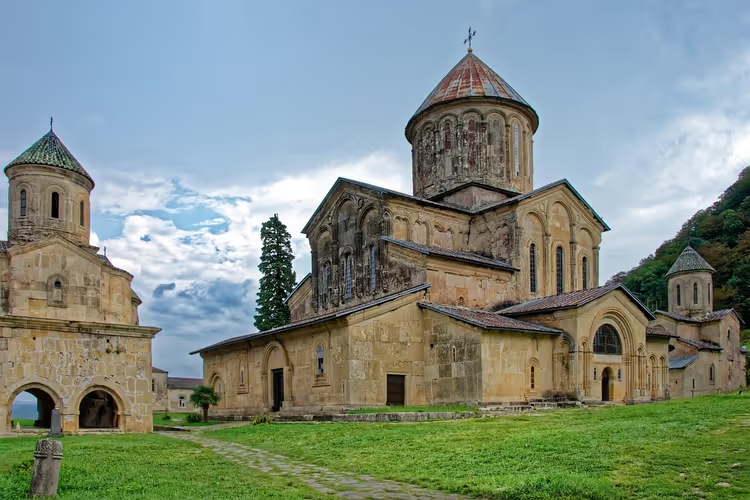
The most pleasant part of a Georgian budget: the main impressions here are free. Churches and monasteries are open to everyone, including Svetitskhoveli in Mtskheta and the Gergeti Trinity Church in Kazbegi. The old town of Tbilisi, Rike Park, the Bridge of Peace, and the flea market near the Dry Bridge also require no ticket.
Paid items start where infrastructure appears. The figures below, tour prices, and tastings depend on the season and the organizer:
Activity | Price |
|---|---|
Cable car to Narikala | 2.5 lari one way (as of 09/2026, TTC) |
Public sulfur bath, Abanotubani | from a few lari for entry |
Private room in a sulfur bath, per hour | tens of lari, depends on the bathhouse |
National Museum of Georgia | 40 lari for foreigners, about 13 € (as of 09/2026, museum website) |
Wine tasting in Kakheti | from ~6 €, depends on the winery |
Group day tour to Kazbegi | from ~20 € per person |
Private driver for a day | from ~80 € |
Movie ticket | about 17 lari, about 6 € (Numbeo, 09/2026) |
Group tours burn through a budget the fastest. Three trips in a week cost about 100 € per person, while Kazbegi by minibus comes to less than 10 €, but takes two days instead of one. The choice is yours, and the math here is on the side of the minibus.
Ticket and excursion prices are easier to check in a catalog in advance: tickets and excursions on GetYourGuide. In high season, popular slots sell out several days ahead.
About cash: in the old town and at markets, card readers fail regularly, and ATMs charge a fee for foreign cards. Carry lari with you for baths, market stalls, and small cafes, and withdraw larger amounts in a single transaction.
Tours and tickets in Tbilisi
Guided tours, skip-the-line tickets and activities — most offers can be cancelled free of charge.
See offers on GetYourGuideThe widget loads once you give your consent.
Health insurance for entry from January 2026
Almost all German-language guides missed this rule, and it can ruin your entry. From January 1, 2026, every tourist must have health insurance with coverage of at least 30,000 lari, or about €10,000 (US Embassy in Tbilisi announcement).
Proof must be in English or Georgian, in printed or electronic form. A small two-week insurance policy costs less than dinner at a Tbilisi restaurant, but it is better to compare insurance options before buying your ticket.
Citizens of Germany, Austria, and Switzerland enter visa-free and can stay in the country for almost a year. This is exactly what made Tbilisi one of the hubs for remote work, and it also drove up rental prices in the center.
Border checks are not always carried out, but you should not count on that. The rule is in effect, and an argument at passport control after a four-hour flight will cost you more than the policy itself.
Weekly budget benchmarks
Below are three ready-made scenarios per person per day, excluding flights. Treat them as a frame within which you can adjust accommodation and food.
Budget option, 25-40 €
A hostel bed costs about 5-15 €, food at local cafes and bakeries about 10-15 €, metro and minibuses 2-5 €. Paid attractions are few and far between, because churches, parks, and the old town are free.
Mid-range option, 50-80 €
A double room or apartment costs about 25-40 € per person, two restaurant meals a day about 15-25 €, Bolt rides 5-10 €. Most travelers fall into this category.
Comfort option, from 120 €
A good hotel in the center starts at about 60 € per person, international restaurants and wine bars take 40-60 €, day trips outside the city come with a private driver. Even at this level, you pay a fraction of a Western European bill for the same standard.
Item | Benchmark per person per day |
|---|---|
Accommodation, central apartment for two | 25-40 € |
Food: cafe breakfast, local lunch, dinner | 15-25 € |
Transport within the city and minibuses | 2-10 € |
SIM card or eSIM | under 1 € |
Tickets and tastings | 3-10 € |
These lines add up to about 45-86 € per day, and a typical mid-range option fits into 50-80 €. If you drop the central apartment and restaurants, the daily budget falls by half without losing the experience.
Where you can actually save money in Georgia
Walk. Tbilisi is compact, and most routes through the center take half an hour on foot. You won't need transport every day, and saving money isn't even the main point here: on foot you see the city, not just its traffic jams.
Eat where locals eat. A khinkali place in a side street and a restaurant on Rustaveli differ in price by three to four times for the same cuisine. Go in the morning or early evening: at lunchtime the dining rooms are packed and service is slower.
Buy groceries at the market. In Tbilisi, that means Dezerter Bazaar, where vegetables, cheese, and herbs cost less than at the supermarket. The difference is noticeable if you cook for yourself at least occasionally rather than eating only at cafes.
Take a minibus instead of a tour. Kazbegi by minibus costs under 10 € versus ~20 € and up on a group tour. You lose a day, but you save enough to cover a night in a guesthouse.
Buy wine at the store. A bottle of Georgian wine at the supermarket starts at a few euros, and the quality is perfectly fine for an everyday dinner. In a wine bar, the same glass costs several times more.
Explore the city without a guide. The old town, bridges, Rike Park, and churches don't require a ticket, and you can build your own walking routes through them for free. It's worth paying only where an entrance or a cable car ride is required.
Stay longer. A monthly apartment rental in Tbilisi works out three to four times cheaper per night than a weekly one. This is the biggest savings lever of the entire trip, and it works in any season.
Where you shouldn't cut corners
On insurance. From January 2026, a policy is mandatory for entry, and the cost for two weeks is less than a local dinner.
On currency exchange at the airport. The rate at the terminal is noticeably worse than in the city, so exchange a small amount for the first few hours and get the bulk of your cash in the city.
On taxis without an app. The apparent saving turns into an extra charge: you negotiate the price with the driver on the street, and you're bargaining blind.
On heating in the mountains in winter. Winters in Svaneti and Tusheti are cold, and simple guesthouses don't always have heating. Check the heating before you book, not after you arrive.
Best time to visit and prices
The season directly moves the two biggest budget lines: flights and accommodation.
Season | What happens | Prices |
|---|---|---|
May-June | warm, around 22 °C, little rain, no crowds | moderate |
July-August | heat in Tbilisi, Batumi is packed | peak, flights cost more |
September-October | grape harvest in Kakheti, warm days | drop again |
November-March | gray Tbilisi, snow in Gudauri and Bakuriani | minimal |
May and June offer the best compromise between weather and price. The days are already warm, there's little rain, and lines at paid attractions are still short.
September and October are worth considering if you love wine. The harvest is underway in Kakheti, tastings at wineries are inexpensive, and evenings stay warm. In October, Tbilisi hosts the city festival Tbilisoba with street fairs and concerts.
November remains the cheapest month for flights, while ski lovers choose January and February in Gudauri and Bakuriani. If you're tied to July, book accommodation two to three months ahead: in Batumi, available rooms run out first.
Keep the differences between regions in mind. The Black Sea coast has a subtropical, humid climate, summers in Tbilisi are dry and hot, and in the mountains at altitude it's cool even at the height of the season. This spread affects your suitcase and your heating bill.
🇬🇪 General information about Georgia
The purchasing power of the euro here is noticeably higher than in Germany: for the same money you get more services, food, and accommodation. Below is a quick country reference.
Indicator | Value |
|---|---|
Population | about 3.9 million people (statistics of Georgia) |
GDP per capita | about 9,700 $ (statistical data) |
GDP per capita at purchasing power parity | about 29,400 $ |
Exchange rate | 1 € ≈ 3.03 lari (official lari to euro rates) |
Largest cities | Tbilisi, Batumi, Kutaisi |
Religion | Georgian Orthodoxy, churches are open to tourists |
Country code | +995 |
Power outlets | type C and F, German plugs work without an adapter |
Tap water | mostly safe, but in old districts it's better to drink bottled |
Traffic | right-hand drive, drivers are fairly aggressive |
Money on the trip comes down to two things: a card and small cash. Visa and Mastercard are accepted at hotels, supermarkets, and most restaurants, but keep lari on hand for bathhouses, markets, and minibuses. Exchange offices in central Tbilisi usually offer rates closer to the official one than airport counters.
⁉️🤔 Frequently asked questions
How much does a week in Georgia cost?
Per person excluding flights, budget from 300 to 550 € in the mid-range option. Accommodation takes 25-40 € per day, food 15-25 €, transport and tickets another 5-15 €. The budget scenario fits into 200-280 € per week, while the comfort option starts at 800 €.
Which prices in Tbilisi turn out higher than expected?
Accommodation. A central apartment for a short stay costs about 50-80 € per night, while a local resident pays about 1,800 lari per month, roughly 600 € (based on user data from Numbeo, 09/2026). Food, transport, and entrance tickets, on the other hand, are cheaper than you'd expect by German standards.
Do you need cash in Georgia?
Yes, for part of the trip. Hotels, supermarkets, and restaurants accept cards, but in the old town, at markets, in sulfur baths, and on minibuses you need lari. Withdraw money in larger amounts at once to avoid paying a fee on every transaction.
How much does food cost in Georgia?
Lunch at a simple restaurant costs about 10 €, a three-course dinner for two about 33 € (based on user data from Numbeo, 09/2026), khinkali cost under 1.5 € each, khachapuri is usually within 10 €. If you cook at home, daily food fits into 10 € per person.
Do you need a visa and insurance?
Citizens of Germany, Austria, and Switzerland don't need a visa and can stay in the country for almost a year. From January 1, 2026, medical insurance with coverage of at least 30,000 lari (about 10,000 €) is mandatory, and proof is accepted in English or Georgian.
How much should you tip?
In some Tbilisi restaurants, a service charge is already included in the bill. Check the line items before paying and don't pay twice. Where there's no service charge, it's customary to leave a tenth of the order amount.
Is it worth renting a car?
For Kakheti, Svaneti, and Tusheti, yes, minibuses run there infrequently. In Tbilisi you don't need a car: parking is paid and tight, and the local driving style takes getting used to. Rental starts at ~20 € per day depending on the season, gasoline Euro Regular costs 3.85 lari per liter (as of 09/2026, Gulf).
In short: what is worth booking
Georgia in 2026 offers a strong balance of price and experience. Churches, the old town, and mountain views are free, and you control your own budget for accommodation and restaurants.
- If you are flying for the first time and want to minimize travel time, choose Tbilisi and an apartment near the metro.
- If budget matters more than comfort, fly through Kutaisi and stay in a guesthouse.
- If you are traveling in high season, book accommodation two to three months in advance.
Before your trip, check tickets: find flights on Kiwi.com. Look for accommodation early, in July the selection in the center disappears quickly: hotel prices in Tbilisi.
It is more convenient to book tours and tickets before departure, so you do not spend your first day negotiating with drivers: GetYourGuide tours and tickets catalog.

A small editorial team writing guides for independent travel. We travel ourselves, but we haven’t been everywhere, so we check prices, opening hours and how to get there against official sources.