
















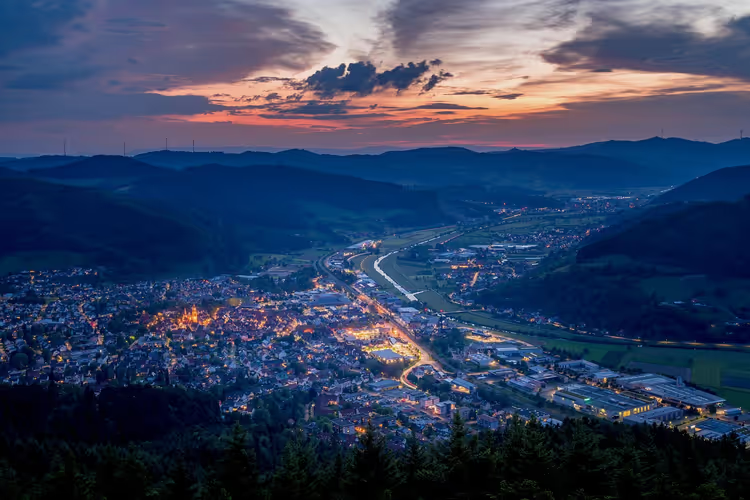
Germany's romantic road: how to drive 460 km from Würzburg to Füssen
Germany’s Romantic Road packs dozens of towns and castles into a single route. It was created in 1950 to show travelers the south of the country (Romantische Straße). Over 460 kilometers, you’ll pass medieval walls, bishops’ palaces, and the castle that inspired Disney.
Planning this trip is trickier than it looks. It’s unclear how many days to allow, how to get around, and which towns you shouldn’t skip. Below we break down the route from Würzburg to Füssen: transport, tickets, prices, and the honest catches.
Ad: this article contains affiliate links, we earn a commission if you book through them, at no extra cost to you.
The Romantic Road: where it runs
💡 In short:
- the route runs from north to south through Bavaria, from Würzburg to Füssen at the foot of the Alps
- officially it’s 460 kilometers and 29 towns, Germany’s oldest tourist road
- prices and opening hours: 09/2026, checked on the official website of the Bavarian palaces
The road starts in Würzburg and ends in Füssen, right at the Bavarian Alps.
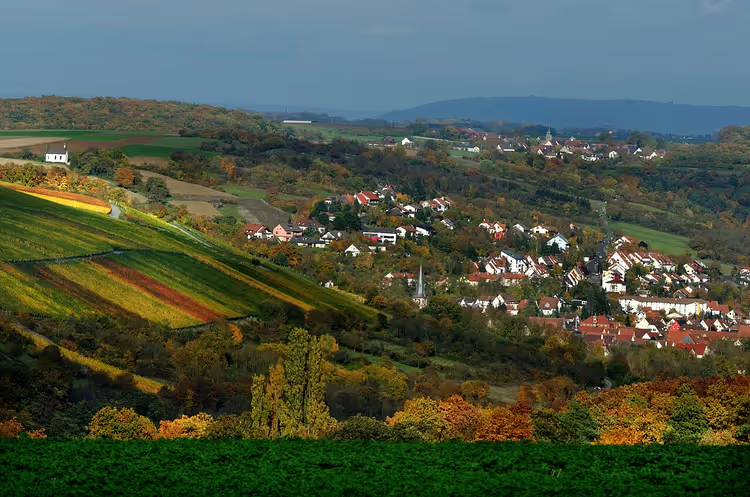 © Holger Uwe Schmitt · CC BY-SAPhoto: Holger Uwe Schmitt, CC BY-SA (https://creativecommons.org/licenses/by-sa/4.0), Wikimedia Commons
Formally it isn’t one road, but a chain of historic streets and highways through Franconia, Swabia, and the Allgäu. You can drive the whole thing or pick just some of the towns. Larger towns are connected by regional trains and buses, while rural sections are easier to reach by car.
It’s more practical to plan the route over several days, with overnight stays in Würzburg, Rothenburg, and Füssen. You can cover the whole distance in a single day, but then you’ll see almost nothing. Each town has its own atmosphere, and it doesn’t come through when you’re rushing.
How to get to the start of the route
The easiest way to reach Würzburg is to fly into Frankfurt am Main, and for Füssen and Neuschwanstein fly into Munich. Both airports have flights year-round, and it’s worth looking for tickets in advance (cheap flights).
From Frankfurt to Würzburg the train takes just over an hour; from Munich to Füssen about two (Deutsche Bahn timetable). Regional trains run between the towns, sometimes with a connection, so always allow extra time.
If you don’t want to drive yourself, there are ready-made bus tours along the Romantic Road. Their schedules and prices are listed on the route’s official website (travel options). A tour like this takes you through the towns on its own schedule.
By train and bus
Most of the route is doable without a car. Würzburg, Rothenburg, Augsburg, and Füssen are connected by regional trains, and buses run between the smaller towns. It is convenient to buy tickets in advance (trains and buses across Germany).
The best option for a family or a group is a Bavaria day ticket. It is valid for one day on regional trains, S-Bahn, metro, and most buses. It costs €34 for one person and €74 for five (according to Deutsche Bahn, 09/2026, schedule and prices). The ticket is not valid on ICE and IC high-speed trains.
The catch: on rural sections the schedule is sparse, especially on weekends. Check connections in advance, otherwise you will lose half a day at a stop. For a short hop, take a train, and for two consecutive stops, a bus.
By car: rental and parking
A car gives you the freedom to detour to Wieskirche or linger in the vineyards of Franconia. Renting for several days will cost more than the train, especially in summer, but you move along the route at your own pace (rent a car).
The roads on the route are calm: these are not autobahns but regional roads between towns. Some old town centers are closed to cars, so leave your car at the entrance and walk. That way you will also see the town, not just parking lots.
The catch: in Rothenburg and near Neuschwanstein, parking is paid and fills up by morning. Arrive when ticket offices open or park farther from the center and walk.
When to go: summer, winter, and fairs
In summer, the Romantic Road looks brighter: vineyards, green forests, and snow-capped Alps closer to the south. But in July and August, Rothenburg and Neuschwanstein are very crowded, and ticket lines stretch for hours.
Winter suits those who love Christmas markets. In Würzburg, Rothenburg, and Augsburg, they open in late November and run until Christmas. Germans put them on in a big way, so pick one or two towns and do not try to cover everything in one weekend.
A separate topic is wine. The route passes through Franconia, one of the country's main wine regions. Wineries with tastings operate here, and wine festivals take place in summer and autumn. Book a tasting tour in advance (wine tours on GetYourGuide).
Tickets: how much admission costs
On the route, you will mainly pay for two sights. The other towns are free to see, and money goes only to individual museums and tours.
Sight | Admission | Note |
|---|---|---|
Neuschwanstein | €21 | children under 18 free (ticket rates) |
Würzburg Residence | €10 | palace church and garden free (prices and hours) |
Book your slot at Neuschwanstein in advance: ticket offices in Hohenschwangau often sell out by morning. It is easier to book a tour online and arrive at your scheduled time (Neuschwanstein tours).
Sights along the Romantic Road
What exactly to see is up to you: the route leaves plenty of room for choice. Below are the main stops from north to south, with photos and practical details for each. If you plan to stay overnight in the historic center, book Rothenburg hotels months in advance (prices and options).
Würzburg: fortress and residence
Würzburg opens the route from the north and immediately sets a high bar. The Marienberg Fortress stands above the city; construction began around 1200. Below it stretch the vineyards of Franconia. The fortress combines two passions of the local knights: fighting and drinking wine.
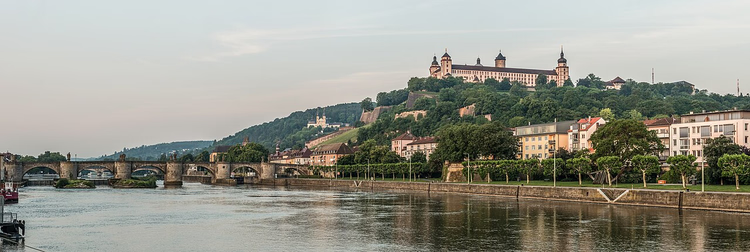 © Daniel Vorndran · CC BY-SAPhoto: Daniel Vorndran, CC BY-SA (https://creativecommons.org/licenses/by-sa/3.0), Wikimedia Commons
The main stop is the 18th-century prince-bishops' residence. It became the first secular building in Germany on the UNESCO list, and its 167-meter facade appears on most postcards of the city. On the ceiling, look for one of the country's largest frescoes. Admission is €10; the court church and garden are free (Würzburg Residence).
Don't miss the 11th-century St. Kilian Cathedral and the Market Square with the 14th-century Church of Our Lady. The center is compact; you can walk it in a couple of hours without rushing.
Weikersheim: a little Versailles
Weikersheim is called a little Versailles, and that is no exaggeration. The 16th-century castle stands amid a park with an orangery, and its knights' hall is painted with hunting scenes. Here the exterior beauty matches the interior.
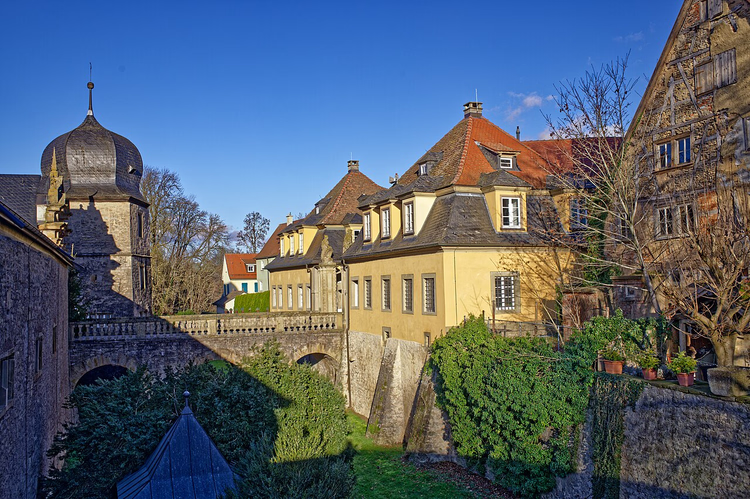 © Tilman2007 · CC BY-SAPhoto: Tilman2007, CC BY-SA (https://creativecommons.org/licenses/by-sa/4.0), Wikimedia Commons
Inside, a coffered ceiling with genre paintings and life-size animal figures has been preserved. One of the rooms once served as an alchemist's laboratory. The park invites a long walk; allow at least an hour for it.
Rothenburg ob der Tauber: the medieval wall
Rothenburg holds the title of Germany's most romantic town. Its medieval wall with towers has survived almost entirely, and you can walk along it around the whole old town.
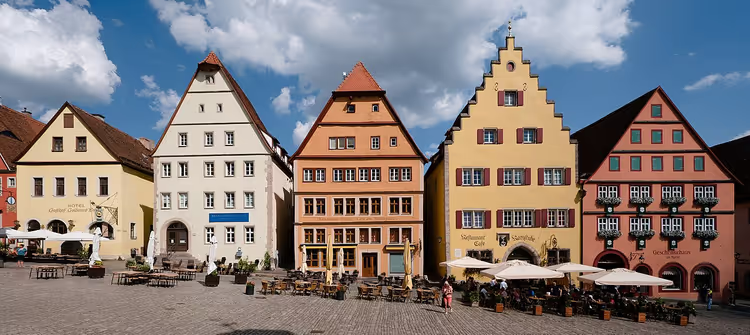 © Johannes Robalotoff · CC BY-SAPhoto: Johannes Robalotoff, CC BY-SA (https://creativecommons.org/licenses/by-sa/4.0), Wikimedia Commons
A legend about mayor Georg Nusch is tied to the town. During the Thirty Years' War, he drank a huge goblet of wine in one gulp and saved Rothenburg from destruction. In memory of this, the Meistertrunk festival is performed here every year.
Rothenburg was filmed for Harry Potter and the Deathly Hallows, but the scenes did not make it into the movie. Arrive at opening time: by midday the streets are packed with tourists, and a line forms at the gate for the wall.
Dinkelsbühl: a museum town
Dinkelsbühl looks like a complete medieval ensemble: colorful gingerbread houses, cobblestones, and preserved towers. The old town is almost entirely surrounded by a wall and separated from the newer districts.
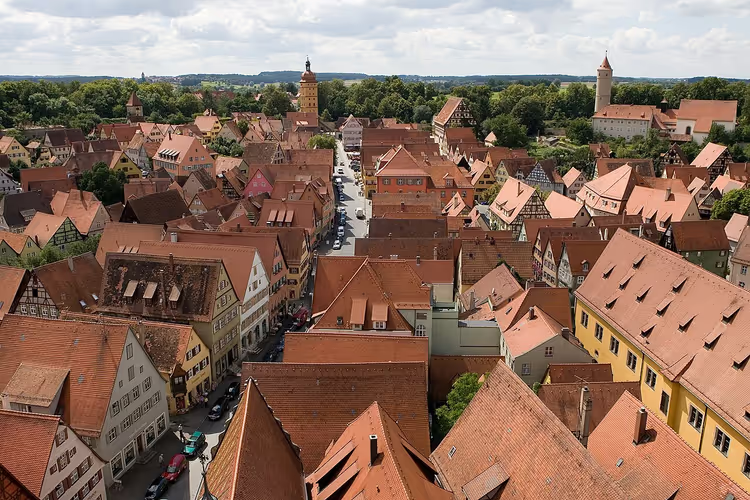 © Mylius · CC BY-SAPhoto: Mylius, CC BY-SA (http://creativecommons.org/licenses/by-sa/3.0/), Wikimedia Commons
The local administration deliberately kept old and new development apart, so here you can see what the town looked like in the Middle Ages. Every summer, Kinderzeche is performed in the streets, a costumed play about the town's surrender to Swedish troops.
Neuschwanstein: the fairytale castle
Neuschwanstein was built by Bavarian King Ludwig II, inspired by knights' castles and Wagner's operas. The white towers look nothing like the heavy fortresses of its neighbors, hence its fame as Germany's most famous castle.
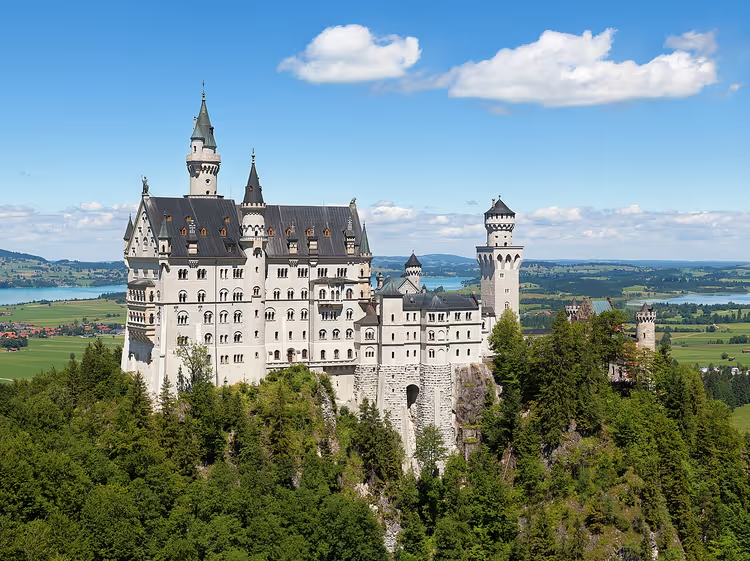 © Thomas Wolf , www.foto-tw.de · CC BY-SAPhoto: Thomas Wolf , www.foto-tw.de, CC BY-SA (https://creativecommons.org/licenses/by-sa/3.0/de/deed.en), Wikimedia Commons
It was Neuschwanstein that inspired Sleeping Beauty's castle in Disney parks. Inside, you'll find frescoes based on Wagner's operas and a swan motif, while the castle itself stands in a gorge above the village of Hohenschwangau.
Ticket offices sell out time slots by morning, so book online in advance.
- The catch: tickets for convenient times go first, and without a slot at the ticket office you risk being turned away (slot sales rules).
Also on the route: Harburg, Augsburg, and Wieskirche
Neuschwanstein is not the only castle along the way. If you have time, make detours to a few places off the main line.
Above the town of Harburg rises one of the most impressive medieval castles in Europe. The surrounding area resembles an antiquities preserve: traces of Romans, ancient Germanic tribes, and medieval princes have been found here.
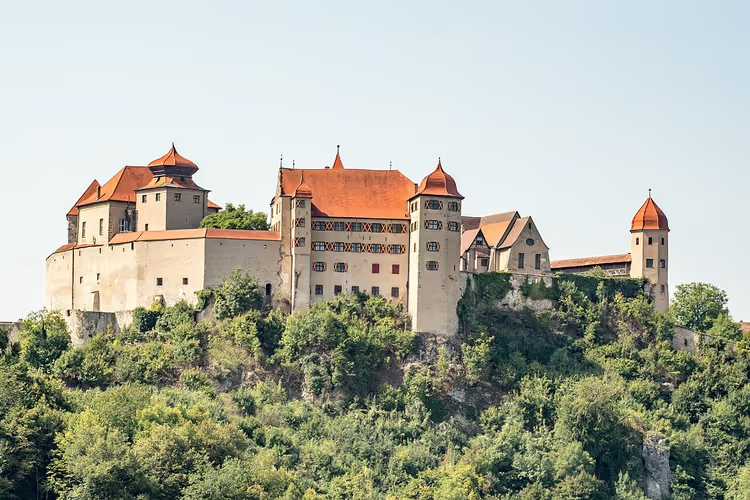 © Tilman2007 · CC BY-SAPhoto: Tilman2007, CC BY-SA (https://creativecommons.org/licenses/by-sa/4.0), Wikimedia Commons
Augsburg is older than most towns on the route. See the old town hall with its Golden Hall, the Cathedral of Our Lady, and the Basilica of Saints Ulrich and Afra. Away from the grand center lies the Fuggerei, the world's first social housing complex, founded in the early 16th century.
For a break from towns, head to Wildsteig, a small community among the Alpine foothills and lakes. Nearby stands Wieskirche, a rococo church on the UNESCO list: its painted ceiling is worth the long journey.
Find hotels
Compare prices across booking sites and filter for rooms with free cancellation.
Compare prices on Discover CarsThe widget loads once you give your consent.
⁉️🤔 Frequently asked questions
How many days do you need for the Romantic Road?
A comfortable pace is a few days, with two or three towns per day. Technically you can cover all 460 kilometers in one day of daylight (official website), but you won't really see anything. Plan overnight stays in Würzburg, Rothenburg, and Füssen so you don't have to backtrack every evening.
Can you do the Romantic Road without a car?
Yes. Regional trains run between Würzburg, Rothenburg, Augsburg, and Füssen, and buses connect the smaller towns. A Bavaria day ticket costs €34 for one person and €74 for five (according to Deutsche Bahn, 09/2026, day tickets). Check connections in advance: schedules are sparse on rural sections.
When is the best time to drive the Romantic Road?
Summer makes the route look more vibrant, but the main towns are packed in July and August. May, June, and September are the calmest months. In winter, come for the Christmas markets in Würzburg, Rothenburg, and Augsburg: they open in late November and run right up to Christmas.
How much does Neuschwanstein cost?
An adult ticket costs €21, and children under 18 enter free (official prices). Online booking adds a small fee. Time slots sell out quickly, so buy them in advance rather than at the ticket office in Hohenschwangau on the day of your visit.
What should you see if you're short on time?
If you only have one or two days, focus on Würzburg, Rothenburg, and Neuschwanstein. These are the strongest stops on the route: the prince-bishop's residence, the medieval wall, and the fairytale castle. Leave the other towns for your next trip and don't rush along the highway.
In short: what to book
The Romantic Road works in any format: a week-long road trip or a short visit to three towns. The key is deciding in advance how you'll get around and where you'll stay.
If you have a car: plan the route yourself and book your vehicle in advance (car rental).
If you're traveling by train: get a Bavaria day ticket for the whole group (trains and buses).
If you want to stay in historic centers: book hotels in advance (hotels in Würzburg and Rothenburg).

A small editorial team writing guides for independent travel. We travel ourselves, but we haven’t been everywhere, so we check prices, opening hours and how to get there against official sources.