
















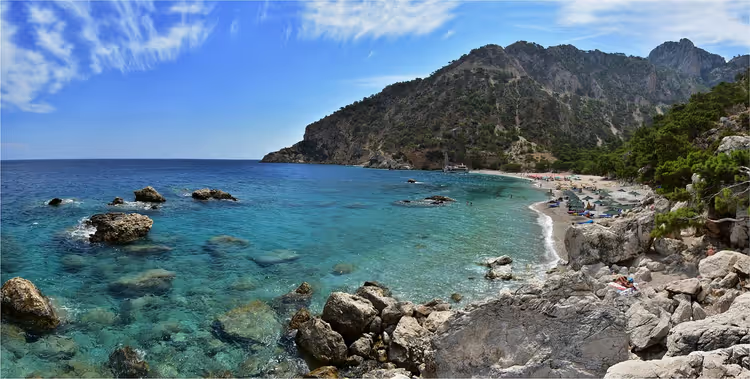
Where to swim in Greece without crowds: beaches of Karpathos and Kefalonia
Greece is among the world leaders in the number of Blue Flag beaches. In 2025, the country received 657 such awards (As of 2025, Keep Talking Greece). Choosing the best shore among them is difficult. Some are packed with sunbeds, umbrellas, and tavernas, while others remain wild coves with no people around.
Below are five beaches for peaceful swimming: Apella on Karpathos, Paralia with ready-made infrastructure, and Myrtos, Petani, and Lepeda on Kefalonia. For each one you'll find directions, surface type, and an honest catch. Beach access in Greece is free, you only pay for a sunbed and umbrella.
Greece's main seas are the Ionian and the Aegean. The Ionian greets you with white pebbles and deep water, the Aegean offers sand and a gentle entry. So one list doesn't fit everyone: consider the surface, the wind, and the road to the shore.
Beaches in Greece: what to choose
💡 In short:
- Look at the islands: wild coves remain where no bus goes.
- Choose the west coast for sunset, and the east coast for morning calm.
- Book a car in advance, most shores are reached only by winding mountain roads.
- Beach access and infrastructure: 09/2026, according to the official Greek portal.
Our picks
Beach | Region | Surface | Who it's for |
|---|---|---|---|
Apella | Karpathos, east | fine pebbles | couples, wild cove lovers |
Paralia | organized shore | sand | families with children |
Myrtos | Kefalonia, west | white pebbles | photos and early swimming |
Petani | Kefalonia, west | pebbles | sunset and quiet |
Lepeda | Kefalonia, west | red sand | toddlers and calm water |
1. Apella: a pine-fringed cove on Karpathos
 © Tomisti · CC BY-SAPhoto: Tomisti, CC BY-SA (https://creativecommons.org/licenses/by-sa/4.0), Wikimedia Commons
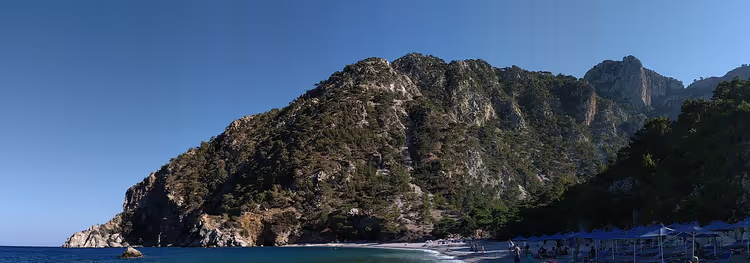
Look to the eastern side of Karpathos. Apella lies in a cove with crystal-clear water, fine pebbles, and pine-covered slopes that descend almost to the water's edge (As of 09/2026, VisitGreece). In summer, more people arrive during the day, so come early in the morning or in September, when the heat eases and the sea stays warm. The pines provide shade right by the shore, and the water entry remains gradual.
- How to get there: 19 km, about 30 minutes by car from the island's main settlement (As of 09/2026, VisitGreece).
- Cost: entry is free, you only pay for a sunbed and umbrella.
- Who it's for: those who want turquoise water and pines instead of concrete.
- The catch: you can't get here without a car, no bus goes to the cove.
2. Paralia: a beach with full infrastructure
 © Rosa-Maria Rinkl · CC BY-SAPhoto: Rosa-Maria Rinkl, CC BY-SA (https://creativecommons.org/licenses/by-sa/4.0), Wikimedia Commons
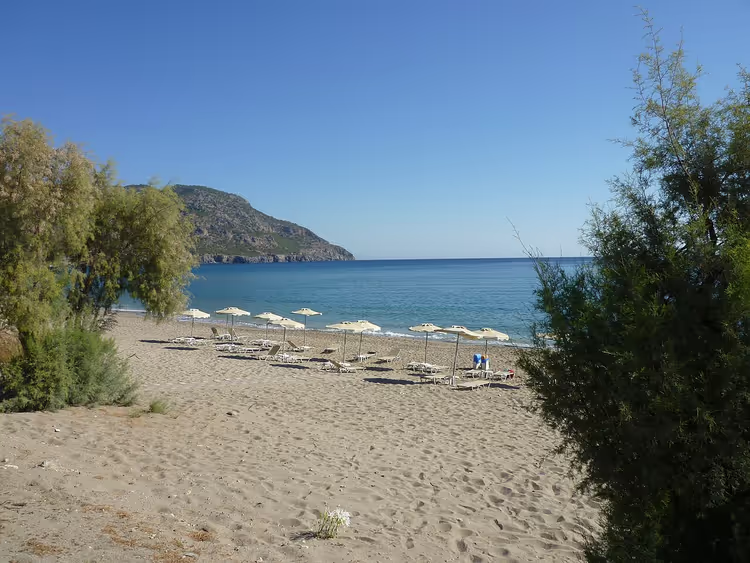
Paralia is an organized shore for those who don't want to seek out wildness. Most of the beach is taken up by sunbeds with umbrellas, and vendors walk among them with bags, sunglasses, corn, and honey baklava. It gets very hot here during the day, so swim in the morning or closer to evening. Cafes and tavernas line the shore, where you can order local cuisine right by the sea.
- How to get there: cafes and tavernas run along the shore, accommodation sits right at the water's edge.
- Cost: sunbeds are paid, sea access is free.
- Who it's for: families and those who value ready-made service.
- The catch: at midday there's heat and vendor noise, it's better to sunbathe before or after lunch.
3. Myrtos: Kefalonia's most recognizable cove
 © Matt Sims · CC BYPhoto: Matt Sims, CC BY (https://creativecommons.org/licenses/by/2.0), Wikimedia Commons
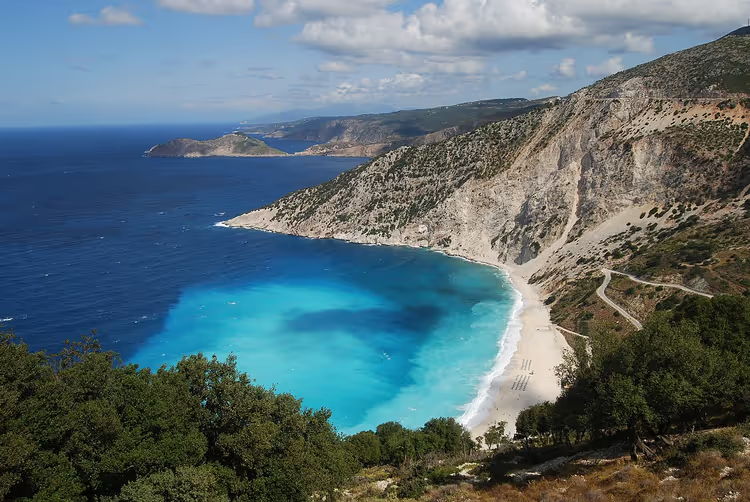
Myrtos is white pebbles and a deep turquoise color, which is why it's called one of the most photographed coves in Greece (As of 09/2026, VisitGreece's Kefalonia page). The beach lies between two cliffs, and near the water's edge the bottom drops off quickly. It's not safe here with small children, swim only near the shore and keep your child in sight. The white pebbles here are large, so bring water shoes.
- How to get there: a winding mountain road descends to the beach, you need a car.
- Cost: entry is free, sunbeds optional.
- Who it's for: beautiful photos and early swimming.
- The catch: sharp drop-off near the shore, watch your children.
4. Petani and Lepeda: Kefalonia's west coast
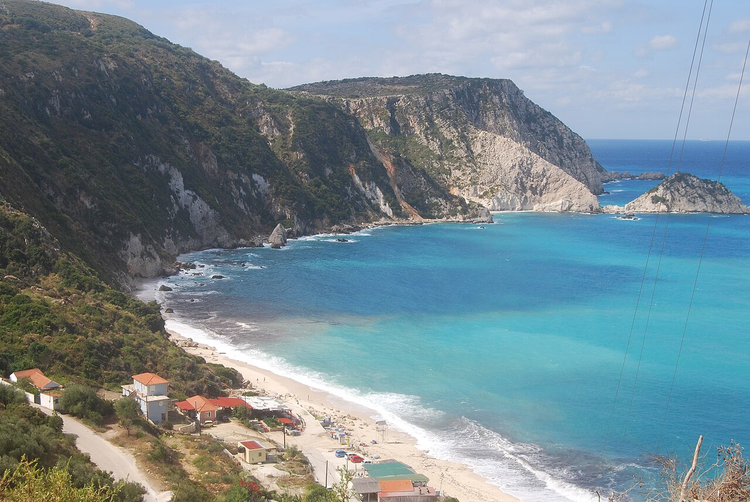 © Matt Sims · CC BYPhoto: Matt Sims, CC BY (https://creativecommons.org/licenses/by/2.0), Wikimedia Commons
Petani sits on the same western side as Myrtos. It's surrounded by steep cliffs with an open view of the sunset, and in character it resembles its famous neighbor, only with fewer people (As of 09/2026, VisitGreece on Kefalonia). On a windy day you can spend hours watching the waves and listening to the surf. In the evening people gather here for sunset shots, so come to the water early.
Lepeda is red sand and quiet water. The cliffs form small pools, the depth increases slowly, so the shore is convenient for swimming with children. Strong waves are rare here, and the warm shallows last longer than on the neighboring pebble beaches. Bring a mask: you can see small fish near the rocks.
- How to get there: both shores lie on the west coast, best reached by car.
- Cost: entry is free.
- Who it's for: sunsets, quiet, and family swimming.
- The catch: on a windy day, waves pick up at Petani.
Islands and peninsulas of Greece
Besides these five beaches, Greece has dozens more destinations. Travelers favor Corfu, Crete, Mykonos, Rhodes, Patmos, and Santorini. Ithaca is a separate island near Kefalonia and the homeland of Odysseus, with rocky terrain, ports, caves, and monasteries. It also has olive groves, a blue lagoon, and wild coves without sunbeds.
The Halkidiki peninsula is also worth a look: kilometers of sand and a calm sea. Choose a shore that matches your pace: wild, family-friendly, or urban. For a long trip, pick two islands rather than three: ferry transfers eat up a whole day.
Vacationing in Greece with children
For families, Greece is convenient thanks to shallow water near the shore and short drives between beaches. School-age kids enjoy excursions to ancient cities and excavation sites, while toddlers like playgrounds and hotel nannies. Choose shores with sand and a gradual water entry: Lepeda and the organized beaches of Paralia work best. On pebbles, give your child water shoes, the stones get hot during the day.
Cuisine, music, and evening entertainment
After the sea, many people head to waterfront tavernas. The menu features local cuisine: grilled fish, olives, cheese, and vegetables with olive oil. In the evening, resorts have live music, and traditional dances take place in the square. Set aside one free evening to simply sit by the sea after sunset.
⁉️🤔 Frequently asked questions
When to go to the beaches of Greece?
The best time is late May, June, and September. In July and August it's hot during the day, and organized shores are crowded. For Apella, choose September: the heat eases and the sea stays warm. For wild coves, come in the first half of the day, while the cliffs still provide shade.
How to get to Apella?
A mountain road leads to Apella from Karpathos's main settlement. Public transport doesn't go to the cove, so take a car or taxi. Parking near the beach is small, arrive early, otherwise there won't be any spots left.
Where to swim with children?
For children, Lepeda and organized beaches like Paralia are best. Lepeda has red sand and a gradual water entry, Paralia has sunbeds, umbrellas, and cafes nearby. At Myrtos and Petani the bottom drops off quickly, so watch your child near the shore and don't let them go alone.
Are there sunbeds and umbrellas on the beaches?
On organized shores like Paralia, sunbeds and umbrellas line the entire water's edge, and you pay for a spot. On wild coves like Apella there's little infrastructure, so bring an umbrella, water, and food with you. Sea access remains free everywhere.
Do you need a car for the beaches of Greece?
For Apella, Myrtos, Petani, and Lepeda you need a car: they're reached by winding mountain roads, and buses run rarely. At Paralia you can manage without a car, everything is within walking distance. Book a car in advance, in season there are none left, and taxis at wild coves take a long time to arrive.
In short: what to book
If you have a family with toddlers, choose Lepeda. If you want photos and deep water, go for Myrtos. If you want quiet and sunset, look at Petani. If you don't want to hunt for infrastructure, Paralia works.
Book accommodation near your chosen shore in advance and head to the water early in the morning. At midday, organized beaches are hot and crowded, while wild coves offer shade only near the cliffs.

A small editorial team writing guides for independent travel. We travel ourselves, but we haven’t been everywhere, so we check prices, opening hours and how to get there against official sources.