
















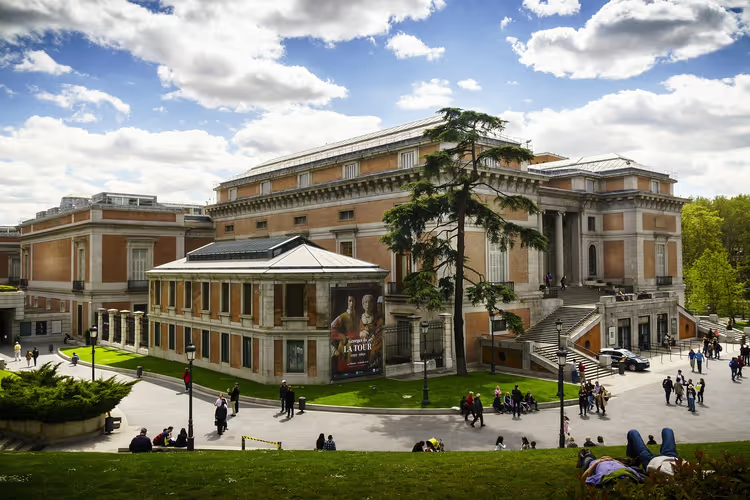
Prado Museum in Madrid: timed-entry tickets, opening hours and free admission
The Prado rivals the Louvre in the density of original masterpieces per square meter.
In 2024, the museum welcomed 3.46 million visitors (according to the museum), and in high season the line at the entrance on Paseo del Prado forms by ten in the morning. Below is practical information that saves you time: opening hours, free admission windows, the main galleries, and how to get there from the metro.
Ad: this article contains affiliate links, we earn a commission if you book through them, at no extra cost to you.
Tickets and opening hours (as of 09/2026)
💡 In short:
- Ticket 15 €, reduced 7.50 €, visitors under 18 enter free (as of 09/2026, buy a ticket online).
- Free admission Mon-Sat from 6:00 PM to 8:00 PM and on Sunday from 5:00 PM to 7:00 PM (as of 09/2026, museum hours page).
- Choose your time slot online in advance; the ticket office at the entrance works, but the line there is longer.
- Prices and opening hours: 09/2026, verified on the official website
The museum is open Monday through Saturday from 10:00 AM to 8:00 PM, and on Sundays and holidays until 7:00 PM (as of 09/2026, official museum website). Closed on January 1, May 1, and December 25, while on January 6, December 24, and December 31 it is open only until 2:00 PM. Admission stops half an hour before closing, and visitors are asked to leave ten minutes before the end of the day.
Entry is by time slot: you choose the date and hour when purchasing. Prices and discounts are listed in the box above (prices on the official website). Visitors under 18 need an ID for free admission. One ticket covers both the permanent collection and temporary exhibitions.
The best time to visit: the evening free admission windows. Free admission hours are listed in the table below (opening hours on the museum website). During these times you have access to the permanent collection, while temporary exhibitions are available at a reduced price. Last entry during the free window is at 7:30 PM and 6:30 PM, so don't be late.
Day | Opening hours | Free admission |
|---|---|---|
Monday - Saturday | 10:00 AM-8:00 PM | 6:00 PM-8:00 PM |
Sunday and holidays | 10:00 AM-7:00 PM | 5:00 PM-7:00 PM |
January 1, May 1, December 25 | closed | none |
January 6, December 24 and 31 | 10:00 AM-2:00 PM | none |
In practice, this means the following: right after opening, the galleries are still uncrowded. By midday, organized groups arrive, and by evening it gets quieter again. If you want to see "Las Meninas" without a dense ring of visitors, come at opening time.
- The catch: you can't cover the entire permanent collection in one visit; a second visit requires a separate time slot.
Museum history: from palace to royal collection
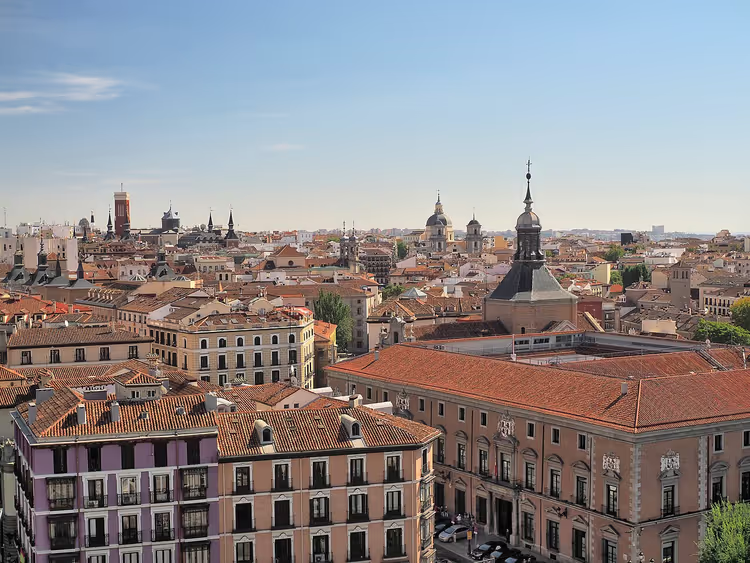
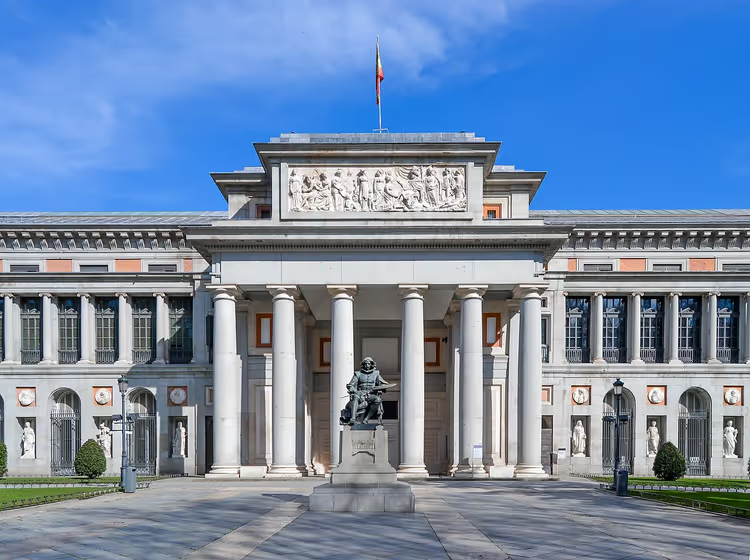
The museum's history reflects the history of the Spanish state. The Prado officially opened on November 19, 1819, when it was called the Royal Museum of Painting (Wikipedia). The building on Paseo del Prado was designed by architect Juan de Villanueva on the orders of King Charles III.
 © Dmitry Dzhus from London · CC BYPhoto: Dmitry Dzhus from London, CC BY (https://creativecommons.org/licenses/by/2.0), Wikimedia Commons
For a long time, only monarchs and the church could collect painting in Spain. That is why religious subjects dominated old collections, while secular genres appeared more slowly. A change of king often ended with a sale of paintings, because heirs did not always appreciate their predecessor's taste.
The turning point came under Carlos I. He was the first to abandon the tradition of sales, and his collection passed intact to his heir Philip II. Philip turned out to be a fine connoisseur of painting and expanded the collection not only with religious canvases but also with genre scenes and portraits.
Under Philip II, the court public saw the royal collection for the first time at the El Pardo palace, the king's country residence. The museum's name came not from the palace but from the meadow Prado de San Jerónimo. At the Escorial, another residence of Philip II, ordinary visitors were shown only canvases on religious subjects.
Philip III had almost no interest in art. During his reign the collection did not grow, and some paintings were distributed among courtiers. Philip IV set things right: he bought works by European masters and commissioned new ones. Under the Bourbons, the Spanish royal collection was enriched with French painting.
There are no collections of the early Castilian kings in the Prado, because they were sold off long before the museum opened. The Spanish school, however, is shown here in full force. Italian, Flemish, Dutch, and German masters occupy separate rooms, so in one visit you will see the entire map of European art.
Collection: the main rooms of the Prado
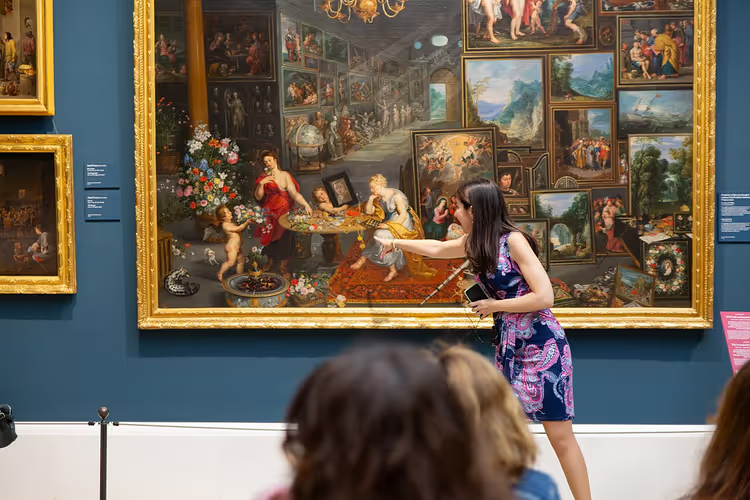
The Prado presents the Spanish school as a distinct movement, and it is worth starting with El Greco. His manner is immediately recognizable: elongated figures, harsh light, rich colors. In the rooms with his works, visitors linger longest at the "Trinity" and the "Crucifixion with the Virgin, Saint John, and Mary Magdalene."
 © Barcex · CC BY-SAPhoto: Barcex, CC BY-SA (https://creativecommons.org/licenses/by-sa/4.0), Wikimedia Commons
Next comes Diego Velázquez. He painted portraits where a person's character matters more than formal dress. In the "Portrait of Philip IV in Hunting Dress" the king's arrogance is visible, while the "Triumph of Bacchus," also known as "The Drinkers," turns myth into a scene with ordinary people. In the same room you will see "Las Meninas," the central work of the entire collection.
Francisco Goya completes the Spanish line. In his rooms, the serene "Family of Charles IV" hangs next to the harsh scenes of the Madrid uprising against the French, where the brushstroke becomes sharp and nervous. The contrast is understandable: between these canvases came war and French occupation.
Besides the Spaniards, the Prado holds the best works of European schools. The Italian Renaissance, Flemish portraiture, Dutch still life, and German painting occupy separate rooms. The sculpture collection numbers almost a thousand works, from ancient marbles to court busts (according to the collection page). Jewelry and decorative art by old masters are added to these.
Not everything is shown in the rooms: a significant part of the collection is kept in storage and appears from time to time in temporary exhibitions. Before your trip, check the schedule on the museum's website. Sometimes people make a separate trip to the Prado for a single visiting exhibition.
Tours and tickets in Prado Museum
Guided tours, skip-the-line tickets and activities — most offers can be cancelled free of charge.
See offers on TiqetsThe widget loads once you give your consent.
How to get to the Prado from the metro
The museum occupies a block on Paseo del Prado. The closest metro station is Banco de España on line L2: from the exit to the entrance is about 400 m, or 5-6 minutes on foot (according to the map).
The Atocha and Estación del Arte stations on line L1 are convenient if you are coming from the train station: 10-12 minutes on foot (according to the map). From Puerta del Sol it will take 20-25 minutes at a relaxed pace (according to the map). From Barajas Airport, the Cercanías train takes you to Atocha, then you walk north along the boulevard.
 © Emilio J. Rodríguez Posada · CC BY-SAPhoto: Emilio J. Rodríguez Posada, CC BY-SA (https://creativecommons.org/licenses/by-sa/2.0), Wikimedia Commons
Use the boulevard fountains as landmarks: from Neptuno to the museum is closer than from Cibeles. Combine the visit with a walk: the Botanical Garden begins nearby, and beyond it opens Retiro Park (according to the map). In hot weather, go through the garden, because there is shade along almost the entire route.
⁉️🤔 Frequently asked questions
How much does a Prado ticket cost?
Prices and discounts are collected in the box in the tickets section (museum ticket sales). Free hours are listed in the table there (hours and prices page). Book your slot online, because at the ticket office they may be sold out for the next few hours.
How long does a visit take?
Allow at least half a day if you want to cover the Spanish school and the European rooms. A quick route through the main rooms will take a couple of hours, but it is easy to lose track of time with Velázquez. The free evening window is short: in two hours you will only manage the main line, so it is better to come back for Goya in the morning.
Do I need to buy a ticket in advance?
Yes, entry is by time slot, and in high season morning slots close a day or two ahead. Buying online removes the risk of queuing at the ticket office, and the free slot also needs to be reserved in advance. Check the exchange conditions on the museum's ticket service website, where you can also see available slots for your date.
What should I see first?
Start with the Spanish school: El Greco, Velázquez and Goya occupy the strongest rooms. Then look at the Italians and Flemish, and leave sculpture and decorative art for a second pass. If you are short on time, go for "Las Meninas", "The Family of Charles IV" and "The Trinity".
How do I get there from Atocha station?
From Atocha to the Prado it is a 10-12 minute walk north along Paseo del Prado, past the Botanical Garden (see map). Near the station there are Atocha and Estación del Arte metro stops on line L1. If you are coming from the airport, the Cercanías train takes you to Atocha without changes.
In short: what to book
The Prado fills a full day of cultural plans, so choose the format that fits your trip:
- If you are on a budget: a slot in the free evening window, Mon-Sat.
- If you are traveling with children: a morning slot and the Spanish school route.
- If you only have half a day: El Greco, Velázquez, Goya and an evening walk to Retiro Park.
Buy your ticket and slot on the museum's official website, and book a guide for the rooms in advance: Madrid tours on GetYourGuide. Arrive at opening time, and you will see the main rooms before the tour groups.

A small editorial team writing guides for independent travel. We travel ourselves, but we haven’t been everywhere, so we check prices, opening hours and how to get there against official sources.