
















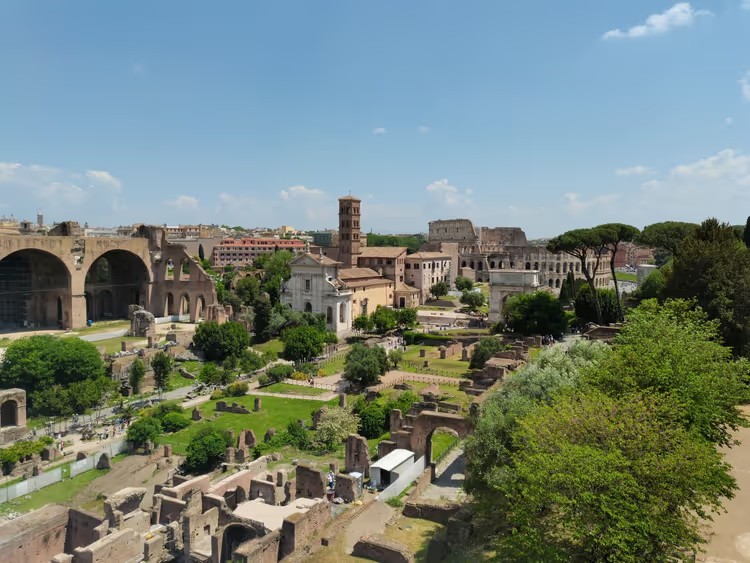
All roads lead to Rome: what remains of them today
All roads lead to Rome. The phrase was born not from beauty, but from logistics: the empire kept in touch with its provinces along paved highways, and along them marched legions, mail, goods, and taxes.
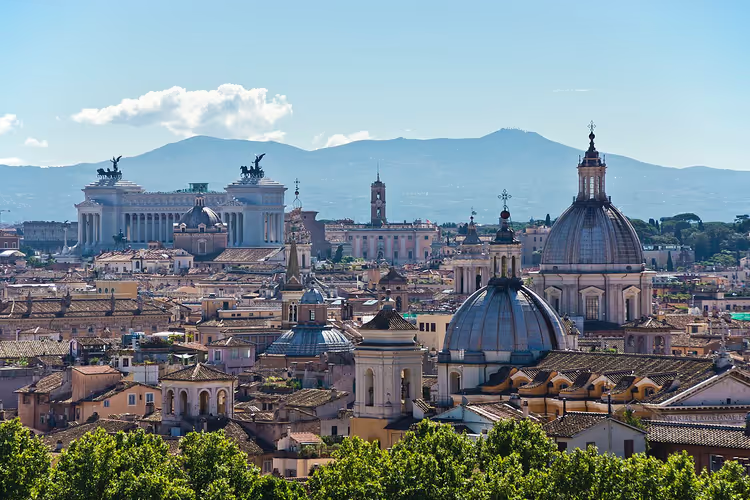
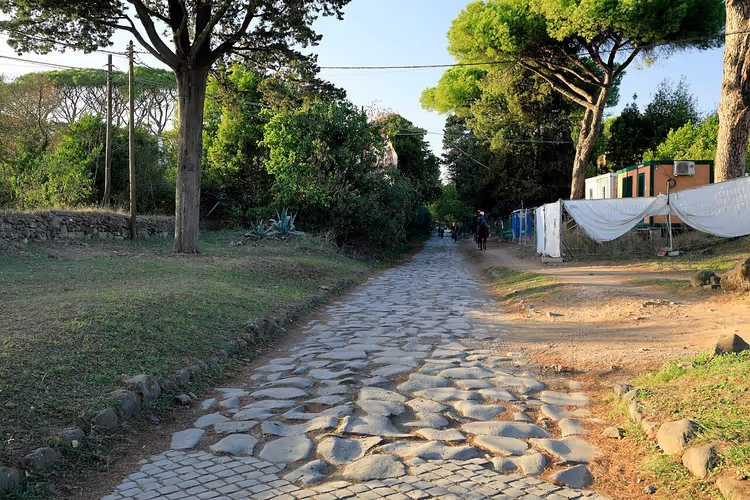
Part of this network has survived to this day, and you can see it with your own eyes. It is best preserved in the Appian Way park in the south of the city.
Ad: this article contains affiliate links, we earn a commission if you book through them, at no extra cost to you.
Below we will look at how the city on seven hills became the capital of an empire, why it needed a road network, and what remains of it is worth seeing.
The legend of Rome's founding
💡 In short:
- Romulus and Remus grew up in a shepherd's family and founded the city after a quarrel.
- Start exploring the legendary sites with the Palatine and the Capitoline.
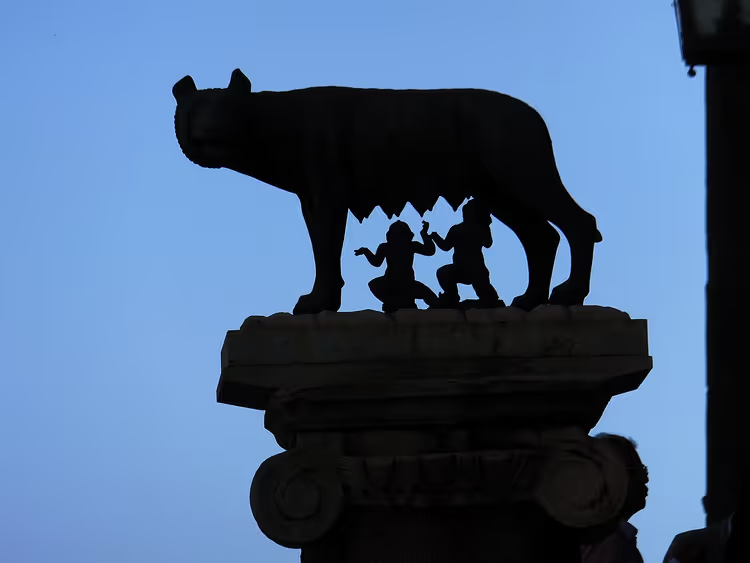
- Checked 09/13/2026: the bronze she-wolf, the symbol of the city, is on display in the Capitoline Museums (official museum website).
The daughter of a deposed king gave birth to two sons by Mars, the god of war. The new ruler ordered the woman killed and the infants thrown into the Tiber, but the slave carrying out the order was frightened by the rising water and left the basket by the shore.
The twins were suckled by a she-wolf, and later a royal shepherd found them and gave the boys their names: Romulus and Remus. The brothers grew up brave, stood up for the weak, and earned the people's respect.
 © lienyuan lee · CC BYPhoto: lienyuan lee, CC BY (https://creativecommons.org/licenses/by/3.0), Wikimedia Commons
One day their grandfather, the deposed king Numitor, heard the young men's story and realized that these were his grandsons. With their help, the old man regained power over his lands.
In gratitude, he offered the brothers the chance to found a new city, but Romulus and Remus argued over the location of the future walls. The quarrel turned into a fight, and Romulus killed his brother, then named the city on the Palatine Hill after himself: Roma.
Ancient tradition dates the founding of the city to the 8th century BC, but there are no written documents from that era, so this is a legend rather than a chronicle. However, archaeologists have indeed found the remains of the first settlements on the Palatine: the hill by the river was not chosen by chance, because it was easy to defend, and the water provided a trade route.
From kingdom to empire
Rome began as a small kingdom on the hills. Its armies gradually seized neighboring lands, and settlers poured into the city, though they had fewer rights than the original inhabitants. Resentment built up for centuries.
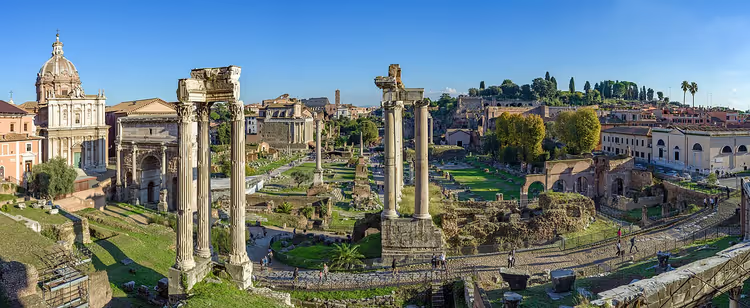
At the end of the 6th century BC, the king was expelled, and Rome became a republic: decisions were made by the senate, and new residents gradually gained access to offices and laws.
 © This Photo was taken by Wolfgang Moroder . Feel free to use my photos, but please mention me as the author and send me a · CC BY-SAPhoto: This Photo was taken by Wolfgang Moroder . Feel free to use my photos, but please mention me as the author and send me a, CC BY-SA (https://creativecommons.org/licenses/by-sa/3.0), Wikimedia Commons
After resolving its internal disputes, the republic turned to conquest. Even earlier, in 390 BC, the Gauls nearly took the city, and the Romans were saved by geese. First the Romans established themselves in central and northern Italy, and then moved beyond the peninsula.
In the 3rd century BC, Rome took Sicily, Sardinia, and Corsica. In the 2nd century BC, Carthage fell, followed by Macedonia, Greece, Syria, Egypt, the Iberian Peninsula, Armenia, and Palestine. Each new border required reliable communication with the center.
This is where logistics comes in: legions needed to reach the borders quickly, and governors needed to send reports and collect taxes. A military task turned into a road-building program.
In the 1st century BC, the republic was torn apart by civil wars. Caesar seized power, but supporters of the senate killed him, and the winner of the new war was Octavian, Caesar's heir. He became the first emperor, and Rome turned from a city into the capital of an empire.
The Appian Way: queen of Roman roads
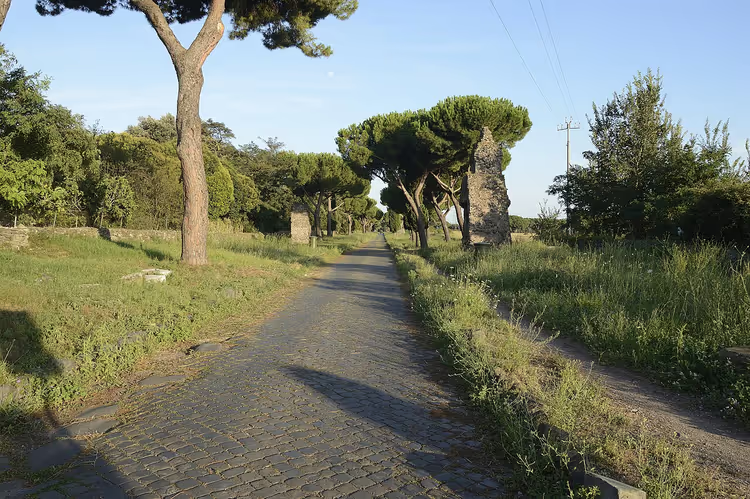
The first paved highway connected Rome with Capua: it was laid at the end of the 4th century BC and named after its initiator, Appius Claudius.
At first the road served a military purpose, and legions used it to reach the south quickly. Later merchants, mail, and travelers followed the route, and the Appian Way park calls it "Regina Viarum," the queen of roads (as of 09/2026, Parco Regionale dell'Appia Antica website).
Standards for building and maintaining roads appeared as early as the republic, and by the imperial era the peninsula was covered by a network of similar roads. Names were given after sponsors, since construction was expensive, or after the regions the road passed through.
 © Livioandronico2013 · CC BY-SAPhoto: Livioandronico2013, CC BY-SA (https://creativecommons.org/licenses/by-sa/4.0), Wikimedia Commons
Roads had two types of stations. At small ones, horses were changed, and at large ones, which were spaced farther apart, travelers ate and spent the night. So the road became a service, not just a surface.
The first traffic rules appeared under Caesar, and around the same time roads were measured and put on maps. Octavian placed the "Golden Milestone" in the Forum, which today would be called kilometer zero: on the gilded column were engraved the names of the empire's main cities and the distances to them.
The total length of the network in its best years is estimated at hundreds of thousands of kilometers, and anyone could use the roads. Getting to Rome was simple: at every fork, choose the widest road.
How the Romans built roads
The surface was made of large cut stones laid on lime mortar, so the foundation was heavy and almost never washed away by water.
Road element | Why it was done |
|---|---|
Cut stones on lime mortar | A durable surface that holds the weight of carts |
A slight rise toward the middle of the road | Water drained into ditches along the edges |
Stone arch bridges | Crossing rivers without stopping traffic |
Post stations along the route | Changing horses, lodging, and food for couriers |
The roadbed was made as level as possible, and arch bridges were thrown across rivers. Some of these bridges still stand today, and you can drive over them in an ordinary car.
 © Bert Kaufmann from Roermond, Netherlands · CC BY-SAPhoto: Bert Kaufmann from Roermond, Netherlands, CC BY-SA (https://creativecommons.org/licenses/by-sa/2.0), Wikimedia Commons
The durability of the pavement exceeded all expectations: in Portugal and Italy, streets paved in the Roman era still survive today.
Hence the joke: the ancients knew how to build roads, and modern people have forgotten. There is some truth to it, but the secret is simple: the Romans built to last for centuries because a road was a matter of power, not economy.
What remains of the Roman roads
The easiest way to see it all with your own eyes is to go to the Appian Way. The pedestrian section of the park stretches for more than 16 kilometers and is open year-round (as of 09/2026, current park data).
The park covers 4,580 hectares and is considered the largest protected urban area in Europe (description of the park and its territories, as of 09/2026). Along the roadsides stand the remains of imperial villas, aqueducts, and old farms.
Walking along the road itself is free: you only pay for entry to the catacombs and individual villas. Book timed-entry tickets in advance, because morning slots sell out the fastest.
Tickets to museums and the main monuments of Rome are easy to browse on Tiqets: you can also see there where a specific time slot is required.
Tours and tickets in Rome
Guided tours, skip-the-line tickets and activities — most offers can be cancelled free of charge.
See offers on TiqetsThe widget loads once you give your consent.
Next, choose your walking format: on foot you can cover the main stretch in half a day, while on a bike you can make it to the aqueducts. Bike rental operates right in the park.
 © Falk2 · CC BY-SAPhoto: Falk2, CC BY-SA (https://creativecommons.org/licenses/by-sa/4.0), Wikimedia Commons
⁉️🤔 Frequently asked questions
What year was Rome founded?
There is no exact date: ancient tradition places the founding in the 8th century BC, and the finds on the Palatine are older than any written records. For a trip, something else matters more: the hill, the Forum, and the Colosseum stand close together, and you can cover them on foot in one day, so leave time for the climb up to the viewing platform.
How much does a walk along the Appian Way cost?
The road itself and the park are free: you can walk without a ticket. You pay for entry to the catacombs, imperial villas, and museums along the way. Prices and hours change by season, so check the official park page and book timed-entry tickets in advance.
How do you get to the park from the center?
From the Colosseum to the park entrance is about a kilometer, roughly a fifteen-minute walk (as of 09/2026, park data). After that, the route heads south, and part of the way is easier to cover by bike: you will find rentals right at the entrance.
How much time should you allow for the walk?
On foot, allow three to four hours if you want to reach the aqueducts and come back. By bike, two hours is enough, and in summer set out in the morning: by midday the open road heats up, and there is almost no shade along the route, so water and a hat are essential.
What from the Roman era can you see right in the city center?
The Colosseum, the Pantheon, and the triumphal arches remain in the center, with fragments of ancient paving between them. Most of the roads and aqueducts survive in the park to the south, so if you are interested in engineering, not just facades, set aside a separate day for this walk: that way you will see what is usually hidden under asphalt.
In short: what to book
Rome does not require a complicated plan: figure out how many days you have and group sights by area.
If you have one day: the center, the Colosseum with a time slot in the morning, and the Pantheon. If you have two days: add the Palatine and a walk along the Appian Way. If you have a week: use Rome as a base and give one day to the catacombs.
Hotels in Rome are best chosen near the metro: see options on Trip.com.
Guided tours of the center and catacombs: see them on GetYourGuide.
Transfer from Fiumicino Airport: book on Kiwitaxi.
Most importantly, book in advance: Colosseum and catacomb tickets go first.

A small editorial team writing guides for independent travel. We travel ourselves, but we haven’t been everywhere, so we check prices, opening hours and how to get there against official sources.