
















Sheikh Zayed Mosque in Abu Dhabi: what to see inside and how to get there from Dubai
Sheikh Zayed Mosque in Abu Dhabi welcomes nearly 7 million visitors a year (as of 2025, mosque's official website). By sunset the line at the entrance grows, and the free tour starts strictly on schedule. Showing up on a whim means losing an hour at the entrance and missing the evening lighting.
It is the largest mosque in the UAE and the main symbol of Abu Dhabi. Entry is free, non-Muslims have been allowed in since 2008, and women are given an abaya and sheila at the entrance. A guided visit takes about an hour and a half to two hours.
Ad: this article contains affiliate links, we earn a commission if you book through them, at no extra cost to you.
A bit of history
💡 In short:
- Entry is free; visits are arranged with an online pass on the official website.
- Free guided tours run several times a day; the visit takes 1.5 to 2 hours.
- Prices and opening hours: 09/2026, verified on the mosque's website.
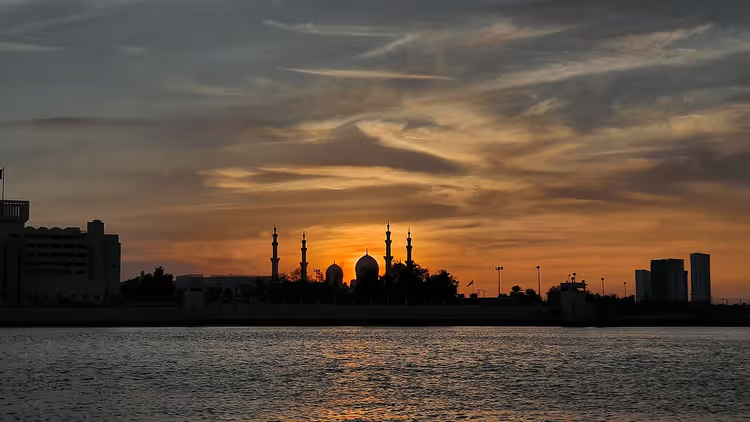
The United Arab Emirates came into being in 1971. Before that, the area consisted of separate Bedouin sheikhdoms that lived from pearl diving and camel breeding (according to the mosque's information).
 © PotatoWitch · CC BY-SAPhoto: PotatoWitch, CC BY-SA (https://creativecommons.org/licenses/by-sa/4.0), Wikimedia Commons
Sheikh Zayed bin Sultan Al Nahyan proposed uniting the emirates into one state and became the first president of the UAE. During his forty years in power, the country became one of the wealthiest on the planet.
The idea of a memorial complex was discussed while the sheikh was still alive, in the late 1980s. The site and design were approved in 1990, and construction began on November 5, 1996.
Work stalled for several years due to disagreements between clients and contractors. In 2001, the UAE government took construction under its control, and things finally moved forward.
The mosque opened during the holy month of Ramadan in 2007. A year later, in 2008, the complex opened to non-Muslims as well: people of different faiths now come here.
Today it is not only a place of worship but also a major cultural center. In 2025, more than 4,000 cultural tours were held here.
The sheikh's tomb
Sheikh Zayed was buried here on November 3, 2004. The site is modest: a small white mausoleum edged with black marble. The Quran is recited here day and night.
 © Валерий Дед · CC BYPhoto: Валерий Дед, CC BY (https://creativecommons.org/licenses/by/3.0), Wikimedia Commons
The burial site is located a short distance from the mosque. Tours do not go there, but you can pay your respects to the sheikh on your own.
Architecture and style
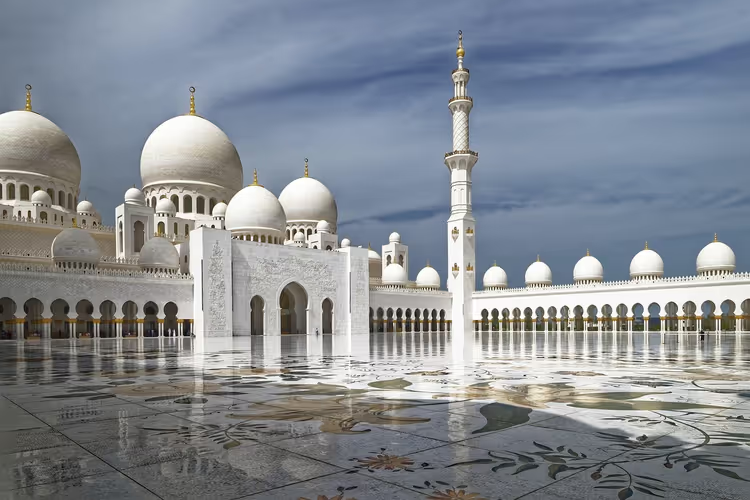
The original mosque design was Moroccan; later the outer walls were enhanced with elements of Turkish style. From above, the complex looks like an enclosed space.
Four minarets, each 107 meters tall, stand at the corners. The grounds are adorned with 82 white marble domes in Moroccan style.
The central dome is impressive in size: 32.8 meters in diameter, 85 meters high, and weighing about 1,000 tons.
Outside, the grounds are supported by 1,000 marble columns. They are inlaid with amethyst, lapis lazuli, mother-of-pearl, and red agate.
The inner courtyard, covering about 17,000 m², is paved with colored marble featuring floral patterns. The flowers are repeated on the columns, walls, and floor, so you walk as if through a field of flowers.
Interior
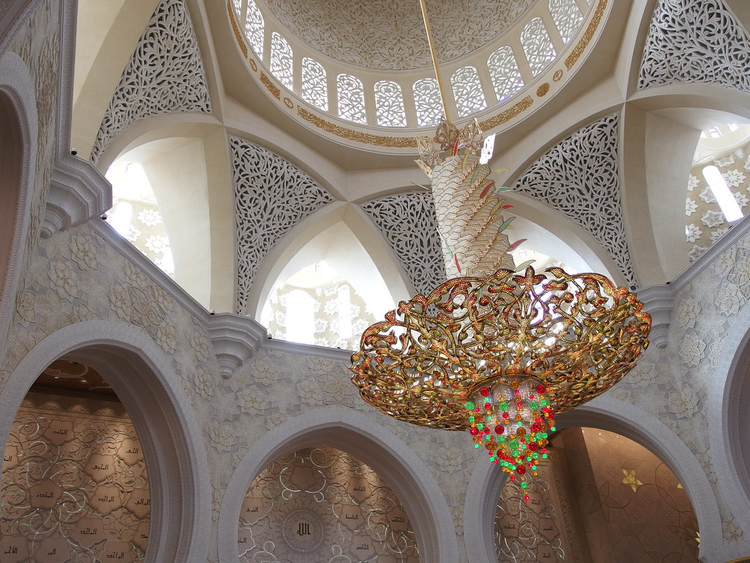
Inside, the mosque is even more lavish than outside. Under the central dome hangs a chandelier listed in the Guinness Book of Records for its size. It lights the main prayer hall.
On the floor of the hall lies a carpet that also made it into the Book of Records. It was woven from a design by an Iranian master using 35 tons of wool and 12 tons of cotton over two years; 1,200 craftsmen worked on it.
 © *_* · CC BYPhoto: *_*, CC BY (https://creativecommons.org/licenses/by/2.0/), Flickr
On the qibla wall, lighting highlights a mosaic of gold and glass. The 99 names of Allah are inscribed there in Kufic calligraphy.
Opening hours and entry
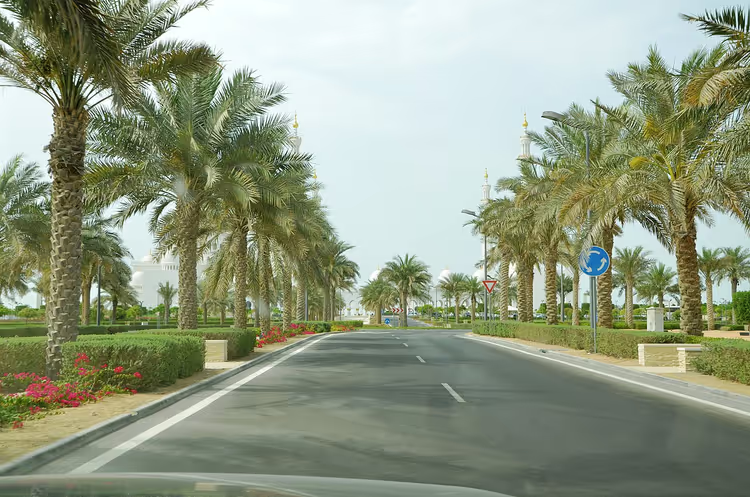
The mosque is open to visitors daily, and entry is free. An online pass is arranged in advance on the official website to avoid waiting in line (according to the visit page).
 © GinaD · CC BY-SAPhoto: GinaD, CC BY-SA (https://creativecommons.org/licenses/by-sa/3.0), Wikimedia Commons
Guided tours are free and run several times a day. Check the schedule on site or on the mosque's website. Visiting hours change by season and during Ramadan, so confirm them before your trip (visiting hours).
Tours and tickets in Abu Dhabi
Guided tours, skip-the-line tickets and activities — most offers can be cancelled free of charge.
See offers on GetYourGuideThe widget loads once you give your consent.
Dress code and rules of conduct
Traditions are taken seriously here, and clothing is checked at the entrance. Men need covered arms and legs. Women are given a free full-length black abaya and sheila (code of conduct).
Shoes are left on shelves at the entrance: you go inside barefoot. After each female guest, the abaya is washed and ironed again. It's worth reviewing the rules of conduct before your visit so you don't spoil your trip.
How to get there from Dubai
From Dubai to Abu Dhabi, an intercity bus runs from Al Ghubaiba bus station, next to Al Ghubaiba metro station. Buses depart every 20-30 minutes, and the trip takes about two hours (as of 09/2026, bus guide).
A ticket costs around 25 AED (as of 09/2026, E100 schedule).
In Abu Dhabi, transfer to a city bus to the Zayed Mosque stop. Routes 032, 044, and 054 work, and the fare is 2 AED with a Hafilat card (as of 09/2026, Hafilat fares).
If you're traveling with luggage or family, it's more convenient to take a taxi from the bus station: the ride is short and inexpensive.
⁉️🤔 Frequently asked questions
Is there an entrance fee for the mosque?
No, entry is free for all visitors, regardless of religion. You only pay for certain tours with transfers organized by third parties. The online pass on the official website is also free (visiting rules).
What should a woman wear to the mosque?
Modest, covered clothing and a headscarf are enough. A free full-length black abaya and sheila are provided at the entrance, so you don't need to buy anything specifically. Men should wear trousers and a long-sleeved shirt (clothing guidelines).
How long does a visit take?
The guided route takes from one and a half to two hours. Tours are free and run on a schedule several times a day. If you want to take photos with the evening lighting, add another hour.
How do I get there from Dubai without a car?
From Dubai, take the intercity bus from Al Ghubaiba station. The trip takes about two hours, and a ticket costs around 25 AED (as of 09/2026, intercity route). In Abu Dhabi, transfer to a city bus to the Zayed Mosque stop.
At opening in the morning, before 11:00, there are fewer people and soft light for photos. In the evening the mosque is beautifully lit, but most tours arrive around sunset. On Fridays worshippers come, so the flow is higher.
In short: what's worth booking
Sheikh Zayed Mosque is worth visiting on your very first day in Abu Dhabi. If you're coming from Dubai for one day, take the morning bus and save the evening for the lighting. If you're with family, plan your visit before noon: fewer people and milder heat.
To get to know the city, add the mosque to a general tour: Abu Dhabi tour on GetYourGuide.
A hotel near the mosque will simplify logistics: selection of Abu Dhabi hotels on Trip.com.

A small editorial team writing guides for independent travel. We travel ourselves, but we haven’t been everywhere, so we check prices, opening hours and how to get there against official sources.