
















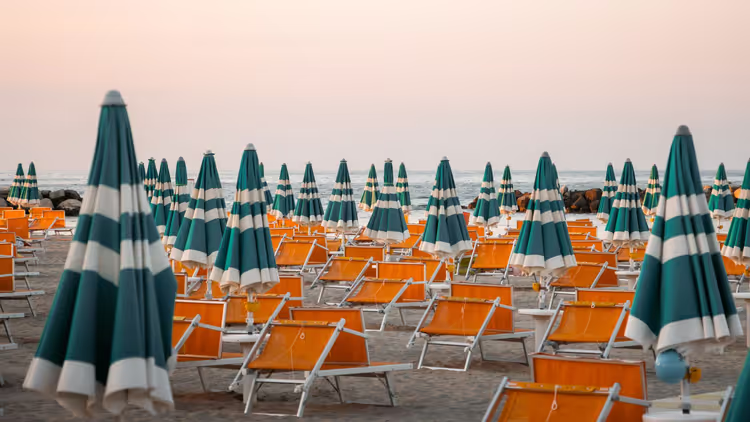
Rimini in two days: 15 places from the Arch of Augustus to the beaches
Rimini stretches along the Adriatic and is known primarily for its beaches. But the city is older than its resort: it has the oldest triumphal arch in Italy, and cars have been crossing the Tiberius Bridge for about two thousand years.
In two days you can cover both history and entertainment: the Arch of Augustus, both central squares, Castel Sismondo, the Ferris wheel, and parks like Fiabilandia. Paid attractions are marked separately.
Ad: this article contains affiliate links, we earn a commission if you book through them, at no extra cost to you.
Below are 15 places in walking order: from the Borgo San Giuliano district across the Tiberius Bridge to the beaches in the north of the city.
What to see in Rimini: 15 best places
💡 In short:
- The historic center is walkable: the Arch of Augustus, the Tiberius Bridge, Piazza Cavour, and Piazza Tre Martiri are all close together.
- Visit paid attractions (Museo Fellini, Domus del Chirurgo, Italia in Miniatura, Fiabilandia) in the morning before the lines form.
- Prices and opening hours: 09/2026, verified on the park's pricing page.
Place | What it is | Admission |
|---|---|---|
Borgo San Giuliano | district with frescoes and seafood restaurants | free |
Piazza Cavour | pedestrian square with three palaces | free |
Piazza Tre Martiri | Roman forum and baroque church | free |
Rimini Fiera | exhibition center with shuttle | event ticket |
Arch of Augustus | the oldest arch in Italy | free |
Tiberius Bridge | five-arch bridge over the Marecchia | free |
Castel Sismondo | Malatesta fortress and Museo Fellini | museum ticket |
Tempio Malatestiano | cathedral with a marble facade | free |
Domus del Chirurgo | glass canopy over a Roman house | museum ticket |
Museo Nazionale del Motociclo | motorcycle collection in the suburbs | museum ticket |
Italia in Miniatura | park of miniature replicas of Italy | park ticket |
Fiabilandia | amusement park for children | park ticket |
Parco Federico Fellini | park on the seafront | free |
Ruota Panoramica | Ferris wheel near the port | ticket |
Rimini beaches | sandy strip along the city | some sections free |
1. Borgo San Giuliano
 © RatMan1234 · CC BY-SAPhoto: RatMan1234, CC BY-SA (https://creativecommons.org/licenses/by-sa/4.0), Wikimedia Commons
Across the Tiberius Bridge begins Borgo San Giuliano, the most colorful residential district in the city. Houses stand close together, windowsills are filled with flowers, and the walls are painted with bright frescoes. It is also home to a 9th-century Benedictine abbey and the Romanesque church of San Giuliano.
Federico Fellini lived at Via San Giuliano, 71 and eavesdropped on his neighbors' conversations: lines from these courtyards ended up in his films. In the evening the district turns into a restaurant street with seafood menus, and locals still keep the tradition of ligaza, communal meals right on the square. If you get hungry, come here around seven.
- How to get there: on foot across the Tiberius Bridge, about 10 minutes from Piazza Tre Martiri (on the map).
- Nearby: the fish market and the Marecchia embankment.
2. Piazza Cavour
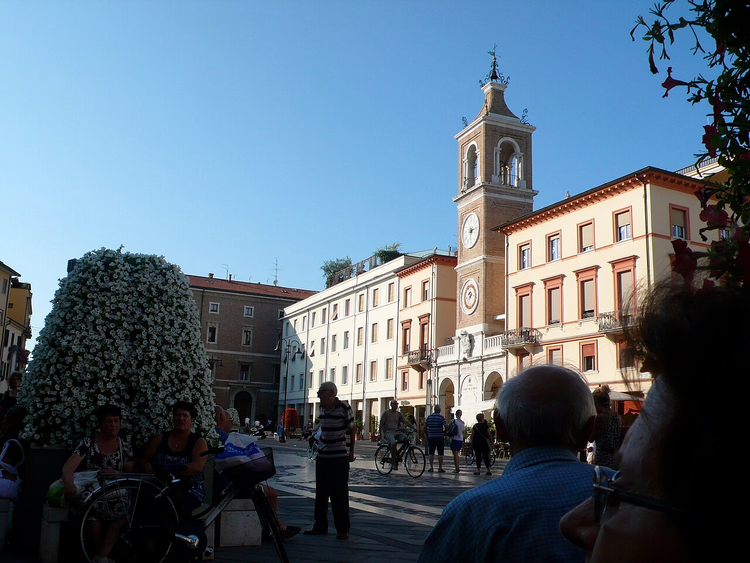
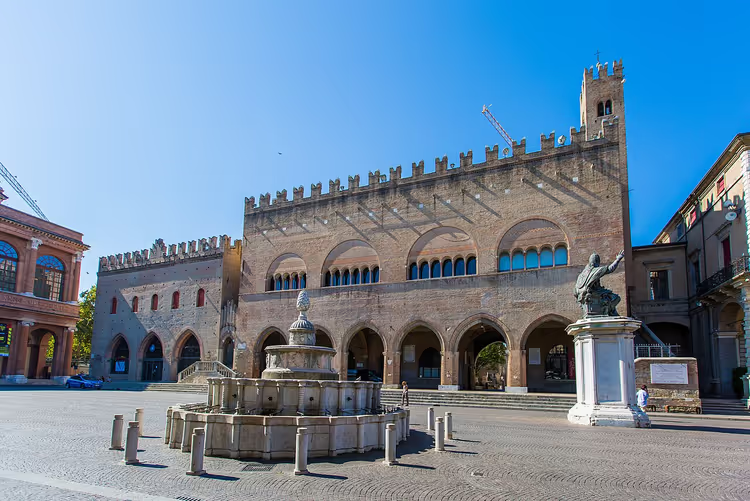
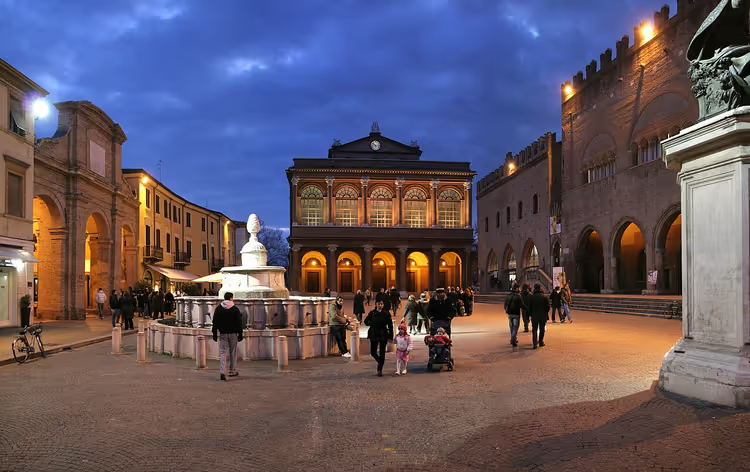
Rimini's cultural center brings together monuments from different eras on Piazza Cavour. On the pedestrian square you will see three palaces from the 13th to 16th centuries: the town hall, the palace of the city governor, and the medieval council hall. In the center stands a monument to Pope Paul V.
 © Laura Monetini · CC BY-SAPhoto: Laura Monetini, CC BY-SA (https://creativecommons.org/licenses/by-sa/4.0), Wikimedia Commons
You can cool off at the marble Pigna fountain: its water is drinkable, and benches are set up around it. For souvenirs, visitors head to the fish market with its 18th-century stone counters. Trading takes place every morning except Sunday, so it is best to come before noon.
- Admission: the square is open around the clock and free.
- Market: mornings on weekdays and Saturday, closed on Sundays.
- The catch: the fish market is closed on Sunday, and that is the main local spot.
3. Piazza Tre Martiri
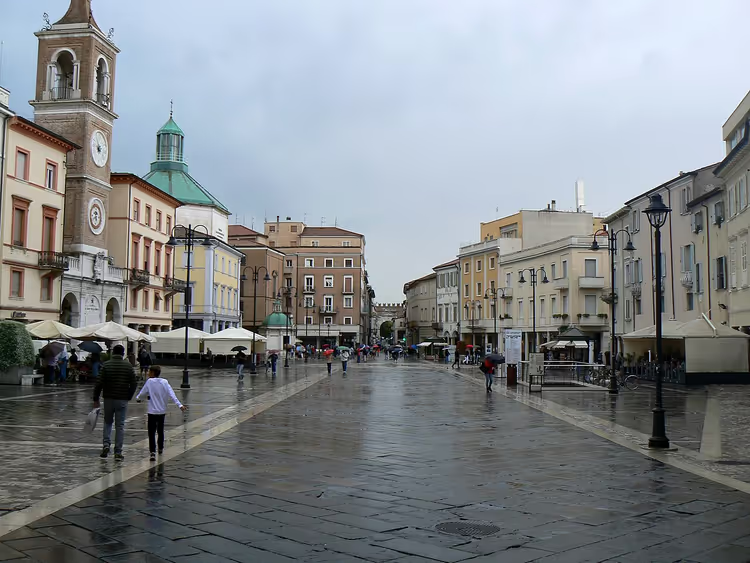
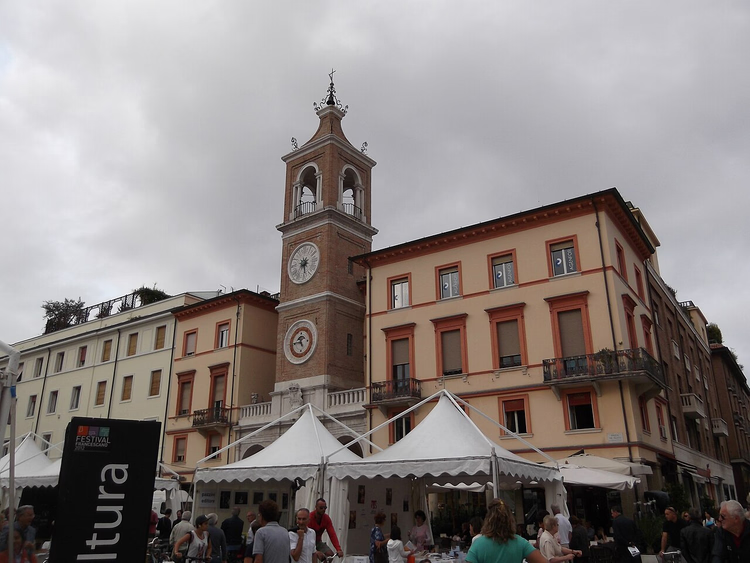
The square got its current name in memory of a World War II tragedy: in 1944 three Italian partisans were executed here. But the place is much older than its name. Before the square, there was a Roman forum here, and according to historians, Julius Caesar addressed the city from the surviving platform.
 © Paperoastro · CC BY-SAPhoto: Paperoastro, CC BY-SA (https://creativecommons.org/licenses/by-sa/4.0), Wikimedia Commons
The architectural core today consists of the 16th-century baroque church of Sant'Antonio and Palazzo Brioli with its brick clock tower, wrought-iron details, and astrological clock. The bronze monument to Caesar, installed in 1933, is on the north side of the square.
- Admission: free, the square is open around the clock.
- What to see: the astrological clock on the tower of Palazzo Brioli.
4. Rimini Fiera exhibition complex
In the northern part of the city, at Via Emilia, 155, the international exhibition center Rimini Fiera has been operating since 2001. It focuses on four themes: entertainment and tourism, ecology and technology, the food industry, and the hotel business.
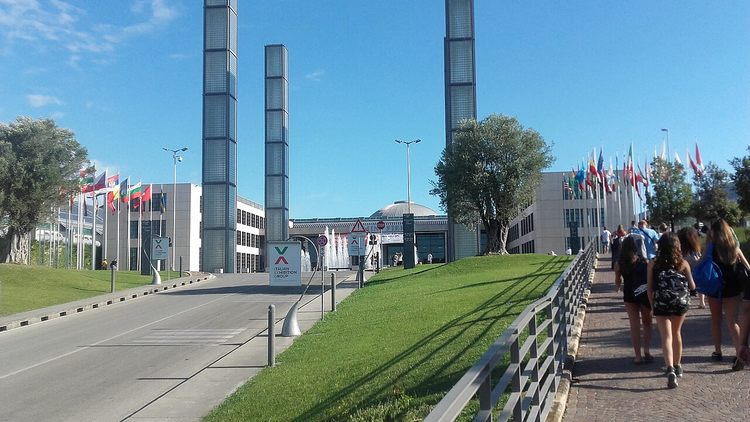 © Samuele2002 · CC BY-SAPhoto: Samuele2002, CC BY-SA (https://creativecommons.org/licenses/by-sa/4.0), Wikimedia Commons
The complex is so large that it has its own railway platform, Riminifiera, and an internal bus station. A free shuttle takes you between the pavilions, and inside there are conference halls, restaurants, and car rental. Tickets for public fairs are sold in advance, including through the city's travel agencies.
- Address: Via Emilia, 155, north of the city.
- How to get in: by train to the Riminifiera platform or on the free shuttle.
- The catch: this is a fairground, not a museum: outside of exhibitions there is nothing to see here.
5. Arch of Emperor Augustus
The Arch of Augustus closes off the pedestrian street Corso d'Augusto and is considered the oldest surviving triumphal arch in Italy. It was erected in honor of the emperor in 27 BC as part of the city's defensive wall.
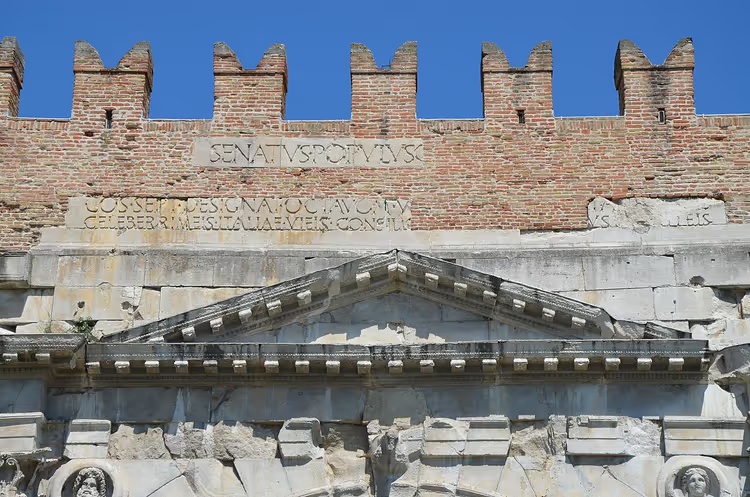 © Carole Raddato from FRANKFURT, Germany · CC BY-SAPhoto: Carole Raddato from FRANKFURT, Germany, CC BY-SA (https://creativecommons.org/licenses/by-sa/2.0), Wikimedia Commons
The arch was originally topped by a quadriga, but an earthquake destroyed it, and in the Middle Ages the structure was covered with a crenellated crown. On the facade facing Rome you can make out medallions of Jupiter and Apollo, and on the reverse side Minerva and Neptune. A model of the arch in its original form is kept in the city history museum.
- Address: Corso d'Augusto, at the start of the pedestrian zone.
- Admission: free, the monument stands in the open air.
6. Bridge of Tiberius
The Bridge of Tiberius did not end up on the city coat of arms by chance: five arches connect the banks of the Marecchia River. Construction began under Emperor Augustus and was completed under Tiberius.
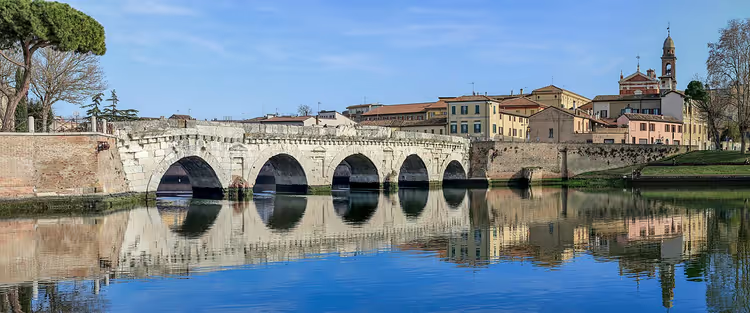 © Terragio67 · CC BY-SAPhoto: Terragio67, CC BY-SA (https://creativecommons.org/licenses/by-sa/4.0), Wikimedia Commons
The bridge has survived to this day almost unchanged. Latin inscriptions are still legible on the parapet, and on one of the stones there is a mark popularly known as the "devil's hoofprint." Its strength is attributed to a mortar made of lime and volcanic ash.
- Getting there: from Piazza Tre Martiri along Corso d'Augusto, about a 10-minute walk (see map).
- The catch: cars and buses still drive across the bridge, so you will have to walk alongside traffic.
7. Castel Sismondo
Castel Sismondo was built by Sigismondo Malatesta, who came to power in 1430. The work lasted 15 years, and in 1446 the family moved into the new residence, which looked more like a fortress. A moat and thirty-meter walls with bronze cannons separated it from the city.
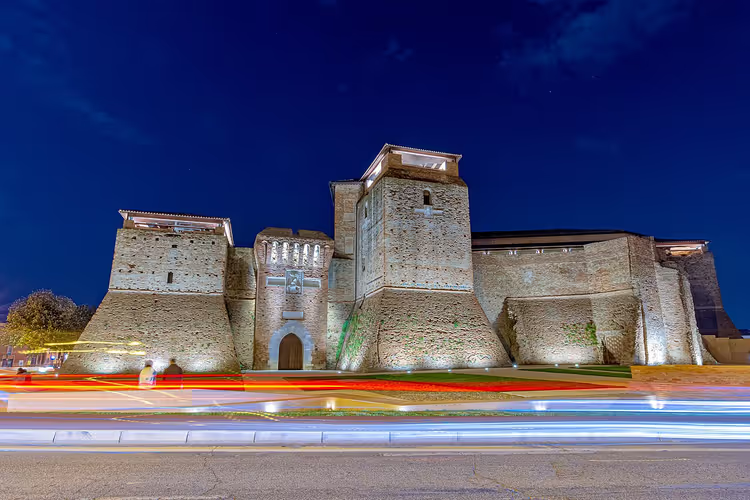 © Perpaulo40 · CC BY-SAPhoto: Perpaulo40, CC BY-SA (https://creativecommons.org/licenses/by-sa/4.0), Wikimedia Commons
After the ruler's death in 1468, the castle was turned into a barracks, and the rooms of the former palace were given over to exhibitions. Today the halls house the Museo Fellini, and the courtyard serves as a venue for cultural events. You will find massive walls, an inner courtyard, and exhibition halls.
- Address: Piazza Malatesta, historic center.
- Tickets and hours: check the official Museo Fellini website for closing days and opening times.
8. Tempio Malatestiano
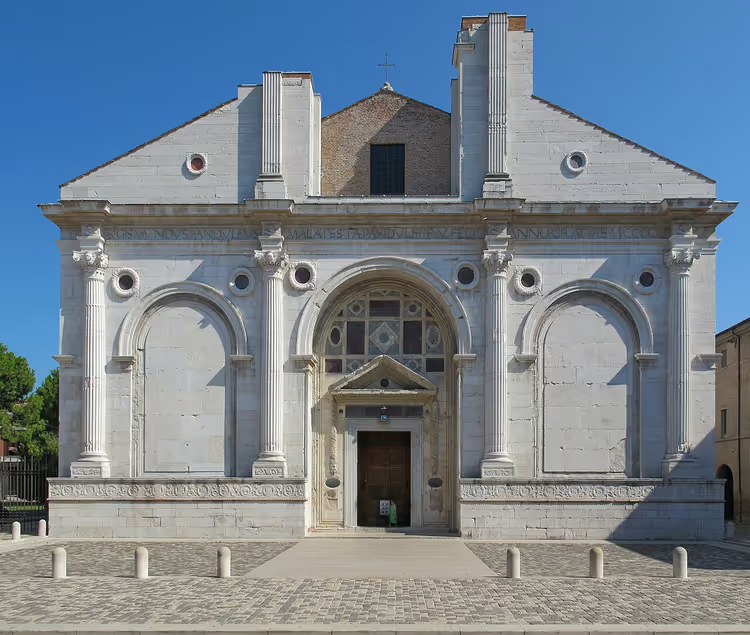
The Franciscan church at Via IV Novembre, 35 was rebuilt in the 15th century as a mausoleum for the Malatesta family. The architect Leon Battista Alberti was supposed to create a building comparable to the Pantheon, but the pope excommunicated Sigismondo, and construction was halted.
 © Sailko · CC BY-SAPhoto: Sailko, CC BY-SA (https://creativecommons.org/licenses/by-sa/3.0), Wikimedia Commons
The grand design was never completed. Today the cathedral is adorned with a marble facade, sculptures, and blind arches. Inside you will see a large altar crucifix and the sarcophagi holding Sigismondo and his beloved Isotta.
- Opening hours: times vary by day; see the current schedule on the Rimini parishes website.
- Admission: free.
9. The surgeon's house museum (Domus del Chirurgo)
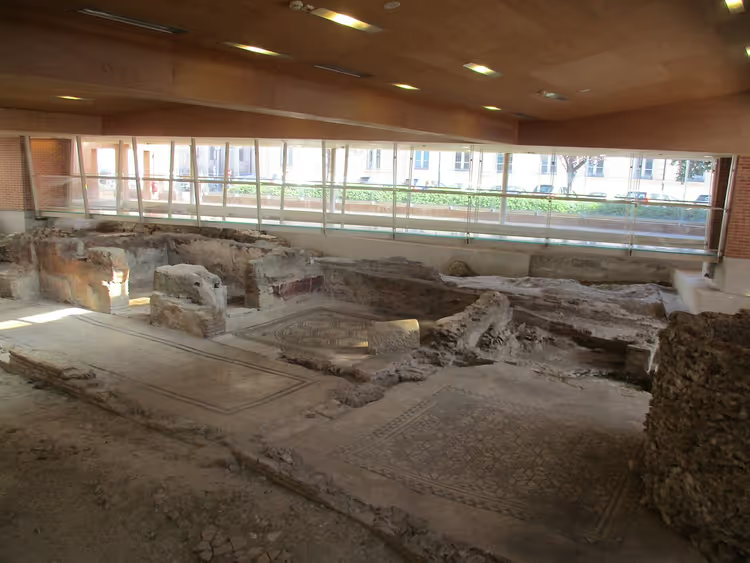
Domus del Chirurgo was discovered by accident: in 1989, during renovations on Piazza Ferrari, the remains of a two-story house from the 2nd century that was destroyed in a fire were uncovered. Excavations lasted ten years and yielded mosaics, coins, interior objects, and 150 medical instruments.
 © Capvalerio85 · CC BY-SAPhoto: Capvalerio85, CC BY-SA (https://creativecommons.org/licenses/by-sa/4.0), Wikimedia Commons
Today the 700 m² site is covered by a glass structure, and a museum operates inside. Here you will see the ruins of ancient buildings and artifacts from the 2nd to 18th centuries, and the surgical set is considered the most complete ever found in the Roman world.
- Address: Piazza Ferrari, historic center.
- Hours and tickets: closed on Mondays, prices and schedule on the Domus information page.
- Tickets online: tickets to Rimini museums on Tiqets.
- The catch: the museum is closed on Mondays.
10. National Motorcycle Museum
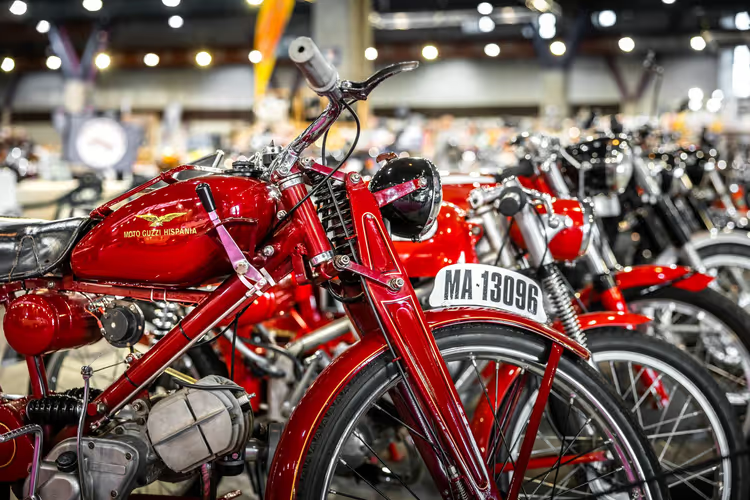
Museo Nazionale del Motociclo is located in the suburbs, at Via Casalecchio, 58. The two-story pavilion houses eight themed collections and about 250 models from 60 manufacturers: Frera, Ducati, Moto Guzzi, Benelli.
The museum's pride: an 1816 wooden bicycle, the 1920 Moto Pattino A.B.C. scooter ancestor, and a 1942 Harley-Davidson. Guests are welcome Tuesday through Sunday, so plan Monday for another item on your itinerary.
- Getting there: you will need a car or taxi to reach the suburbs (see map).
- Before you go: compare insurance options for your trip.
- The catch: far from the beach area, not walkable from the center.
11. Italia in Miniatura Park
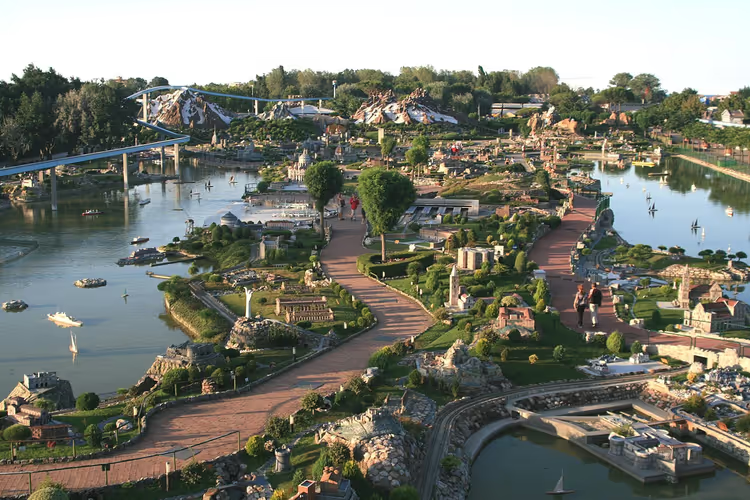
Italia in Miniatura opened in 1970 at Via Popilia, 239. The grounds feature 272 scaled-down replicas of Italian landmarks: the Colosseum, St. Peter's Basilica, the Grand Canal, where you can ride a gondola.
 © Hic et nunc · CC BY-SAPhoto: Hic et nunc, CC BY-SA (https://creativecommons.org/licenses/by-sa/3.0), Wikimedia Commons
Beyond the models, there are interactive exhibits: planes take off from miniature runways, trains depart from tiny stations. In the warm season the park is open daily, in winter it is open only on weekends, so it is best to check the calendar in advance. If you are traveling with kids, set aside half a day for the park.
- Prices and calendar: see the park's official website.
- Tickets: Rimini park tickets online.
- The catch: from October to March the park welcomes guests only on weekends.
12. Fiabilandia Amusement Park
Fiabilandia opened in 1965, making it Italy's first amusement park. At the entrance, guests are greeted by the fairy-tale castle of the wizard Merlin, and the 150,000 m² grounds are divided into four zones: the Wild West with Apache and Navajo villages, Peter Pan's pirate bay, the eastern sector, and the medieval section.
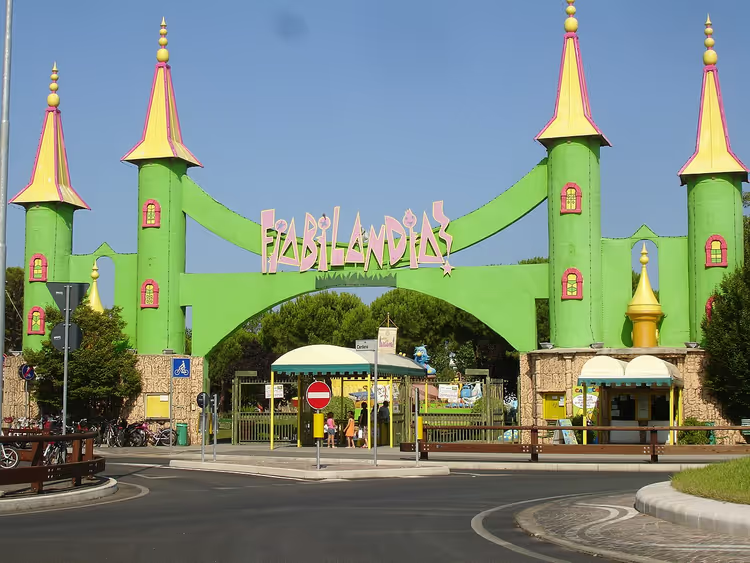
The ticket is valid for two consecutive days (as of 09/2026, Fiabilandia rates), so it's convenient to split the park into two visits. Prices checked on 14.09.2026 on the official website: adult online ticket 26 €, child ticket for heights 90-130 cm 18 €, children under 90 cm enter free (as of 09/2026, Fiabilandia rates).
- Address: Via Gerolamo Cardano, 15.
- 2026 season: standard tickets are valid from March 1 to November 8 (as of 09/2026, 2026 season calendar).
- The catch: the park is designed for children, adults will be done in two to three hours.
13. Federico Fellini Park
Parco Federico Fellini stretches along the city waterfront and is named after Rimini's famous native son. People come here for the shady alleys and leisurely seaside walks.
 © Emilio Salvatori · CC BY-SAPhoto: Emilio Salvatori, CC BY-SA (https://creativecommons.org/licenses/by-sa/4.0), Wikimedia Commons
The five-star Grand Hotel Rimini stands nearby: several scenes for the film "Amarcord" were shot there. A walk through the park fits easily into your route to the beaches.
- Admission: free, the park is open around the clock.
- Address: seaside promenade, next to Grand Hotel Rimini.
14. Ferris wheel
Ruota Panoramica stands by the Porto Canale canal and lifts guests to a height of 60 meters. On a clear day, from the top you'll see the city, the Adriatic, and even the Republic of San Marino.
 © RiminiCity · CC BY-SAPhoto: RiminiCity, CC BY-SA (https://creativecommons.org/licenses/by-sa/3.0), Wikimedia Commons
The wheel has 42 gondolas, and lighting made up of tens of thousands of lights makes it visible from afar. The rotation is fast, and sometimes the ride stops so passengers can board their cabins. It's especially beautiful here after sunset.
- Address: Largo Ruggero Boscovich, 1, by the port.
- Cost: adult ticket in the low double digits, children cheaper, current prices on the official website.
- The catch: in bad weather the schedule changes, and rides are canceled in windy conditions.
15. Rimini beaches
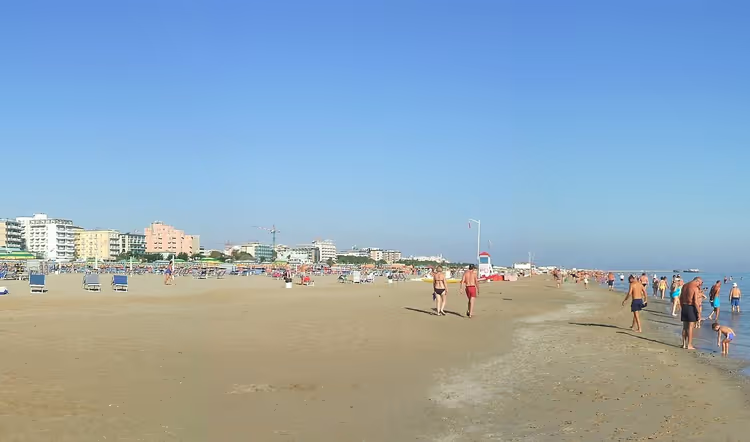
Rimini's beaches stretch along the city for about 15 km. From mid-June to September, people sunbathe on the fine sand and pebbles, play volleyball and tennis, and many sections host dance classes.
 © karel291 · CC BYPhoto: karel291, CC BY (https://creativecommons.org/licenses/by/3.0), Wikimedia Commons
In the south of the city, the shore is protected by a stone wall, so there are almost no waves there. The best areas are considered to be Bellariva, Marebello, Marina Centro, San Giuliano Mare, Rivabella, Miramare, and Viserabella. Choose a section that matches your pace: the center is livelier, the south is calmer.
- How much it costs: most beaches are paid and equipped with loungers and umbrellas, but free sections also exist.
- The catch: free beaches are crowded in summer, and by evening there can be litter.
- Where to stay: see hotels in Rimini on Trip.com.
Tours and tickets in Rimini
Guided tours, skip-the-line tickets and activities — most offers can be cancelled free of charge.
See offers on GetYourGuideThe widget loads once you give your consent.
⁉️🤔 Frequently asked questions
How many days do you need in Rimini?
Two days are enough for the historic center and entertainment: one day from the Arch of Augustus to Piazza Cavour, the second for the parks and the Ferris wheel. If you're coming for the sea, add another two to three days, since the beaches stretch for 15 km and each area differs from the next.
What can you see in Rimini for free?
The Arch of Augustus, the Tiberius Bridge, both central squares, Fellini Park, and admission to Tempio Malatestiano are free. Some beaches are also free. You'll have to pay for Museo Fellini in the Sismondo Castle, Domus del Chirurgo, Museo Nazionale del Motociclo, Italia in Miniatura, and Fiabilandia.
When is the best time to visit Rimini?
Beach season opens in mid-June and lasts through September. Parks operate longer: Fiabilandia welcomes guests from March to November, while Italia in Miniatura is open only on weekends in winter. For sightseeing, May and September are more comfortable.
Is it worth buying park tickets in advance?
Yes, online is cheaper and lets you skip the line at the entrance. We listed Fiabilandia ticket prices in the park section.
Is Rimini suitable for a family trip with kids?
It is. Fiabilandia is designed for children, Italia in Miniatura has moving models, and the sea near the shore is shallow. The historic center is also stroller-friendly: almost all streets are pedestrian, and distances between sights are short.
In short: what to book
If your trip is two days, choose a hotel in the center: from Piazza Cavour to the beach you can walk. If you're traveling with kids, add a day for Fiabilandia and Italia in Miniatura and buy tickets online. If the sea is your priority, look at the Bellariva and Miramare areas: they're calmer than Marina Centro.
Next, sort out your accommodation in advance: see hotels in Rimini on Trip.com.

A small editorial team writing guides for independent travel. We travel ourselves, but we haven’t been everywhere, so we check prices, opening hours and how to get there against official sources.