
















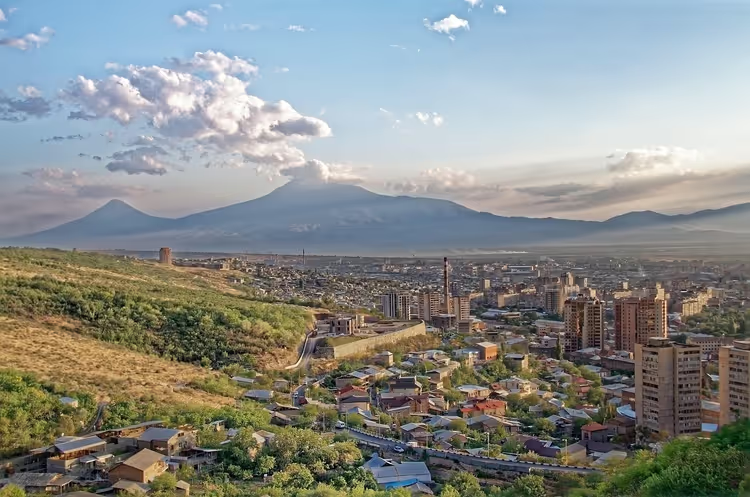
Yerevan in one day: 15 places and a walking route through the center
Yerevan is more compact than it seems. Most of the main sights are in the center, within walking distance of Republic Square. In one day you can cover the ancient fortress, the manuscript collection, and the evening fountains. The key is to plan the order, otherwise the day will be spent on getting around. Below is a route through Yerevan's main sights with prices, hours, and the logic behind the sequence. You'll take a taxi to the outlying points and walk the rest.
Ad: this article contains affiliate links, we earn a commission if you book through them, at no extra cost to you.
How to plan your Yerevan route
💡 In short:
- In the morning, go to the Cascade and Matenadaran: fewer people and softer light.
- Republic Square, the History Museum, and the Singing Fountains are best combined into one block closer to the evening.
- Erebuni Fortress and Tsitsernakaberd sit on different hills, so take a taxi between them.
- Prices and opening hours: 09/2026, verified on the official Matenadaran website
The Cascade complex
 © Gerd Eichmann · CC BY-SAPhoto: Gerd Eichmann, CC BY-SA (https://creativecommons.org/licenses/by-sa/4.0), Wikimedia Commons
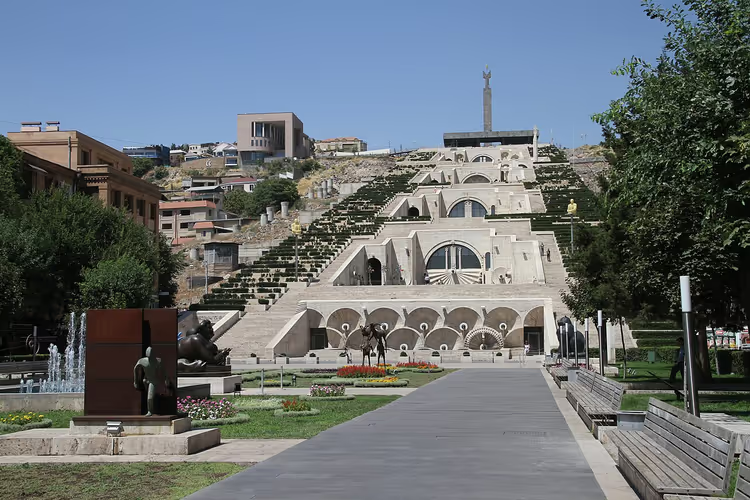
The Cascade is a monumental staircase that descends from Mashtots Avenue toward the city center. The project was conceived by architect Tamanyan back in the early twentieth century, so the staircase is considered part of the city's overall development plan. Flower beds and fountains sit between the flights of steps, and the complex is crowned by the obelisk "Reborn Armenia". Exhibition halls and cafes are gradually opening inside, so you'll spend part of your time beyond just the steps.
The climb takes longer than it looks in photos. The steps are high, and in summer they get scorching hot in the sun. Come before the heat or closer to sunset. From the middle of the climb, a wide panorama of the city opens up in front of you, and this is a good spot for your first photos.
- Getting there: the complex is in the center, off Mashtots Avenue.
- Cost: admission is free.
Matenadaran Museum
 © Diego Delso · CC BY-SAPhoto: Diego Delso, CC BY-SA (https://creativecommons.org/licenses/by-sa/4.0), Wikimedia Commons
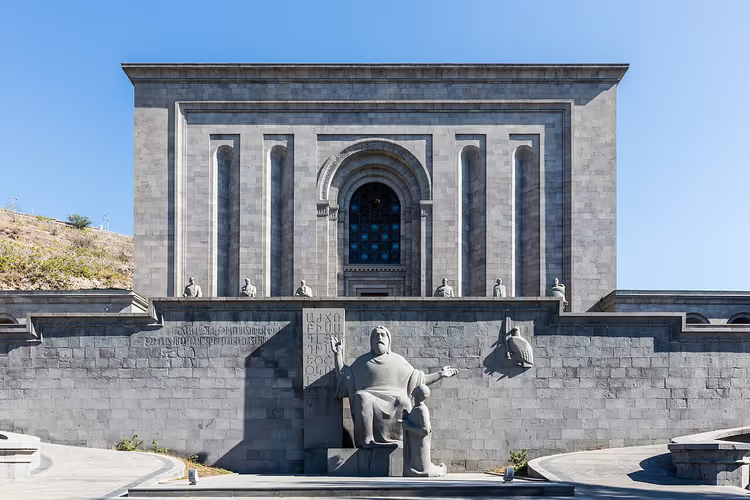
Matenadaran is an institute of ancient manuscripts and one of the city's main museums. It houses thousands of Armenian manuscripts and documents, including the first printed books in Armenian. The exhibition explains the history of Armenian writing and the writing of the state of Urartu. The name translates as "book depository", and it captures the essence of the place precisely. Among the manuscripts are works on history, geography, philosophy, and medicine.
The building is designed in the style of Armenian architecture, with sculptures of Mesrop Mashtots and other scholars standing in front of the entrance. The museum is open Tuesday through Saturday, from 10:00 to 17:50. Adult admission costs 2000 AMD, about 5 € (as of 09/2026, official website). Monday is a day off, so don't schedule your visit for the first day of your trip. Allow an hour for the visit; you're unlikely to stay longer without a guide.
Tsitsernakaberd Memorial
 © Aleksey Chalabyan (a.k.a. Xelgen) · CC BY-SAPhoto: Aleksey Chalabyan (a.k.a. Xelgen), CC BY-SA (https://creativecommons.org/licenses/by-sa/4.0), Wikimedia Commons
Tsitsernakaberd serves as a memorial to the victims of the Armenian genocide in the Ottoman Empire. It stands on a hilltop in the park of the same name. At the center of a circular mausoleum made of twelve pylons burns an eternal flame. Each pylon symbolizes one of the provinces where Armenians lived, and the mausoleum is crowned by a tall obelisk split into two parts.
An avenue of fir trees planted by official guests from various countries leads to the memorial. The place is quiet and solemn; visitors are expected to behave with restraint and keep noise down. Come here in the morning or on a weekday: on commemorative dates it gets crowded. The visit will take you about half an hour.
Mother Armenia Monument
 © Mosinyan · CC BY-SAPhoto: Mosinyan, CC BY-SA (https://creativecommons.org/licenses/by-sa/3.0), Wikimedia Commons
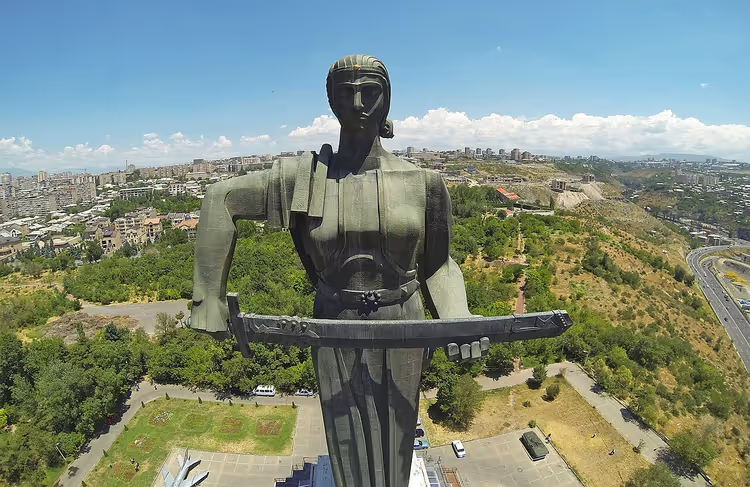
The Mother Armenia Monument stands on a hill in Victory Park, in line with Mashtots Avenue. It is a tall female figure with a sword: she is sheathing it, and a shield lies at her feet. In this way the sculpture evokes readiness to defend the country and hope for peace. Until the 1960s, a statue of Stalin stood on this pedestal; it was later replaced by Mother Armenia.
The statue is made of hammered copper. Next to the monument are displays of military equipment, and at its foot an eternal flame burns at the Tomb of the Unknown Soldier. The Ministry of Defense Museum also operates here. From the platform in front of the statue you get a view of the city center, and it's a good spot for panoramic shots.
Armenian Genocide Museum
 © User:Matthias Süßen · CC BY-SAPhoto: User:Matthias Süßen, CC BY-SA (https://creativecommons.org/licenses/by-sa/4.0), Wikimedia Commons
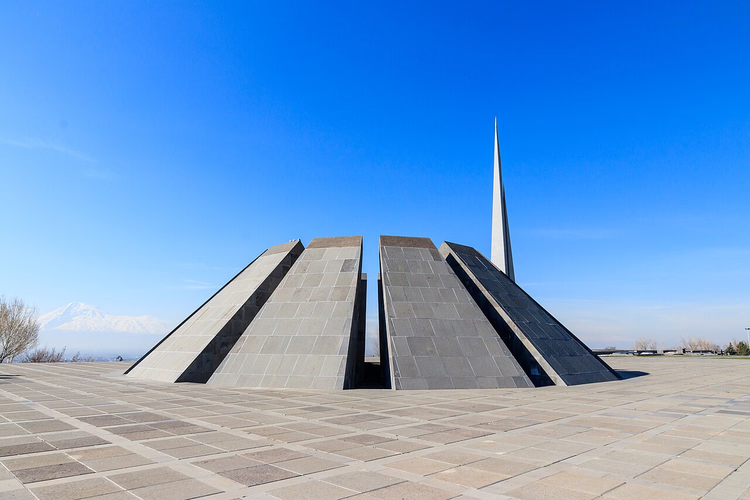
The Armenian Genocide Museum is open next to the Tsitsernakaberd memorial. It is built underground: two levels where the exhibition tells the story of the causes and course of the tragedy. You will see original photographs, documents and testimonies. The rooms on the lower level resemble a vast tomb, while the circular halls on the upper level represent the circles of hell.
The open-air hall is made of granite blocks bearing words of condemnation of the genocide from famous people around the world. An archive, a library and a lecture hall also operate here. Admission is free, but the entrance area and opening hours may change on commemorative dates. The exhibition is emotionally heavy, so do not leave it for the very end of the day.
Blue Mosque
 © 23artashes · CC BY-SAPhoto: 23artashes, CC BY-SA (https://creativecommons.org/licenses/by-sa/4.0), Wikimedia Commons
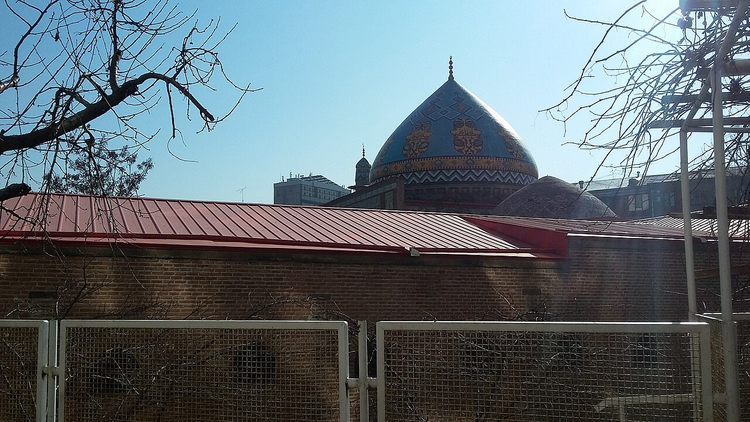
The Blue Mosque is a Persian mosque, unusual for an Armenian city. It got its name from the color of its dome and the blue lines of the Quran on its walls. The building was preserved during the Soviet years: the poet Yeghishe Charents proposed turning it into a history museum and making it a neutral site. Today it is a functioning mosque and cultural center, a symbol of good neighborly relations.
Around the mosque there is a garden and a pond, a pleasant place to rest in the heat. Admission is usually free, but during prayer times tourists are asked not to disturb worshippers and not to photograph people in close-up. Keep this in mind if you plan to go inside.
Erebuni Fortress
 © Dm Bsg · CC BYPhoto: Dm Bsg, CC BY (https://creativecommons.org/licenses/by/3.0), Wikimedia Commons
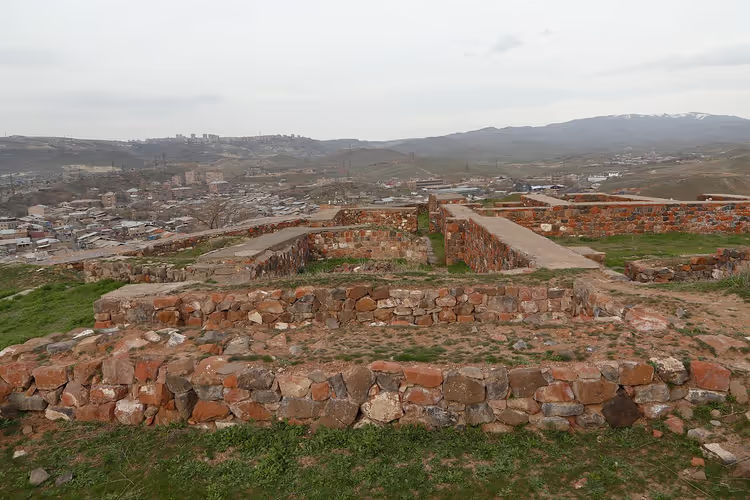
Erebuni is the ruins of the fortress where the history of Yerevan began. King Argishti I founded it almost three thousand years ago, and the date is recorded in a cuneiform document found during excavations. Today it is an open-air museum: massive walls of clay bricks, remains of the royal palace and temples, fragments of wall paintings.
The museum at the fortress opened in 1968 and holds finds from three ancient sites. A model helps you imagine the original appearance of the buildings. The area is open, so bring a hat and water. Finds from these excavations continually add to the museum's collection. You can get here from the center by taxi, and the ride does not take long.
Republic Square
 © Vyacheslav Argenberg · CC BYPhoto: Vyacheslav Argenberg, CC BY (https://creativecommons.org/licenses/by/4.0), Wikimedia Commons
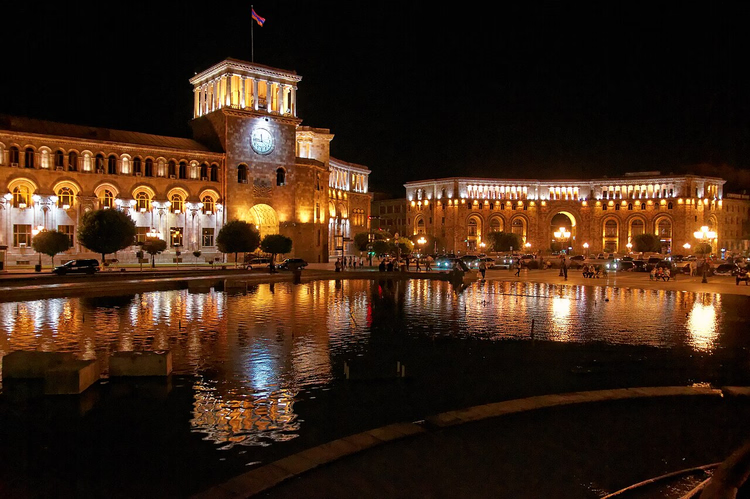
Republic Square is considered the main square of the city, and its plan combines an oval and a trapezoid. Along its perimeter stand five buildings of tuff and basalt: the Government House, the House of Ministries, the Central Post Office, the Marriott Armenia hotel and the History Museum. The project was designed by architect Tamanyan, and work on the ensemble took him more than twenty years.
All the buildings are made of multicolored tuff: pink, black and white. The facades are decorated with arches, columns and carved ornament in the national style. In the evening it is especially crowded here, and the lighting gives the square a ceremonial look. During the day tour groups pass through. You can easily spend an hour here just looking at the architecture.
National history museum of Armenia
 © Diego Delso · CC BY-SAPhoto: Diego Delso, CC BY-SA (https://creativecommons.org/licenses/by-sa/4.0), Wikimedia Commons
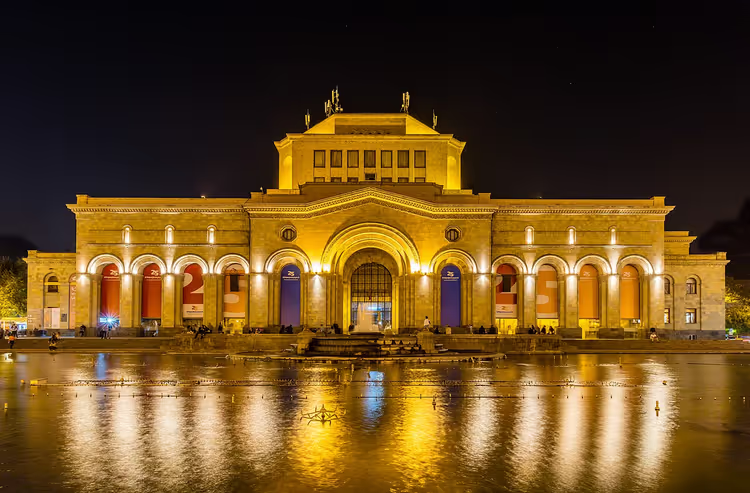
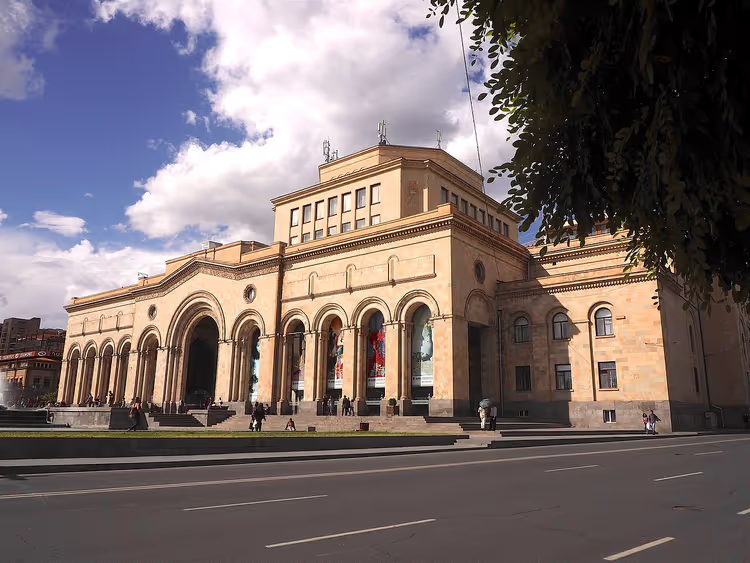
The National History Museum of Armenia occupies half of one of the buildings on Republic Square. The other half is given to the National Gallery. The museum's collection numbers about four hundred thousand items and covers all periods of the country's history. Five departments operate here: archaeology, ethnography, numismatics, architecture and modern history.
Founded in 1921, the museum is constantly growing (as of 09/2026, official website). In the archaeology hall you will see bronze, ceramics, gold and silver, weapons and cuneiform texts. The Urartu exhibition works especially well after visiting Erebuni Fortress. The Urartu halls display vessels for wine and grain. It is better to buy tickets online to avoid standing in line at the ticket office.
Singing Fountains
 © Vyacheslav Argenberg · CC BYPhoto: Vyacheslav Argenberg, CC BY (https://creativecommons.org/licenses/by/4.0), Wikimedia Commons
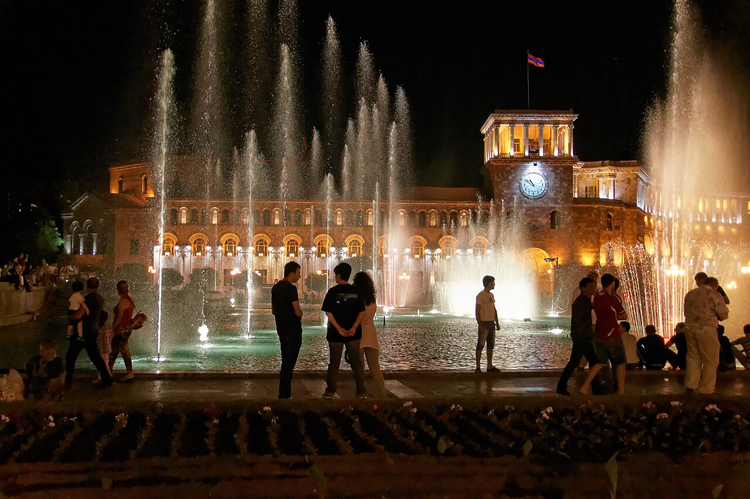
The Singing Fountains stand on Republic Square, near the History Museum building. The jets rise in time with the music and change their lighting. The first such fountain was assembled on a German model more than half a century ago, and later it was reconstructed and modernized. The music varies, from classical to contemporary melodies. The show is free, and you do not need a ticket.
In the evening both tourists and locals gather around the basin. Come at dusk to get a good spot by the parapet. The schedule depends on the season, so check the exact time on site. In winter the fountains are usually turned off.
Charles Aznavour Square
 © Clay Gilliland from Chandler, U.S.A. · CC BY-SAPhoto: Clay Gilliland from Chandler, U.S.A., CC BY-SA (https://creativecommons.org/licenses/by-sa/2.0), Wikimedia Commons
Charles Aznavour Square is named after the French chansonnier of Armenian descent. It was laid out according to Tamanyan's plan and is now surrounded by cultural institutions: the Moscow cinema, the Stanislavski Drama Theater, and the Artists' House. At its center stands the Zodiac Signs fountain with twelve figures, and from different angles they look different each time.
The square was named after Aznavour in the early 2000s, when he visited for the republic's independence celebrations. It also has its own Walk of Stars with the names of cultural figures. It's a quiet spot just steps from the bustling Republic Square, and you can easily combine both in one walk.
Ararat Brandy Factory
 © Gerd Eichmann · CC BY-SAPhoto: Gerd Eichmann, CC BY-SA (https://creativecommons.org/licenses/by-sa/4.0), Wikimedia Commons
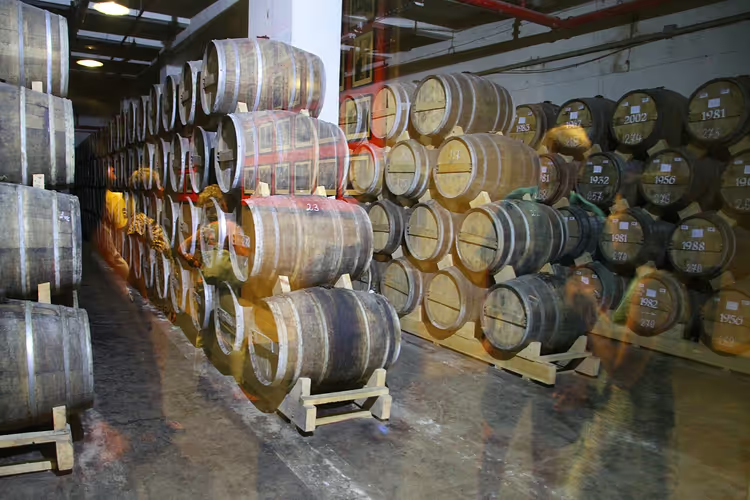
The Ararat Brandy Factory is considered one of Armenia's symbols. It produces brandy that has been made since the late nineteenth century, and today the company is part of the Pernod Ricard group. During a tour you'll see the cellars and production areas and get to taste several varieties. The brand has won medals at international exhibitions many times, and today it's one of the country's most recognizable enterprises.
It's best to book in advance: tours run on a schedule, and spots fill up quickly in season. Across from the factory is the Noy wine and brandy complex with a museum, and at the company store you can buy a bottle of the variety you want. Check opening hours and tour prices on the official website.
Zoo
 © RG72 · CC BY-SAPhoto: RG72, CC BY-SA (https://creativecommons.org/licenses/by-sa/4.0), Wikimedia Commons
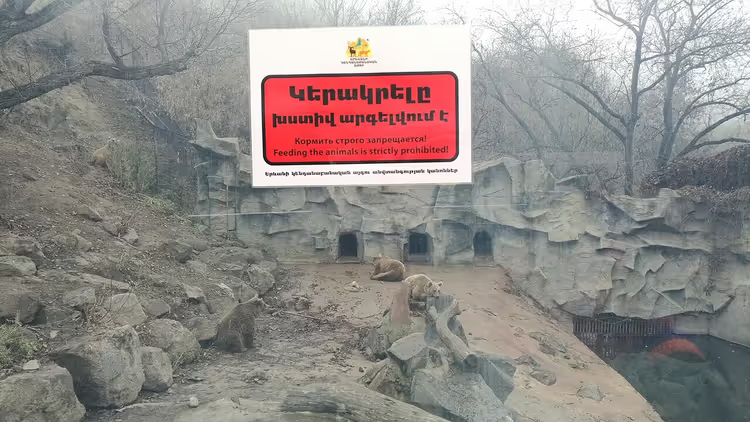
Yerevan Zoo occupies a large area in the northeast of the city. It opened in the pre-war years, and the main idea here is that animals get their food themselves. Fruit is hidden in ice cubes for the bears, meat is hung up for the tigers, and food is packed into cardboard boxes for the cats. As a result, the animals move more and behave more actively, especially at feeding times.
Watching these "meals" is interesting for both adults and children. On holidays the zoo puts on shows with animation and puppet performances. On the grounds you'll see sculptures made by children from plastic bottles and other materials.
Lovers' Park
 © GeoO · CC BY-SAPhoto: GeoO, CC BY-SA (https://creativecommons.org/licenses/by-sa/4.0), Wikimedia Commons
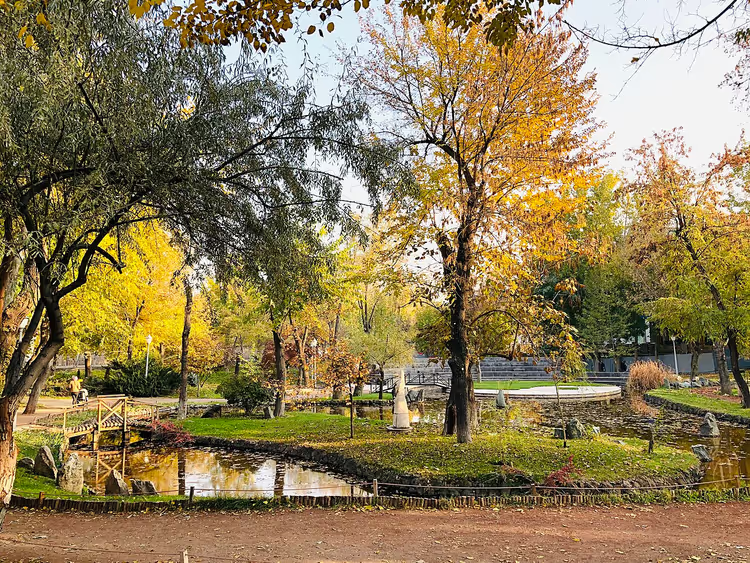
Lovers' Park lies on Marshal Baghramyan Avenue. It used to be called Pushkin Garden, and it got its romantic name in the 1990s. After a major renovation, it gained a summer cafe and an amphitheater where concerts and celebrations are held. At the center of the park stands a statue of the poet Gevorg Emin.
The park has walkways, a small lake, ponds, and a mini waterfall, with ornamental shrubs and flower beds along the paths. It's a convenient place to rest after Republic Square. The site is small, and half an hour is enough for a stroll.
Sergei Parajanov house museum
 © Tiia Monto · CC BY-SAPhoto: Tiia Monto, CC BY-SA (https://creativecommons.org/licenses/by-sa/3.0), Wikimedia Commons
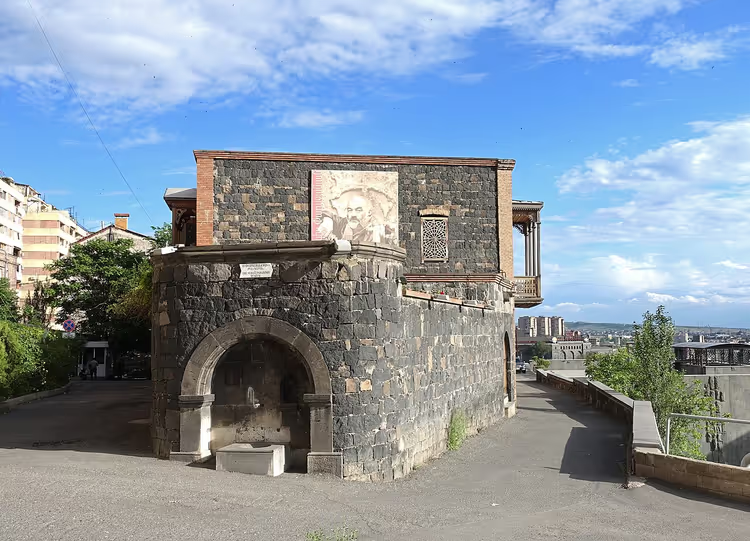
The Sergei Parajanov house museum is dedicated to the film director and artist who bequeathed his works to Armenia. The museum was founded during his lifetime and opened in 1991. Inside, the interior of his Tbilisi home has been recreated and personal belongings are on display. Among the main exhibits you'll see drawings, collages, film sketches, dolls, and ceramics.
The museum is open every day from 10:30 to 18:00, with last entry at 17:15 (as of 09/2026, official website). Allow about an hour for your visit. Two memorial rooms contain photographs, letters, and critics' reviews. It's a quiet place, and here you'll see Parajanov not as a director but as an artist.
Tours and tickets in Yerevan
Guided tours, skip-the-line tickets and activities — most offers can be cancelled free of charge.
See offers on GetYourGuideThe widget loads once you give your consent.
One-day Yerevan route on the map
Below is a map with the route points. Open it on your phone and check off what you've covered. This way you won't get lost between the hills and the center and you'll save time on getting around.
What to see in Yerevan in one day
Places on the map
- 1Cascade Staircase monument with the 'Reborn Armenia' obelisk
- 2Matenadaran Institute of ancient manuscripts, thousands of Armenian manuscripts
- 3Tsitsernakaberd Memorial to the victims of the Armenian genocide, Eternal Flame
- 4Mother Armenia Monument Tall female figure with a sword in Victory Park
- 5Blue Mosque Persian mosque with a blue dome and Quran inscriptions on the walls
- 6Erebuni Fortress Ruins of a fortress nearly three thousand years old
- 7Republic Square Main tuff-stone square, architectural ensemble by Tamanyan
- 8National History Museum of Armenia About four hundred thousand exhibits, the Urartu hall
- 9Singing Fountains Water jets synced to music with changing illumination
- 10Charles Aznavour Square 'Zodiac Signs' fountain and its own 'Walk of Fame'
- 11Yerevan Zoo Animals find their own hidden food
- 12Lovers' Park Former Pushkin Garden with a lake and amphitheater
- 13Sergei Parajanov House-Museum Drawings, collages and personal belongings of the director
⁉️🤔 Frequently asked questions
Will I be able to see Yerevan in one day?
Yes, if you stick to the center and don't take a tour in every museum. The Cascade, Republic Square, and the Singing Fountains are close together. Matenadaran will take about an hour, and the History Museum about the same. Put Erebuni Fortress and Tsitsernakaberd in the afternoon, between the morning block and Republic Square.
What can I see in Yerevan for free?
The Cascade, Republic Square, the Singing Fountains, Charles Aznavour Square, Lovers' Park, the Blue Mosque, and the Tsitsernakaberd Memorial. These are open spaces with no ticket. You only pay for museums and tastings. The evening fountains are also free.
When do the Singing Fountains turn on?
The fountains operate in the warm season, usually starting at dusk. They are turned off in winter. The exact time depends on the month and weather, so check on site. Arrive early: there are always many people around the basin.
How do I get from Yerevan airport to the center?
A taxi or transfer to the center takes little time and is convenient with luggage. The bus is cheaper but takes longer. Compare transfer options in advance so you don't have to look for a car on the spot.
What days are the museums in Yerevan open?
Most museums are closed on Mondays, while the Matenadaran is open Tuesday through Saturday, from 10:00 to 17:50 (current hours). Check the website before your visit: hours change on holidays. The Parajanov House-Museum is open every day (schedule).
In short: what to book
If you only have one day, it's best to stay near Republic Square. From there you can walk to the Cascade, museums, and fountains, leaving only Erebuni and Tsitsernakaberd for a taxi.
If you want to see as much as possible, look for accommodation in the center: hotels in Yerevan on Trip.com.
If you're traveling without a car, book tours on GetYourGuide. And arrange your airport transfer in advance through a transfer service.
Plan your evening at the Singing Fountains ahead of time, and your day will be packed without feeling rushed.

A small editorial team writing guides for independent travel. We travel ourselves, but we haven’t been everywhere, so we check prices, opening hours and how to get there against official sources.