
















Sri Mariamman in Singapore: opening hours, entry and route from the metro
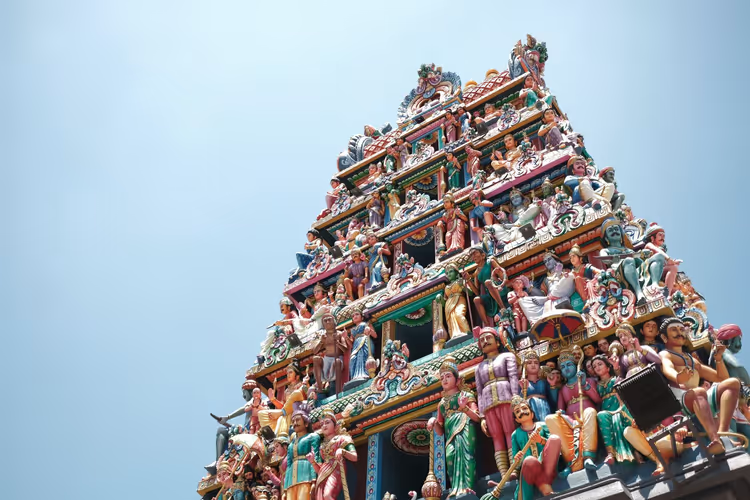
Sri Mariamman Temple has stood in Chinatown since 1827. It is the oldest Hindu temple in Singapore, and admission is free. Every day, dozens of people remove their shoes at the threshold and walk up to the six-tiered gopuram. Behind the tower, white columns, painted murals, and active shrines await you.
Both worshippers and tourists come here. The rules are short but strict: shoes stay at the entrance, and the bell at the threshold rings twice. In October or November, the temple hosts the fire-walking festival of Thimithi.
Below is the practical part: opening hours, admission, directions from the MRT, and tips that will save you time.
Ad: this article contains affiliate links, we earn a commission from them, the price for you stays the same.
History of sri mariamman temple
💡 In short:
- Admission is free, the temple was founded in 1827 (according to the Chinatown tourism website).
- Open daily: 05:30-12:00 and 16:30-21:00 (opening hours).
- Address: 244 South Bridge Road, Singapore 058793 (temple contacts).
- Prices and opening hours: as of 09/2026, verified on the official temple website.
The idea for the temple was proposed by Naraina Pillai, a clerk of the East India Company from Penang. He arrived in Singapore together with Stamford Raffles in 1819 and opened the first brick kiln here (according to the official temple website). Business quickly took off, and Pillai became a leader of the Indian community.
The first plot for the temple was allocated by the company on Telok Ayer Street. There was no fresh water there, and without it rituals are impossible. William Farquhar approved another plot near the future Stamford Canal in 1821, but city plans changed. The land on South Bridge Road was granted only in 1823 (according to the official temple website).
 © Rainer Halama · CC BY-SAPhoto: Rainer Halama, CC BY-SA (https://creativecommons.org/licenses/by-sa/4.0), Wikimedia Commons
By 1827, a wooden temple with an attap roof stood on the site. Around the same time, Naraina Pillai installed a small statue of the deity "Sinna Amman". This statue has survived and stands in the main shrine today (according to the temple's official website). In 1843, the first brick and plaster building appeared, and in 1962 the temple was rebuilt and decorated with carvings.
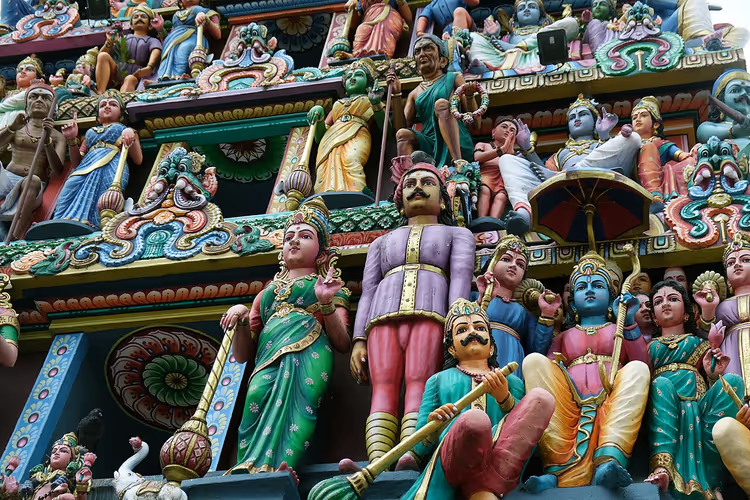
The gopuram has its own story. The first tower was erected in the late 19th century with almost no ornamentation. In the 1930s it was dismantled and reassembled, and in the 1960s it was covered with carved sculptures (according to the temple's official website). Today the gopuram has six tiers (according to the National Library of Singapore). The temple is listed as a national monument of the city (according to the national monuments register).
During the colonial years, the temple gave shelter to new immigrants from South India. Hindu marriages were also performed here: only the priests of Sri Mariamman had the right to do so (according to the temple's official website).
Temple and shrine overview
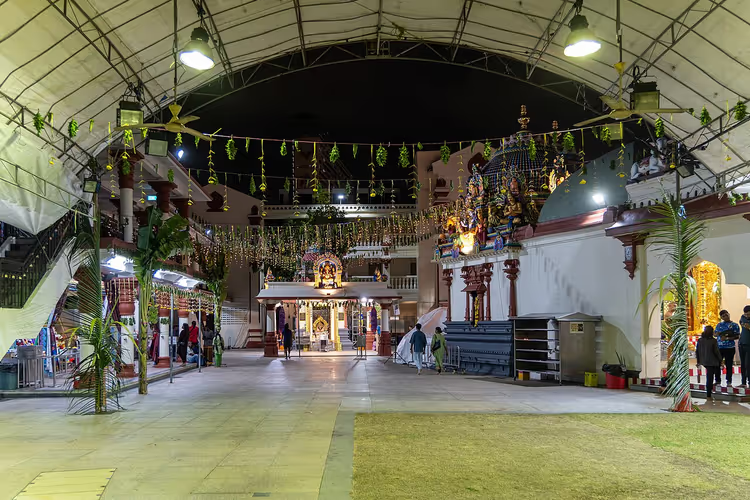
Walking through Chinatown, you are unlikely to miss it. The gopuram facade is densely packed with figures of Indian gods across all six tiers. The walls inside are painted with colorful scenes, and white columns divide the hall into galleries.
 © kallerna · CC BY-SAPhoto: kallerna, CC BY-SA (https://creativecommons.org/licenses/by-sa/4.0), Wikimedia Commons
Behind the columned arcade stands the main altar. It is dedicated to Mariamman, the goddess who, according to legend, healed people from epidemics. The passage to the altar is closed to visitors; only priests may enter.
Shrines to other gods are arranged around the perimeter of the hall. On the left stand Ganesha and Durga, the warrior goddess who protects against demons. Nearby, devotees honor Iravan and Draupadi, whose shrine is considered the second most important. The five Pandavas from the epic "Mahabharata" occupy a separate spot by the left wall (according to the temple's official website).
The temple contains sculptures of yoni and lingam, symbols of the female and male principles. A flagpole stands at the entrance. When a festival or ritual is being prepared, a banner is raised on it as a sign for the whole community.
Opening hours and admission (as of 09/2026)
What | Details |
|---|---|
Morning | 05:30-12:00 |
Evening | 16:30-21:00 |
Admission | free for adults and children |
Address | 244 South Bridge Road, Singapore 058793 |
Phone | +65 6223 4064 |
Hours and prices are taken from the Chinatown website (as of 09/2026). The temple closes at noon, so do not plan your visit around lunchtime. There are fewer visitors in the morning: by 08:00 the area near the gopuram is almost empty.
Admission is free, but the rules apply to everyone. You leave your shoes on the shelf by the door and walk barefoot both in the courtyard and inside. The bell at the threshold rings twice: once on the way in and once on the way out.
Photography inside is allowed for a separate fee; check the amount on site. It is best to cover your shoulders and knees. Tourists are not allowed into the main altar.
Want to see Chinatown with a guide? Chinatown tours on GetYourGuide run every day.
Tours and tickets in Singapore
Guided tours, skip-the-line tickets and activities — most offers can be cancelled free of charge.
See offers on GetYourGuideThe widget loads once you give your consent.
Tips before your visit
Before entering, think through three things: shoes, clothing, and camera. The short list below will save you time and stress.
- Ring the bell at the entrance and on the way out. This is how you announce your arrival to the gods.
- Go barefoot. Leave your shoes at the entrance, this is a mandatory rule for everyone.
- Cover your shoulders and knees. There is no strict dress code, but respect for the place matters.
- Photos inside are paid. Ask the attendants about the price, and do not photograph people without their consent.
- Sit on the floor by the wall and observe. The prayer goes on as usual, and no one will disturb you.
Theemithi festival in October and November
The temple's main festival is Theemithi, the firewalking ceremony. It takes place every year in October or November (according to the temple's official website). Devotees walk barefoot across a pit of hot coals to prove the strength of their faith.
The procession starts from the neighboring Sri Srinivasa Perumal Temple. A priest leads the way, followed by hundreds of people (according to the Hindu Endowments Board). Traditionally, men walk across the coals.
The spectacle draws thousands of spectators. If you are in Singapore during these weeks, come early: spots along South Bridge Road are taken well before the start. The exact date for 2026 is announced on the temple's website.
How to get to the temple
The address is simple: 244 South Bridge Road in Chinatown. The nearest MRT station is Chinatown, about 400 m from the temple, a 5-minute walk. Exit toward South Bridge Road and walk along the block.
You can also come by bus: the stop is right next to the temple. Taxis and Grab are easy to call to Chinatown Complex, from there it is a one-minute walk to the gate.
Two more landmarks stand nearby: Jamae Mosque and Sri Srinivasa Perumal Temple (according to the National Heritage Board). The route along South Bridge Road turns out short and packed.
Sri Mariamman Temple in Singapore on the map
Below is an interactive map. Open it to build a route from your hotel or from Chinatown MRT station. From the MRT you can walk there in a few minutes.
⁉️🤔 Frequently asked questions
How much does it cost to enter Sri Mariamman Temple?
Entry is free for adults and children; you only pay for photos inside (as of 09/2026, Chinatown website). The temple is open from 05:30 to 12:00 and from 16:30 to 21:00. The doors close at noon, so plan your visit for the morning or evening. In an hour you can see the hall, the shrines, and the gopuram.
How to get to the temple from the MRT?
The nearest station is Chinatown. From there to the temple is about 400 m, or a 5-minute walk at a normal pace. Exit toward South Bridge Road and walk along the buildings; the tower is visible from a distance. By bus you can get to the stop right at the gates. A taxi is easy to call to Chinatown Complex.
What is the Thimithi festival?
Thimithi is a fire-walking ritual held every year in October or November (according to the temple's official website). Hundreds of devotees walk barefoot across a pit of hot coals. Traditionally men take part in the ritual, and the procession starts from Sri Srinivasa Perumal Temple (according to the Hindu Endowments Board). Thousands of people come to watch, so get your spot early.
Is it a working temple or a museum?
It is a working temple and at the same time a national monument of Singapore (according to the National Heritage Board). Rituals, weddings, and festivals are held here, so visitors are asked to keep quiet. Visitors are not allowed into the main shrine; only priests enter it. Entry is free, and it is open to people of all religions.
Can you take photos inside?
Inside, photography is allowed for a separate fee. The exact amount is given by the attendants on site; it is not published in advance. Do not photograph people during prayer without their consent. Outside you can take photos freely: the gopuram is fully visible from South Bridge Road.
In short: what to book
There are no tickets for Sri Mariamman: entry is free. What you should book here is not entry, but your time and logistics, so you don't arrive during the midday break.
What to choose based on your goal:
- If you want quiet: come in the morning right after opening or in the evening.
- If you're going for the neighborhood's culture: book Singapore tours and excursions on GetYourGuide.
- If you need a place to stay nearby: check hotels in Chinatown on Trip.com and pick one within walking distance of South Bridge Road.
Set aside an hour for the temple, and give the rest of the day to Chinatown.

A small editorial team writing guides for independent travel. We travel ourselves, but we haven’t been everywhere, so we check prices, opening hours and how to get there against official sources.