
















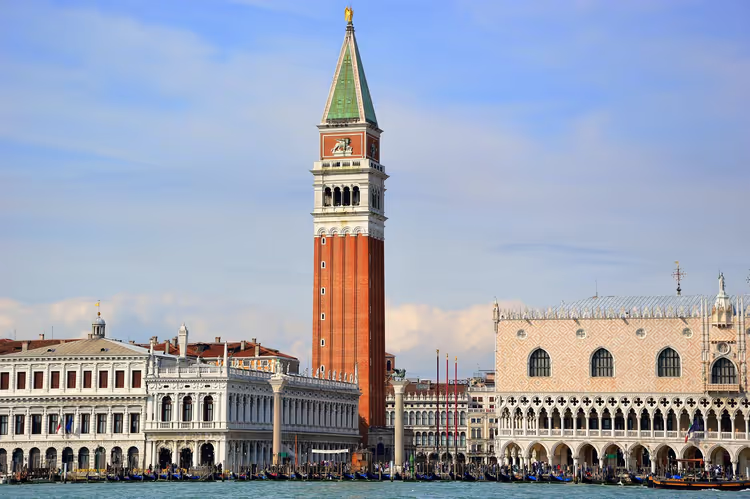
St. Mark's Square: tickets, hours and best time to visit
The cathedral, the Doge's Palace, and the oldest cafe in Italy stand on the same square. St. Mark's Square welcomes tens of thousands of tourists a day, and in high season it is crowded from morning to evening.
Exploring the square will take half a day if you skip the lines. Below we break down the square's sights, tickets and opening hours, cafes, high water, and the best times to visit.
Ad: this article contains affiliate links, we earn a commission if you book through them, at no extra cost to you.
Main sights on St. Mark's Square
The square lies in a low-lying area by the lagoon. That explains the flooding, the dense crowds, and the pricey cafes under the arcades. All the main sights are on the square itself or right next to it, so you can realistically cover them in half a day. A short plan will help you get your bearings.
💡 In short:
- Main sights: St. Mark's Basilica, the Doge's Palace with the Bridge of Sighs, St. Mark's Campanile, and the Correr Museum.
- Allow half a day: the basilica and the palace take one and a half to two hours each, the bell tower about half an hour.
- Buy tickets online in advance. In summer, the line at the entrance takes an hour or more.
- Arrive at opening time, around nine in the morning, before the tour groups show up.
- Doge's Palace opening hours: 09:00-19:00 from April to October, 09:00-18:00 from November to March (as of 09/2026, official website).
St. Mark's Basilica
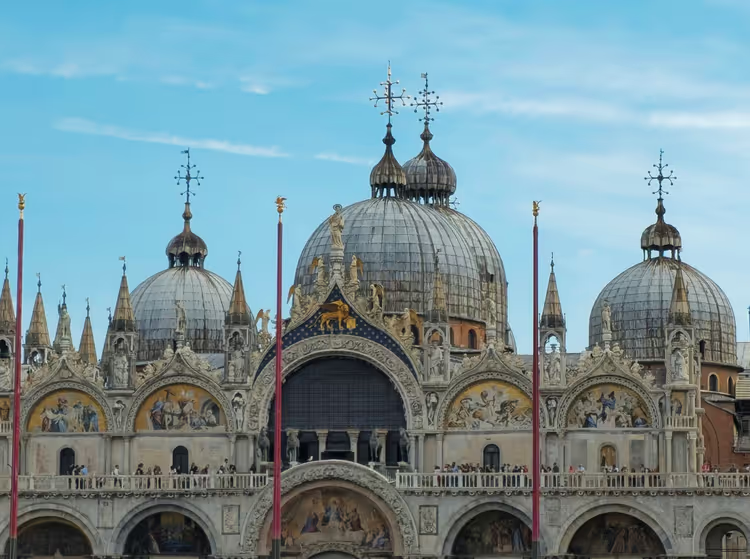
The basilica stands on the eastern side of the square and houses the relics of St. Mark. The relic was brought from Alexandria in the 9th century, and since then the church has been considered the most important in the city.
The current building was constructed in the 11th century. It blends Byzantine, Romanesque, and Gothic features. The mosaic domes recall Byzantium, the massive arches and pillars recall the Romanesque style, and the fine facade detailing already points to Gothic.
The basilica's five domes form a Greek cross layout, a scheme that links the church to Byzantine churches. Above the main entrance you can see the bronze horses: the facade displays copies, while the originals are kept inside the museum.
Inside, it is worth seeing the golden mosaics on the walls and domes, the Pala d'Oro altar with precious stones, the museum with the Horses of Saint Mark, and the terrace overlooking the square. The mosaics cover the vaults like a continuous golden carpet and tell biblical stories. Each area is paid for separately, and this is easy to forget.
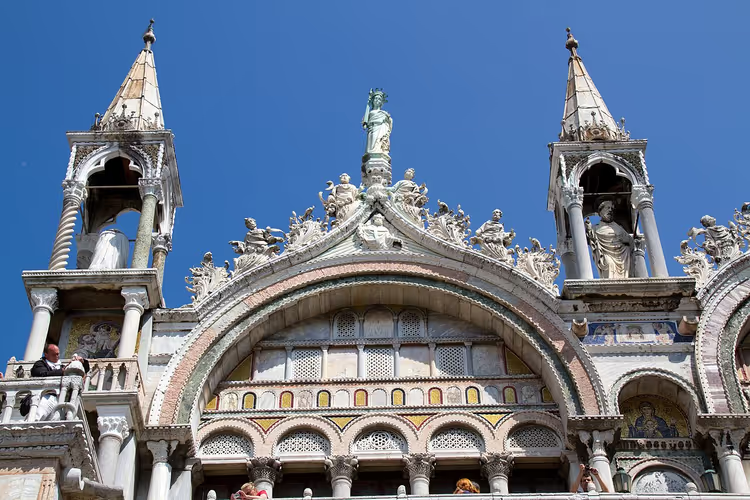 © Tony Hisgett from Birmingham, UK · CC BYPhoto: Tony Hisgett from Birmingham, UK, CC BY (https://creativecommons.org/licenses/by/2.0), Wikimedia Commons
It is easy to get confused by the tickets here. Each area is paid for separately, and you risk buying something other than what you want to see. Check at the ticket office what your ticket includes before you go in.
At midday the basilica is packed, and the crowd moves slowly, step by step. We recommend a morning slot: then you can study the mosaics without being squeezed and still make it to the terrace.
Doge's palace and the Bridge of Sighs
The Doge's Palace stands right next to the basilica and tells the story of Venice better than any museum. This is where the doges ruled, where political decisions were made, and where careers ended in prison.
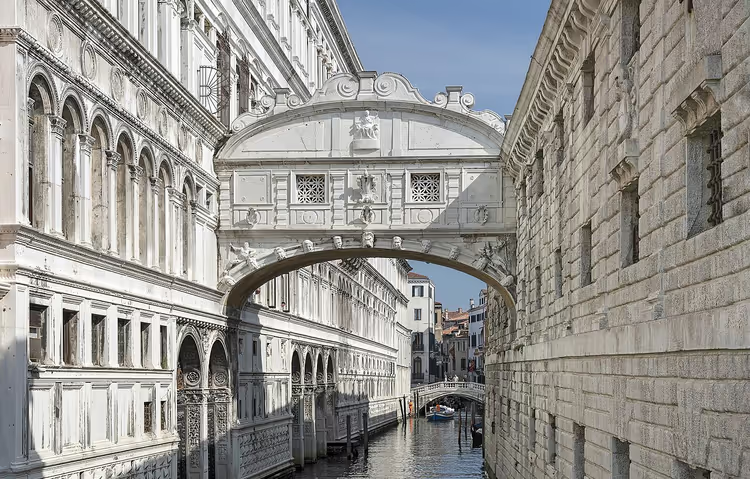 © Didier Descouens · CC BY-SAPhoto: Didier Descouens, CC BY-SA (https://creativecommons.org/licenses/by-sa/4.0), Wikimedia Commons
The doge was considered the head of the republic but had almost no real power. He was elected by the Great Council from patrician families listed in the Golden Book. To keep the doge from gaining too much influence, a system of councils with strict oversight operated alongside him.
You will see the Golden Book of patrician families during your visit. The Great Council made its decisions in vast halls decorated by the republic's finest artists.
The palace route leads through the state rooms, the Great Council hall, and the doge's apartments, and ends at the prison beyond the Bridge of Sighs. The visit takes about two hours, longer with an audio guide.
The Venetian Gothic facade is a great shot in itself. But the inner courtyard with its view of the basilica is even more impressive, and inside you will find halls with gilded ceilings and huge canvases by Tintoretto, Veronese, and Titian.
The palace route includes the Bridge of Sighs. It connects the palace to the prison, and the name is no accident: according to legend, the condemned took one last look at the lagoon from the bridge. During the visit you will walk across the covered bridge yourself and peek into the prison cells.
Morning tickets solve the main problem. By nine in the morning the halls are almost empty, and you can calmly tour the state rooms without a crowd behind you.
The palace audio guide tells you more about the paintings than about intrigue and secrets. If you are interested in behind-the-scenes stories, take a guided tour, including one through the secret corridors. Doge's Palace tours on GetYourGuide come with different sets of halls and different durations.
St. Mark's Campanile
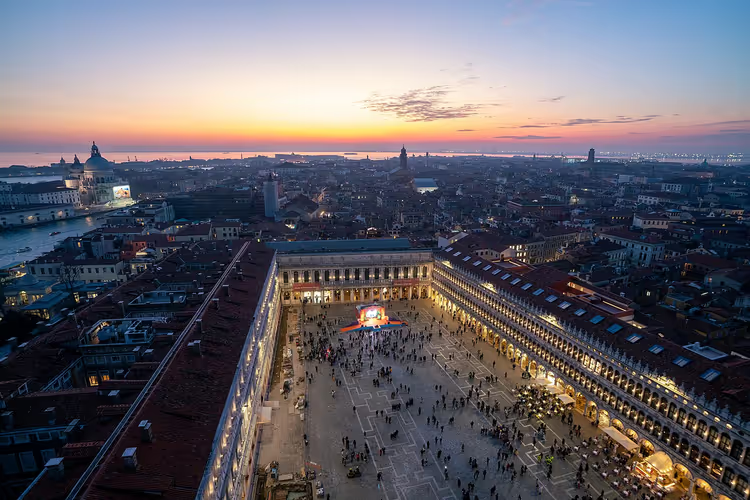
The Campanile stands opposite the basilica and is considered the tallest structure in Venice. It once served as a watchtower; now it is an observation deck above the square and the city's rooftops.
 © Paul Colin Hennig firstdorsal.eu · CC BY-SAPhoto: Paul Colin Hennig firstdorsal.eu, CC BY-SA (https://creativecommons.org/licenses/by-sa/4.0), Wikimedia Commons
You go up by elevator, no stairs to climb. Tickets to the top should also be bought in advance, because the line at the entrance is only fast in the morning. Unlike the basilica, there are almost no interior halls here; the whole point of the trip is the top.
At the top there is an open observation deck around the entire perimeter of the tower. From there you can see the whole square and the rooftops of Venice, so bring a camera and come on a clear day. The deck is not protected from the wind, so a light jacket will come in handy.
Correr Museum
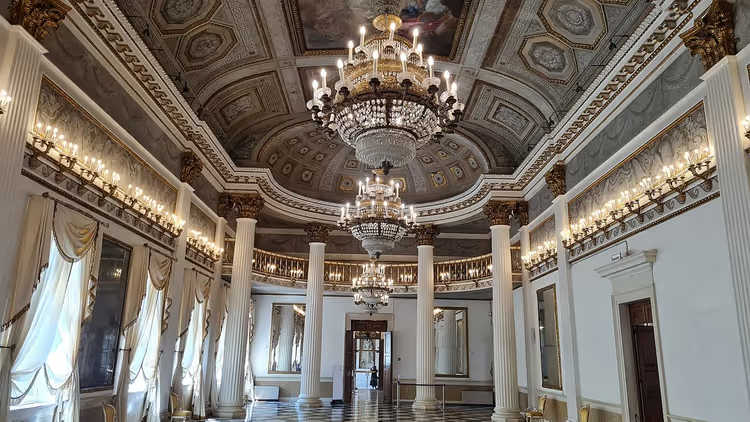
While most tourists head from the basilica to the palace, the Correr Museum stays off to the side. It occupies the Procuratie Nuove on the south side of the square and tells the story of the Venetian Republic.
 © Derbrauni · CC BYPhoto: Derbrauni, CC BY (https://creativecommons.org/licenses/by/4.0), Wikimedia Commons
Here you will walk through the imperial apartments. Emperor Francis I and Empress Sisi lived here when the city was part of the Habsburg Empire. After the paintings in the Doge's Palace, the museum's halls feel calmer, but there are plenty of historical maps, sculptures, and documents.
The Procuratie Nuove was built in the 16th and 17th centuries. Napoleon occupied Venice at the end of the 18th century and abolished the republic. To the building he added only the Ala Napoleonica wing. Later the building served as the official residence of Emperor Francis I, and Sisi stayed here during her visits.
You can skip the museum if you have only one day for the square. But admission is often already included in the combined ticket, and then the visit is almost free.
Tickets, opening hours, and combined tickets
Opening hours vary by season, and tickets are easier to compare in a table. Check exact rates on the official websites of the sights; they change every season.
Sight | Opening hours | Admission |
|---|---|---|
St. Mark's Basilica | morning and afternoon, Sundays only after midday | paid, Pala d'Oro, museum, and terrace separate |
Doge's Palace | 09:00-19:00 (Apr-Oct), 09:00-18:00 (Nov-Mar) | full ticket, combined with square museums |
St. Mark's Campanile | daytime until evening | separate ticket, elevator to the top |
Correr Museum | same as Doge's Palace | often included in combined ticket |
The Doge's Palace is open from 09:00 to 19:00 from April to October and from 09:00 to 18:00 from November to March, the Correr Museum from 10:00 to 18:00 and from 10:00 to 17:00, with last entry one hour before closing. In summer, on Fridays and Saturdays, both museums stay open until 23:00 (as of 09/2026, official MUVE website). The same pages give exact prices and schedules for the basilica and the bell tower: official St. Mark's Basilica website.
A combined ticket for the square's museums is a better deal if you plan to visit both the Doge's Palace and the Correr Museum. Then you pay once and skip some of the lines. Skip-the-line Venice museum tickets are also worth buying in advance.
Buy a ticket for a specific time slot. Online entry often has a separate line, and you save the energy you would otherwise spend waiting in the sun.
Tours and tickets in Venice
Guided tours, skip-the-line tickets and activities — most offers can be cancelled free of charge.
See offers on TiqetsThe widget loads once you give your consent.
Cafes on the square: Caffè Florian and Caffè Quadri
Historic cafes operate under the square's arcades, and their prices are almost as famous as their guests.
 © This Photo was taken by Wolfgang Moroder . Feel free to use my photos, but please mention me as the author and send me a · CC BY-SAPhoto: This Photo was taken by Wolfgang Moroder . Feel free to use my photos, but please mention me as the author and send me a, CC BY-SA (https://creativecommons.org/licenses/by-sa/3.0), Wikimedia Commons
Caffè Florian opened in the 18th century and is considered the oldest continuously operating cafe in Italy. Goethe, Casanova, and Lord Byron sat at its tables. Caffè Quadri appeared later and attracted a different crowd, including Napoleon and the writer Marcel Proust.
Espresso and hot chocolate on the square cost noticeably more than in the alleys a two-minute walk away. During carnival days, guests in baroque costumes sit at the tables, and the room turns into a stage set.
At the tables on the square itself, you pay for the view and the history, not for the portion size. Both cafes open in the morning, and before noon it is noticeably calmer.
If your budget is tight, check the menu at the entrance and limit yourself to one drink. On weekends there are lines at the cafes, and you will not get a table right away.
High water (acqua alta)
High water comes to Venice in the cold season, most often from October to March. Then the square and other low-lying parts of the city can be flooded. The worst flood of recent decades happened in 2019 and submerged much of the historic center.
Since 2020, the city has been protected by the MOSE system, and it has already stopped some of the water rises. Shops are prepared for water and sell shoe covers to tourists. Before your trip, check the water level and forecast: then you can bring waterproof shoes in advance.
Nobody can predict the exact date of a water rise, so in the cold season keep waterproof shoes handy. Water does not reach the square itself every year, but the low passages near the lagoon get wet first.
Pigeons on the square
Old photos of Venice with dozens of pigeons on the square are now history. Feeding the birds is prohibited because the corrosive droppings were damaging the historic buildings.
The pigeon tradition goes back to the republic: on holidays, birds were given to citizens, and over time there were too many of them. Later, during the tourism boom, street vendors sold feed to anyone who wanted a photo with the birds.
Today only a few pigeons fly over the square, and those that land near the tables fly off after a weak spray of water from the waiters.
When is the best time to visit the square
The time of your visit matters more than any ticket. On carnival weekends the square is packed, especially near the stage in front of the Procuratie Nuove. But the next morning you will see an almost empty square.
Arrive by nine in the morning. By that hour the basilica and the Doge's Palace open, and the tour groups have not yet arrived. You will have half an hour to cross the square without crowds and take photos without people behind you.
The square changes depending on the hour. In the morning it is an almost empty stone expanse; during the day the flow of people does not stop until evening.
If you are staying in the quiet Cannaregio district, the square is an easy walk or a vaporetto ride away. From there it takes about half an hour on foot. A selection of Venice hotels on Trip.com helps you choose a district that fits your route.
Useful tips for the trip
A few small things make the visit easier. Charge your phone in advance: tickets and maps are more convenient to keep in electronic form. Bring a little cash for cafes and souvenirs, although cards are accepted almost everywhere.
Bring a bottle of water and a light jacket if you are going for opening time. At midday there is little shade on the square.
Mobile internet in Italy is cheaper than roaming, and it is convenient to set it up before your flight.
⁉️🤔 Frequently asked questions
How much time do you need for St. Mark's Square?
Allow half a day. The basilica and the Doge's Palace take one and a half to two hours each, the Campanile about half an hour, and the Correr Museum another hour. If you have less time, choose the basilica, the palace, and the bell tower, and leave the museum for a second visit.
Do you need to buy tickets in advance?
Yes, especially in summer and during carnival days. Lines at the basilica and the Campanile stretch for an hour or more, and online tickets often have a separate line. Take morning slots: then you will get through without crowds.
When is the square least crowded?
Early in the morning and late in the evening. On carnival weekends during the day it is packed. If you end up there on such a day, come at opening time or move your visit to the next morning.
What should you do during high water?
Check the water level forecast before your trip. Shops on the square sell shoe covers, which are enough for shallow water. Bring waterproof shoes and do not plan long walks through low-lying streets on such days.
Can you feed the pigeons on the square?
No, feeding the birds is prohibited. Because of the corrosive droppings, the city incurred major expenses restoring buildings. There are noticeably fewer pigeons on the square now, and cafe staff shoo them away from the tables.
In short: what to book
St. Mark's Square fits into half a day. If you are short on time, take the basilica and the Doge's Palace with the Bridge of Sighs. If you want a panorama of the city, add the Campanile. If you are interested in art and the history of the republic, leave the Correr Museum for the combined ticket.
Skip-the-line Venice museum tickets are easier to arrange before your trip, and choose a hotel away from the square, in quiet districts like Cannaregio.

A small editorial team writing guides for independent travel. We travel ourselves, but we haven’t been everywhere, so we check prices, opening hours and how to get there against official sources.