
















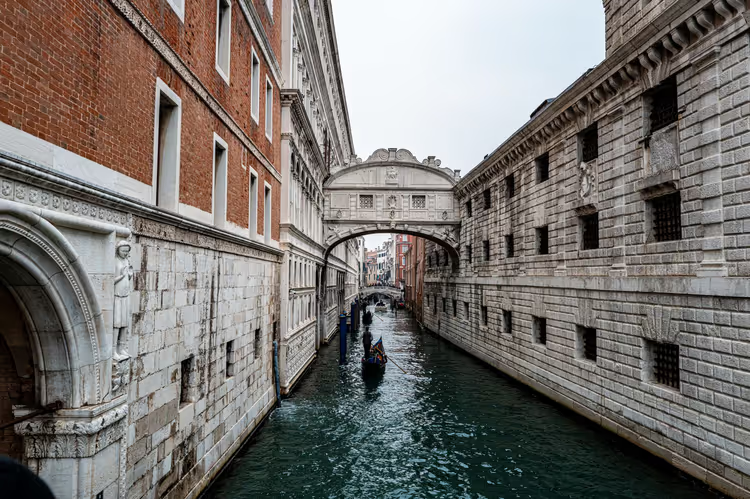
Bridge of Sighs in Venice: best view for photos and how to go inside
The Bridge of Sighs in Venice connects the Doge's Palace with the city prison. Hence its second name: the bridge of the condemned. From the outside, it is a snow-white arch over the narrow Rio di Palazzo canal. You can only go inside with a ticket to the Doge's Palace.
It was built in 1600-1602, and the grim legend was invented a century later. Below you will find what is historical fact here and what is a tourist myth. And two spots from which the bridge is photographed best.
Ad: the text contains affiliate links, we earn a commission from them, the price for you does not change.
History of the bridge's construction
💡 In short:
- The bridge was built in 1600-1602 to a design by Antonio Contin.
- It connected the Doge's Palace with the new prison across the Rio di Palazzo canal.
- You can walk across the bridge inside only with a ticket to the Doge's Palace.
- Opening hours and tickets: 09/2026, verified on the Doge's Palace visit page.
The bridge was built in two years. Work began in 1600 and ended in 1602. The project's author, Antonio Contin, was the nephew of Antonio da Ponte, the architect of the Rialto Bridge.
The purpose was practical, not decorative. The bridge connected the Doge's Palace with the new prison on the other side of the canal. It is the only fully enclosed bridge in Venice, and inside it is divided into two passages (according to Wikipedia, as of: 09/2026).
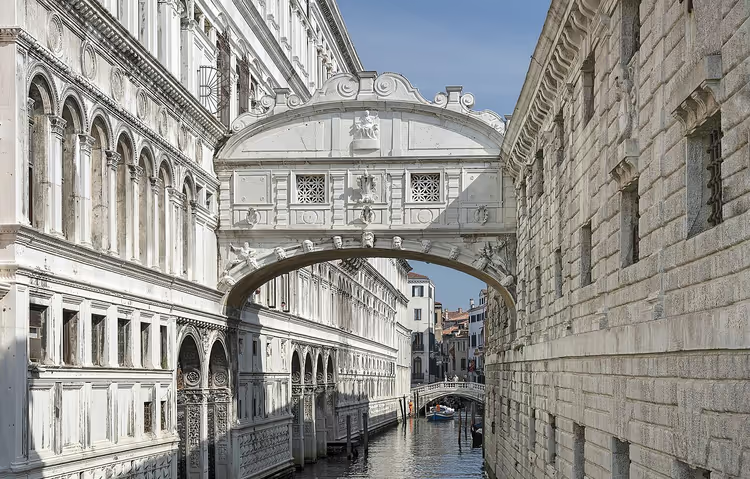 © Didier Descouens · CC BY-SAPhoto: Didier Descouens, CC BY-SA (https://creativecommons.org/licenses/by-sa/4.0), Wikimedia Commons
Legends of the Bridge of Sighs
Nobody knows for certain why the bridge has this name. Locals have two versions, and both sound beautiful. The first tells of the condemned, the second of lovers. Both appeared much later than 1600.
According to the first legend, the sighs belong to criminals who were being led to execution. The covered bridge connected the Doge's chambers with the damp and dark new prison on the other side. They saw the city for the last time through tiny barred windows. Beyond that began a stone dungeon where few lived to see their sentence.
Historians undermine this version. By the time the bridge was built, the death penalty was almost never used in Venice. The new prison held thieves and petty fraudsters, who had little reason to sigh (according to the encyclopedic article about the bridge, as of: 09/2026). The English name Bridge of Sighs was introduced by Lord Byron in the early 19th century, after the legend had already spread across Europe.
The second version is far brighter. It is about lovers who kiss under the bridge at sunset. According to the tale, a kiss in a gondola to the ringing of the bells of St. Mark's Basilica promises eternal love. Meeting all the conditions is almost impossible: sunset and bell-ringing rarely coincide. So couples simply float under the bridge and kiss to the songs of gondoliers.
The most famous prisoner is Giacomo Casanova. He was arrested in 1755 and held in the Piombi prison under the lead roof of the Doge's Palace. After 15 months he escaped: a monk he knew passed him a tool, and Casanova got out across the roof (according to Wikipedia, as of: 09/2026). His farewell sigh turned out not to be a farewell.
The modern Bridge of Sighs
Today the bridge looks elegant. It was built from white Istrian limestone, which was brought from what is now Croatia. The stone was chosen for its durability: the salty air of the lagoon quickly eats away at soft rocks. Inside, by contrast, the structure is modest and grim.
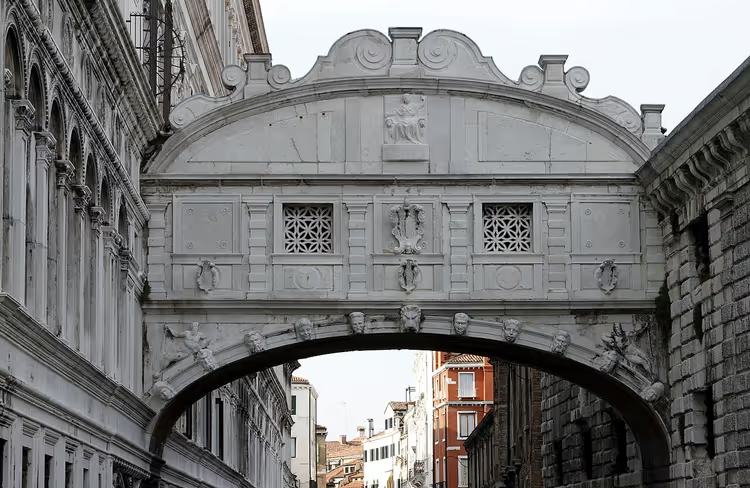 © José Luiz · CC BY-SAPhoto: José Luiz, CC BY-SA (https://creativecommons.org/licenses/by-sa/4.0), Wikimedia Commons
The facade facing the Riva degli Schiavoni embankment is decorated with mascarons. These are stone faces, a favorite Baroque motif. Among them there are sad ones, angry ones, and one smiling face. You can only make them out from the water or from the neighboring bridge.
Inside, there are two separate passages. They were built so that prisoners and judges would not meet. Tourists walk across the bridge when they leave the halls of the Doge's Palace and head to the prison section of the route.
The bridge inspired not only architects. Its features can be recognized in buildings in England, Canada, and the United States. Edgar Allan Poe mentioned it in a short story.
Over four centuries, the bridge has become one of the city's symbols. It appears on postcards and souvenirs, and almost no Venice itinerary is complete without it. Gondolas pass under the arch one after another, and gondoliers slow down so passengers can get the shot.
The best shots come from two points. From the south, it is the Ponte della Paglia on the embankment; from the north, the Ponte de la Canonica. From the Ponte della Paglia, the bridge is visible in full, together with the water and gondolas.
Where the bridge is and how to get there
The bridge stands a few steps from St. Mark's Square. It spans the Rio di Palazzo between the Doge's Palace and the Riva degli Schiavoni embankment. On foot from St. Mark's Basilica, you can reach it in two to three minutes.
By vaporetto, get off at San Zaccaria or Vallaresso. Both stops are 300-400 m from the square. A single ACTV ticket costs €9.50 and is valid for 75 minutes; a 24-hour pass costs €25 (as of 09/2026, official Venice tourism portal). Children under six ride free.
It is best to view the bridge from outside. Inside access is only available with a ticket to the Doge's Palace or as part of a guided tour. We checked the palace's opening hours on 13.09.2026 on the museum's website.
Season | Doge's Palace hours | Last entry |
|---|---|---|
Summer (1.04-31.10) | 09:00-19:00 | 18:00 |
Winter (1.11-31.03) | 09:00-18:00 | 17:00 |
Source: museum page, as of 09/2026.
Book tickets and guided tours online in advance: Doge's Palace tours and tickets on GetYourGuide. In summer, entry without a reservation means standing in line.
Bridge of Sighs on the map
Below is an interactive map. The bridge is marked with a dot between the Doge's Palace and the embankment.
⁉️🤔 Frequently asked questions
Where is the best place to photograph the Bridge of Sighs?
The best spot is the Ponte della Paglia, a stone bridge on the embankment between the Doge's Palace and the Riva degli Schiavoni (according to the official Venice tourism portal, as of 09/2026). Come at 8-9 in the morning: the sun lights up the facade, and there are still few people on the bridge. From the north side, the shot opens up from the Ponte de la Canonica.
Can you walk across the bridge inside?
The bridge itself is closed: it is an internal passage of the Doge's Palace. You can only get inside with a ticket to the palace or with a tour of the secret itineraries. A regular ticket takes you across the bridge after the halls, and the Secret Itineraries route includes the Piombi prison. Check opening hours on the official website, as of 09/2026.
How much does the vaporetto to the bridge cost?
A single ACTV ticket costs €9.50, a 24-hour pass costs €25 (as of 09/2026, official Venice tourism portal). You'll find stops and all other details in the "Where the bridge is and how to get there" section.
Is it true that condemned prisoners were led across the bridge to their execution?
That's a later legend. Executions were rarely used in Venice at the time (according to Wikipedia, as of 09/2026). Read more about the myth in the "Legends of the Bridge of Sighs" section.
Who was held in the Doge's Palace prison?
The most famous prisoner was Giacomo Casanova, who was held in the Piombi prison under the roof of the Doge's Palace. You'll find the story of his escape in the "Legends of the Bridge of Sighs" section.
Tours and tickets in Venice
Guided tours, skip-the-line tickets and activities — most offers can be cancelled free of charge.
See offers on GetYourGuideThe widget loads once you give your consent.
In short: what's worth booking
The bridge itself is free: walk up to the Ponte della Paglia and take as many photos as you like. If you want to walk across it on the inside, book a Doge's Palace ticket in advance. In summer, ticket office lines start growing by ten in the morning.
If you have half a day: a Doge's Palace ticket plus the view from the Ponte della Paglia.
If you're only going for photos: arrive by 8 a.m. and leave by 10.
If you're in Venice with your family: get a 24-hour vaporetto pass and take your time.
Half an hour is enough for photos. Allow two hours for the interior walk-through.

A small editorial team writing guides for independent travel. We travel ourselves, but we haven’t been everywhere, so we check prices, opening hours and how to get there against official sources.