
















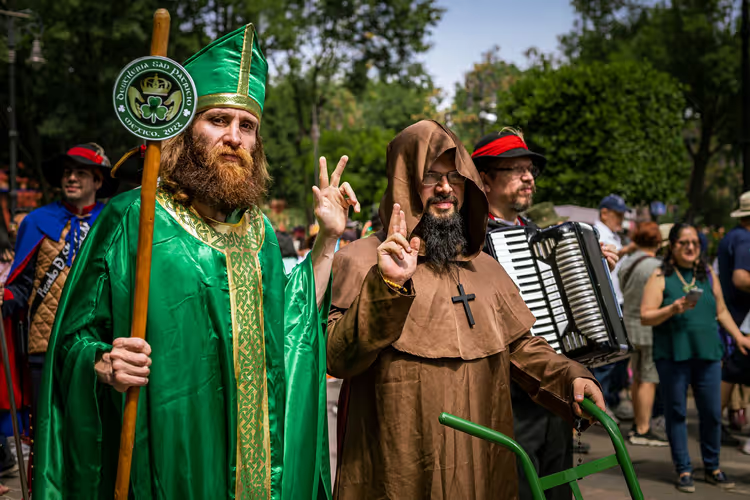
St. Patrick's Day: history, customs and the March 17 parade in Dublin
On March 17, Ireland and dozens of cities around the world put on green. In Dublin, the national parade starts exactly at 12:00 local time (as of 09/2026, St. Patrick's Festival).
The procession goes through the city center: from Parnell Square down O'Connell Street, across O'Connell Bridge and further south to the Kevin Street intersection.
Chicago also dyes its river green, and Tokyo holds its own parade. These parades in the US and Tokyo often take place on the nearest weekend, not necessarily on March 17. Let's sort it out in order: where the holiday came from, what the shamrock and leprechauns mean, and how you can watch the main parade without any hassle.
Ad: this article contains affiliate links, we earn a commission if you book through them, at no extra cost to you.
History of the holiday and Saint Patrick
💡 In short:
- Saint Patrick is venerated as the patron saint of Ireland, and March 17 is linked to the date of his death in the 5th century (as of 09/2026, History.com).
- The first documented parade took place back in 1601, in what is now Florida (as of 09/2026, History.com).
Saint Patrick was a 5th-century Christian missionary, and his life is confirmed by written sources (as of 09/2026, History.com). According to tradition, he was kidnapped as a young man and taken to Ireland, escaped, and later returned to convert the island to Christianity.
The date of March 17 is tied to the day of his death, not his birth. Historians still debate the exact year, but the holiday itself has remained fixed for many centuries.
The Irish spread the tradition around the world through emigration. In the US, it was celebrated as early as the 18th century, and after the mass influx of Irish immigrants in the 1800s, the holiday became a true street celebration.
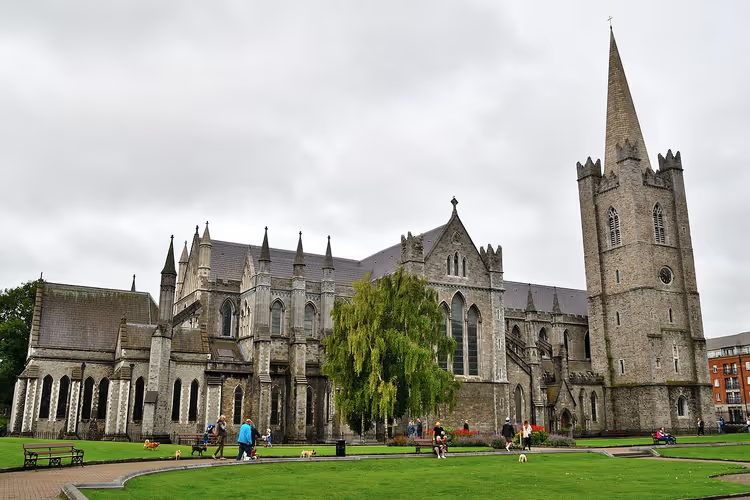 © Rene Cortin · CC BY-SAPhoto: Rene Cortin, CC BY-SA (https://creativecommons.org/licenses/by-sa/4.0), Wikimedia Commons
A separate twist happened in Ireland itself, where March 17 remained a church day for centuries. It became a public holiday only in 1903 (as of 09/2026, History.com).
Dishes for the holiday table
The main holiday dish in the US has almost nothing to do with Ireland. It's corned beef with cabbage, and the recipe came from Irish-American cuisine.
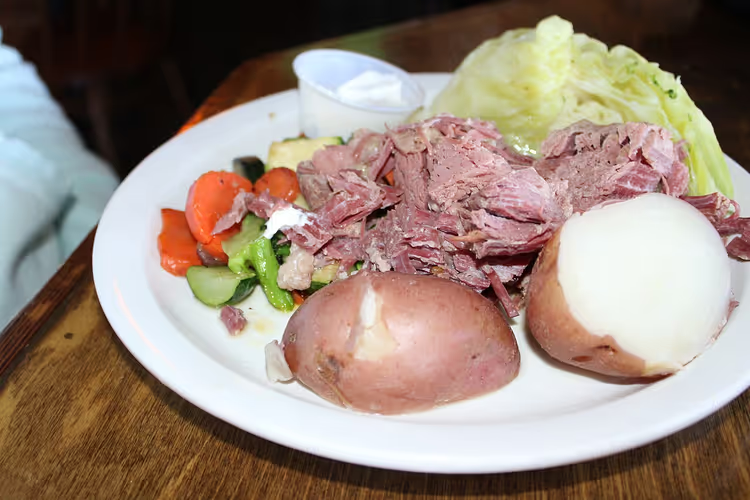 © Chris Light · CC BY-SAPhoto: Chris Light, CC BY-SA (https://creativecommons.org/licenses/by-sa/4.0), Wikimedia Commons
At first, the Irish preferred local bacon. In the 1800s, immigrants in American cities took notice of cheap corned beef, and cabbage appeared on the table along with it.
The tradition took hold and came back: today, on March 17, it's cooked in Dublin, in New York, and in any pub with Irish cuisine. If you find yourself in such a pub, the dish is usually on the menu.
The shamrock: a symbol of Ireland
The shamrock became the main symbol of the holiday because, according to tradition, Saint Patrick used it to explain the doctrine of the Trinity: three leaves and one stem.
That's why on March 17 you'll see shamrocks on hats, costumes, and signs. They're painted on cheeks, printed on flags, and handed out as souvenirs.

There is also a separate custom: a shamrock is dipped into a glass of whiskey and drunk in honor of the saint. According to legend, in a Dublin pub Patrick was once served a half-empty glass, and on his next visit the drinks were filled to the brim.
Who the leprechauns are
Leprechauns are depicted as short, bearded little men in green. The word itself goes back to the Irish lobaircin and means "small body."
The image comes from Celtic mythology, where leprechauns repair shoes for fairies and hide pots of gold. They can only be caught by trickery.
These characters have a difficult nature: they are calculating and do not like to share their treasures, which is why tricks and deceptions are attributed to them.
 © Solo Beckett · CC BY-SAPhoto: Solo Beckett, CC BY-SA (https://creativecommons.org/licenses/by-sa/4.0), Wikimedia Commons
Leprechaun costumes have long been part of parades. On March 17 you will see them by the dozen: on the streets, in pubs, and among the participants in the procession.
Parades around the world
The holiday gained its modern scale in the United States. Since the 1760s, processions have been held regularly in New York (as of 09/2026, History.com).

The New York parade is considered the oldest and largest in the world. It runs 1.5 miles along Fifth Avenue and involves about 150,000 participants (as of 09/2026, History.com). In 2002, 300,000 participants took to the streets, and 3 million spectators came to watch them.
Chicago responds with its own spectacle. The city has been dyeing a section of the river green since the early 1960s, and it is done by the Plumbers Local 130 union (as of 09/2026, union website). The central parade here has been running since 1956.
Dublin hosts the main procession. The festival has turned into a multi-day event with concerts and street theater, and the parade itself draws more than half a million spectators (as of 09/2026, History.com).
Outside Ireland and the United States, the tradition has also taken root: in Montreal the parade has run continuously since 1824, in Auckland since 1995, in Oslo since 2000 (as of 09/2026, History.com).
The Tokyo parade runs along Omotesando and is considered the largest in Asia; it has been organized by Irish Network Japan since 1992 (as of 09/2026, Embassy of Ireland in Japan).
The scale is visible in the numbers: about 32.7 million US residents identify as being of Irish descent, the second largest group after Germans (as of 09/2026, History.com).
How to watch the parade in Dublin
You don't need paid tickets for the parade itself, you just pick a spot along the route and wait for the 12:00 start (as of 09/2026, St. Patrick's Festival).
 © William Murphy · CC BY-SAPhoto: William Murphy, CC BY-SA (https://creativecommons.org/licenses/by-sa/2.0), Wikimedia Commons
If you want to sit, there is a limited number of grandstand seats. Tickets for the 2027 parade went on sale on September 28, 2026, and the festival program will be published in January 2027 (as of 09/2026, St. Patrick's Festival).
Dublin city center is closed to traffic on these days. Arrive by 10:30, grab a spot near O'Connell Bridge, and stay away from narrow side streets, where the crowd is at its densest.
To add a city walk to the parade, check out Dublin tour options on GetYourGuide.
Where to stay in Dublin
Hotels in the center get booked up long before the holiday. During festival week, prices are higher than usual, and closer to the date there are almost no rooms left.
Look for options near O'Connell Street or along the waterfront. From there you can walk to the parade route and won't have to rely on transport in the closed-off center.
See Dublin hotels on Trip.com.
⁉️🤔 Frequently asked questions
When is St. Patrick's Day celebrated?
March 17, a fixed date that doesn't change from year to year. In 2027 it falls on a Wednesday, and the Dublin festival runs from March 13 to 17 (as of 09/2026, St. Patrick's Festival). In the US and Canada, major parades are often moved to the nearest weekend to draw larger crowds.
Do you need tickets for the Dublin parade?
No, access to the route is free. You only pay for a grandstand seat, and those are limited (as of 09/2026, St. Patrick's Festival). If you miss out, pick a spot along the street and arrive early.
Why is the shamrock the symbol of the holiday?
It's linked to St. Patrick's preaching. The shamrock is worn on clothing, and together with the color green it has become a recognizable symbol of Ireland. On March 17, almost no parade goes without it.
Where did the tradition of dyeing the Chicago River come from?
The river is dyed by the local plumbers' union, details are in the parades section. The city hosts three different parades. The tradition has been going strong for more than six decades.
Is it true that a leprechaun grants wishes?
In myths, leprechauns guard hidden treasure and are in no hurry to give it up. You can only catch them through trickery, and even then they'll try to outwit the hunter. That's why on March 17 they're more often depicted in costumes at parades than taken seriously.
In short: what to book
St. Patrick's Day is easy to plan. The parade itself is free, you only pay for travel and accommodation, and lodging in Dublin during festival week should be booked in advance.
- If you have just one day in Dublin: grab a spot near O'Connell Bridge by 10:30.
- If you want a grandstand seat: buy your ticket in advance.
Plan your travel ahead of time so you make it to the parade: flights to Dublin on Kiwi.com.

A small editorial team writing guides for independent travel. We travel ourselves, but we haven’t been everywhere, so we check prices, opening hours and how to get there against official sources.