
















Abu Simbel: how to get to the rock temples of Ramses II and what to see inside
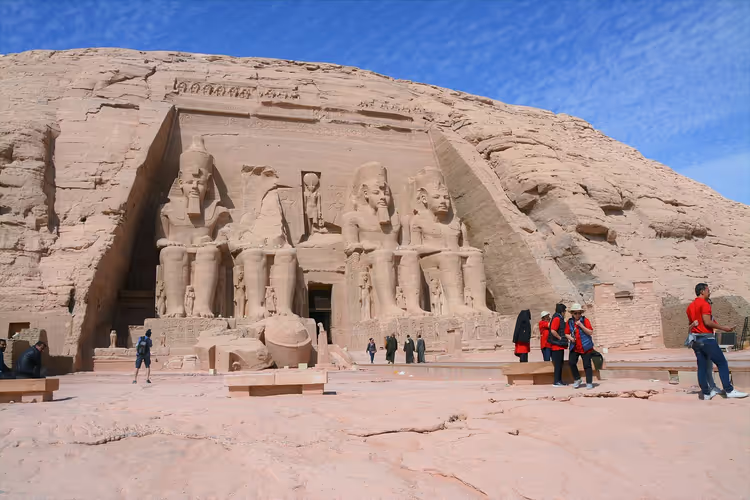
The twenty-meter colossi of Ramesses II are carved directly into the cliff above Lake Nasser. Getting to them is not easy: Abu Simbel stands in the desert far from any cities, so the trip needs to be planned in advance.
We have put together practical information about this site: what you will see inside both temples, when the sun enters the sanctuary, and how to get there from Aswan without overpaying.
Abu Simbel is a complex of two rock-cut temples that are more than three thousand years old.
Ad: this article contains affiliate links, we earn a commission if you book through them, at no extra cost to you.
Where the Abu Simbel temples are located
💡 In short:
- Abu Simbel consists of two rock-cut temples: the Great Temple of Ramesses II and the Small Temple of Hathor.
- Both were carved into sandstone in the 13th century BC and relocated to a new site in the middle of the last century.
- Historical background and the relocation of the temples: 09/2026, verified against UNESCO materials
Abu Simbel stands in Nubia, in southern Egypt, almost at the border with Sudan. The nearest city with an airport is Aswan, about 250 km away by desert road (open on map). From Cairo it is more than 1,200 km, so Abu Simbel is not a stopover on the way.
The complex was relocated in the middle of the last century, when the water level rose because of the Aswan High Dam. The temples were dismantled into blocks and reassembled at a new site above the lake level. The international campaign to save the monuments was led by UNESCO, and the complex became part of the World Heritage list (according to UNESCO, 09/2026).
Today both temples stand side by side on a rocky terrace by the water. They are less than two hundred meters apart, so you can see the entire complex in one visit.
History of the temples' discovery
For centuries these structures were buried in sand, and no one knew what lay beneath the dunes. A chance walk changed everything.
In the early 19th century, the Swiss traveler Johann Ludwig Burckhardt was wandering along the west bank of the Nile. He noticed the heads of enormous statues sticking out of the sand and could not immediately tell whether they were seated or standing. It was impossible to make out the figures' poses at the time.
The excavations were continued by the Italian Giovanni Battista Belzoni. He cleared the entrance to the Great Temple and saw not one statue but an entire facade with four colossi. By the end of the 19th century, Europe was talking about Abu Simbel.
Today you enter the temple through the same facade that was cleared two centuries ago. What is more, you walk inside along the same path that priests and the pharaoh once took.
The great temple of Ramesses II
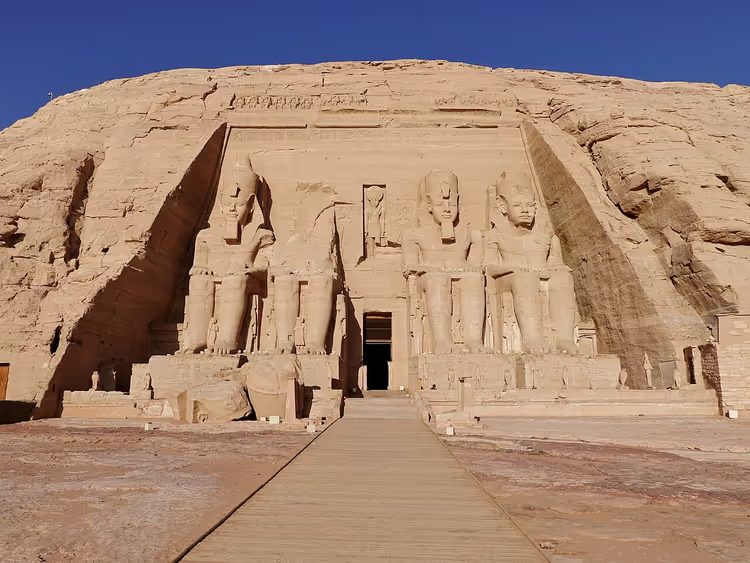
The Great Temple was carved on the orders of Ramesses II to commemorate his victory over the Hittites at Kadesh. The facade is supported by four seated colossi about twenty meters high, and between their legs and at their feet stand small figures of the pharaoh's mother, wife, and children. The scale of the family group is deliberately reduced, and this contrast is the first thing you notice.
All four colossi on the facade depict Ramesses II himself. The statues of the gods are inside, in the sanctuary at the back of the temple. There, next to Ramesses, sit Ra-Horakhty, Amun-Ra, and Ptah. This composition presented the pharaoh as equal to the gods.
Inside, the temple is divided into four halls that follow one after another. The first hall was open to ordinary Egyptians, the second only to the nobility, the third to priests, and the last was entered only by the pharaoh and his retinue. The walls of the halls are painted with battle scenes from Ramesses' campaigns, and along them stand statues of the pharaoh in the form of Osiris.
From bright daylight you step into semi-darkness, and your eyes need time to adjust. The sense of hierarchy only grows stronger: light stays outside, while the pharaoh's power lives in the darkness of the halls.
The small temple of Hathor and Nefertari
The small temple stands about a hundred meters from the Great Temple. It was dedicated to the goddess Hathor and Queen Nefertari, the beloved wife of Ramesses II. The facade is decorated with six full-length statues: the two central ones depict Nefertari, the rest the pharaoh himself. The figures stand in deep niches, and the play of light and shadow makes them more monumental than they appear up close.
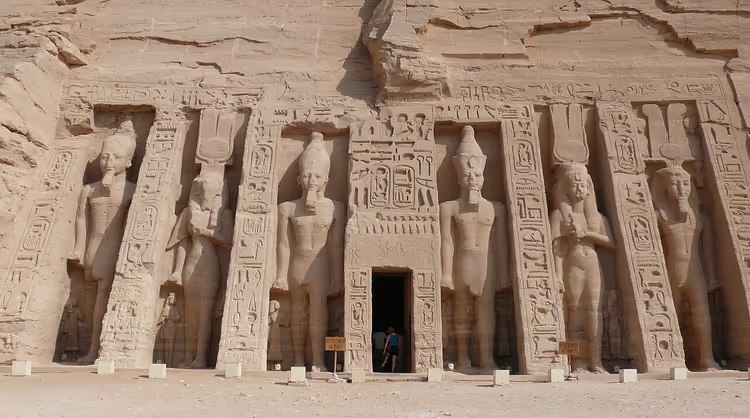 © Ad Meskens · CC BY-SAPhoto: Ad Meskens, CC BY-SA (https://creativecommons.org/licenses/by-sa/3.0), Wikimedia Commons
Inside, you pass through a dark columned hall and reach the sanctuary. There stands a statue of the sacred cow, the form in which Hathor was worshipped. Ramesses stands before the cow, and this arrangement was read as the goddess protecting the pharaoh. The Small Temple is noticeably more modest than the Great Temple, but it is here that you see how personal this dedication was.
Legends and the solar phenomenon
The main optical mystery of Abu Simbel is hidden inside the Great Temple. The sun's rays enter the sanctuary only twice a year, in late February and late October. The light travels through the enfilade of halls and illuminates the face of Ramesses, while the statue of Ptah remains in darkness.
People plan ahead for the days of the solar festival. In late February and late October, visitor numbers are many times higher than on a normal day, and tickets for these dates should be bought well in advance.
If you want to see the effect with your own eyes, plan your trip for these dates and arrive at opening time. The light passes through the halls for only a short time, and latecomers see only an evenly lit facade.
Tickets and opening hours
Abu Simbel welcomes visitors daily, but the last entry here is earlier than you might think.
The ticket is bought on the official portal of Egypt's Ministry of Tourism and Antiquities or at the ticket office on site. The price for foreigners is set in Egyptian pounds and is updated periodically, so check the exact amount on the official website before your trip. Cards are not accepted everywhere, so keep cash on hand.
Opening hours should also be checked in advance: the last entry time changes in different seasons. The entrance ticket does not include the nighttime sound and light show; that is bought separately.
We recommend arriving at opening time. By midday the sun is at its zenith, shadows disappear, and the facade looks flat. On top of that, several bus groups arrive at the terrace around that time, and the area around the colossi gets crowded.
Tours and tickets in Abu Simbel
Guided tours, skip-the-line tickets and activities — most offers can be cancelled free of charge.
See offers on TiqetsThe widget loads once you give your consent.
How to get to Abu Simbel
A single desert road leads from Aswan to Abu Simbel. The simplest option is a tour bus. Groups leave early in the morning and return by evening; the drive one way takes several hours.
The second option is a flight from Aswan. The plane saves time but ties you to the flight schedule. Some travelers hire a car with a driver and leave before the bus convoys.
Many people combine the trip with an overnight stay in Aswan. That way you head to the temples in the morning instead of getting up in the middle of the night in Hurghada or Luxor, and you have time to see the city itself.
What to see near Aswan
If you have an extra day, the city is worth staying another night. At the Aswan High Dam and Lake Nasser you will see the second, modern part of this story.
Next on the list are Philae Island with the temple of the goddess Isis, Kitchener's Island with its botanical garden, and the Temple of Kalabsha right by the dam. The Temple of Kalabsha was relocated to a new site just like Abu Simbel, so the logic behind these two monuments is the same.
The route ends with the Mausoleum of the Aga Khan on the west bank. From there you get a view of the Nile and the sandy hills, and it is a good spot for an evening walk.
Abu Simbel temple on the map
Both temples stand on the west bank of Lake Nasser, south of Aswan. The coordinates for your navigator are shown on the map below. If you are driving yourself, check in advance that the driver knows the drop-off point at the entrance.
⁉️🤔 Frequently asked questions
When is the best time to go to Abu Simbel?
From October to April, Egypt is cooler and the visit is easier. The terrace in front of the temples has almost no shelter from the sun. In winter mornings can be chilly, so bring a light jacket.
How much time do you need for the visit?
Two to three hours is enough for both temples and photos at the facade. But the drive one way takes several hours, so the trip will take a full day. Do not plan other excursions after Abu Simbel on the same day.
What is the solar phenomenon of Abu Simbel?
Twice a year, in late February and late October, the sun's rays pass through the enfilade of halls and illuminate the face of Ramesses II in the sanctuary. The statue of Ptah remains in darkness.
Can you get to the temples from Hurghada or Luxor?
You can, but it is long and exhausting. The nearest major city with an airport is Aswan, and it makes more sense to use it as your base. From there you can leave for the temples early in the morning and return by evening.
Is it worth taking an organized tour?
If you do not want to deal with transport and schedules, a tour is more convenient: you are picked up from your hotel and brought back. For independent travelers, the option of a car with a driver is usually cheaper. Decide based on your budget and how willing you are to get up early.
In short: what to book
Abu Simbel does not require complicated preparation. You need an entrance ticket, transport from Aswan, and enough time for the journey.
If you have one day: take an early departure and see both temples in a single morning. If you love history, add a day for Aswan and the Temple of Philae.
For the trip, it is convenient to book a tour from Aswan on GetYourGuide: it lists options for day trips to the rock-cut temples.

A small editorial team writing guides for independent travel. We travel ourselves, but we haven’t been everywhere, so we check prices, opening hours and how to get there against official sources.