
















What to see in Corfu: 15 main places on the island
Corfu is unlike the rest of Greece. The Ottomans never managed to capture this island, so Venetian facades, British palaces, and Orthodox churches survived here. All of the above are within walking distance of each other.
In three days you can see the old town, a mountain monastery, and a fortress on a cliff above the sea. We put together fifteen places worth planning a trip around, and added the price, opening hours, and practical details for each. Below you will find what to see, how much it costs, and how to get there.
We list the date we checked next to each price and each schedule.
Ad: this article contains affiliate links, we earn a commission if you book through them, at no extra cost to you.
1. Kerkyra, or Corfu Town
💡 In short:
- In the old town you will see Venetian houses, English palaces, and Orthodox churches in one day.
- Easter on Corfu is celebrated more loudly than anywhere else in Greece: hotels are booked a year in advance.
- You can walk to the fortresses, the Liston promenade, and the port.
 © Dietmar Rabich · CC BY-SAPhoto: Dietmar Rabich, CC BY-SA (https://creativecommons.org/licenses/by-sa/4.0), Wikimedia Commons
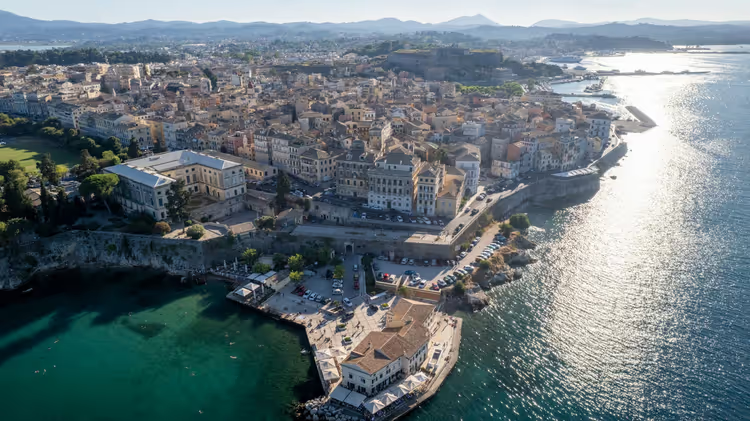
Kerkyra, or Corfu Town, sits on the eastern shore of the island and greets visitors right after the airport and the seaport. The airport is practically within the city limits, so you can reach the center in a matter of minutes. Over its history, the city belonged to Venice, France, Britain, and Rome, and each ruler left a mark here. The facade of the old town most closely resembles Italian cities, although English architects also worked on it.
In the center you find yourself in Greece, Italy, and England at the same time. Venetian houses stand next to British palaces, with Orthodox churches and Catholic cathedrals nearby. Corfu Town has a street modeled on the Parisian Rue de Rivoli, built after a French design. The houses here are tall, with arcades below, and between them hide narrow alleys where it is easy to get lost.
The city lives through music and festivals. The people of Corfu are religious, hospitable, and almost always singing. Art lovers from all over Europe come here for cultural events: philharmonic concerts, the local artists' exhibition "Artistic Autumn," and the Corfu carnival, a twin of the Venetian mask carnival.
The main event of the year for the island is Easter. For the three Easter days, all of mainland Greece tries to get here, and hotels are booked a year in advance. The traditions have remained unchanged for centuries. On Holy Saturday, before dawn, parishioners "rock" the walls of the church, imitating an earthquake, and at exactly eleven in the morning pots of water fly from windows.
Fifteen brass bands take part in the processions, which is why Corfiot Easter is considered the loudest in the country. At nine in the evening, the holy fire is brought out of the Church of Saint Paraskevi and a liturgy is held in the square. At midnight the bells ring out and the Great Cross is lit, and fireworks burst over the old fortress. On Sunday, a lunch of roast lamb is added to all this.
Orthodoxy here is part of everyday life. There are so many churches that they become part of the landscape: people marry, baptize, and attend regular services in them. For religious visitors, Corfu holds another important fact: it was on Greek soil that Orthodoxy became established as the foundation of the culture.
How much time should you set aside for the city? One day is enough to walk around the old town, climb both fortresses, and sit on the Liston promenade. The best time for walking is early morning and evening, when the heat subsides. The center is compact, and you do not need a car here.
2. Church of Saint Spyridon
 © Dietmar Rabich · CC BY-SAPhoto: Dietmar Rabich, CC BY-SA (https://creativecommons.org/licenses/by-sa/4.0), Wikimedia Commons
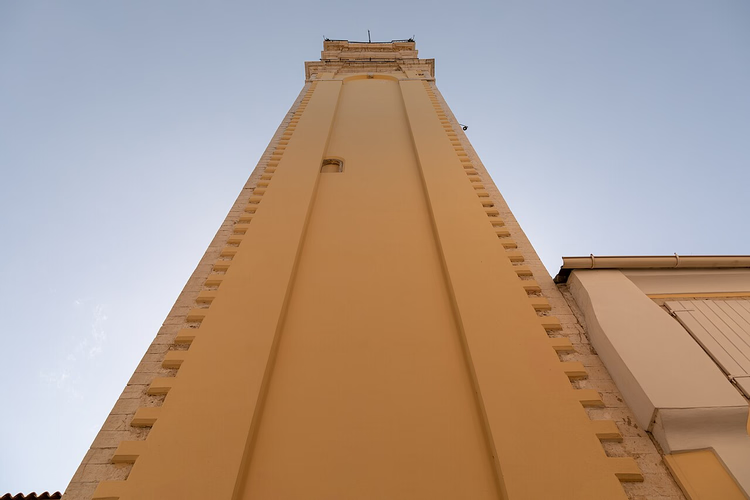
Saint Spyridon is considered the patron saint of the island, and he is venerated more than any other saint. The church itself is modest and hidden in a web of narrow medieval streets of the old town, but any passerby will point you the way. Pilgrims from all over the world come here to venerate the incorrupt relics, and legends of miraculous healings are still discussed to this day.
Exactly one week before Easter, the island celebrates the saint's day, and its scale rivals the Easter days. Come in the morning: by noon the line to the relics grows longer, and services run almost without a break.
3. Achilleion Palace
 © Marc Ryckaert ( MJJR ) · CC BYPhoto: Marc Ryckaert ( MJJR ), CC BY (https://creativecommons.org/licenses/by/3.0), Wikimedia Commons
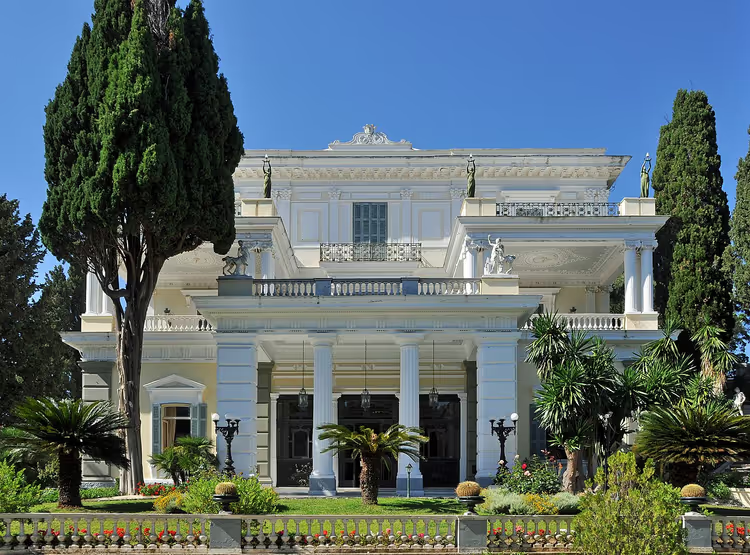
The palace was built by Elisabeth of Austria, known as Empress Sisi. In the late 19th century, while traveling through Europe, she chose Corfu as a place of rest and dedicated the palace to her favorite hero, Achilles. Inside there was no pomp, more a cozy home than an imperial residence. Later the palace's appearance was changed by its next owner, Kaiser Wilhelm II, but the site remains on the list of the island's main attractions.
Admission costs 7 € (as of 09/2026, checked on the official Achilleion website). From April to October the palace is open from 8:00 to 20:00, in winter from 8:00 to 16:00. Important: restoration work is currently underway, and only the park and imperial gardens are open to visitors, so buy your ticket online in advance.
The gardens with marble statues of Achilles and views of the Ionian Sea deserve a separate trip. If you want to see the palace with a guide, tours to the Achilleion are easier to book in advance.
4. Mount Pantokrator
 © Dietmar Rabich · CC BY-SAPhoto: Dietmar Rabich, CC BY-SA (https://creativecommons.org/licenses/by-sa/4.0), Wikimedia Commons
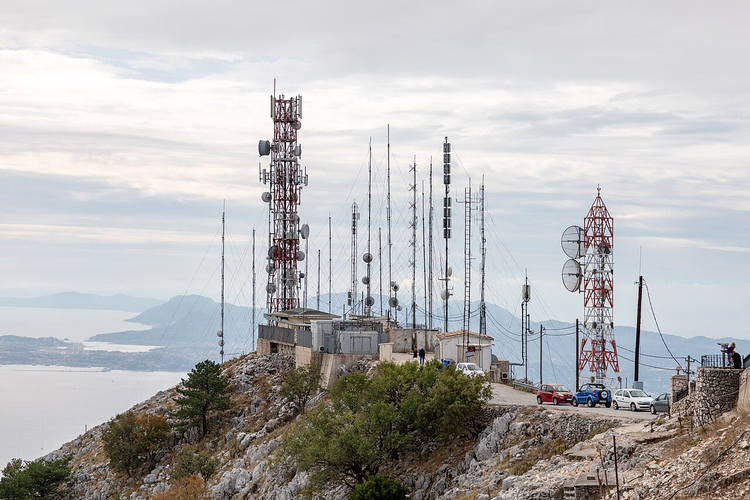
Pantokrator is considered the highest point of the island, rising above the entire northeast. A winding serpentine road leads to the top, and by car the climb takes about half an hour (according to the map). In clear weather, the outlines of Italy and the shores of Albania are visible from the summit.
At the very top stands the Church of the Transfiguration of the Lord, built in the 7th century on the site of a destroyed monastery. Many people call Corfu the "island of returns" precisely because of these views: you want to come back here.
5. Paleokastritsa and its bays
 © Dietmar Rabich · CC BY-SAPhoto: Dietmar Rabich, CC BY-SA (https://creativecommons.org/licenses/by-sa/4.0), Wikimedia Commons
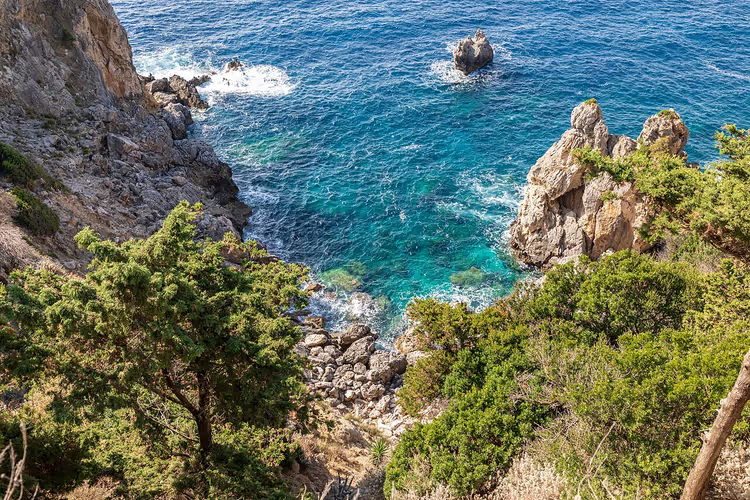
Paleokastritsa is what Greeks themselves call the island's most beautiful scenery. The sea has carved countless grottoes and caves into the cliffs, and sheer drops hang over the shore. The area's history is turbulent: pirates and invaders passed through these bays, so the villages moved up into the mountains, where they were easier to defend. The Orthodox monastery of the Life-Giving Spring stands on the highest cape and is well hidden from prying eyes.
Today there are hotels with views, beaches, and moorings for pleasure yachts. The best way to see the grottoes is by boat. A boat trip to the grottoes will show you bays you cannot see from the shore. Come in the morning; by midday the moorings are crowded.
6. Corfu marina
 © Marc Ryckaert ( MJJR ) · CC BYPhoto: Marc Ryckaert ( MJJR ), CC BY (https://creativecommons.org/licenses/by/3.0), Wikimedia Commons
Corfu marina serves as a mooring point where yachts and pleasure boats dock. Excursions to the island's distant bays depart from here. Yachting is becoming increasingly popular here, and in summer it is not easy to find a free berth.
7. Palaio Frourio (the old fortress)
 © Dietmar Rabich · CC BY-SAPhoto: Dietmar Rabich, CC BY-SA (https://creativecommons.org/licenses/by-sa/4.0), Wikimedia Commons
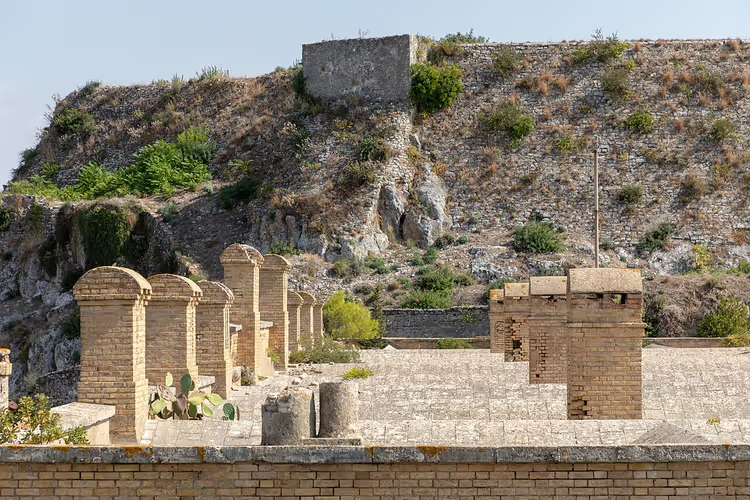
Palaio Frourio stands on an artificial island separated from the town by a narrow channel. The first fortifications here were built by the Byzantines in the 7th century; later the fortress was expanded during the Ottoman raids, and the channel became a defensive moat. The British rebuilt the fort: they added bastions and erected the Church of St. George, which looks unlike Orthodox churches. Today concerts, festivals, and battle reenactments are held here.
You need to buy a ticket separately for each site: the combined ticket for Corfu's museums no longer works (as of 09/2026, Greek Ministry of Culture). The climb up to the lighthouse is worth it for the view over the Liston rooftops and the bay. If you are planning to visit more museums, check Corfu museum tickets in advance.
8. Mouse Island
 © Dimitris Pachakis · CC BY-SAPhoto: Dimitris Pachakis, CC BY-SA (https://creativecommons.org/licenses/by-sa/2.0), Wikimedia Commons
A couple of kilometers from Corfu lies the tiny islet of Pontikonisi, which everyone calls Mouse Island.
For photographers this place is a must: the shot works from any angle, which is why an image of the island appears in every tourist brochure and on souvenirs. A trip to Greece leaves many impressions, but Corfu stands apart. Locals will never say they are Greek: they call themselves Corfiots.
9. Monastery of the virgin Mary in Paleokastritsa
 © Redeemer · CC BY-SAPhoto: Redeemer, CC BY-SA (https://creativecommons.org/licenses/by-sa/4.0), Wikimedia Commons
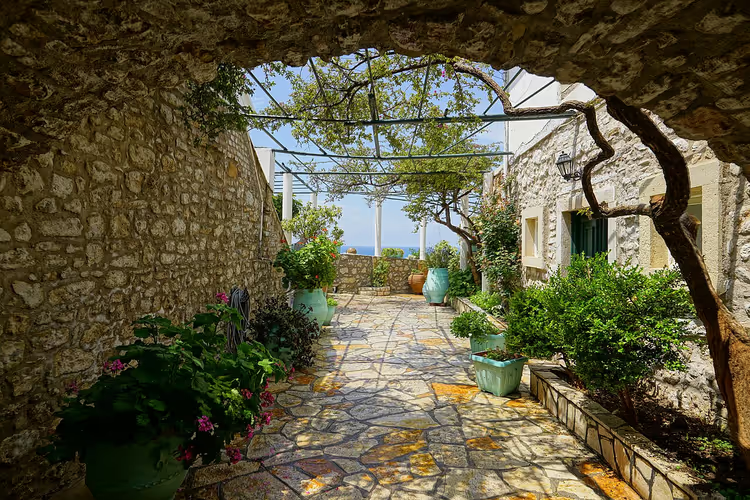
The Monastery of the Virgin Mary, or Theotokou in Greek, stands in the most scenic area of the island. The monastery was founded in the 13th century on the ruins of an ancient fortress and expanded in the 17th century, which is why it now features a mix of architectural styles. Monks maintain the grounds: perfect cleanliness, flowers, a well-kept garden and vineyard. Through an arched courtyard with bougainvilleas and mosaics, you reach the monastery cells.
A small olive press operates at the monastery, and you can buy olive oil on site. The monks make wine, keep animals, bake bread, and grow vegetables, fully providing for themselves. Buying their products is considered a donation toward the monastery's upkeep. Many cats of various colors live in the courtyard.
The church at the top of the hill houses the miraculous icons of the Dormition of the Mother of God, the "Life-Giving Spring," and "Skopiotissa." Thousands of pilgrims come to see them. The interiors are decorated in Venetian style: the ceilings are painted with uranias, imitations of paintings in ornate frames. A small museum of Byzantine and post-Byzantine icons operates nearby.
A separate tradition: the wishing well. You stand with your back to it, make a wish, and toss a coin, trying to hit the target. You can make several attempts, each time with a new wish. Admiral Ushakov's cannon also stands here, left behind after military campaigns.
The monastery is active, so it is best to cover your shoulders and knees. Arrive at opening time: tour groups gather near the entrance around midday.
10. Kanoni Village
 © Marc Ryckaert · CC BYPhoto: Marc Ryckaert, CC BY (https://creativecommons.org/licenses/by/3.0), Wikimedia Commons
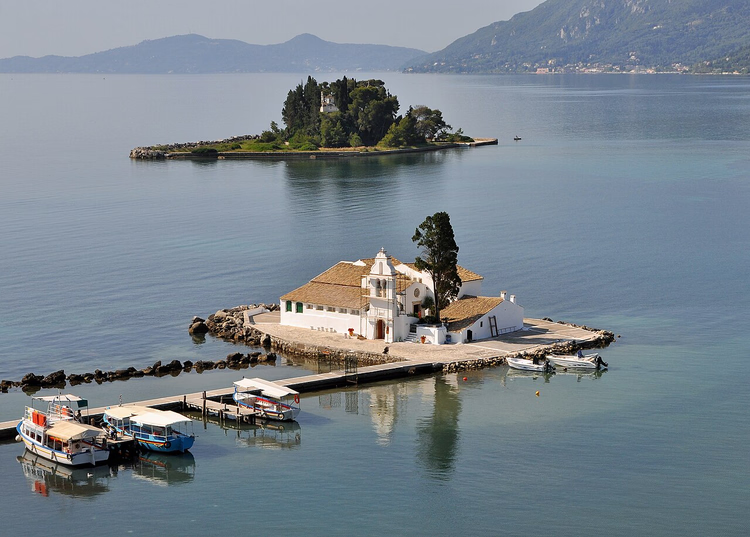
Kanoni Village lies in the southern part of Corfu and occupies a small peninsula. It has quiet beaches, cozy houses, and views of the medieval Monastery of Panagia Vlacherna on a tiny islet, reached by a narrow rocky causeway. The peninsula is lush with greenery and pleasant to explore on foot.
A legend is tied to Pontikonisi islet: it supposedly formed from the petrified ship of Odysseus and resembles a frozen mouse, hence the name "mouse island." The Chalkiopoulou lagoon, where migratory birds nest, is also beautiful. Come here specifically for the sunset: in the evening light everything looks different than during the day.
11. Panagia Spiliotissa Cathedral
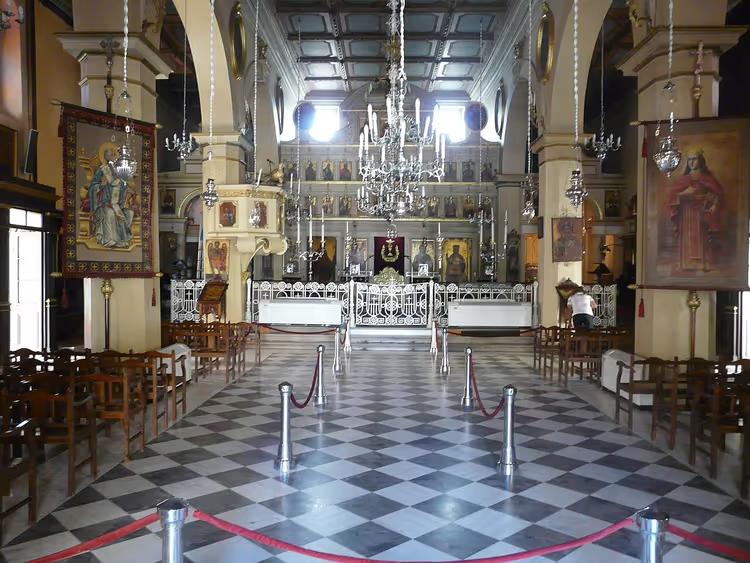 © Piotrus · CC BY-SAPhoto: Piotrus, CC BY-SA (https://creativecommons.org/licenses/by-sa/3.0), Wikimedia Commons
The cathedral is dedicated to Saint Theodora, a blessed Christian deeply venerated in Greece. Her relics are kept in a silver tomb in front of the altar.
The church was built in the late 16th century as an ordinary church, but after reconstruction it became the city's central cathedral and amassed a rich collection of icons. Outside, the terracotta-colored walls are decorated with white stucco ornaments, a cross rises above the pediment, and a clock is mounted on the elegant bell tower with its distinctive dome.
Inside, the central hall is especially beautiful: an openwork altar screen, silver oil lamps, a large chandelier, and a mosaic floor. Hundreds of parishioners come here to see the interiors and pray at the relics. Women should bring a headscarf and cover their shoulders and knees.
12. Spianada Square
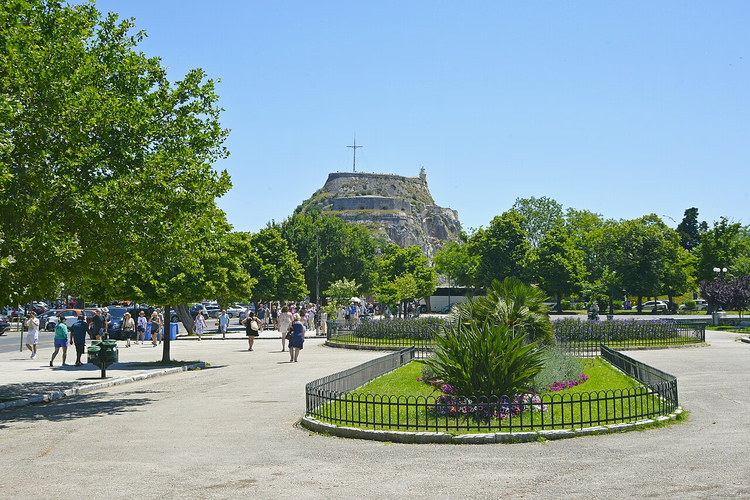 © Alberto-g-rovi · CC BYPhoto: Alberto-g-rovi, CC BY (https://creativecommons.org/licenses/by/4.0), Wikimedia Commons
Spianada is considered the largest square in Greece, laid out in the 19th century next to the Venetian fortress. A street divides the square into two parts: Ano Plateia, the upper, and Kato Plateia, the lower. Century-old trees and trimmed shrubs grow here, and in the evenings both locals and tourists stroll around.
The square's main structure is the Maitland Monument, a rotunda pavilion in Romanesque style. It was created in memory of the British officer Thomas Maitland. The metal fence, the openwork tracery of the dome, and the slender columns draw the eye. Nearby stands the Palace of St. Michael and St. George, built of Maltese stone with a long colonnade and arched vaults.
A fountain stands in the center, and on a cylindrical pedestal is a monument to Frederick Adam, governor of the Ionian Islands and hero of the Battle of Waterloo. The base is shaped like a rock overgrown with ivy. A bronze statue of I. Kapodistrias, a native of Corfu and former president of Greece, also stands here.
The philharmonic orchestra performs in the Music Pavilion. The Asian Art Museum houses masks, tableware, samurai armor, and Eastern weapons. And in one corner of the square, under a century-old tree, stands a bust of the writer Gerald Durrell: his nose has been rubbed shiny by passersby. You can walk around the entire square in an hour if you do not go into the museums.
13. The "canal of love" in Sidari
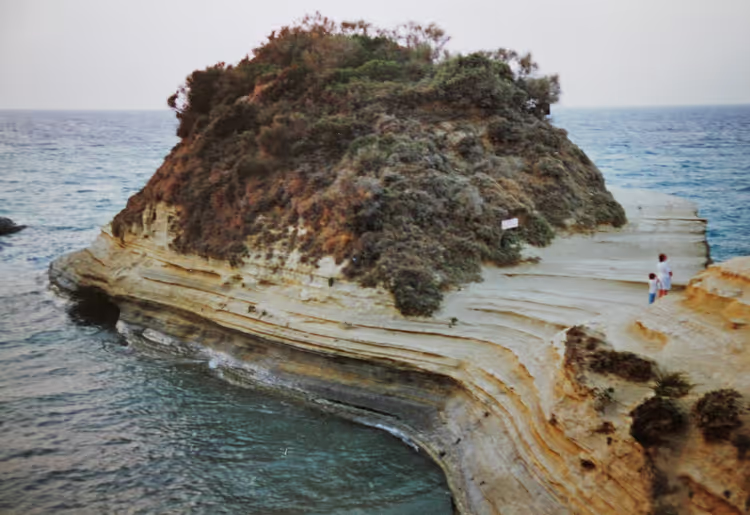 © Tony Hisgett from Birmingham, UK · CC BYPhoto: Tony Hisgett from Birmingham, UK, CC BY (https://creativecommons.org/licenses/by/2.0), Wikimedia Commons
Sidari is known for a narrow strip of water between the cliffs called the "Canal of Love." The canal formed naturally: over thousands of years, water carved a channel about twenty meters wide into the rocks. The sea here is sheltered from the wind, and the water is always warm, so it is convenient for swimming with children.
A legend about two lovers whom the gods turned into rocks is tied to the canal. This is where the customs that visitors follow come from. If a couple wants to stay together forever, they must swim across the canal together. If someone is looking for love, they swim under the rock arch and say aloud the name of the person they would like to have by their side.
There are caves and tunnels nearby, and views open up from every side. To get here, walk through Sidari toward Peroulades Beach: to the right of it there is a sign pointing to the romantic beach. The best time for swimming is morning.
14. Sidari Beach
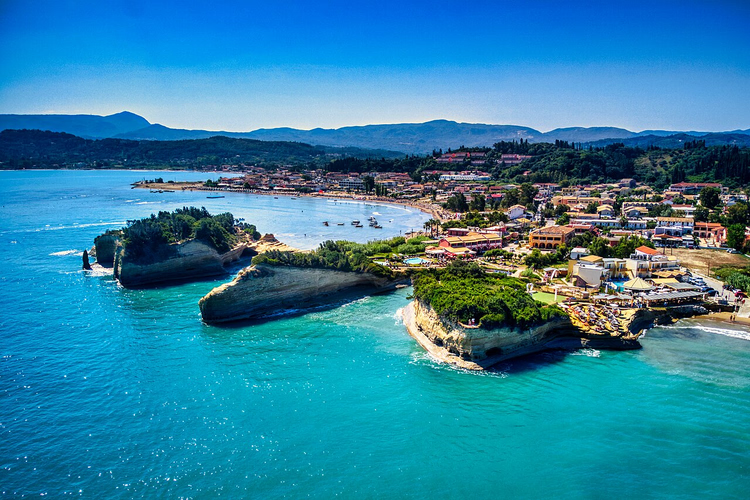 © Hagai Agmon-Snir حچاي اچمون-سنير חגי אגמון-שניר · CC BY-SAPhoto: Hagai Agmon-Snir حچاي اچمون-سنير חגי אגמון-שניר, CC BY-SA (https://creativecommons.org/licenses/by-sa/4.0), Wikimedia Commons
Sidari has long turned into an entire resort area: several villages are connected by beaches, and the longest of them bears the same name. A wide sandy strip juts into the sea and forms a bay. It is convenient here with children: little ones run on the soft sand and sunbathe.
The infrastructure is well developed. On the beach you can rent paragliders, ATVs, motorboats, catamarans, water skis, and surfing and diving equipment. Cafes and restaurants serving fresh fish, seafood, vegetables, and fruit operate along the shore. In the evening, discos and entertainment programs open up, so there are plenty of young people here.
Not far away there is another small beach among high cliffs. It is chosen by experienced swimmers who do diving and underwater photography. Come to the beach in the morning if you want to get a spot by the water in high season.
15. Angelokastro Fortress
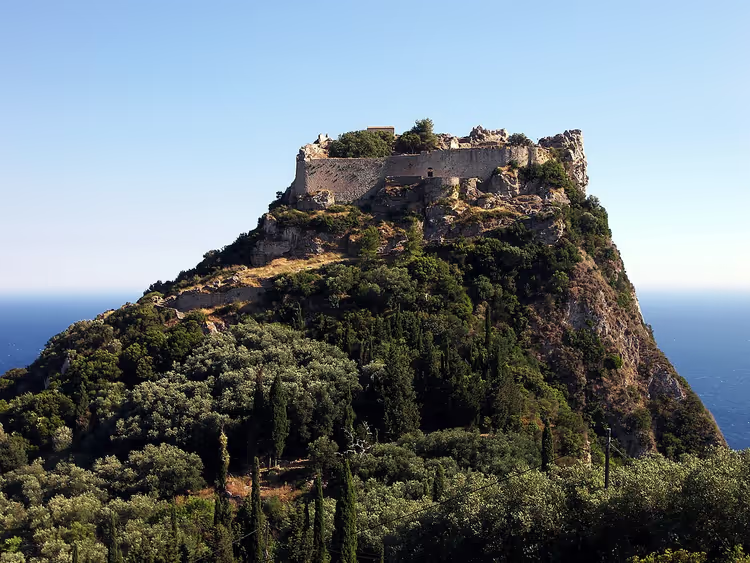 © Dr.K. · CC BY-SAPhoto: Dr.K., CC BY-SA (https://creativecommons.org/licenses/by-sa/3.0), Wikimedia Commons
Angelokastro stands on a peak of the northwestern coast, not far from Paleokastritsa. The Byzantine emperor Michael II Komnenos built the fortress in the early 13th century and named it after his father Angelos. Its second name, the Fortress of the Archangel Michael, is tied to a small church nearby. For Byzantium, this was the westernmost outpost.
Excavations in the late 20th century uncovered two Christian tombs dating to the early Byzantine period, the 5th to 7th centuries. After the fortress was built, the ancient Paleokastro monastery was moved to a safer location, where it remains today.
Despite its inaccessibility, the fortress was captured by the Angevins in the late 13th century, as recounted in an ancient manuscript, the oldest written record of its history. The Angevins were expelled, but in the late 14th century the fortress was besieged by the troops of the Republic of Venice and incorporated into their holdings. Later the Genoese and the Turks tried unsuccessfully to take it; the fortress did not surrender, just like the entire island.
Today the fortifications are being restored, and the fortress is explored like an open-air museum. Inside stands the Church of the Archangel Michael, and in the Chapel of Saint Kyriaki, 18th-century frescoes are well preserved. The walls offer a panorama of the surrounding area and the sea. The fortress is closed on Wednesdays; on other days it is open from morning to evening, with exact hours to be confirmed on site. The climb to the gate is steep, so wear comfortable shoes.
Corfu attractions on the map
All fifteen points are easy to view on a map: the old town, fortresses, monasteries, and beaches are located in different parts of the island. Plan your route in advance so you do not spend half a day traveling between them. The easiest way to get from the airport to your hotel is to book a transfer: a car waits at the exit, and you head straight to your destination.
If you do not want to drive yourself, check out ready-made island tours: local guides take you to Achilleion, Paleokastritsa, and Angelokastro in one day.
Tours and tickets in Corfu
Guided tours, skip-the-line tickets and activities — most offers can be cancelled free of charge.
See offers on GetYourGuideThe widget loads once you give your consent.
⁉️🤔 Frequently asked questions
How many days do you need to see the highlights of Corfu?
Two days are enough for the old town with its two fortresses, Achilleion, and Mouse Island. If you want to add Paleokastritsa, the monastery, Angelokastro, and the Sidari beaches, plan for three days. The island is elongated, so the drive between the west and east coasts takes about an hour.
When is the best time to visit Corfu?
Mild weather lasts through May, June, and September, when the sea is already warm and the heat eases off. July and August are the busiest and most expensive months. If you want to catch the Easter traditions, book your hotel early: over the three holiday days, the island receives nearly as many visitors as its resident population.
Do you need a car on Corfu?
In Corfu Town you don't need a car: the center is compact and everything is close by. For Paleokastritsa, Pantokrator, and Angelokastro, it's more convenient to rent a car or join a tour, since buses run infrequently. Look for parking in the old town ahead of time, as free spaces are scarce there.
How much does entry to Achilleion cost?
A standard ticket costs 7 € (as of 09/2026, official website). Due to restoration work, only the park and gardens are open, so check which areas are accessible before buying. Children under six and visitors with disabilities enter free of charge, while students and seniors pay a reduced rate.
Can you swim at the Canal d'Amour with children?
Yes, the strip of water is sheltered from the wind and always warm, so swimming with children is easy there. Go in the morning: by midday it gets crowded, and finding a free spot by the water becomes harder. Wear non-slip shoes, because the rocks nearby are slippery.
In short: what's worth booking
The trip logic is simple: give one day to the old town, one to the west coast, and another to the Sidari beaches. That way you cover all fifteen spots without rushing.
- If you're short on time: book a hotel in Corfu Town and explore the city on foot.
- If you're traveling with children: choose Sidari, where there's sand and calm water.
- If you're after views and quiet: look at Paleokastritsa.
- If you want nightlife and cafes: stay in Sidari or Kanoni.
If you haven't chosen accommodation yet, compare neighborhoods and browse Corfu hotels on Trip.com.

A small editorial team writing guides for independent travel. We travel ourselves, but we haven’t been everywhere, so we check prices, opening hours and how to get there against official sources.