
















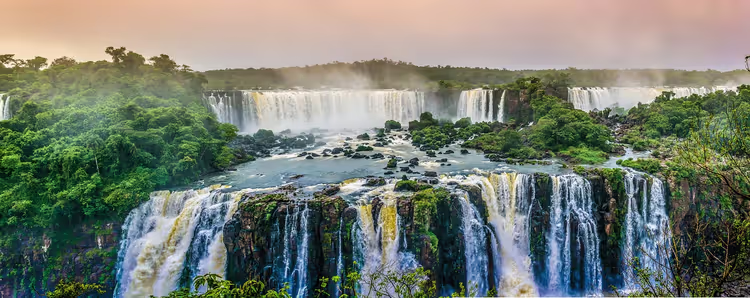
Niagara, Iguazu and Angel: 8 waterfalls and what you need to know before the trip
The season matters more than the distance. At peak times, more than 168,000 cubic meters of water per minute flows over the crest of Niagara (as of 09/2026, source). By late summer, some waterfalls turn into thin trickles, and some only run during the rainy season. Picking the right month here matters more than buying a ticket in advance.
The eight waterfalls below are spread across four continents, and we left Blood Falls in Antarctica off the list: the water there is colored by iron, and getting to it is nearly impossible. For each waterfall below, you'll find the height, the best time to visit, how entry works, and how to get to the viewing areas. We checked the numbers and seasons against official park websites and open sources (09/2026).
Ad: this article contains affiliate links, we earn a commission if you book through them, at no extra cost to you.
What to know before you go
💡 In short:
- The season matters more than the distance: at Niagara and Iguazu the water is at its most powerful in spring and early summer, while at Jog and Tugela everything depends on the rain.
- Entry is paid almost everywhere. Tickets are sold by the national parks, so check prices on their websites before you travel.
- Height, season, and entry details: 09/2026, for Yosemite based on the US National Park Service guide, for Niagara based on Niagara Parks.
What you usually pay for is not the waterfall itself, but the road to it. The banks of Niagara are open year-round, while the boats and viewing attractions operate only in the warm season. Iguazu and Yosemite are reached through national parks, so you'll need a park ticket there. Canaima and Tugela are hard to reach without a guide or a rental car.
Then there's the journey. Some waterfalls sit near cities with airports, while others are hidden in mountains and jungle. Plan a full day for travel, not for the waterfall itself: you'll spend an hour and a half at the viewing areas, and half a day getting there.
1. Niagara Falls
Niagara is made up of three waterfalls, not one. Horseshoe Falls is known as the Canadian Falls, while American Falls and Bridal Veil Falls lie on US territory. The whole group sits on the Niagara River, on the border between the Canadian province of Ontario and the state of New York. The total drop is 51 meters, with an average flow of about 2,400 cubic meters per second (as of 09/2026, source). By water volume, Niagara ranks among the top ten waterfalls on the planet and remains the most powerful waterfall in North America.
 © Robert F. Tobler · CC BY-SAPhoto: Robert F. Tobler, CC BY-SA (https://creativecommons.org/licenses/by-sa/4.0), Wikimedia Commons
The best views are from the Canadian side. You look at the Horseshoe from the Table Rock viewing platform, descend into a tunnel behind the wall of water, and board a boat. The Hornblower departs from the Canadian side, the Maid of the Mist from the American side, and both boats approach the very wall of falling water. Tickets are sold online; check prices with the operator before you travel. In winter, the banks are decorated with festive lights, and the flow looks completely different beneath them.
- How to see it: from the Canadian side, from Table Rock and from the tunnel near the falls.
- The catch: in high season, the crest of the Horseshoe is crowded all day, so arrive when the viewing areas open.
2. Victoria Falls
Victoria Falls (Mosi-oa-Tunya, "the smoke that thunders") sits on the Zambezi River, on the border between Zambia and Zimbabwe. The drop is 108 meters, the width is 1,708 meters, and the average flow is about 1,088 cubic meters per second (as of 09/2026, source). In 1989, the falls were inscribed on the World Heritage list, and today national parks operate on both sides of the border.
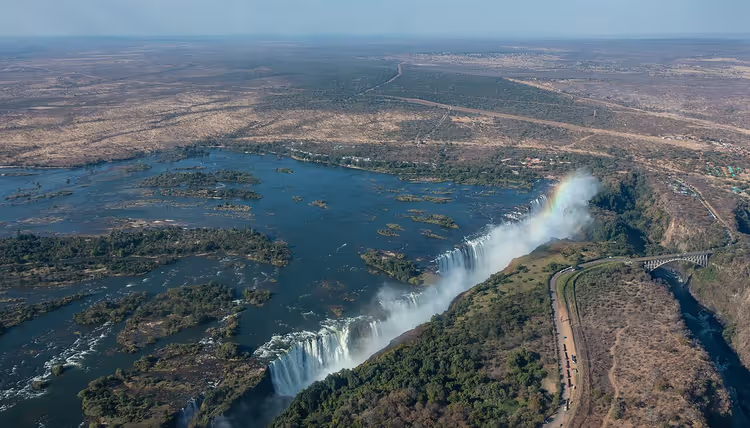 © Diego Delso · CC BY-SAPhoto: Diego Delso, CC BY-SA (https://creativecommons.org/licenses/by-sa/4.0), Wikimedia Commons
The flow depends on the season. In spring, you see a solid wall of water and a cloud of spray, while at the end of the dry season the rocks are exposed and the falls break into separate channels. It's convenient to split your visit into two parts: on the Zambia side, a trail and the Knife Edge bridge lead to the gorge, while on the Zimbabwe side you walk along the viewing platforms in the park. If you're short on time, book Victoria Falls tours on GetYourGuide: they include transport to both sides.
3. Iguazu Falls
Iguazu consists of 275 falls on the river of the same name, on the border between Argentina and Brazil. The highest single drop is 82 meters, with an average flow of about 1,756 cubic meters per second (as of 09/2026, source). The national parks on both sides are UNESCO World Heritage sites, and the system itself is considered the largest in the world by number of falls.
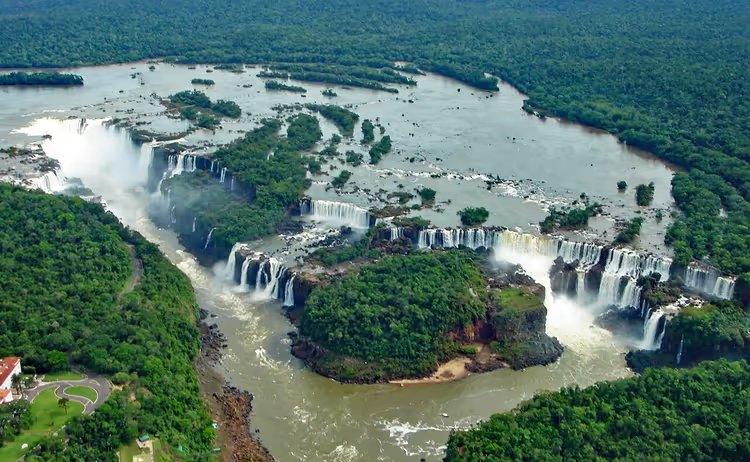 © Mariordo (Mario Roberto Durán Ortiz) · CC BY-SAPhoto: Mariordo (Mario Roberto Durán Ortiz), CC BY-SA (https://creativecommons.org/licenses/by-sa/4.0), Wikimedia Commons
The two sides offer two different experiences. On the Argentine side, you walk along trails right above the water and reach the cascades by eco-train; on the Brazilian side, you get a wide panorama that shows almost the entire wall of falls. The nearest airports are in Foz do Iguaçu on the Brazilian side and Puerto Iguazú on the Argentine side. If you are traveling without a car, book Iguazu Falls tours on GetYourGuide: they include transport, a guide, and tickets.
4. Angel Falls
Angel Falls holds first place for height: 979 meters of total height and 807 meters of uninterrupted drop (as of 09/2026, source). The water falls from the summit of Auyán-tepui in Canaima National Park, Bolívar State, Venezuela. The park is a UNESCO World Heritage site, and some of the water never reaches the ground, hanging in the air as mist.
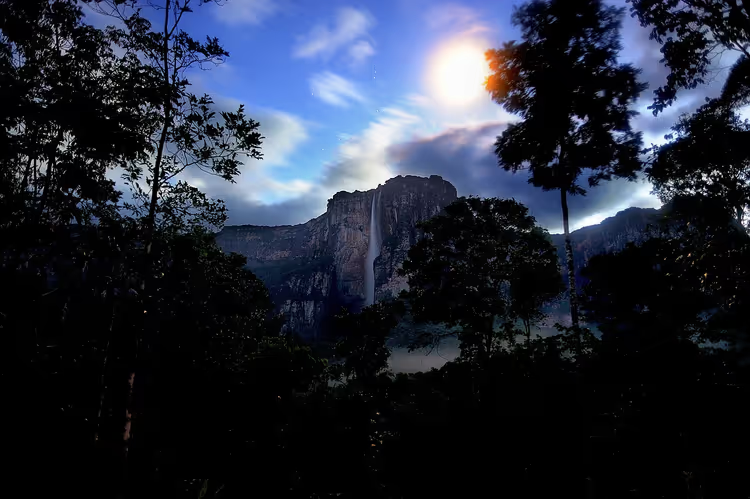 © Paulo Capiotti · CC BY-SAPhoto: Paulo Capiotti, CC BY-SA (https://creativecommons.org/licenses/by-sa/2.0), Wikimedia Commons
Getting here is more expensive and takes longer than reaching the other waterfalls on this list. You fly from Caracas or Ciudad Bolívar to a camp in Canaima, then travel by canoe along the river and reach the base of the falls with a guide. You pay an entrance fee at the park gate, and before departure you are asked for a yellow fever vaccination certificate, so arrange it in advance. Tours are sold as multi-day packages; check the price with the operator.
- The catch: without a guide and a booked flight, the trip does not come together.
5. Tugela Falls
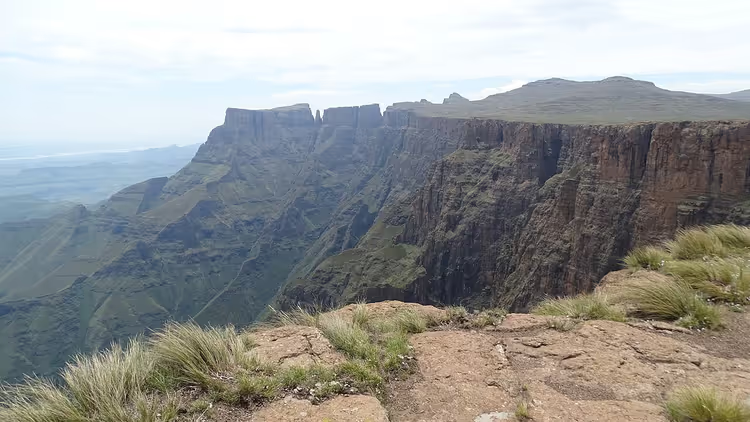
Tugela consists of five cascades in the Drakensberg mountains, KwaZulu-Natal province, South Africa. The official height is 948 meters, with the longest single drop at 411 meters (as of 09/2026, source).
 © Lutz Maertens · CC BY-SAPhoto: Lutz Maertens, CC BY-SA (https://creativecommons.org/licenses/by-sa/4.0), Wikimedia Commons
The falls are seasonal. They come alive after heavy rain and are best seen at sunset, when the water is lit by the low sun. Hiking trails lead to the falls: the short route starts at the Sentinel Car Park near Witsieshoek, and you can complete this climb in half a day. The long route goes through gorges and boulders and requires a full day. Look for accommodation in the mountain camps near Royal Natal National Park.
- The catch: in dry months, the falls almost disappear.
6. Utigard Falls
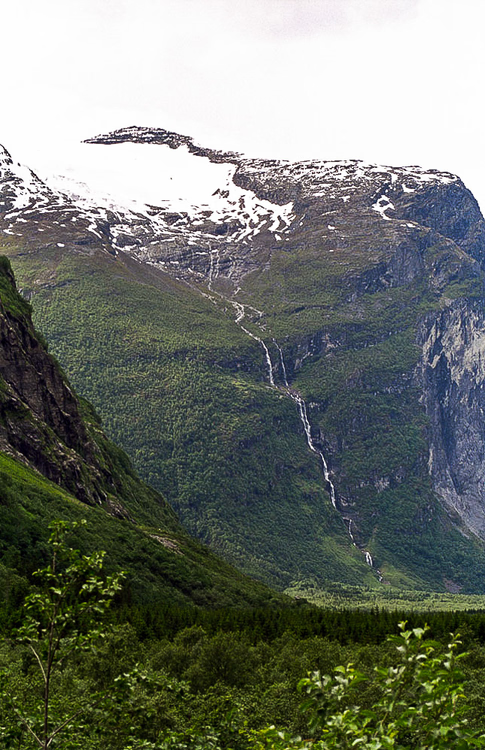
Utigardsfossen, also known as Ramnefjellsfossen, is in western Norway, in Stryn Municipality. Total drop is 818 meters, four tiers, the longest single drop is 405 meters, average width is 15 meters (as of 09/2026, source). The waterfall is fed by the Ramnefjellbreen glacier, an arm of the large Jostedalsbreen, and pours into Lake Lovatnet.
 © Ohelwig · CC BY-SAPhoto: Ohelwig, CC BY-SA (https://creativecommons.org/licenses/by-sa/4.0), Wikimedia Commons
Getting here is easier than to Angel Falls. The road runs along the lake, and the villages of Loen and Olden are nearby, where you will find lodging and camping. The water volume is low, so in a dry summer the flow looks more modest than in photos. In 1905 and 1936, landslides from Mount Ramnefjellet killed more than a hundred people (as of 09/2026, history of the Lovatnet landslides).
7. Yosemite Falls
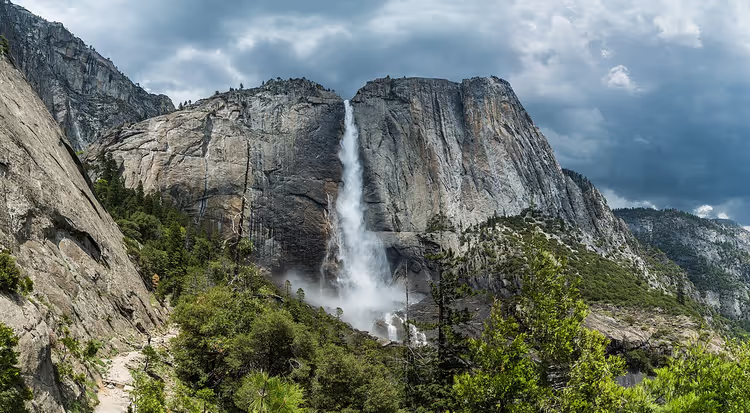
Yosemite Falls is considered the tallest in Yosemite National Park and one of the tallest in North America. Total height is 739 meters, the longest single drop is 436 meters, and the water flows over three tiers (as of 09/2026, National Park Service). The waterfall is fed by Yosemite Creek in the Sierra Nevada mountains of California.
 © Diliff · CC BY-SAPhoto: Diliff, CC BY-SA (https://creativecommons.org/licenses/by-sa/3.0), Wikimedia Commons
This waterfall has a short season. Peak flow comes in late spring, by late summer it shrinks, and in a dry year it can disappear entirely. The Upper Yosemite Fall Trail climbs from the valley to the top: the ascent takes several hours, there is almost no shade, so bring water with you. You do not have to go all the way to the top. The most striking view of the waterfall opens up from the first overlooks in the valley, which you can reach by car.
- The catch: in summer the flow drops, and the waterfall loses its power.
8. Jog Falls
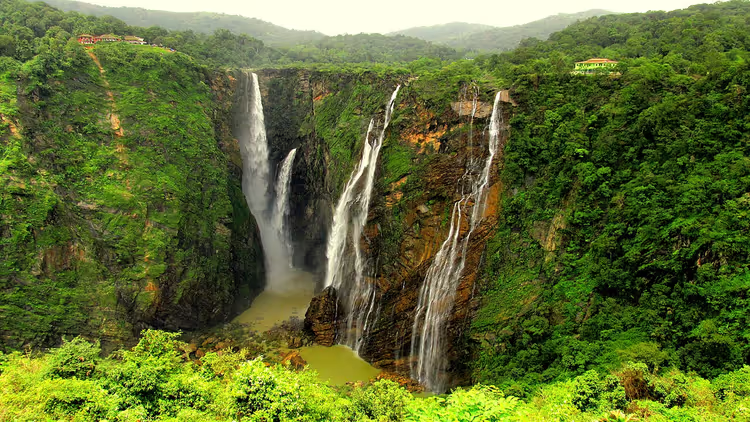
Jog drops from a height of 253 meters and splits into four streams: Raja, Rani, Rocket, and Roarer. It sits on the Sharavati River in Karnataka, India, and is considered the third-highest waterfall in the country (as of 09/2026, Karnataka tourism website). The average width of the flow is 472 meters, and the best season coincides with the monsoon.
 © Arkadeep Meta · CC BY-SAPhoto: Arkadeep Meta, CC BY-SA (https://creativecommons.org/licenses/by-sa/4.0), Wikimedia Commons
During the rainy season, the water comes down as a solid wall and throws up a cloud of spray. In the dry season, only thin streams remain, and some tourists hike down to swim at the base of the falls. You can only go there with a local guide: the current is treacherous and the banks are slippery. The best views are from two platforms: the panoramic one is near Jog-Kargal, and the second, the British Bungalow viewpoint, is right by the falls. You can stay overnight in the village of Kargal and in the towns of Sagara and Honavar. You can reach the falls by bus from the airports in Hubli, Bangalore, and Mangalore.
- The catch: the surrounding area is tropical jungle with venomous insects, so do not go into the forest without a guide.
⁉️🤔 Frequently asked questions
What is the highest waterfall in the world?
Angel Falls in Venezuela: 979 meters of total height and 807 meters of uninterrupted drop (as of 09/2026, source). Technically, Tugela Falls in South Africa disputes this, because new measurements put its height at 983 meters. These figures have not yet received international confirmation, so first place remains with Angel Falls.
How much does it cost to see waterfalls?
It depends on the location. At Niagara, the banks are open for free; you only pay for the boat and viewing attractions. For Iguazu, Yosemite, Canaima, and the Drakensberg, you pay a national park entrance fee (Yosemite data as of 09/2026, National Park Service). Check the price on the park's website: it changes every season.
When is the best time to visit Niagara?
Peak flow occurs in late spring and early summer, when the Great Lakes snow melts. Boats and viewing attractions operate in the warm season; in winter, you only have access to the banks and the holiday lights. In summer, you will face crowds and heat, so morning remains the best time for photos.
Do I need a yellow fever vaccination?
You need one for a trip to Canaima, where Angel Falls is located: the certificate is checked before boarding the domestic flight. Get it in advance, a couple of weeks before your trip. Zambia and Zimbabwe may also require the certificate if you are going to Victoria Falls. Check the requirements for Iguazu with Brazil and Argentina before traveling. For Niagara, Tugela, Utigard, Yosemite, and Jog, no vaccination is required, but you should get vaccinated separately against tropical infections.
Can you swim at waterfalls?
Swimming at large waterfalls is dangerous: strong currents, rocks, and cold water. Tourists go down to the water only with a guide and only in calm spots, such as the pool at Jog in the dry season. Plan to view the falls from observation platforms and do not cross barriers.
In short: what to book
If you are going for the first time, start with Niagara: the infrastructure is straightforward and the banks are accessible year-round. For maximum water volume, head to Jog during the monsoon season or to Victoria in spring, when the flow gains strength. For trekking and height, choose Tugela in the Drakensberg; for the highest waterfall on the planet, fly to Canaima. Book accommodation near waterfalls and national parks in advance: in high season, hotels near waterfalls on Trip.com sell out several weeks ahead, and campsites near parks even earlier.

A small editorial team writing guides for independent travel. We travel ourselves, but we haven’t been everywhere, so we check prices, opening hours and how to get there against official sources.