
















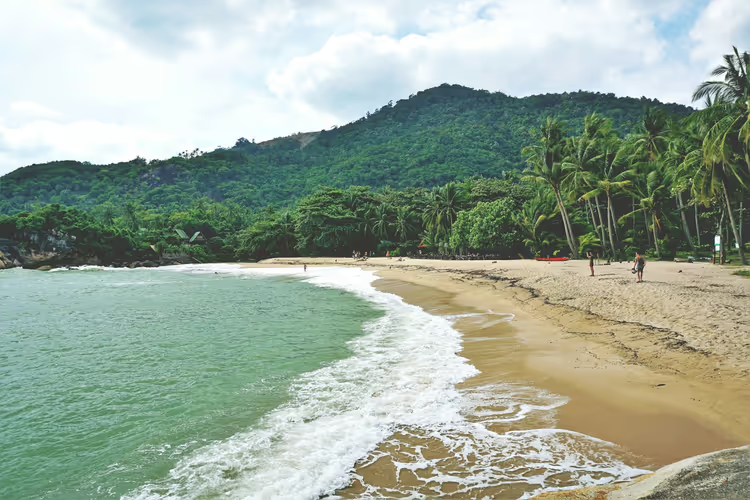
30 Main attractions of Koh Samui: what to see and how to get there
Koh Samui can be circled on your own in a few days. The ring road around the island connects nearly all the main sights, and neighboring stops are usually just a few dozen minutes apart.
There are more than thirty temples, waterfalls, zoos, and farms on the island. You most likely have only two or three free days, so we have put together a list of only the key places. For each one, we noted where entry is free and where you need a ticket.
Ad: this article contains affiliate links, we earn a commission if you book through them, at no extra cost to you.
How to circle the island in two days
💡 In short:
- Rent a scooter or a car: public transport between stops barely runs.
- See the south of the island, where the waterfalls and farms are concentrated, in the morning before it gets hot.
- Visit temples before sunset: most of them close in the evening.
Plan your route along the ring road so you do not have to cross the whole island to return to one stop. The north is convenient to see on one day, the south on another. Download an offline map in advance: near waterfalls in the jungle, cell service drops out.
Renting a scooter or a car costs less than taxis, and it is the most flexible way to get around the island. Traffic in Thailand drives on the left, so give yourself time to adjust over the first few kilometers. A helmet is mandatory, and an international driving permit will help if you are stopped.
Stick to the main ring road: secondary roads turn into dirt tracks in places and dead-end in the jungle. There are enough gas stations along the route, but there are fewer in the southern part. Fill up in advance if you plan to return after sunset.
Keep a relaxed pace. Driving between the north and south of the island along the ring road takes a few dozen minutes, and the heat and humidity drain your energy. Two or three places a day is a comfortable schedule that lets you see everything properly.
Early morning and the time before sunset are best for sightseeing: the light is softer and there are fewer people. At midday, plan stops with shade or travel between points by vehicle.
1. Big Buddha Temple
 © Golfer70 · CC BY-SAPhoto: Golfer70, CC BY-SA (https://creativecommons.org/licenses/by-sa/3.0), Wikimedia Commons
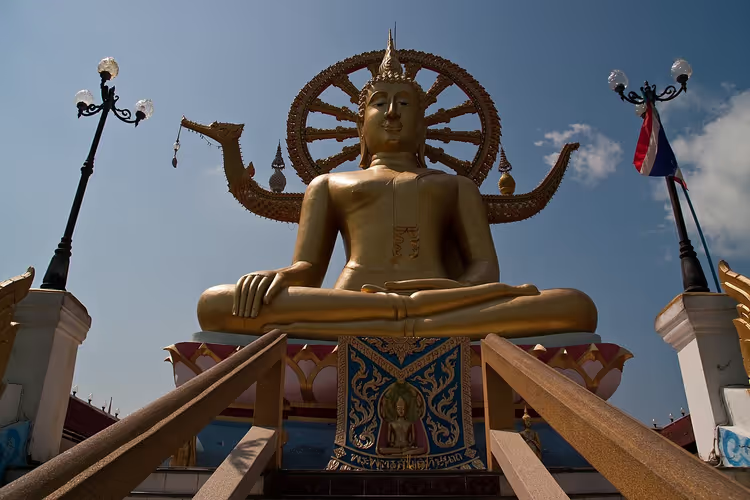
In the northeast of the island, on the small islet of Koh Fan, stands a 12-meter golden Buddha statue (as of 09/2026, guide to Wat Phra Yai). It is the main landmark of Koh Samui, visible even from the airplane window when landing. A causeway and a wide staircase with dozens of steps lead up to the statue.
The steps are divided into three sections by railings with naga heads. The central passage is reserved for monks; you climb along the sides. At the base, shoes are removed, and socks are also best left on the shelf.
- Cost: free entry (as of 09/2026, guide).
- How to get there: about 3 km north of Samui Airport (on the map), a few minutes by scooter.
- The catch: from 10 am to 4 pm, the stone steps heat up so much that they burn bare feet.
At the top, you walk around the statue in a circle and reach a viewing platform overlooking the bay. Many visitors buy roof tiles from the monks, write a wish on them, and leave them for repairing the complex's roofs. Striking the bell near the platform is also considered a good sign here.
2. Secret Buddha Garden
 © אברהם שוורץ · CC BY-SAPhoto: אברהם שוורץ, CC BY-SA (https://creativecommons.org/licenses/by-sa/4.0), Wikimedia Commons
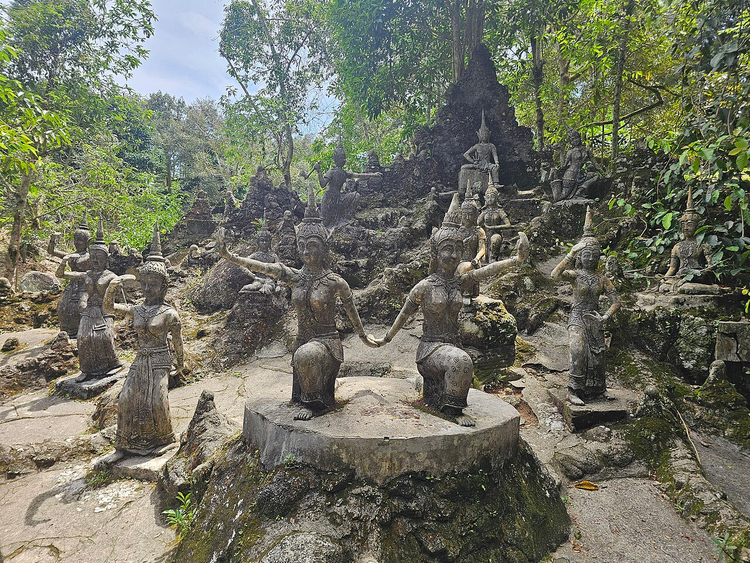
On Khao Yai mountain, deep in the island's interior, a local farmer named Nim Thongsuk carved an entire garden out of stone. In his old age, he began building it at the bottom of a ravine, and today dozens of mythological figures stand there. A small stream runs along the winding riverbed, with people, birds, and animals sitting along its banks.
Some of the sculptures are covered in lichen and seem part of the forest, while others remain unfinished. In niches, the artist placed figures of himself and his brother, not wanting to leave the garden. Separate small houses were built for monks, where one could be alone and meditate.
Locals respect this place and buried Nim together with his wife right here, creating a crypt. Entry to the grounds is free, and the path from the parking area takes a few minutes on foot. Bring water: the uphill climb over rocks is not easy for everyone.
3. Wat Plai Laem
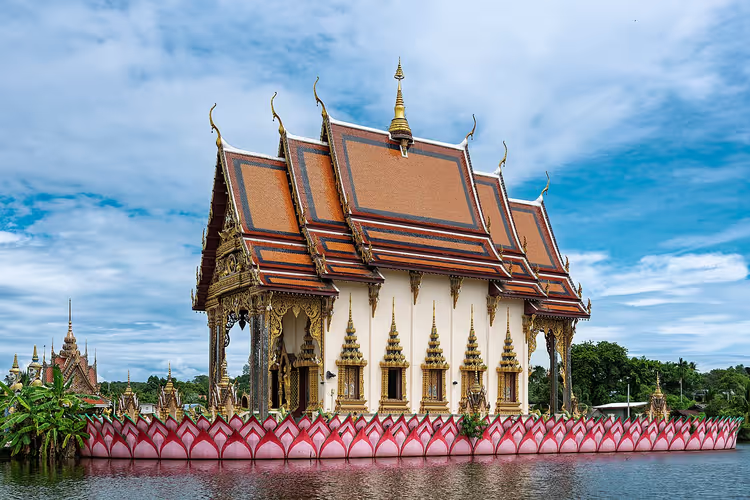
Wat Plai Laem stands on a small lake in the northeast and combines three traditions at once: Thai, Chinese, and Japanese. The central place is occupied by the Thai bot, where prayers are held daily. It is built on an artificial island, around which turtles and large catfish swim.
Feeding the fish here has become a separate activity; food is sold at a stall near the bridge. You enter the temple without shoes; devout Thais take off their sandals already at the bridge. The walls are painted with scenes from the Ramayana, and the many-armed goddess Guanyin sits on a green dragon.
Guanyin is considered the protector of the family, and people come to her with requests for help. After making a wish, you can tie a red thread on her arm, but touching the deity is not allowed. Opposite, the Chinese Hotei smiles: according to legend, you should rub his belly, and then your wish will come true.
Nearby, a shop sells souvenirs and shell jewelry. Entry is free, but shoulders and knees should be covered.
4. Na Muang 1 Waterfall
 © Maksim Sundukov · CC BY-SAPhoto: Maksim Sundukov, CC BY-SA (https://creativecommons.org/licenses/by-sa/3.0), Wikimedia Commons
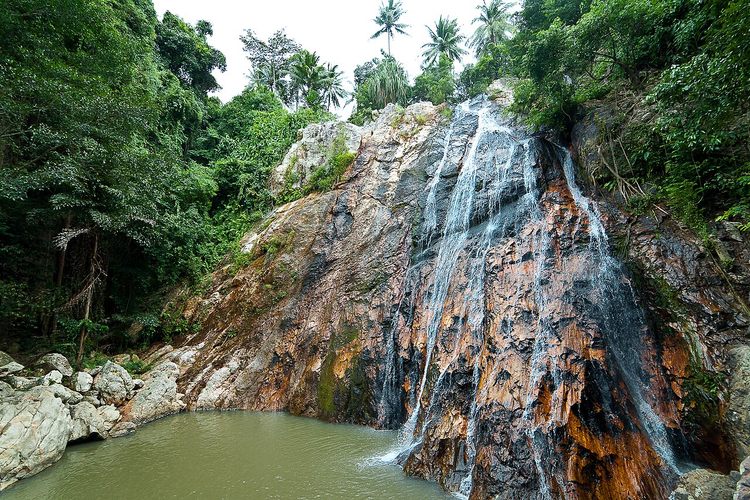
Namuang 1 is in the southern part of the island, and its name translates as "purple." The water runs over purple-hued rocks, which is how the waterfall got its name. The drop here is about 18 m (as of 09/2026, discoverkosamui.com).
The bottom of the small lake at the base is covered with sharp rocks, so jumping from the ledge is prohibited. Swimming is also awkward because of the strong current, though the water is calmer in the dry season. Local kids splash around away from the main flow, where the water is warmed by the sun.
The waterfall has viewing platforms with statues of Buddhist deities. Nearby there is an elephant trekking attraction through the jungle, and after the ride it is customary to treat the elephants to bananas. This is a convenient stop if you are driving the southern loop and want to combine nature and animals.
There are cafes and fruit stalls near the waterfall where you can wait out the heat. The elephant route through the jungle starts at the entrance and takes about an hour. Both Namuang waterfalls are easy to see in one trip: they are only a few minutes' drive apart.
5. Namuang 2 waterfall
 © Manfred Werner · CC BY-SAPhoto: Manfred Werner, CC BY-SA (http://creativecommons.org/licenses/by-sa/3.0/), Wikimedia Commons
Namuang 2 is taller and considered more dangerous. Its water falls in several cascades from a height of about 80 m (as of 09/2026, discoverkosamui.com). Swimming here is allowed only at the lower pool, and the water in it is cool.
To see the full panorama, you will need to climb up along maintained trails and ladders above the water. In late winter and early spring the upper tiers partially dry up, while in the rainy season the streams rush down at high speed. Wear non-slip shoes: the rocks are wet.
At the base there is a safari park with attractions for children. Local residents also offer photos with tiger cubs, snakes, monkeys, and crocodiles. You can also go to a crocodile, snake, or bird show.
The climb to the upper pool takes about half an hour and suits those who are confident walking on rocks. Bring water with you and do not climb up during rain: the trail gets slippery. There is a cafe at the lower pool where you can rest after swimming.
6. Paradise Park
 © Roma Neus · CC BYPhoto: Roma Neus, CC BY (https://creativecommons.org/licenses/by/3.0), Wikimedia Commons
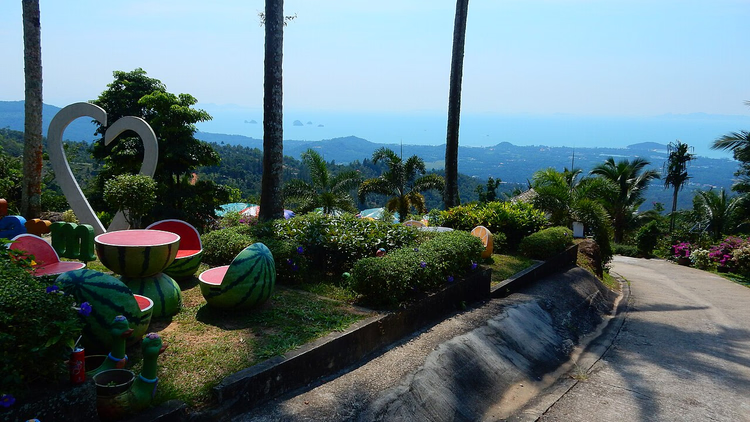
Paradise Park occupies the slope of Khao Pom mountain and stretches almost to the very top. It is a zoo where birds and animals live in conditions close to natural. Each species has its own zone, with paths for visitors laid out between them. Pets here are allowed to be fed and petted.
The park was originally conceived as a bird park, but over time animals were brought in as well. A particular pride of the park is its parrot collection: they are kept in houses made of coconut shells. It is home to macaws, aratingas, budgerigars, African greys, cockatoos, cockatiels, and lovebirds. Besides birds, you will see ostriches, peacocks, and ducks.
The mini-zoo houses deer, goats, rabbits, and reptiles. The most famous resident is a gibbon named Cola, whom tourists spoil with drinks, even though it is harmful for the animal. The park's high elevation lets you combine viewing the animals with a jungle panorama.
At the top there is a pool whose edge creates the illusion of a drop-off right past the rim. Check the entrance fee on site: prices change by season.
7. Wat Khunaram Temple
 © Roma Neus · CC BYPhoto: Roma Neus, CC BY (https://creativecommons.org/licenses/by/3.0), Wikimedia Commons
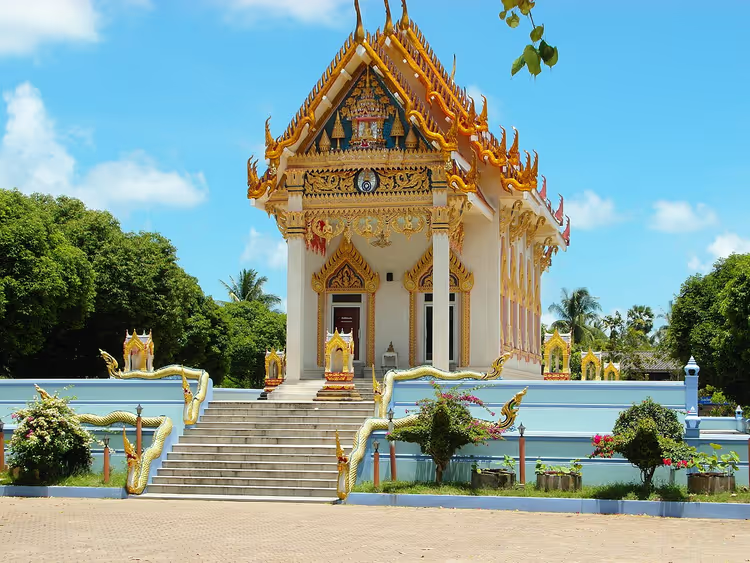
In the eastern part of the island there is a temple complex with the mummy of Luang Pho Daeng, the monastery's founder. During his life, he spent entire nights in meditation and felt full of energy in the morning. He died during meditation, sitting in the lotus position, and his body, according to accounts, did not decay.
The remains were placed in a glass sarcophagus and installed in the temple so that anyone could approach the teacher. Today the mummy is dressed in orange robes, and its eyes are covered with dark glasses. Buddhists from all over the world come here to pay their respects and make a wish.
You can buy incense sticks with numbers from the local monks. You cannot choose: you should take the first one you pick up, then find the prediction for that number on the display board. It is also customary here to rub the gong: if it sounds under your hand, it is believed that good luck is with you.
Admission is free, but dress modestly: shoulders and knees must be covered. The temple is active, so do not disturb worshippers during services.
8. Hin Lad Waterfall
Hin Lad is the island's third most popular cascade. At its foot there is a small Buddhist pagoda with the same name, and nearby a bridge leads into the jungle. There is also a pond with goldfish that you are allowed to feed. Trails are set up for tourists, but the climb is made harder by the heat and tree roots.
The water flows over several ledges, and it only appears in full force after heavy rains. In winter the water is filled with rain runoff, and by spring the cascade shrinks. To the right of Hin Lad there is another small stream, and between them hides a shady oasis.
Along the way you will see how exotic fruits grow in nature. Wear comfortable shoes: climbing over wet rocks requires caution.
9. Tiger Zoo and Aquarium
 © Thajsko · CC BYPhoto: Thajsko, CC BY (https://creativecommons.org/licenses/by/3.0), Wikimedia Commons
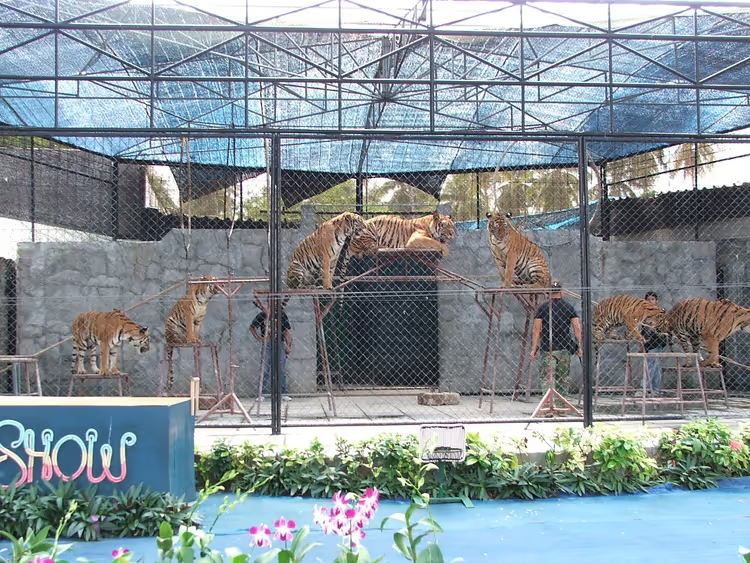
On the southeastern coast, a tiger zoo and aquarium operate under one roof. The main celebrities here are tigers of various species, and you can even have your photo taken with a Bengal tiger cub. Besides them, the park is home to birds, monkeys, and fur seals. A show starts during the day: first the seals perform, then the tigers.
In a long corridor with dim lighting, aquariums with tropical fish are installed. Not only bright reef inhabitants live here, but also sharks, moray eels, as well as crabs, mollusks, and turtles. Visitors are allowed to feed the turtles.
If you are traveling with children, this stop is easy to combine with the southern waterfalls. Check show times at the entrance: the schedule changes.
10. Ang Thong National Marine Park
 © Vyacheslav Argenberg · CC BYPhoto: Vyacheslav Argenberg, CC BY (https://creativecommons.org/licenses/by/4.0), Wikimedia Commons
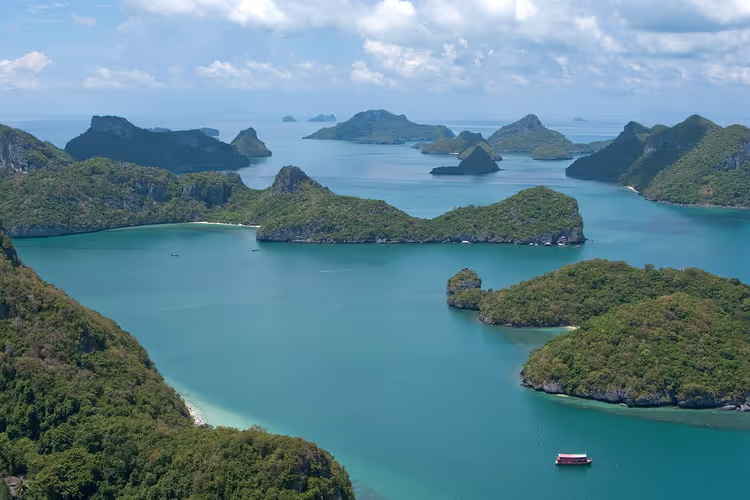
The Ang Thong archipelago consists of 42 islands with uninhabited jungle, and its name translates as "golden bowl." It is a separate protected area where people go for snorkeling and the climb to the viewpoint lake. An adult park ticket costs 300 baht (as of 09/2026, Ang Thong National Park).
Here you can swim with a mask and see butterflyfish, angelfish, parrotfish, rays, and blue crabs. You may also encounter oysters, sea cucumbers, reef sharks, and groupers. The clear water makes Ang Thong one of the best places for a first introduction to Thailand's underwater world.
The easiest way to get here is as part of a day boat trip. Keep in mind that swimming near some islands is restricted to protect the reefs.
Compare Ang Thong boat trips on GetYourGuide
11. Wat Khao Hua Juk Temple
Locals believe that there are only five Buddha footprints in the world, and one of them is here. A sign at the entrance to the shrine says so. A Buddha statue is installed in the lower part, and a golden pagoda rises at the top, visible from various points on the island.
The observation deck offers a view of the surrounding area, the local airport, and the sea bay. There are no official tours here, but you can come on your own. The climb is short, and the view is worth the time spent.
12. Pink Elephant Water Park
The water park in Maenam Bay is designed for family recreation and is suitable for a trip with toddlers. While children play in the activity zone, parents can relax in the jacuzzi and grab a bite at the cafe. There are few extreme slides here, but plenty of gentle attractions.
A special device changes the wave strength in the pool from gentle to stormy. Tall slides descend from both sides of the tower, and a separate platform is built for thrill-seekers. There is also a long "river" that slowly carries you around the pool.
For toddlers there is a zone with fountains, a shallow pool, and low slides. There is also a corner for infants, which is rare for the island. If you want to avoid crowds, come at opening time.
13. Laem Sor Pagoda and Temple
 © Per Meistrup · CC BY-SAPhoto: Per Meistrup, CC BY-SA (https://creativecommons.org/licenses/by-sa/4.0), Wikimedia Commons
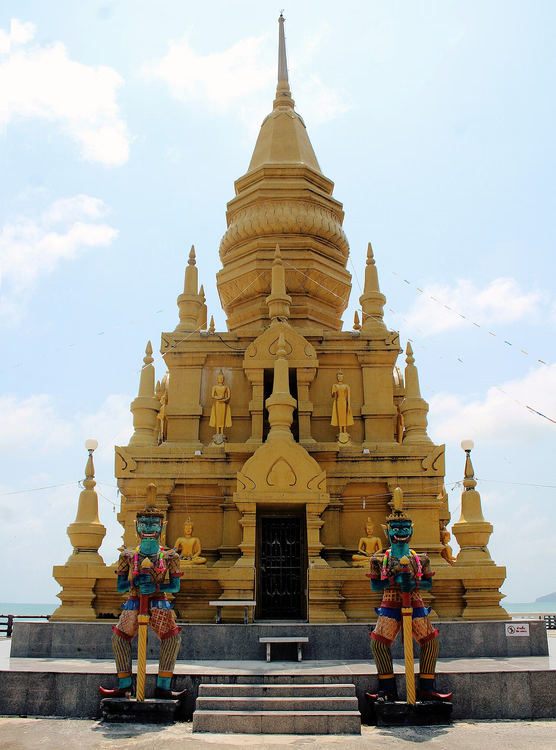
In the south of the island stands the Laem Sor Pagoda, which is rarely included in tour programs. For locals it is a sacred place: the pagoda once stood on a neighboring hill, but after two lightning strikes it was moved to the seashore. Now the largest pagoda is washed by the waves, and the gold shines against the sky.
Nearby there is a small shrine with model boats and the mummy of a monk who died in the 19th century. According to legend, he founded this shrine and passed away here. Some believe the figure is made of wax, but most likely the mummy is real.
It is quiet and uncrowded here even in high season. Respect local customs: loud music and revealing clothing are inappropriate.
14. Skyhawk Zipline
The Skyhawk zipline is a course over the jungle stretching several kilometers. Depending on your fitness level, you choose a route that suits your abilities: there are also children's options. Moving along the cable, you fly over the crowns of tropical trees and freeze at the height.
Several routes are offered for adults, and each is designed to give the feeling of free flight. Instructors provide equipment and belay you along the entire route. Check age and weight restrictions when booking: the operator's rules change.
15. Wat Sila Ngu Temple
 © Eletroboss · CC BY-SAPhoto: Eletroboss, CC BY-SA (https://creativecommons.org/licenses/by-sa/4.0), Wikimedia Commons
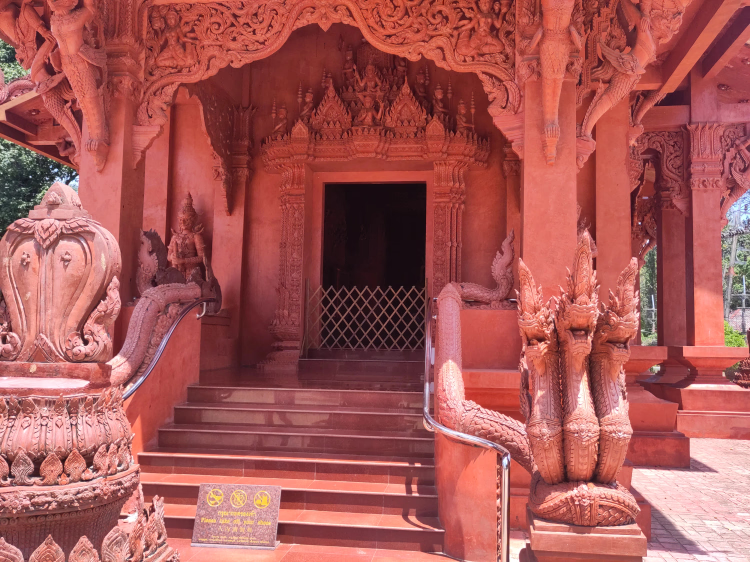
The name Wat Sila Ngu translates as "golden serpent." The shrine's unusual red color comes from unfired clay, which is why it is often called the "red temple." According to legend, it was built in the 1930s, and the founder's grave is nearby.
It is claimed that a golden serpent also rests here. Construction is not finished: the temple is being built on donations, and Buddhist monks currently live there. The pagoda walls are covered with sculptural images of mythical creatures.
The staircase leading from the pagoda to the sea is decorated with serpent bodies. The monks believe that a serpent protected the Buddha during meditation. The descent to the shore takes a few minutes, and from there a view of the bay opens up.
16. Khao Yai Waterfall
Khao Yai Waterfall is found at the southern tip of the island, away from the busy Lamai. Locals link its name to the owner of a durian plantation that once stood nearby. The place attracts visitors not only with views of the surroundings but also with a sculpture of a girl in traditional Thai dress at the very top.
You can climb up via a concrete staircase, from which a panorama of the jungle opens. The cascade falls over several ledges and forms shallow pools. To swim, you climb to the upper observation deck, where bathing areas are set up.
Like other waterfalls on the island, Khao Yai can dry up in some sections during the transition period from winter to spring. The best time to visit is the rainy season, when the flow is full.
17. Butterfly Garden
 © Sasha India · CC BYPhoto: Sasha India, CC BY (https://creativecommons.org/licenses/by/2.0), Wikimedia Commons
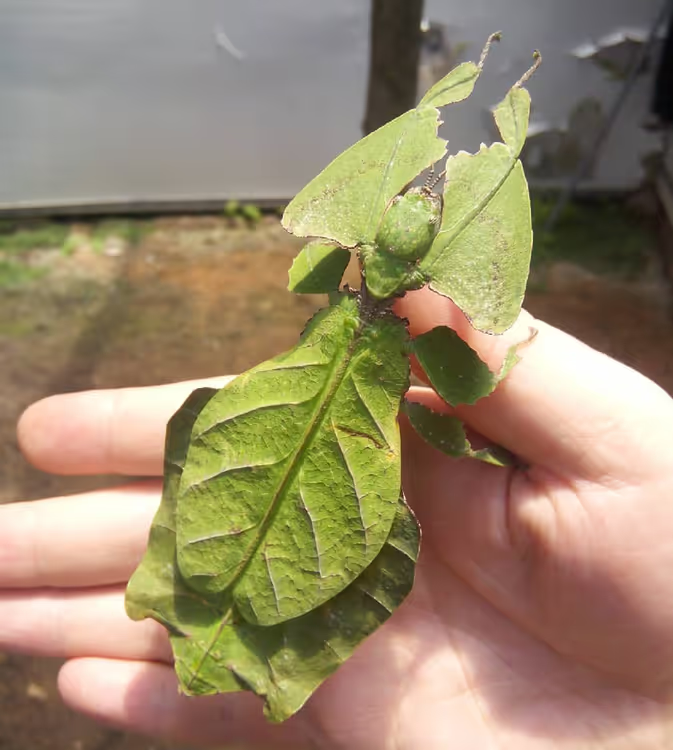
On the southeastern coast lies the Butterfly Garden, which locals call the Kingdom. It is located on a hilly elevation, and wooden staircases lead you higher and higher among flower beds. Dozens of species of these insects live here, and they cannot leave the area: the entire space is enclosed with netting.
To attract butterflies, many bright flowers have been planted in the garden. There is also a traditional-style Bee House and an Insect Museum with exhibits from around the world. You can end your walk at the pavilion with aquariums containing cocoons: new butterflies will soon emerge from them.
This is a peaceful place for a leisurely visit with children. Bring a camera with macro mode: the insects here are close and not afraid of people.
18. Siwa Tara waterfall and the love stone
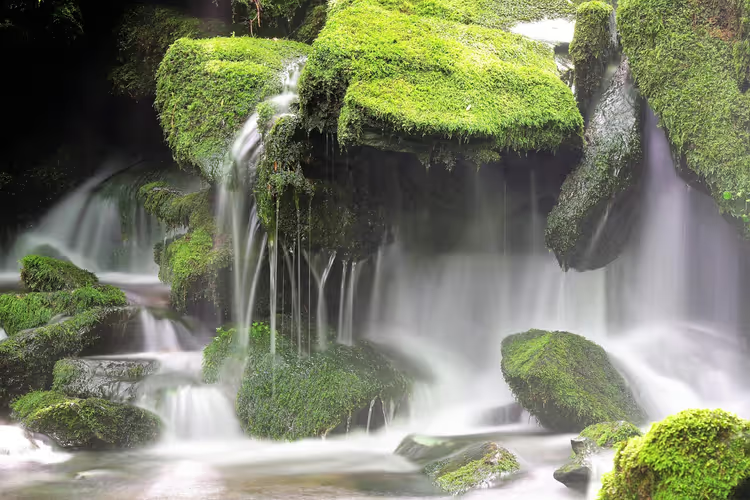
Around an unusual stone whose outline resembles a human heart, another cascade has formed. It is what draws tourists here, even though the stream itself is small and dries up in the dry season. A maintained path leads to the top, and fish swim in the pool at the foot.
There is a salon here where you can get an unusual massage: the fish gently clean the skin on your feet, and the service is offered for an extra fee. The observation deck is raised high, and from there you get a view of the Lamai beach area. A suspended cable lets you fly from one platform to another above the jungle.
If you are afraid of heights, just stick to the walk to the cascade. The path to it is short and suitable for any age.
19. Wat Lamai temple
 © Christophe95 · CC BY-SAPhoto: Christophe95, CC BY-SA (https://creativecommons.org/licenses/by-sa/4.0), Wikimedia Commons
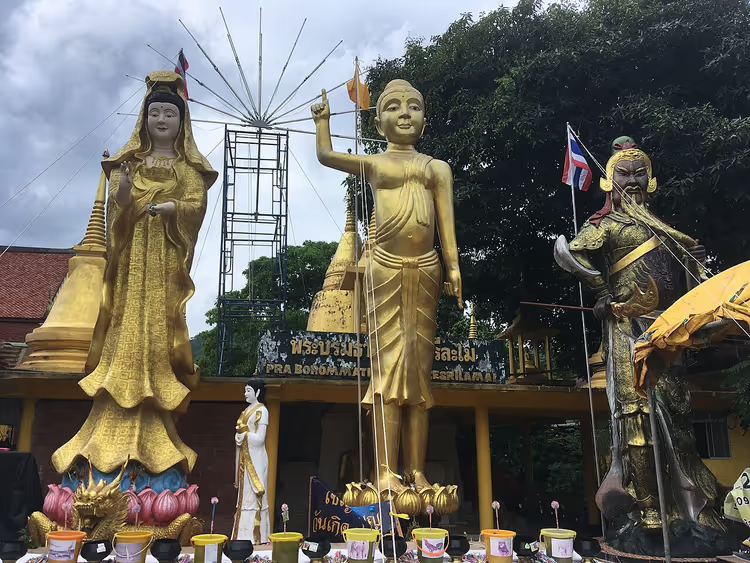
Wat Lamai is a popular place where locals hold their ceremonies: weddings, blessings for children, and farewells to the deceased. For Buddhists, funerals remain the main rite they prepare for throughout their lives, and they are also performed here. Pilgrims from all over the world come here for religious festivals.
The temple building is shaped like a lotus. At the entrance stands a multi-armed statue of a deity holding gifts for parishioners. The complex is guarded by figures of warriors in frightening masks.
Visitors of any faith may enter the temple. The main thing is to respect local customs and not disturb those at prayer.
20. Grandmother and Grandfather rocks
 © Dirk Enthoven · CC BYPhoto: Dirk Enthoven, CC BY (https://creativecommons.org/licenses/by/3.0), Wikimedia Commons
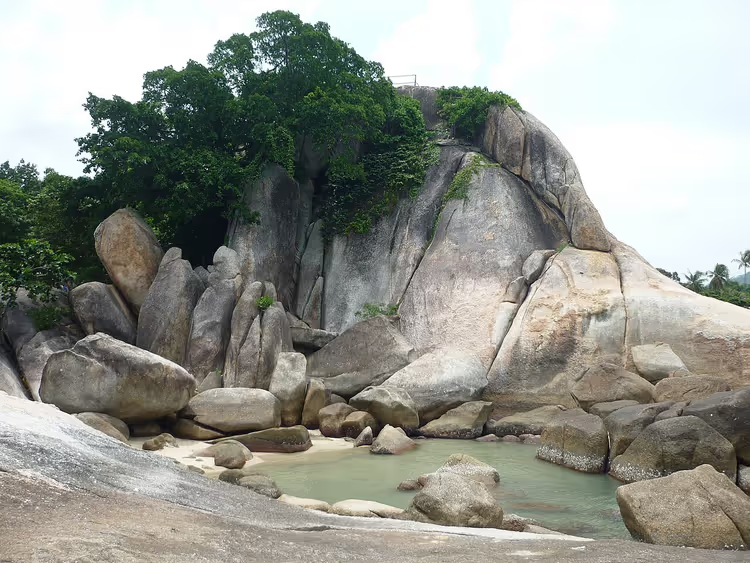
On Lamai beach, among the rocks, rise the Hin Ta and Hin Yai stones, whose outlines resemble male and female genitalia. Several legends explain their appearance. According to one, a ship carrying an elderly couple was wrecked here: the bodies washed ashore turned into stones and remained together forever.
Another legend tells of lovers whose union their parents did not approve of. So they stayed next to each other forever in this place. Locals attribute miraculous powers to the stones: to make a wish, you need to hold on to the rocks.
This is a free stop along the southern coast, with cafes and souvenir shops nearby. Come in the morning: during the day the stones are crowded and hot.
21. Church of the Ascension
On the west coast stands the Orthodox Church of the Ascension, the fourth Orthodox parish in Thailand. The plot of land was bought specifically so that Orthodox visitors to the island could attend services. The church was consecrated in honor of the Ascension, and the first service took place even before that event.
It is a white building with several gold and blue domes. The openwork iconostasis is made using an ancient woodcarving technique, and the icons are set in gold shrines. The church walls are covered with frescoes.
Particles of the relics of Orthodox saints are kept here. The church has a library with books on history and religion.
Baptisms and weddings are held in the church, and Orthodox holidays are celebrated. Tourists are allowed in at any time when there is no service: come in without shorts and with your head covered.
22. Coconut farm
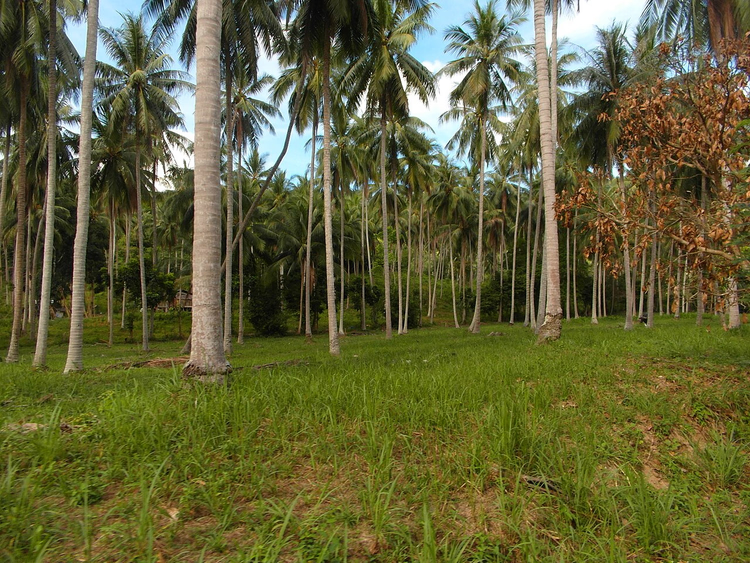 © Roma Neus · CC BYPhoto: Roma Neus, CC BY (https://creativecommons.org/licenses/by/3.0), Wikimedia Commons
Before tourism arrived, the island grew coconuts and shipped them all over the world. Small farms still exist today, and the most famous one lies between Lamai and Taling Ngam beaches. Here coconuts are turned into oils for food and cosmetics.
In memory of the trade that helped Thailand survive hard times, the Coconut Museum was opened. Here you will be invited to take part in making coconut oil yourself, and afterwards you will receive a bottle of the product made by your own hands. In the museum you can also examine items made from coconut: musical instruments, interior elements, and souvenirs.
This is a short stop on the way between the southern waterfalls. A good option for taking home natural oil and showing children how production works.
23. Snake farm
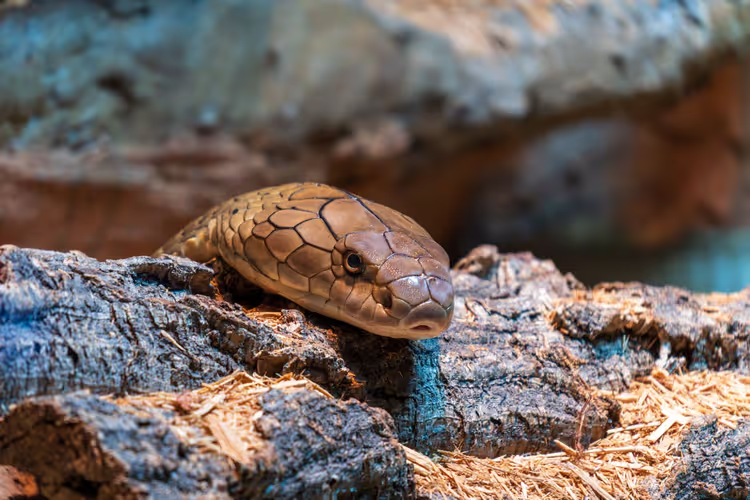
The snake farm is located in the southwest of the island and welcomes guests during the day. Many people come here specifically to see reptiles up close. Here they not only introduce you to the life of snakes, but also produce medicines based on snake venom, so tourists buy them right on the spot.
The terrariums house various reptile species: the king cobra, giant python, crocodiles, lizards, and monitor lizards. A snake show takes place several times a day. During the performance, spectators can touch the dangerous snakes and take photos with them.
The show also features the so-called king and queen of centipedes. After the performance, the bravest guests are offered a tincture based on python bile. Near the farm there are cafes serving snake meat dishes and a souvenir shop.
We recommend checking the show times at the entrance so you can plan the rest of your day.
24. Crocodile farm
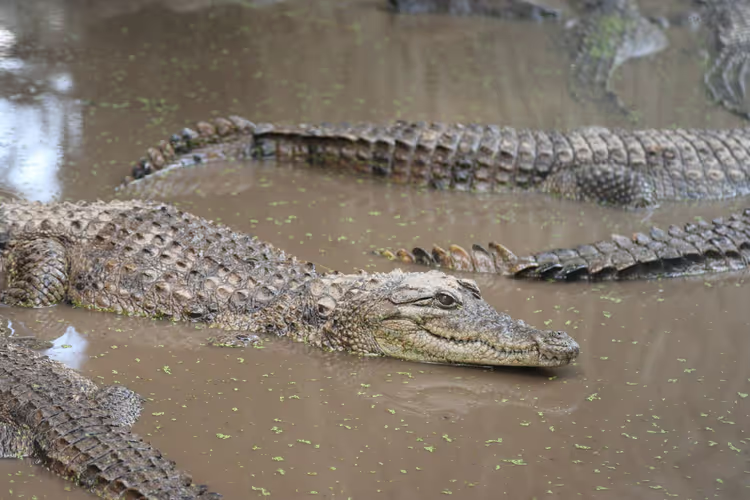
The crocodile farm is located near the airport and covers a large area. Dozens of crocodile species live here, including the rare Siamese crocodile, saltwater crocodile, and caiman. Besides them, you will see monkeys, rabbits, parrots, and snakes. Each enclosure has a sign describing the species and its habitat conditions.
The crocodile show is held for everyone several times a day. The trainer enters the enclosure with motionless crocodiles and starts prodding them. He sits on the animal's body and puts his head into its mouth, and at the end the crocodile is dragged by the tail toward the audience so that those who want to can touch it.
A separate show is dedicated to snakes: the trainer demonstrates how venom is extracted from a snake's fangs for medicine. The farm also runs a crocodile breeding program: eggs are kept in an incubator, and hatchlings are raised in a terrarium. There is also a small museum where a guide tells visitors about the country's inhabitants.
Animal shows may not impress everyone. If you are against such performances, just stick to touring the farm and museum.
25. Hainan Chinese temple
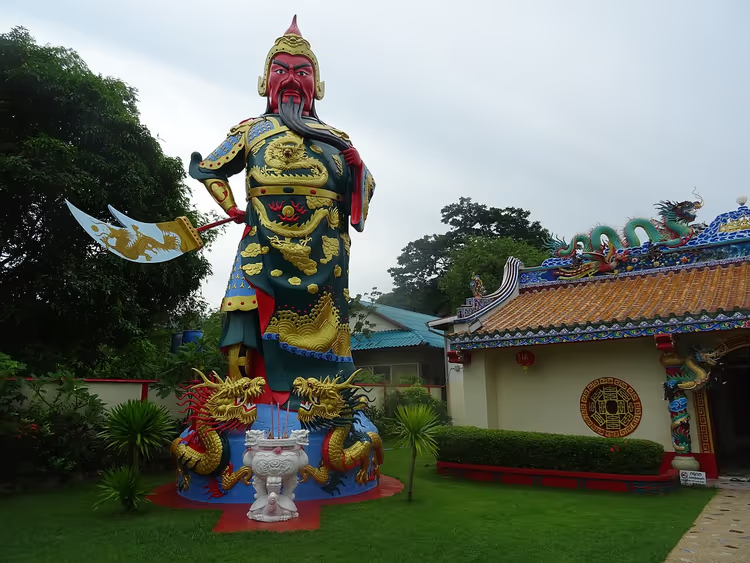 © Christophe95 · CC BY-SAPhoto: Christophe95, CC BY-SA (https://creativecommons.org/licenses/by-sa/4.0), Wikimedia Commons
In the island's administrative center, the town of Nathon, stands the Hainan Chinese temple. It was built by immigrants from China in the 1960s. The building is guarded by two golden lions, the roof is decorated with golden dragons, and the walls are painted with bright designs.
The temple is surrounded by a high wall that preserves the quiet and peace inside. For the island's Chinese diaspora, it has become not only a religious place but also a center for preserving their culture.
Hainan rarely appears on tourist routes, so there are almost no crowds here. While you are there, take a look around Nathon: ferries to the mainland depart from here.
26. Fisherman's village
 © holidaypointau · CC BYPhoto: holidaypointau, CC BY (https://creativecommons.org/licenses/by/2.0/), Flickr
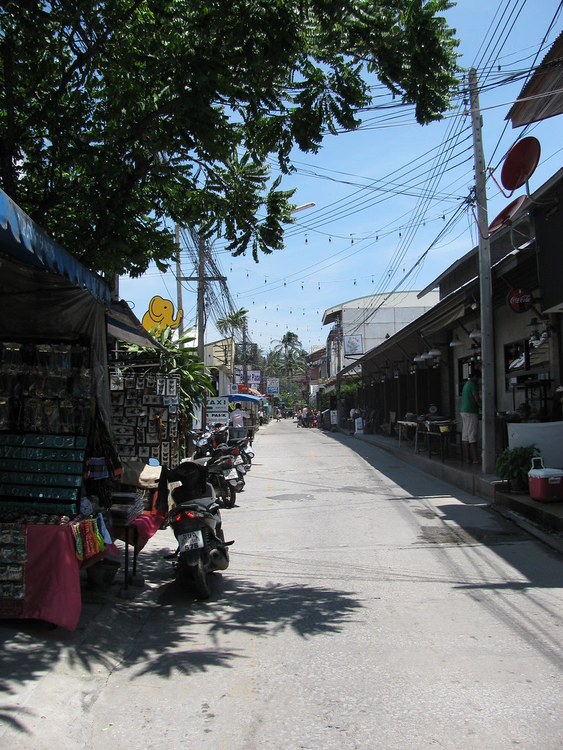
In the historic Bophut area, a fisherman's village has survived and today has turned into a shopping and entertainment complex. In the houses where fishermen once lived, souvenir shops now operate. They sell silk and cashmere clothing, gold and pearl jewelry, and leather goods.
The village resembles an old pedestrian street: local musicians play right on the sidewalks, and touts invite you into cafes and restaurants. The menus include both traditional Thai cuisine made from fresh seafood and European dishes.
In the evening, the most people come here: shops open and street musicians perform. Arrive by sunset to catch both the market and dinner by the water.
27. Khun Si waterfall
Khun Si waterfall hides in the jungle far from the island's main roads. The road to its top changes from concrete to dirt, which makes the climb harder in the rainy season. There are no difficult sections, though, and you climb calmly, stepping over the roots of mighty trees.
In winter the stream is filled with rainwater and looks fuller, while in spring it becomes shallow. At each step of the cascade there is a natural pool where you can swim. Remember that the bottom is covered with sharp rocky fragments: swim in footwear.
Some tourists jump into the water from the rocks that form the upper basin. At the top there is an observation deck with a panorama of the coast and jungle. Snakes are found in these forests, so watch your step.
28. Sheep farm
The sheep farm specializes not only in sheep, but also in growing green vegetables for local cafes. Its grounds are divided into pens for sheep and rabbits, as well as a children's playground. Visitors are allowed to feed the animals, and kids can pet them, like in a petting zoo.
Feed is sold here ready-made: carrots, grass, and milk. While the kids play, parents relax in the cafe on the grounds. If the weather doesn't allow for outdoor time, you can head up to the play area on the second floor, where games and books are available.
Samui has few children's playgrounds, so the Sheep Farm is a convenient stop on a route with little ones. Check the opening hours on site: the schedule changes during the rainy season.
29. Elephant farm
 © Robert Nyman · CC BYPhoto: Robert Nyman, CC BY (https://creativecommons.org/licenses/by/2.0/), Flickr
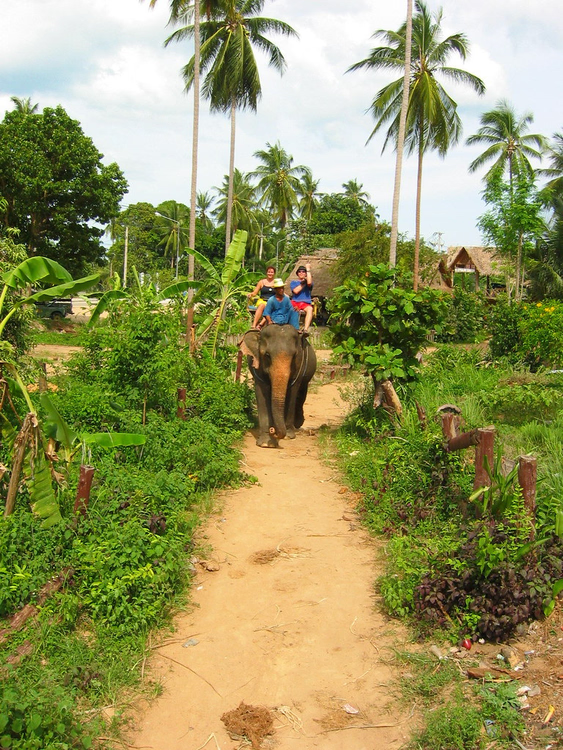
In Southeast Asia, elephants are respected as both working animals and performers. At the Elephant Farm near Namuang Waterfalls, the animals show off their skills: they dance, paint, and play soccer. Visitors also enjoy the massage given by these huge animals.
In gratitude for the show, the elephants ask guests for bananas. For those interested, a jungle route on elephant back is available. The ride takes about an hour and is easy to combine with a visit to Namuang Waterfalls.
Be careful when choosing a program: not all attractions treat the animals equally well. If in doubt, choose an option without riding.
30. Tan Rua Waterfall
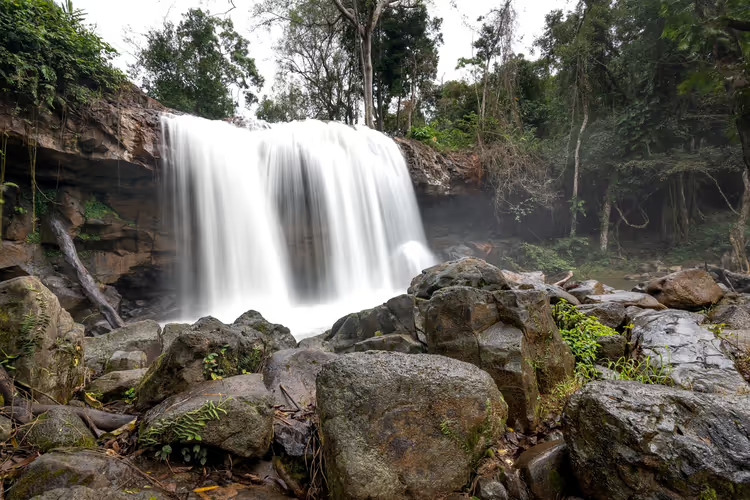
Tan Rua is considered the island's most mysterious waterfall. Visiting tourists named it Secret Falls because not everyone manages to find it. It's hidden near Maenam Beach, and entry to the area is free.
A mountain stream flows down several cascade steps into a pool at the base of the cliffs. Swimming is allowed here, but be careful. For adrenaline lovers, a rope swing is set up: you swing over the water and jump into the pool.
The best time to visit is from December to March, when Thailand's waterfalls are full of water. A rope route leads to the top, offering a view of the jungle, or you can hike up on foot. A sandy staircase across the mountain stream adds a thrill.
Experience shows that it's worth going here by motorbike and with an offline map. Road signs are rare, and without navigation it's easy to ride past.
Tours and tickets in Samui
Guided tours, skip-the-line tickets and activities — most offers can be cancelled free of charge.
See offers on GetYourGuideThe widget loads once you give your consent.
Samui attractions on the map
All the points on the list are easy to view on one map: mark the ones you need and build a route around the ring road. Below is a map of the island with the main sights. Download it in advance, because mobile internet disappears in the jungle near the waterfalls.
30 sights of Samui
Places on the map
- 1Big Buddha Temple 12-metre golden statue on Koh Faan islet, free entry
- 2Magic Buddha Garden Garden of stone mythological figures on Khao Yai hill, free entry
- 3Wat Plai Laem Temple on a lake with the goddess Guanyin, turtles and catfish swim around
- 4Na Muang 1 Waterfall About 18 metres of stream over purple rocks, jumping from the ledge is forbidden
- 5Na Muang 2 Waterfall Cascades about 80 metres high, swimming only at the lower pool
- 6Paradise Park Zoo on the slope of Khao Pom hill with birds and a pool at the top
- 7Wat Khunaram Temple with the mummy of the monk Luang Pho Daeng in a glass sarcophagus
- 8Hin Lad Waterfall Third most popular cascade, a pagoda and a fish pond at the base
- 9Tiger Zoo and Aquarium Tigers, seals and shark aquariums under one roof
- 10Wat Khao Hua Jook Golden pagoda on a hill with a view of the airport and the bay
- 11Pink Elephant Water Park Family water park in Maenam bay with a wave pool and kids' zone
- 12Laem Sor Pagoda Golden pagoda on the southern seashore, a shrine with a monk's mummy nearby
- 13Skyhawk Zipline Zipline over the jungle canopy, routes for different skill levels
- 14Wat Sila Ngu Red temple of unfired clay, stairs to the sea lined with serpent bodies
- 15Khao Yai Waterfall Southern cascade with bathing pools and a sculpture of a girl at the top
- 16Butterfly Garden Kingdom of butterflies on a hillside, Bee House and Insect Museum
- 17Siwa Tara Waterfall and Love Stone Small cascade by a heart-shaped rock, fish that nibble the skin on your feet
- 18Wat Lamai Active lotus-shaped temple, local rites are held here
- 19Grandmother and Grandfather Rocks Hin Ta and Hin Yai rocks on Lamai beach, free stop
- 20Church of the Ascension of the Lord Orthodox parish on the west coast with relics and a school
- 21Coconut Farm Farm with a Coconut Museum, oil is made in front of you and given to take away
- 22Snake Farm Terrariums with cobras and pythons, snake show several times a day
- 23Crocodile Farm Large farm near the airport with crocodile and snake shows and a museum
- 24Hainan Chinese Temple Chinese diaspora temple in Nathon, dome with golden dragons
- 25Bophut Fisherman's Village Old fishermen's houses with shops, cafes and an evening market
- 26Khun Si Waterfall Jungle cascade with natural pools and a viewpoint at the top
- 27Sheep Farm Petting farm with sheep and rabbits, playground and cafe
- 28Elephant Farm Elephant show next to the Na Muang waterfalls and a jungle route
- 29Tan Rua Waterfall Secret Falls near Maenam beach, rope swing over the pool, free entry
⁉️🤔 Frequently asked questions
How many days do you need to cover all 30 places?
You can't cover all 30 places in two days: a comfortable pace is two to three places per day. Pick the main points and see them along the ring road. The north with Big Buddha and Wat Plai Laem is convenient to see on the first day, and the south with waterfalls, rocks, and farms on the second. Set aside one more separate day for Ang Thong Marine Park.
What can you see on Samui for free?
Free entry applies to Big Buddha, Wat Plai Laem, Wat Khunaram, Wat Khao Hua Jook, and the Orthodox Church of the Ascension. You can freely visit Grandmother and Grandfather Rocks, the waterfalls, and Bophut fishing village. You need to pay for entry to Ang Thong and most farms with shows.
When is the best time to go to Samui's waterfalls?
The waterfalls are fullest during the rainy season. By spring, the upper cascades partially dry up, and the flow becomes weaker. Swim in water-friendly clothing or footwear: the bottom of many pools is covered with sharp rocks, and diving from the ledge at Namuang 1 is prohibited.
What to see near the airport?
Big Buddha and Wat Plai Laem are right by the airport, as is the crocodile farm. They're easy to reach on your first day after arrival. Further along the ring road you'll get to Bophut fishing village and Nathon, where ferries depart.
Can you explore the island without a motorbike?
You can, but it's harder: public transport between points runs infrequently, and some waterfalls and farms are off the main road. Take a car with a driver, a taxi, or join a day tour around the island. Renting a motorbike or car gives you more freedom with your schedule.
In short: what's worth booking
Temples, waterfalls, and Grandmother and Grandfather Rocks don't require booking, you just show up. But Ang Thong Marine Park, the snake show, and the crocodile show are easier to plan in advance, especially in high season.
If you have two days: take a day sea trip to Ang Thong and leave one day for the ring road around the island. If you're traveling with kids: combine the Sheep Farm, Butterfly Garden, and the water park in Maenam Bay. If you arrive late: sort out your airport transfer in advance.
Compare Ang Thong sea trips on GetYourGuide and book a transfer from Samui airport.
Check opening hours and prices before your trip: in the off-season, some farms and attractions close for maintenance.

A small editorial team writing guides for independent travel. We travel ourselves, but we haven’t been everywhere, so we check prices, opening hours and how to get there against official sources.