
















Trafalgar Square: what to see for free and how to get there
You don't pay anything to enter London's main square. Trafalgar Square operates around the clock, and no tickets are needed here (verified 09/03/2026 on the square's official page).
The square sits in the heart of Westminster, at the intersection of Pall Mall, Strand, and Whitehall. Here you'll see Nelson's Column with its four bronze lions, two fountains, the equestrian statue of Charles I, and the Fourth Plinth, where a new contemporary sculpture appears every two years.
You can see the square itself in half an hour. The surrounding museums take longer, and we'll cover those below as well.
Ad: this article contains affiliate links, we earn a commission if you book through them, at no extra cost to you.
History of Trafalgar Square
💡 In short:
- It was laid out in the 1840s to a design by John Nash and Charles Barry.
- Nelson's Column has stood here since 1843.
- Admission and opening hours: free 24-hour access (verified 09/03/2026, official page).
The site of the future square was first marked out by King Edward I in the 13th century. At that time, the royal stables serving the palace stood here. Nearby, the king erected a memorial cross in memory of his late wife. In 1647, the cross was demolished by order of Parliament (according to the official history of the square).
After the Restoration, a statue of Charles I appeared here, and public executions were held around it. In the early 19th century, the stables were dismantled. The empty plot in the city center needed to be turned into a ceremonial square, and the project was commissioned from John Nash, George IV's court architect.
Nash didn't finish the work, so the square was completed by Charles Barry. For you, this means the square's appearance only came together by the 1840s. It was intended to be named after William IV, but Trafalgar was chosen instead, in memory of Nelson's victory in 1805.
Nelson's Column and the fountains
Nelson's Column stands in the center of the square and serves as its main landmark. The monument is about 52 m tall including the admiral's statue. Gray granite, a Corinthian capital, and bronze reliefs at the base: each face tells the story of a separate Nelson victory (according to the official page).
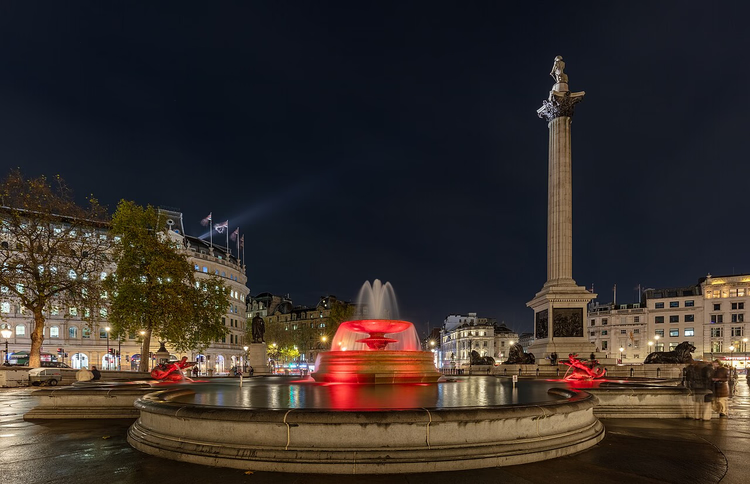 © Diego Delso · CC BY-SAPhoto: Diego Delso, CC BY-SA (https://creativecommons.org/licenses/by-sa/4.0), Wikimedia Commons
The column was erected between 1840 and 1843 to a design by William Railton, and the statue was carved by Edward Hodges Baily. The bronze for the decorations was cast from captured cannons taken in battle. In 1867, four lions by Edwin Landseer appeared at the base.
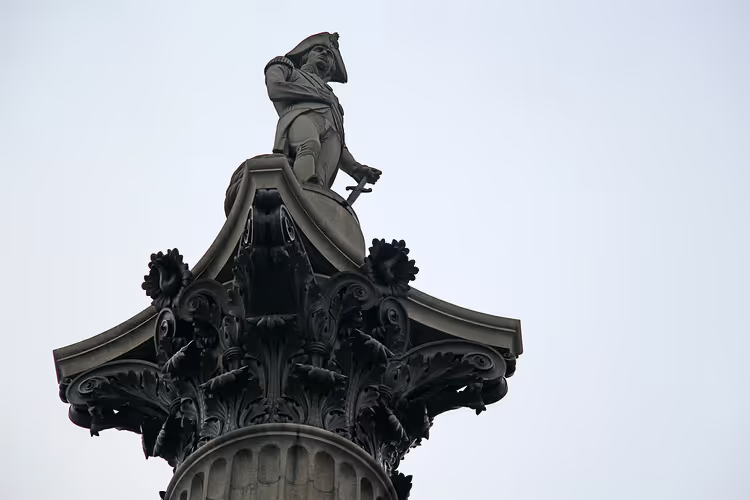 © Fred Romero from Paris, France · CC BYPhoto: Fred Romero from Paris, France, CC BY (https://creativecommons.org/licenses/by/2.0), Wikimedia Commons
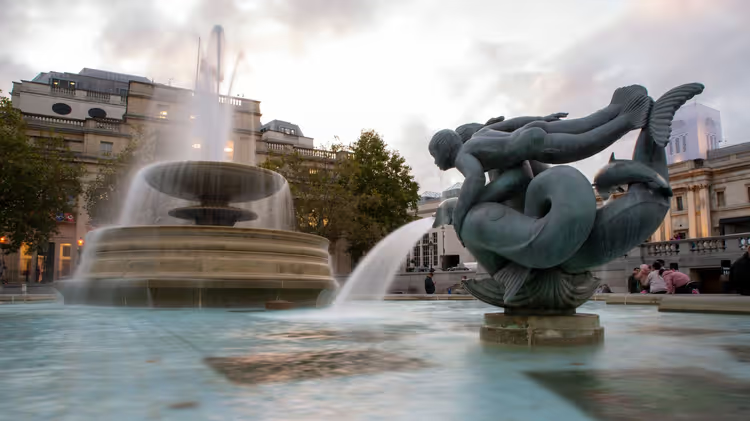
In front of the column, two fountains play, the western and eastern ones. They were named after Admirals Jellicoe and Beatty. The fountains appeared almost immediately after the square was built, and they took their current form after a 1930s renovation. Today they are decorated with bronze dolphins, mermaids, and tritons.
You should come here at opening time. In summer, the area around the water is always crowded, and you'll avoid the lines and crowds before 9:00 or after 18:00.
Statue of Charles I
The statue of Charles I stands behind the column, on an island between traffic lanes. The first equestrian monument in Great Britain was cast by sculptor Hubert Le Sueur in 1633, commissioned by Lord Treasurer Richard Weston.
During the English Revolution, Cromwell ordered the statue confiscated and melted down. The brazier John Rivett hid the bronze king and handed the authorities a fake. After the Restoration, the sculpture was returned to its original place, where the cross had once stood.
This point is considered London's zero mile marker. Distances to all cities in the country are measured from here. Every year on January 30, the anniversary of the king's execution, people gather here with flowers.
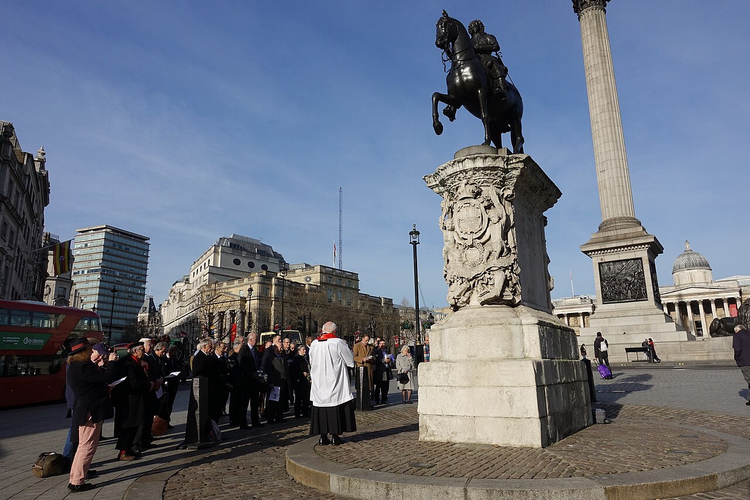 © CrisNYCa · CC BY-SAPhoto: CrisNYCa, CC BY-SA (https://creativecommons.org/licenses/by-sa/4.0), Wikimedia Commons
Statues on the first three plinths
According to Charles Barry's design, the four corners of the square were occupied by plinths for statues. Three spots quickly found their heroes. The fourth remained empty for more than 150 years.
The northeast plinth was reserved by George IV, who paid 9,000 guineas for it. The bronze king on horseback by Francis Chantrey appeared here in 1843. The statue was made for Marble Arch and installed temporarily, but it stayed permanently.
The southwest corner was taken by General Charles Napier, commander of the Indian campaign. His nearly four-meter statue by John Adams appeared in 1856, funded by public subscription. The southeast plinth received General Henry Havelock in 1861.
In 1936, the statues of Napier and Havelock were slated to be replaced with busts of Admirals Beatty and Jellicoe. The busts were ultimately placed along the north wall. In 2003, the city proposed removing the Havelock monument, but Londoners defended their hero.
The Fourth Plinth and contemporary art
The Fourth Plinth was intended for William IV, but there wasn't enough money for the statue. Contemporary sculptures have been exhibited here since 1999, usually one work at a time for eighteen months to two years (according to the official Fourth Plinth page).
The first was Mark Wallinger's figure of Christ, "Ecce Homo." After that, the plinth hosted a pregnant Alison Lapper, a model of a hotel, a horse skeleton, and a seven-meter thumbs-up. In 2009, Antony Gormley's "One & Other" project took place: 2,400 Britons stood on the plinth for one hour each, one after another.
Since 2026, the plinth has been occupied by the sculpture "Lady in Blue" by Tschabalala Self. The next work will be installed in 2028 (according to the list of Fourth Plinth winners).
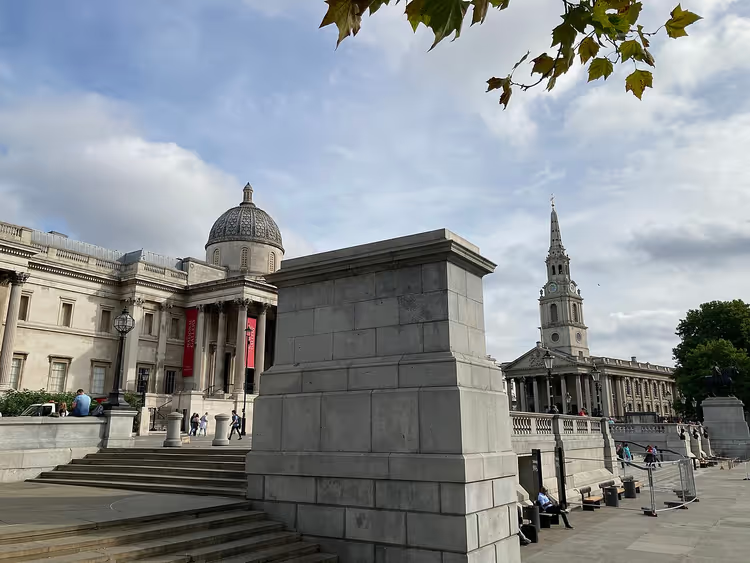 © Matt Brown · CC BYPhoto: Matt Brown, CC BY (https://creativecommons.org/licenses/by/2.0), Wikimedia Commons
The most controversial work was "Hahn/Cock" by Katharina Fritsch. The nearly five-meter fiberglass bird stood out sharply in color against the stone and bronze. Part of the public saw it as a symbol of France, and the mayor had to defend the project.
Pigeons and the square’s rules
Pigeons have long been a fixture of the square. Huge flocks once gathered here, and vendors sold bird feed.
In 2000, the authorities removed the feed stalls. In 2007, feeding pigeons in the square was officially banned, and violators face a fine (according to the square’s visiting rules).
There are noticeably fewer pigeons now. If you want to see them, head south of Nelson’s Column.
What’s around the square
The square is surrounded by museums, a church, and two embassies. On the north side stands the National Gallery. Admission is free, and it is open 361 days a year (according to the National Gallery). You’ll find the opening hours in the table below.
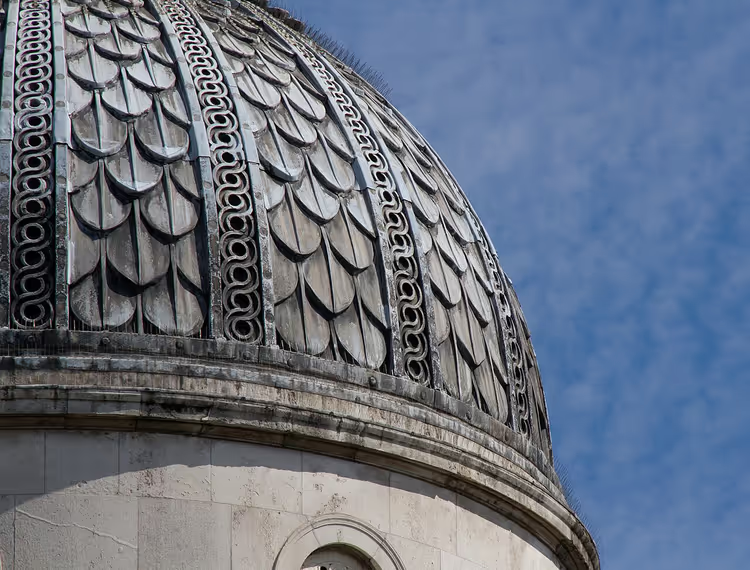 © Tony Hisgett from Birmingham, UK · CC BYPhoto: Tony Hisgett from Birmingham, UK, CC BY (https://creativecommons.org/licenses/by/2.0), Wikimedia Commons
The gallery’s collection includes more than 2,000 paintings by Western European masters. You’ll see works by Michelangelo, Titian, Raphael, and Rembrandt. Millions of visitors come here every year.
Nearby is the National Portrait Gallery. Its collection is smaller, but it’s also worth your attention. Both galleries are connected to the square by a wide staircase, and the street between them has been pedestrianized.
Place | Admission | Opening hours |
|---|---|---|
Trafalgar Square | free | 24/7 (official) |
National Gallery | free | 10:00-18:00, Friday until 21:00 (website) |
National Portrait Gallery | free | check the museum’s website |
St Martin-in-the-Fields | free | according to the service schedule (website) |
To the northeast stands St Martin-in-the-Fields. The royal family attended its parish. Today concerts are held here, and you can get into most of them for free.
On the east side rises South Africa House, with animal reliefs on its facade. The building houses the South African embassy. The Canadian embassy is at the western end, in Canada House.
Tours and tickets in London
Guided tours, skip-the-line tickets and activities — most offers can be cancelled free of charge.
See offers on TiqetsThe widget loads once you give your consent.
Tickets to London attractions
The square itself doesn’t require a ticket. But neighboring attractions are best booked in advance: in summer, the line at the entrance stretches for an hour or more.
- London Eye ticket
- Tower of London ticket with a time slot
- Tower Bridge ticket
- Westminster Abbey entry with audio guide
- Madame Tussauds ticket
- St Paul's Cathedral fast-track entry
- The Shard viewing platform entry
Ticket prices depend on the season and the time slot. Book morning slots: there are fewer people and the photos come out better.
How to get to the square
The square sits at the intersection of Pall Mall, Strand and Whitehall, in Westminster. The easiest way to get there is by tube. Charing Cross and Leicester Square stations are a five-minute walk away, and the Bakerloo, Northern and Piccadilly lines will get you there.
From Charing Cross station you can walk there in five minutes. From Waterloo station you have a choice: a 20-minute walk or two tube stops to Charing Cross (Bakerloo and Northern lines).
From Trafalgar Square to Big Ben is about 800 m, and to Buckingham Palace roughly 1.2 km (on the map). On foot that is a 10-15 minute stroll.
Below is an interactive map so you don't have to guess which exit to take.
Trafalgar Square on the map
⁉️🤔 Frequently asked questions
Is Trafalgar Square paid?
No. Entry to the square is free, it is open 24/7 (checked 03.09.2026 on the official page). You only pay for tickets to the nearby museums and viewing platforms.
How long does a visit take?
The square itself takes 30-40 minutes: Nelson's Column, the fountains, the statue of Charles I and the Fourth Plinth are all close together. With the National Gallery, allow at least two hours. A full loop including St Martin-in-the-Fields and the National Portrait Gallery takes about three hours.
Can you feed the pigeons?
No. Feeding birds in the square has been banned since 2007, and you risk a fine if you do (according to the square's bylaws).
What is on the Fourth Plinth right now?
Since 2026 the plinth has held the sculpture "Lady in Blue" by Tschabalala Self (according to the Fourth Plinth programme). Before it, the plinth displayed the "Blue Cockerel", a hotel model and a horse skeleton. Works change every 18 months to two years, so check the programme before your trip.
How do I get there from the station?
From Charing Cross it is about a five-minute walk. From Waterloo it is a 20-minute walk or two tube stops to Charing Cross. You buy your ticket with a contactless card or phone, no separate travelcard for the center is needed.
In short: what to book
If you have one day in London, start with the square in the morning, before it gets crowded. Then head to the National Gallery: entry is free and the collection is huge.
If you are traveling with children, add the London Eye and Madame Tussauds. If you want to see the city from above, book a viewing platform ticket in advance.

A small editorial team writing guides for independent travel. We travel ourselves, but we haven’t been everywhere, so we check prices, opening hours and how to get there against official sources.