




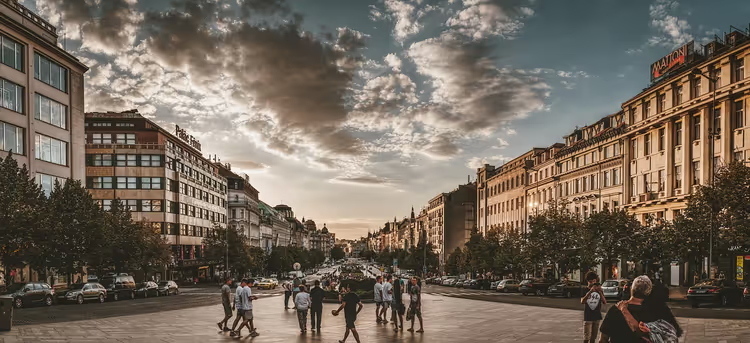
Train to Prague from Germany: direct routes and ticket prices
The train from Berlin to Prague takes under four hours. Direct connections without changes are also available from Munich and Nuremberg (as of 09/2026, DB Berlin-Prague timetable). The ticket price depends more on the day of purchase than on the class (as of 09/2026, Super Sparpreis Europa fare). Below we have put together routes from German cities, current fares, and a step-by-step ticket purchase guide.
In this guide you will find everything you need to choose a route and buy a ticket at a low price.
Ad: this article contains affiliate links. We earn a commission if you book through them, at no extra cost to you.
Train routes to Prague from Germany
💡 In short:
- Direct trains without changes run from Berlin, Munich, and Nuremberg.
- Promotional Super Sparpreis Europa tickets are cheaper than the flexible fare; route prices are below (as of 09/2026, Super Sparpreis Europa fare).
- The fastest route is from Berlin: 3 hours 47 minutes.
- Prices and routes: 09/2026, verified on the Deutsche Bahn routes page.
Prague lies away from Germany's main high-speed lines, but there are plenty of direct trains. A change is only needed from more distant departure points. Deutsche Bahn sells tickets for the entire journey as a single document, including the Czech section (as of 09/2026, DB promotion for travel to Czechia).
Direct trains from Berlin, Munich, and Nuremberg
Around 13 trains per day run from Berlin to Prague, up to nine of them direct (as of 09/2026, DB online timetable). The first departure leaves at 06:12, the last at 21:27, and the fastest Eurocity takes 3 hours 47 minutes.
The Munich route is longer and passes through Pilsen. The fastest train takes 5 hours 37 minutes, and there are also around 13 departures per day (as of 09/2026, DB Munich-Prague timetable). Railjet and Alex operate here, with a bistro car on board.
Departure city | Train | Travel time | Changes |
|---|---|---|---|
Berlin | EC, RJ | about 3:47 | none |
Munich | RJ, ALX | about 5:37 | none |
Nuremberg | EC | about 3:30 | none |
Frankfurt | ICE + EC | about 6:30-7:00 | one, in Nuremberg |
Hamburg | EC | about 7:30-8:00 | none, direct EC via Berlin |
Source for all routes: official DB timetable and ÖBB, checked 09/2026.
How much a train to Prague costs
There are two fare types. Super Sparpreis Europa is cheaper but tied to a specific train, while Flexpreis costs more but can be refunded and moved to another departure. Promo tickets to Czechia start at 14.99 € (as of 09/2026, Super Sparpreis Europa fare). That is the lowest promo price for all of Czechia, and from Berlin a promo ticket starts at 19.99 €.
Route | Promo ticket | Flexible fare |
|---|---|---|
from 19.99 € (as of 09/2026, Super Sparpreis Europa fare) | more expensive, refundable | |
check on the DB website | more expensive, refundable |
BahnCard 25 cuts the price of the German leg by a quarter (as of 09/2026, BahnCard terms). The card does not apply to the Czech segment, but the German part of the route is long, so the savings are noticeable.
How to buy a ticket cheaper
Buying takes a couple of minutes. Open the DB website or the DB Navigator app, enter your city and Praha hl.n., and choose the Super Sparpreis Europa fare, which covers the German and Czech segments with one ticket.
Steps:
- Enter the date and route to Praha hl.n.
- Choose Super Sparpreis Europa instead of Flexpreis.
- Check that the ticket is a single ticket for the whole journey.
- Pay by card and save the PDF to your phone.
The earlier you buy, the lower the price. Promo fares appear several months before the trip and sell out closer to the date.
There are alternatives too. RegioJet sells tickets for departures from Berlin and is often cheaper than DB. ÖBB sells Railjet and Eurocity tickets for transit segments on oebb.at. The FlixBus bus is worth checking if the train price has gone up. You can also buy a ticket through a partner: buy a train ticket on Trip.com.
Arriving in Prague: station and money
All trains from Germany arrive at Praha hl.n., the main station. It sits in the city center, right above the Hlavní nádraží metro station on line C, so you can walk to Old Town Square in 10-15 minutes. The station has luggage storage and ticket offices, and you take an escalator down to the metro.
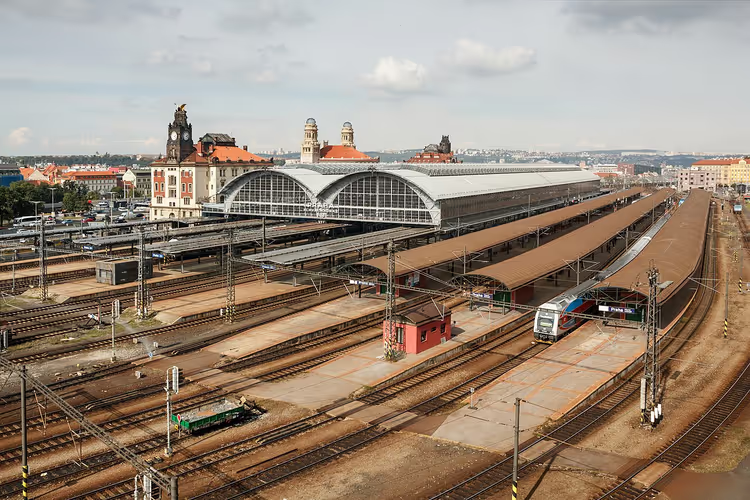 © Lynx1211 · CC BY-SAPhoto: Lynx1211, CC BY-SA (https://creativecommons.org/licenses/by-sa/4.0), Wikimedia Commons
Czechia is in the EU but not in the eurozone. You pay in Czech koruna (CZK), and cards are accepted almost everywhere. Check the exchange rate on the Czech National Bank (ČNB) website, and exchange money at a bank, because exchange offices near the station give worse rates.
Entry rules for EU citizens are covered in the frequently asked questions below (as of 09/2026, entry rules for EU citizens).
Train or plane to Prague
From Berlin, the train wins on door-to-door time. The flight itself is short, but BER airport is outside the city, plus you need time for security and baggage, so in practice the trip takes just as long, and often longer.
From Munich, the plane is slightly faster in pure travel time, but once you factor in getting to the airport the difference almost disappears, and the train takes you from city center to city center.
Criterion | Train | Plane |
|---|---|---|
Travel time | from 3:47 from Berlin | shorter in the air |
Getting to the airport | not needed | airport outside the city |
Baggage | included in the ticket | often paid separately |
Environment | lower emissions | higher emissions |
Rail emits noticeably less CO₂ per passenger than a short flight, so for a short European distance the train is more convenient both for baggage and for scheduling.
Practical tips for the trip
- Book your seat in advance; on long-distance services it costs from €5.50 (as of 09/2026, DB page on seat reservations).
- Check whether the train has a power outlet and a table if you are traveling for more than four hours.
- Arrive at the station early; international trains sometimes have additional checks.
⁉️🤔 Frequently asked questions
Is there a direct train from Germany to Prague?
Yes. From Berlin, direct Eurocity trains run up to nine times a day, and there are also direct services from Munich and Nuremberg (as of 09/2026, Berlin-Prague services on DB). From Berlin the trip takes under four hours, from Munich about five and a half hours. You only need to change on longer routes, usually in Nuremberg.
How much does a train ticket to Prague cost?
The price depends on the route and when you buy; the lowest Super Sparpreis Europa fares are listed in the costs section (as of 09/2026, DB prices for trips to Czechia). When the promotional fares sell out, the expensive Flexpreis remains, which at least is refundable.
Do I need a visa to travel to Czechia?
No. Czechia is in the EU and the Schengen Area, so EU citizens only need a passport or ID card (as of 09/2026, visa information). Check your document's expiry date before you leave. No separate registration is required for train travel.
What currency should I use in Prague?
Czech koruna (CZK), because Czechia has not adopted the euro. Check the exchange rate on the Czech National Bank (ČNB) website. For card payments and currency exchange, see the section on arriving in Prague.
Does the BahnCard work on the route to Prague?
Only on the German section. The BahnCard 25 discount applies up to the border; it does not apply to the Czech part of the ticket (as of 09/2026, DB discount rules). It still affects the final price, because the German section of the route is long. For a one-off trip, calculate the benefit in advance.
In short: what is worth booking
The train to Prague works for both a short trip and a longer route. The choice depends on your departure city:
- If you are traveling from Berlin: take the direct Eurocity, it is faster than flying door to door.
- If from Munich: look at the Railjet via Pilsen, the journey takes about five and a half hours.
- If you are traveling from Frankfurt or Hamburg: reserve a seat in advance, trains fill up in summer.
Tickets are cheapest with the Super Sparpreis Europa fare, read about purchase timing in the section on cheap tickets. Reserve a seat separately if you are traveling on weekends.
Putting the trip together is easy step by step: find a hotel in Prague on Trip.com and book a tour on GetYourGuide.

A small editorial team writing guides for independent travel. We travel ourselves, but we haven’t been everywhere, so we check prices, opening hours and how to get there against official sources.