

















Trains in Portugal: how to buy a cheaper ticket and where they actually reach
Trains in Portugal are slow, old, and inexpensive if you buy tickets in advance. Between major cities they take longer than a tourist from Germany would expect, but they drop you right in the center rather than on the outskirts, and you don't have to hunt for parking.
The trouble starts at the buying stage. A ticket on the Alfa Pendular from Lisbon to Porto costs from €21 with early booking and up to €71 on the day of travel (as of 07/2026, official CP website). The price difference within the same car easily exceeds the cost of lunch, and half the guides online repeat outdated fares and routes that no longer exist.
Below we'll go through, in order, what kinds of trains exist and how they differ, where the network actually reaches, how to buy a ticket without stress, and how to pay less than the person next to you. A separate section covers the inconvenient truth: on some routes the bus is faster and cheaper, and almost nobody writes about it.
Ad: this article contains affiliate links. We earn a commission if you book through them, at no extra cost to you.
English is enough, Portuguese helps
💡 In short:
- Buy tickets directly on cp.pt: that's where they're cheapest and all discounts live.
- The Promo fare gives up to 65% off when you buy 8 days or more in advance (as of 07/2026, Promo rules).
- Prices and schedules: 07/2026, verified on the official CP website
Almost the entire buying process can realistically be done in English. The CP website has an English version, the app is bilingual too, and ticket machines switch languages with a single button. That's enough to buy a ticket and find your platform.
Snags happen where English falls short. The announcement on the platform is only half audible, and you find yourself glancing around to see if anyone else is reacting. At the ticket office the machine won't accept your card, and a line has already formed behind you. The conductor asks a question you couldn't have prepared for.
None of these situations is critical. That's exactly why the train is a good first setting for practicing the language. Learn a few words for tickets, platforms, and directions, and the trip becomes noticeably calmer. Go with the European variety: Brazilian Portuguese from apps sounds different here, and locals notice.
The train is a good way to scout the country before moving
If you've come to decide where in Portugal to live, the train will be your best tool. It handles this task right up until the moment it stops.

Where the train clearly wins
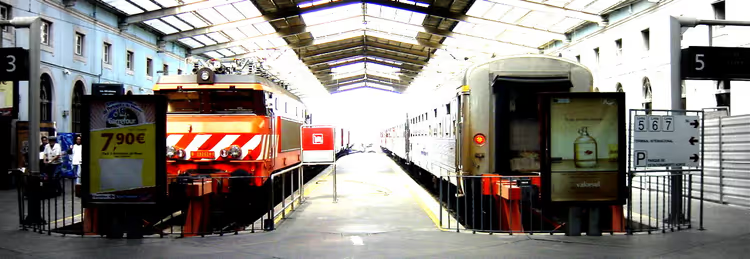
If your list includes Lisbon, Cascais, Coimbra, Aveiro, and Porto, you don't need a car. All these cities sit on one line, trains run frequently, and you get out in the center rather than at a shopping park on the outskirts. Renting a car and parking will cost more than tickets, and you'll see more out the window than the bumper of the car ahead.
Half a day in each city comes without the small hassle of hunting for a parking spot.
 © Feliciano Guimarães from Guimarães, Portugal · CC BYPhoto: Feliciano Guimarães from Guimarães, Portugal, CC BY (https://creativecommons.org/licenses/by/2.0), Wikimedia Commons
Where the scheme breaks down
The railroad covers only part of the country, and you can't plan an entire scouting trip around it. In Ericeira there is no station at all. There isn't one in many small towns and villages that people fall in love with and then buy a house there.
 © Jules Verne Times Two · CC BY-SAPhoto: Jules Verne Times Two, CC BY-SA (https://creativecommons.org/licenses/by-sa/4.0), Wikimedia Commons
If your list consists of such places or of entire regions with villages around them, take a car. You'll see three times as much in a day, and a car rental will cost less than taxis and transfers if the route is long and hot.
The Algarve plays by different rules
You can reach Faro, Portimão, Lagos, and Tavira by train, and if that's the full list, the railroad will be enough. But this is exactly where I would take a car, even though I choose the train by default everywhere else. Local transport in the Algarve is weaker than around Lisbon, so as soon as you want to see a town without a station, you'll get stuck.
 © Steven Fruitsmaak · CC BY-SAPhoto: Steven Fruitsmaak, CC BY-SA (https://creativecommons.org/licenses/by-sa/3.0), Wikimedia Commons
The region stretches from east to west, and a trip from one end to the other takes a long time no matter the transport. In August, air conditioning in a car will be the most useful thing. Getting in and out of local towns is easy, although Portimão's one-way street system can throw you off on your first visit.
Sometimes the bus is just faster
It's always worth checking both options, because the gap can be absurd. From Lisbon's Oriente station to Caldas da Rainha, the train takes more than three hours, while the bus covers the same route in about an hour (according to Rede Expressos, 07/2026).
Buses in Portugal are perfectly fine. The views are worse, there's less romance, but I ride them often, and on long routes they're frequently cheaper and more comfortable than the train. In August, you're more likely to get working air conditioning and working Wi-Fi on a bus than on an Intercidades train.
Two operators worth knowing: Flixbus and Rede Expressos. Flixbus's website is more user-friendly, Rede Expressos often has better prices, so check both. On major routes they compete actively, and that's good news for you.
Local buses live by their own rules. They're almost always cheaper than everything else, but finding the schedule is hard: it could be a PDF on the town hall website or a piece of paper taped to the bus stop. Flixbus sometimes covers short segments that look like a local route, costs more, but at least you can check the time and place and book from your couch.
The real reason to take the train on a scouting trip
There's an argument that has nothing to do with getting from point A to point B. Many people move to Portugal intending to live without a car, and that's one of the country's main draws. But deciding that from an apartment in a country where you have a car is easy, while understanding whether you'll actually like living here is much harder.
So use the scouting trip as a test. Ride the trains, ride the buses, see how much time transfers actually take. Check how you feel on the last stretch from the station to the town and whether the schedule of the daily life you imagine actually suits you. A week of this kind of travel will tell you more than any articles, and it will cost less than moving your whole life and buying a car in year two.
Where the train actually reaches

The network connects all major regions, and most large cities have a station. It doesn't cover the whole country. Look at the CP network map before building your route, because the gaps turn out to be not where you expect.
There's a second trap that catches people who did check the map. A station in a city and a city with a station are not the same thing. The classic example: Albufeira, whose station is in Ferreiras, about six kilometers from the center (according to the map). So "Albufeira by train" means train plus taxi. Bus stations, on the contrary, are almost always right next to the center.
So before booking, check where exactly the station is, not just whether it exists. The check takes two minutes on a map, and it changes the answer more often than you'd think.
Stations that aren't where you think they are
You'll have to pay for a taxi here:
- Albufeira: station in Ferreiras, several kilometers from town (according to the map).
- Loulé: about five kilometers southwest of the center (according to the map). There's no bus from the station. There's a stop some distance away, but the bus runs about once an hour and isn't synced with trains, so in practice it's a taxi at the entrance.
- Guarda: about four kilometers from the center (according to the map), about ten minutes by car.
- Fátima: no station at all. The nearest ones are tens of kilometers to the east and northeast (according to the map).
And here are two stations that look like the same problem but aren't, because the transfer is already included in your ticket:
- Porto-Campanhã: a couple of kilometers east of the historic center (according to the map). Trains from Lisbon arrive here, and you transfer to a suburban train to São Bento, which is where you actually need to be. The ticket covers it.
- Coimbra-B: north of the center, in Eiras (according to the map). Alfa Pendular and Intercidades stop here, not in the center. The connecting train to Coimbra-A takes about ten minutes, the ticket already includes it, and there's also a bus and taxis if you missed it.
These two stations confuse people constantly. The reason isn't the distance, it's that nobody told them about the second train. People walk out of the building and pay for a taxi they don't need.
Four types of CP trains
Comboios de Portugal (CP) runs four main types of domestic trains, and the gap between the best and the worst is bigger than the price difference.
- Alfa Pendular (AP): the fastest and most comfortable. Designed for speeds up to 220 km/h (CP rolling stock data), although it only reaches that on short sections, so Lisbon to Porto still takes about three hours. Free Wi-Fi that works intermittently, a power outlet at every seat, a bar car, and assigned seating. Watch the spelling: Alfa, not Alpha, otherwise you will find nothing on cp.pt.
- Intercidades (IC): slower because it stops more often, but not dramatically so. Older cars, a simpler bar, free Wi-Fi, and power outlets in some cars. This train is also the best option for a bicycle, and for most trips I book exactly the IC.
- Regional (R) and InterRegional (IR): short distances, more stops, and a noticeable step down. Some are quite pleasant. Others: plastic seats and graffiti, closer to a metro car than an intercity train. Seats are not assigned, so you sit wherever you find a spot. On the plus side, they are very cheap.
- Urban (U): suburban networks around Lisbon, Porto, and Coimbra. Simple, frequent, and inexpensive. This includes the Cascais line, the Sintra line, and so on.
Type | Alfa Pendular | Intercidades | Regional / IR | Urban |
|---|---|---|---|---|
Speed | Highest | Slightly lower | Low | Short hops |
Price | Highest | A couple of euros less | Cheap | Cheapest |
Advance booking | Yes, up to 60 days | Yes, up to 60 days | Yes, now online | Coimbra online; Lisbon and Porto by card |
Assigned seat | Yes | Yes | No | No |
Classes | Conforto / Turística | 1st / 2nd | One class | One class |
Wi-Fi | Free | Free | Depends on the train | Depends |
Power outlets | At every seat | In some cars | Depends | No |
Bicycle | Disassembled only | Yes, on hooks with booking | Usually if space allows | Yes, in marked areas |
Advance discounts | Yes (Promo) | Yes (Promo) | No | No |
The table is based on CP data (07/2026).
How to buy train tickets in Portugal
Buy directly on cp.pt or in the CP app. That is where the lowest fares are, where the discounts live, and where you can later change your ticket without hassle. Buy a train ticket only here: I have never bought a Portuguese rail ticket anywhere else.
What to know before you start:
- Booking opens 60 days in advance and works until 15 minutes before departure (as of 07/2026, CP online ticket office).
- Regional and InterRegional tickets can now be bought online. This has changed, and many guides still claim the opposite.
- Urban trains are the exception. In Coimbra they are sold online; in Lisbon and Porto suburban trips usually run on a reloadable card that you buy or top up at the station.
- Tickets are issued to a named passenger. When booking, you enter your ID details, and the name on the ticket must match the document you carry. The conductor may ask to see it, especially if you applied an age discount.
If your card is declined
This happens often with foreign cards, and it is the main complaint about the CP website. Pay via PayPal: the option sits right in the checkout, and you do not need a PayPal account. You pay with your card, and PayPal just processes the payment. MB WAY also works if you have lived here long enough.
A quirk of station search
A small detail that has tripped me up more than once. If the site loads in Portuguese, remember that Lisbon is Lisboa. Type that, and you get Oriente, Rossio, and Santa Apolónia, but not Entrecampos, which only appears once you type the letter e. If a station you know exists does not show up, look for the reason here rather than assuming the site is broken.
What about Omio and other booking sites
Omio is legitimate and listed as an official partner on cp.pt. It is also usually slightly more expensive, and a middleman appears between you and CP if something goes wrong or plans change. If convenience is worth a couple of euros to you, go ahead.
I would avoid resellers that look official in Google results. CP explicitly names several such sites as unofficial and warns that they may charge more. Nothing they offer can be done cheaper on cp.pt.
Ticket machines and ticket offices
Most stations have ticket machines, and they switch to English. This saves you time when the line at the ticket office is long and your train leaves in ten minutes.
But some things can only be done at a staffed ticket office. A ticket for a dog outside a carrier surprises people the most, and some international tickets work the same way. A few Portuguese words about tickets will come in handy here, and everything will go smoothly.
How to pay less for tickets
Trains in Portugal used to be simply cheap. Now they are cheap if you plan ahead, and sometimes not cheap at all. Prices have gone up, like everything else around.
Promo fares
Promo only works for Alfa Pendular and Intercidades: it gives up to 56% off when you buy at least 5 days in advance and up to 65% when you buy 8 days or more in advance (as of 07/2026, Promo rules on cp.pt).
What changed is not the rule, but the number of seats it applies to. Promo is not a discount on the whole ticket, but a limited pool of seats on each train, and when they run out, they run out. It used to feel like Promo seats were available on almost every departure. Now it is a few times a day, and I found dates a week ahead with no Promo at all, while the next day seats appeared.
The takeaway is simple: the discounts are real, but this is a limited number of seats, not a universal price reduction. Book far enough in advance and a seat is usually available. Buy a ticket in July for July, and it most likely will not be there. The cheapest seats also tend to be on departures at six in the morning.
Promo tickets can be exchanged but not refunded, and that is important to know before you build your whole trip around one.
What this looks like in real money
All figures were checked in July 2026, and the whole point is the spread (as of 07/2026, CP fares):
Route | Train in advance | Without discount | Bus |
|---|---|---|---|
Lisbon-Porto | 21 € at 06:39, 34 € at 09:39 | 56.10-71.40 € | none |
Faro-Lisbon | 30 € in summer (IC), 25 € in September (IC) | 49.10 € IC, 52.60 € AP | none |
Across the whole country | 92.30-104.60 € | none | 25.20-34.47 € |
The trip from Vila Real de Santo António to Valença runs across the whole country. A train ticket here costs noticeably more, while the bus covers the same route for a small fraction of that amount. In that comparison, the train does not win on money at all.
The Faro-Porto flight often turns out to be the cheapest option on that route. Compare flights on Kiwi.com is worth doing, but add the trip to Faro airport, getting out of Porto airport, and a connecting train at the other end. Sometimes the flight is still justified. Just calculate the full amount, not only the ticket price.
Age discounts
- Seniors: 50% off from age 65 (senior discount on cp.pt, 07/2026). This is the best deal on the railway and the most important one for readers moving on a D7 or retirement visa. No advance booking needed, no card needed, and no residency requirement either: the discount works regardless of citizenship and country of residence. Select it at checkout and carry an ID with you, because you may be asked for it both at the ticket office and on the train.
- Children: free up to age 3 and half price from 4 to 12 (CP child discounts, 07/2026). Up to age three, a child rides free if they sit on your lap. From four to twelve inclusive, it is half price, and they get their own seat.
- Under 25: 25% discount (under-25 discount, 07/2026). It works simply, up to age 25 inclusive.
- European Youth Card: 25% discount from age 12 to 30 (European Youth Card terms, 07/2026). Any class, any day of the week, but only Intercidades, Regional and InterRegional, no Alfa Pendular. If you are 26-30, this is your discount. If you are under 25, the two discounts overlap, and it makes no difference which one you pick.
There is also the Golden Card, which is easy to confuse with the senior discount. It depends on income, not age: for pensioners whose household income is no higher than the national minimum wage, issued on a CP card. The discount amount is the same, but the criterion is different. If you are a pensioner moving to Portugal, you want the age discount.
Group discount for 3-4 people
Traveling as a group of three gives 40% off, four people 50% (CP group discount terms, 07/2026). Only on Alfa Pendular and Intercidades. The terms are where people stumble:
- only round-trip routes apply;
- travel is possible from Tuesday to Thursday;
- not on Tuesday if Monday was a holiday, and not on Thursday if the holiday is on Friday;
- everyone travels on the same train, in the same class, from one station to one.
So it is a midweek discount dressed up in a group costume. A great option if your trip falls between Tuesday and Thursday. Useless for weekends.
Round-trip tickets
Buy both legs together and you get 10% off for distances from 91 km (as of 07/2026, CP discount rules). If another discount or Promo also applies, it works.
This leads to a rule that underlies everything else: discounts do not stack. You get one. So the only question is which one is bigger, and the answer is usually Promo if you booked early and a seat in the pool was still left, otherwise the age discount.
So is it worth taking the train?
Mostly yes, but with your eyes open. Book in advance if you want a good price, because cheap seats are limited and they get taken. Check the bus before you decide, because sometimes it is faster, and on long routes it is often noticeably cheaper. And do not build a scouting trip around a network that does not go everywhere.
None of this is a reason to give up on the train. When it works, it really works. A cheap ticket from Lisbon to Porto, even at six in the morning, is hard to beat.
⁉️🤔 Frequently asked questions
Can you buy a Regional or InterRegional ticket online?
Yes, they are now sold in the CP online ticket office (as of 07/2026, CP online ticket office). The exception is the Lisbon and Porto urban trains with a rechargeable card.
How many days before the trip does sales open?
Sales open 60 days before departure and continue until 15 minutes before the train leaves (ticket sales windows, 07/2026). For Promo, the earlier you book, the higher your chance of finding a seat at that fare.
Why is my bank card declined on the CP website?
It is usually the website, not your card. Pay via PayPal at checkout, no PayPal account is needed for that. MB WAY also works if you have it.
Do discounts stack, for example Promo and an age discount?
No. You get only one discount per ticket (as of 07/2026, discounts on cp.pt). So pick the biggest one: Promo is usually better when you book early, and if Promo seats are gone, the age discount. Child and senior discounts remain the most reliable.
What is better on the Lisbon-Porto route: train or bus?
On this route the train usually wins: it is faster and brings you into the center of both cities. The bus is worth checking on longer and cross-country routes where the railway makes a big detour. That is where the gap in time and price becomes noticeable.
Do I have to buy a ticket for a specific train in advance?
For Alfa Pendular and Intercidades, it is better to reserve a seat in advance, especially in summer (online booking with CP, 07/2026). A Regional ticket is also sold online, but the seat is not reserved. For Lisbon and Porto commuter trains, the ticket is usually bought or topped up at the station. A named ticket requires the ID document you carry with you.
In short: what is worth booking
If you are traveling across the whole country, book the train in advance and compare it with the bus, because on long routes the price gap can be several times over. If you are already a senior, you do not need the Promo game: the age discount works every day and on every train. If you are traveling as a group of three or four in the middle of the week, look at the group discount.
For scouting before a move, get train tickets on Trip.com, and for the Algarve and rural areas rent a car: without one, half the country will stay outside your route.

A small editorial team writing guides for independent travel. We travel ourselves, but we haven’t been everywhere, so we check prices, opening hours and how to get there against official sources.