















Weather in Tbilisi by month: when to go and what to see
Summer in Tbilisi is genuinely hot, and in winter the temperature drops below freezing at night. The contrast between seasons is sharp, and the month you travel decides a lot: what to pack and how much time you'll spend outdoors.
The best time to visit Tbilisi is May, June, July, August, and September, with mild weather lasting until mid-October. The average annual temperature in Tbilisi is 13.3 °C (as of 09/2026, Weather Atlas).
Below you'll find monthly weather, the answer to "when to go," and the main sights in the city and its surroundings.
Ad: this article contains affiliate links. We earn a commission if you book through them, at no extra cost to you.
When to visit Tbilisi
💡 In short:
- The mildest weather is in late May, June, September, and the first half of October.
- The hottest months are July and August, with daytime temperatures reaching 32 °C.
Peak season falls in late May and June. During these weeks, daytime temperatures stay around 23-27 °C, evenings remain warm, and the streets are busier. May brings more rain than late summer, so a light umbrella won't hurt.
July and August bring the strongest heat: the air warms up to 32 °C, and the sun shines for most of the day. If you don't handle extreme heat well, walk in the morning and evening, and save the middle of the day for museums and cafes. September and the first half of October bring gentle warmth without the stuffiness. Winter in the city is mild but damp: nights can see frost, and lasting snow is rare.
Weather and climate by month
Below are monthly averages that show when Tbilisi is warm, rainy, and sunny (as of 09/2026, monthly averages).
Month | Jan | Feb | Mar | Apr | May | Jun | Jul | Aug | Sep | Oct | Nov | Dec |
|---|---|---|---|---|---|---|---|---|---|---|---|---|
High, °C | 6 | 7 | 11 | 18 | 23 | 27 | 32 | 32 | 26 | 20 | 13 | 7 |
Low, °C | -3 | -1 | 2 | 7 | 12 | 16 | 19 | 19 | 15 | 9 | 4 | -1 |
Sunshine hours | 3.2 | 3.6 | 4.6 | 5.7 | 6.9 | 8.3 | 8.3 | 8 | 6.9 | 5.3 | 3.4 | 3 |
Rainy days | 4 | 5 | 6 | 8 | 10 | 9 | 6 | 6 | 5 | 6 | 4 | 4 |
Precipitation, mm | 13 | 13 | 31 | 33 | 51 | 28 | 21 | 24 | 23 | 26 | 18 | 14 |
Snow days | 7 | 6 | 3 | 1 | 0 | 0 | 0 | 0 | 0 | 0 | 2 | 3 |
UV index | 2 | 2 | 3 | 4 | 5 | 6 | 6 | 6 | 4 | 3 | 2 | 2 |
The city's climate is temperate, and two types meet here: humid subtropical and humid continental. The annual temperature range is wide, from 6 °C during the day in January to 32 °C in July and August. The most rain falls in March, April, and May, while January, February, and December are the driest. There are more sunshine hours in summer: in June and July, there are about eight per day. Winter is mild, and a lasting snow cover doesn't hold in the city.
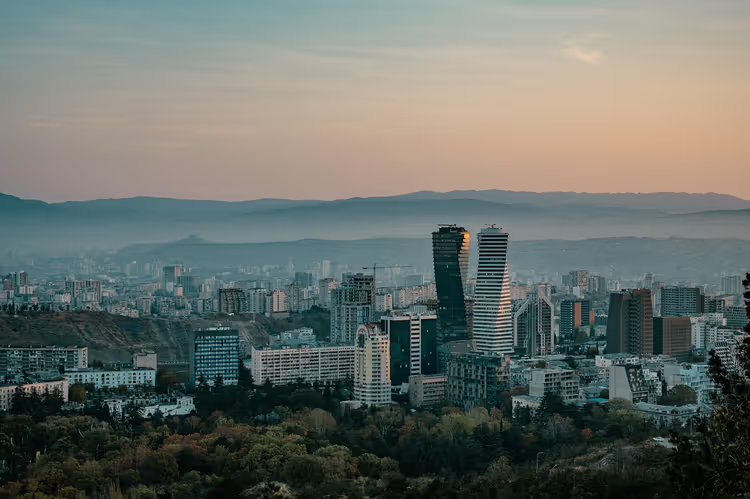
Tbilisi sits in the eastern part of Georgia, closer to the center of the Caucasus isthmus. The city stretches along the Kura River (Mtkvari in Georgian) for about twenty kilometers, squeezed by three mountain ridges. The city itself lies at elevations from 380 to 727 meters above sea level (as of 09/2026, Wikipedia).
What to see in Tbilisi
The main sights sit compactly on both banks of the Kura, so they're easy to cover on foot in one or two days.
 © David1010 · CC BY-SAPhoto: David1010, CC BY-SA (https://creativecommons.org/licenses/by-sa/4.0), Wikimedia Commons
Narikala Fortress and the Kartlis Deda statue
On the right bank of the Kura, above the old town, stand the ruins of Narikala Fortress. You can get up here by cable car from Rike Park: the cabins run from the park straight to the viewing platform by the fortress. Above the fortress rises the monumental statue of Kartlis Deda, "Mother of Georgia," with a sword and a bowl in her hands. Below lies the Botanical Garden, established in the mid-19th century on the site of the fortress park. From this point you'll see the best panorama of old Tbilisi's rooftops.
Old Town and the sulfur baths
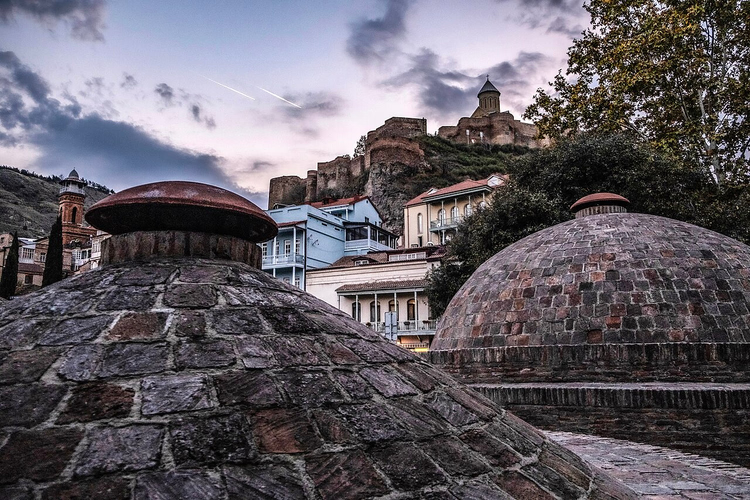
Old Tbilisi is on the UNESCO World Heritage tentative list (as of 09/2026, UNESCO). It's a labyrinth of narrow cobbled streets with wooden houses and carved overhanging balconies. Here you'll find the 5th-century Sioni Cathedral, the 13th-century Metekhi Church, the 6th-century Anchiskhati Basilica, and the Great Synagogue. The Great Silk Road once passed through these quarters, and the old caravanserais still stand. In the Abanotubani bath district, 17th-century sulfur baths are still in operation, and the mosque is located there.
 © Wowan1978 · CC BY-SAPhoto: Wowan1978, CC BY-SA (https://creativecommons.org/licenses/by-sa/4.0), Wikimedia Commons
Rustaveli Avenue and the Garetubani district
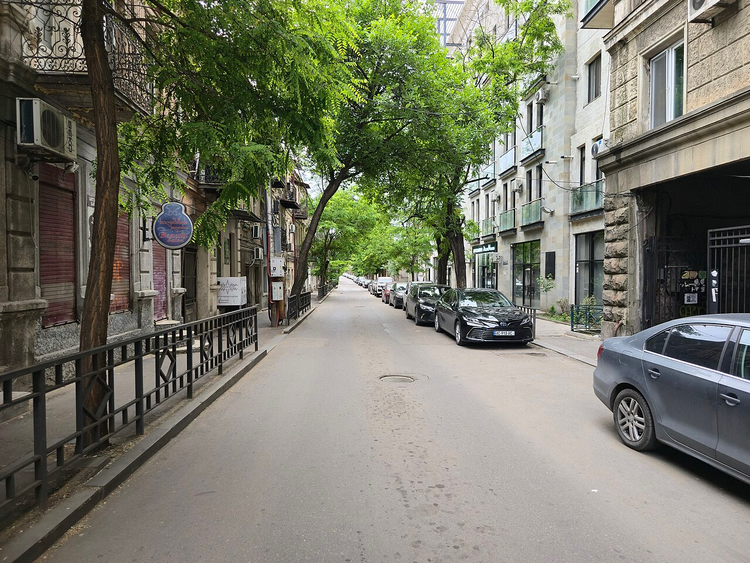
Next to the old town lie the grand 19th-century quarters. Take a walk along Rustaveli Avenue, the main street of the district between Freedom Square and Republic Square. Along it stand the Kashveti Church, the National Gallery, the History Museum, the Rustaveli Theater, the Opera House, and the parliament building.
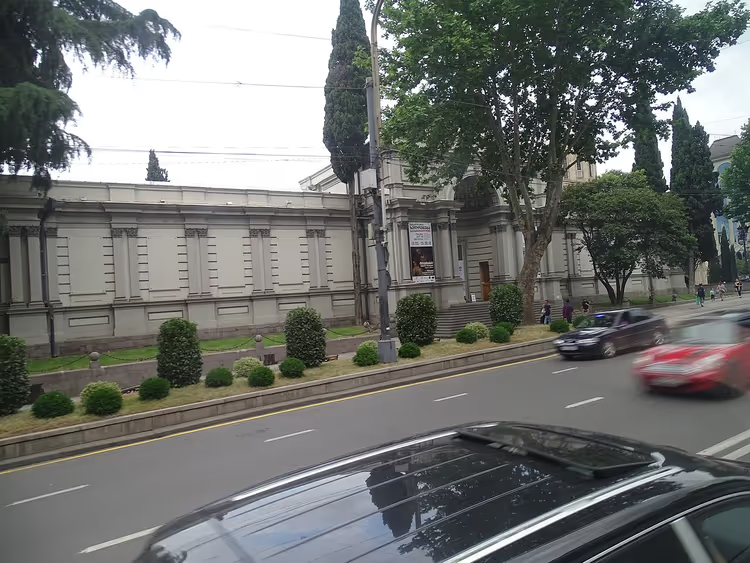 © Giftzwerg 88 · CC BY-SAPhoto: Giftzwerg 88, CC BY-SA (https://creativecommons.org/licenses/by-sa/3.0), Wikimedia Commons
Mtatsminda Mountain and the funicular
A funicular will take you to the top of Mtatsminda mountain. Halfway up are the pantheon and cemetery where writers Ilia Chavchavadze and Akaki Tsereteli are buried. At the top, a flat area with a large park awaits you, which was expanded in 2009 with the Mtatsminda amusement park. At night, the TV tower, one of Tbilisi's symbols, glows over the city.

Sameba cathedral and the bridge of peace
On the left bank of the Mtkvari River stands Sameba Cathedral (Holy Trinity), the largest church in the South Caucasus. Entry to the cathedral is free; opening hours were verified 09/2026 on the cathedral's official website. Nearby is Tbilisi's main railway station. The pedestrian Bridge of Peace with its glass roof spans the Mtkvari; in the evening it is illuminated and draws photographers.
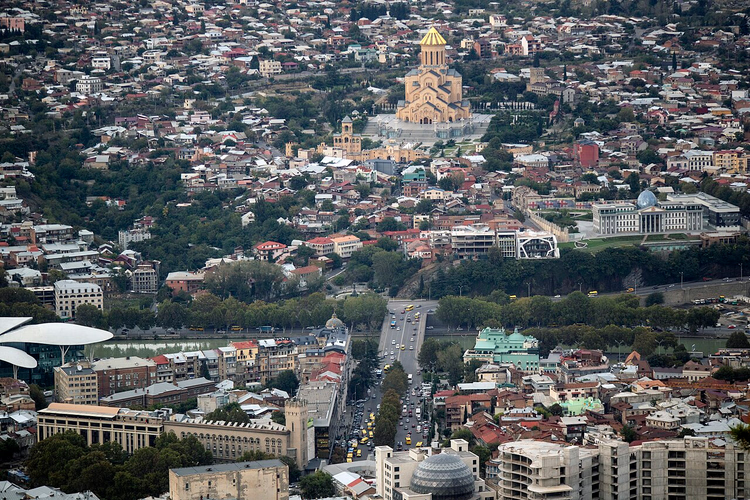 © Mostafameraji · CC BY-SAPhoto: Mostafameraji, CC BY-SA (https://creativecommons.org/licenses/by-sa/4.0), Wikimedia Commons
Day trips from Tbilisi
If you have an extra day, it's easy to get out of the city from Tbilisi. The Chronicles of Georgia, a huge stone monument on the outskirts, is known as the "Georgian Stonehenge", and there are still few tourists here. About two hours away lies the Tsalka (Dashbashi) Canyon with the Diamond Bridge, a glass bridge over the gorge (as of 09/2026, Georgian National Tourism Administration). In the highlands stands Stepantsminda with Gergeti Church, where the trip schedule is completely different.
⁉️🤔 Frequently asked questions
When is the best time to visit Tbilisi?
The mildest weather is in late May, June, September, and the first half of October. During these months, daytime temperatures are around 23-27 °C, and walking around the city is pleasant.
How hot is Tbilisi in July and August?
During the day, the air heats up to 32 °C, and the sun shines for most of the day. In the shade, the heat is more bearable, so it's better to walk in the morning and after sunset. From midday, take shelter in museums, churches, and air-conditioned cafes. The peak comes in the second half of July and early August (as of 09/2026, weather observation archive).
What to see in Tbilisi in one day?
Start with Narikala Fortress and the Kartlis Deda statue, then descend into the old town with its sulfur baths and churches. After lunch, walk along Rustaveli Avenue and take the funicular up to Mtatsminda. End the day at the Bridge of Peace and Sameba Cathedral; they are beautifully illuminated in the evening.
How many days do you need for Tbilisi?
Two days are enough for the city itself: one for the old town and the fortress, the second for Mtatsminda, Sameba, and Rustaveli Avenue. If you want to visit Tsalka Canyon or Stepantsminda, add one more day for each trip.
How do you get up to Narikala Fortress?
The easiest way is by cable car from Rike Park: the cabins go to the viewing platform near the fortress (according to the Tbilisi guide, 09/2026). You can also walk up through the old town streets, but the climb is steep. In the evening, this is the best spot for views of the illuminated city.
In short: what to book
Plan your trip for May, June, or September: the weather in these months is the most stable. In summer, book accommodation with air conditioning and head out for walks in the morning. In winter, the city is cheaper, but it's damp, so warm clothes are essential.
- For walks around the old town, choose May and September.
- For festivals and the warmest sea in Batumi, June and July work well.
- To save money, look at November and February, when prices are lower.
Book accommodation in the center in advance: find a hotel in Tbilisi on Trip.com.

A small editorial team writing guides for independent travel. We travel ourselves, but we haven’t been everywhere, so we check prices, opening hours and how to get there against official sources.