
















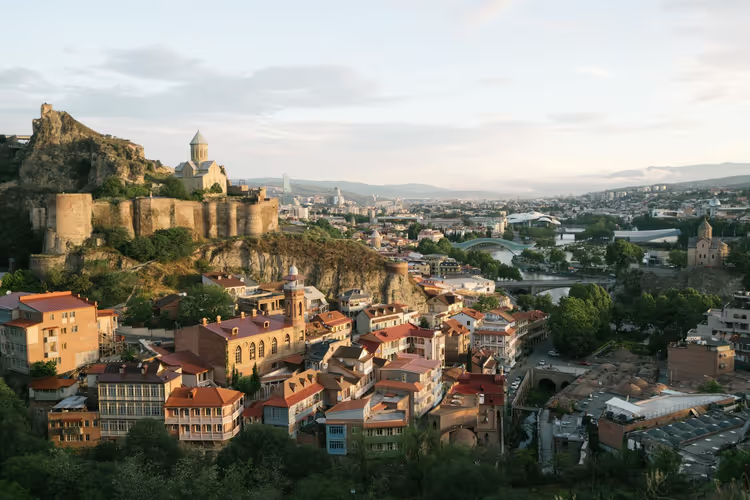
30 Main places in Tbilisi: what to see and how to get there
Tbilisi only looks compact on a map. Between Narikala Fortress, the sulfur baths, and the Botanical Garden, it's easy to rack up 12-15 km on foot in a single day. We've put together 30 places worth seeing and organized them by neighborhood so you don't have to crisscross the whole city.
Most viewpoints, churches, and bridges are free to visit. You'll need tickets for the Botanical Garden, the zoo, the National Museum, the cable car, and the funicular. Below you'll find opening hours, admission prices, and how to get to each place.
Ad: this article contains affiliate links, we earn a commission if you book through them, at no extra cost to you.
1. Narikala Fortress
💡 In short:
- Plan for 2-3 days: 30 sites are spread from Mtatsminda to Turtle Lake.
- The Old Town is walkable, but it's easier to reach Narikala and Mtatsminda by cable car and funicular.
- Major museums are open Tuesday through Sunday; the Botanical Garden is closed on Mondays.
- Prices and opening hours: 09/2026, verified on the official website of the Georgian tourism office
 © This Photo was taken by Supanut Arunoprayote . Feel free to use any of my images, but please mention me as the author an · CC BYPhoto: This Photo was taken by Supanut Arunoprayote . Feel free to use any of my images, but please mention me as the author an, CC BY (https://creativecommons.org/licenses/by/4.0), Wikimedia Commons
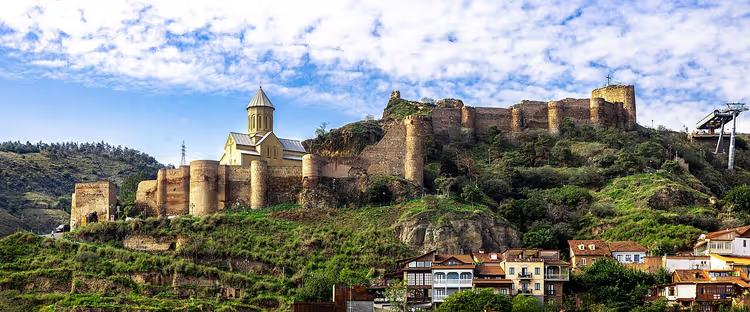
Narikala stands on the Sololaki ridge and descends in stepped walls right down to the Kura River. The fortress controlled the trade route along the river, which is why it was fortified so thoroughly. Its walls and towers survived sieges by the Mongols, Persians, and Turks. The Mongols gave the citadel their own name, "Naryn-Kala," meaning small fortress. That's where today's familiar "Narikala" comes from. Inside, traces of a well-designed water supply system remain: water flowed through channels and aqueducts.
The 1827 earthquake destroyed some of the towers. The fortress stood in ruins until the 1990s, when it was restored. The Church of St. Nicholas was rebuilt on a foundation discovered during excavations in 1966. It's small, but it sits right on the edge of the cliff. From its terrace you can see the Bridge of Peace, the sulfur baths, and the tiled roofs of the Old Town.
- How to get there: cable car from Rike Park to the Sololaki ridge; the ride takes under 2 minutes (according to the Georgian tourism office, 09/2026).
- Cost: entry to the fortress grounds is free; you only pay for the ride up.
- Who it's for: anyone who wants a panoramic view of the city and is willing to climb stairs.
2. Shota Rustaveli Avenue
 © Giftzwerg 88 · CC BY-SAPhoto: Giftzwerg 88, CC BY-SA (https://creativecommons.org/licenses/by-sa/3.0), Wikimedia Commons
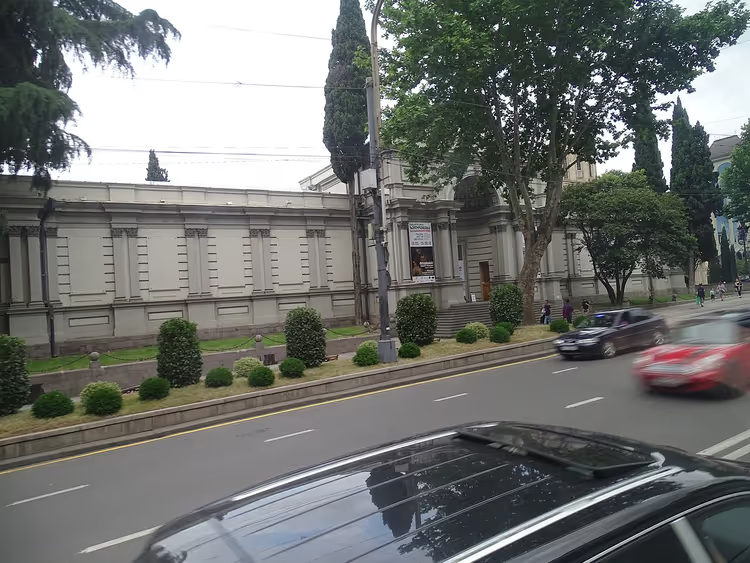
Tbilisi's central avenue was once an ordinary dirt road connecting the village of Digomi with the walled city. In the first half of the 19th century, residential buildings and government offices began to appear along it, and the road itself was paved with cobblestones. That's how Golovin Avenue came to be, which in Soviet times was declared the main street and named after the poet Shota Rustaveli.
Today the avenue runs from Freedom Square and is divided by a wide plane tree and chestnut promenade. Walking along it takes about an hour if you don't go inside any buildings. Here you'll find the Tbilisi Marriott hotel, the 1824 headquarters of the Caucasus Corps, and the parliament building of Georgia.
The Kashveti Church deserves special attention. It was built in 1907 with funds from a cognac factory owner, and its exterior replicates the neo-Georgian style of the church in Samtavisi. Inside you'll see frescoes by the artist Lado Gudiashvili, whose unconventional style once drew criticism. Nearby, the Rustaveli Drama Theater operates in a 1901 pseudo-Baroque building with a grand entrance. The Rustaveli cinema next door has 5 screens.
Opposite the Vorontsov Palace is the National Museum of Georgia with its Golden Fund of prehistoric gold artifacts. A separate chapter in the avenue's history is tied to the parliament building: it witnessed the January 1992 fighting, the farewell to Prime Minister Zhvania, and Saakashvili's inauguration. These events made the street the country's main political stage.
The avenue's main landmarks stand along a single line. Walking from Freedom Square to Rustaveli Square, you'll pass the parliament, the National Museum, the drama theater, and the Kashveti Church. About an hour is enough to see the facades, and it's worth going inside the museum and the church. The central plane tree promenade divides the street into two parts and serves as a guide for your walk.
- How to get there: metro to Rustaveli or Freedom Square station, then walk.
- Where to stay: hotels near Rustaveli Avenue on Trip.com.
- Who it's for: architecture lovers and anyone who wants to explore the city on foot.
- The catch: in summer the promenade provides shade only in spots; it gets hot here during the day.
3. Sioni Cathedral
 © This Photo was taken by Supanut Arunoprayote . Feel free to use any of my images, but please mention me as the author an · CC BYPhoto: This Photo was taken by Supanut Arunoprayote . Feel free to use any of my images, but please mention me as the author an, CC BY (https://creativecommons.org/licenses/by/4.0), Wikimedia Commons
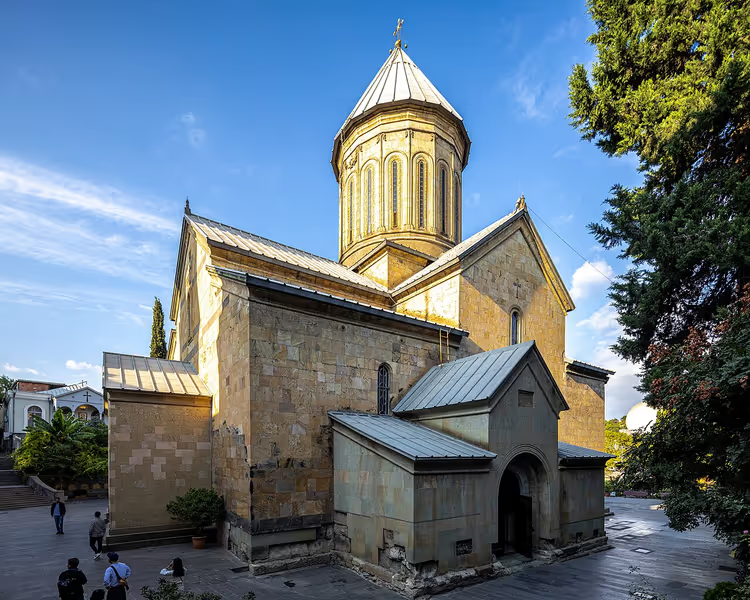
Sioni Cathedral on the bank of the Kura was built in the 6th century in honor of the Dormition of the Mother of God, and it took its name from the mountain of the same name. The Arabs destroyed it, and only in the 12th century under King David was the church rebuilt. Later the walls were restored more than once and faced with pink tuff. During the Beria era there were attempts to demolish the cathedral, but it survived.
From the outside the building looks modest and austere. Inside, everything changes: the high vaults are painted, and icons adorn the walls. The cathedral's main relic is the cross of Saint Nino, the founder of Christianity in Georgia.
- Cost: free entry.
- Who it's for: those who want to see one of the city's oldest churches.
- The catch: during services tourists are asked not to walk around the hall.
4. Old Tbilisi
 © Andrew Milligan sumo · CC BYPhoto: Andrew Milligan sumo, CC BY (https://creativecommons.org/licenses/by/2.0), Wikimedia Commons
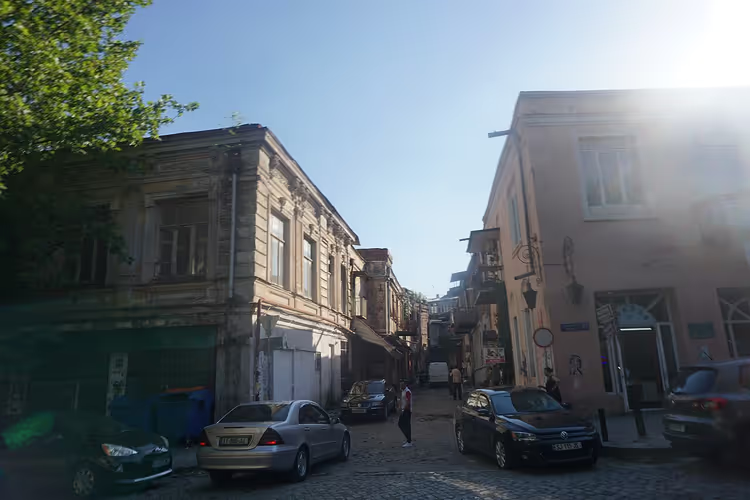
The district was once surrounded by a fortress wall, fragments of which survive here and there to this day. The sulfur baths and ancient temples of two confessions also stand here.
The 18th-century Armenian church of Surb Nshan on Vertskhli Street is in a state of disrepair, but that is exactly what gives it its distinctive look. The Church of the Mother of God of Bethlehem in the Kldisubani district is active and draws worshippers especially on August 28, the Day of the Dormition. Another 18th-century church, the Cathedral of Saint George, survived years of neglect and was revived after restoration.
The Holy Trinity Cathedral of Sameba rises above the district. It can hold 15,000 worshippers at once. Every street here keeps its own shrine: an Orthodox church, a Muslim mosque, or an Armenian church.
- How to get there: on foot from Freedom Square down toward the Kura.
- Who it's for: those who want to see the city without filters and tourist shop windows.
5. Abanotubani
 © Henri MOREAU · CC BY-SAPhoto: Henri MOREAU, CC BY-SA (https://creativecommons.org/licenses/by-sa/4.0), Wikimedia Commons
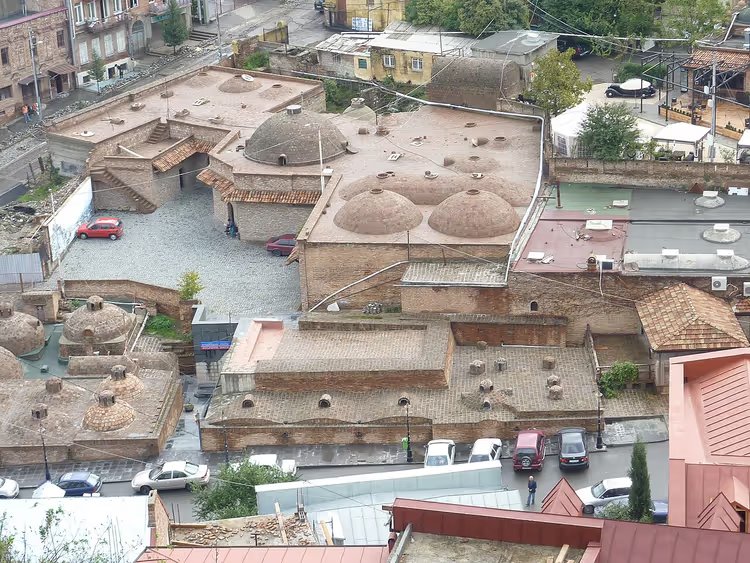
The word "tbili" itself translates as "warm," and that points directly to the hot springs beneath the city. Since the 16th century, locals have built bathhouses on the site of the springs. These are low buildings in an oriental style with semicircular domes and large glass windows. Light passes through them directly into the halls, which lie below ground level. Each bathhouse was named after its owner's surname: Zubalovskaya, Orbelianovskaya, and others.
- How to get there: Kura embankment, below the Metekhi Bridge.
- Cost: private bathhouses charge a separate fee, check prices on site.
- Who it's for: those who want to rest after a long walk.
6. Vorontsov Palace
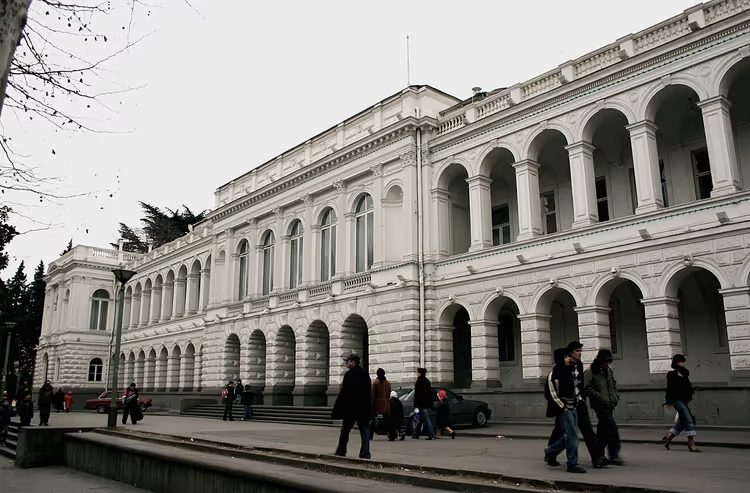
Vorontsov Palace, in the Renaissance style, was built in 1868 under Viceroy Count Vorontsov. The white building with ornate facade detailing and a row of arched windows is considered one of the most beautiful on Rustaveli Avenue. Inside, the Persian Hall in white tones draws particular attention: the stucco is inlaid with mirrors, and the room seems almost weightless.
After the revolution the building was given over to children and young people. Today it is officially called the Youth Palace.
- How to get there: Rustaveli Avenue, not far from the Freedom Square metro station.
- Cost: entry to the building is limited, viewing is mostly from outside.
- Who it's for: those who love palace architecture and interiors.
7. Georgian Betania
 © კოლხი · CC BY-SAPhoto: კოლხი, CC BY-SA (https://creativecommons.org/licenses/by-sa/4.0), Wikimedia Commons
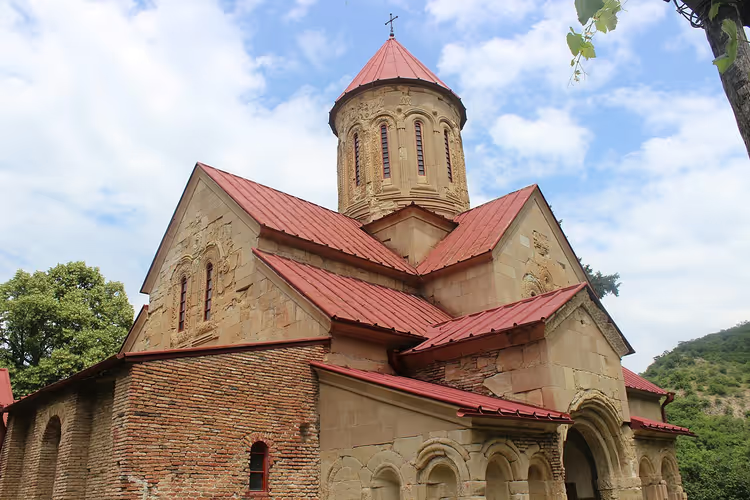
Betania Monastery hides in a remote spot among pines, ash trees, and walnut trees, away from the city noise. According to tradition, the monastery was founded as early as the time of Queen Tamar. Because of the inaccessibility of these places, the monastery stood abandoned for a long time. It was discovered by the architect and amateur artist Gagarin, who was studying the surroundings of Tbilisi.
After that the monastery became known, and it was revived. It is quiet and green here, and tourist groups are almost never seen. The walls and interior of the church have preserved ancient paintings.
- How to get there: by car or with a guided tour, public transport does not go here.
- Cost: free entry.
- Who it's for: those who want to see a working ancient monastery without the crowds.
8. National Museum of Georgia
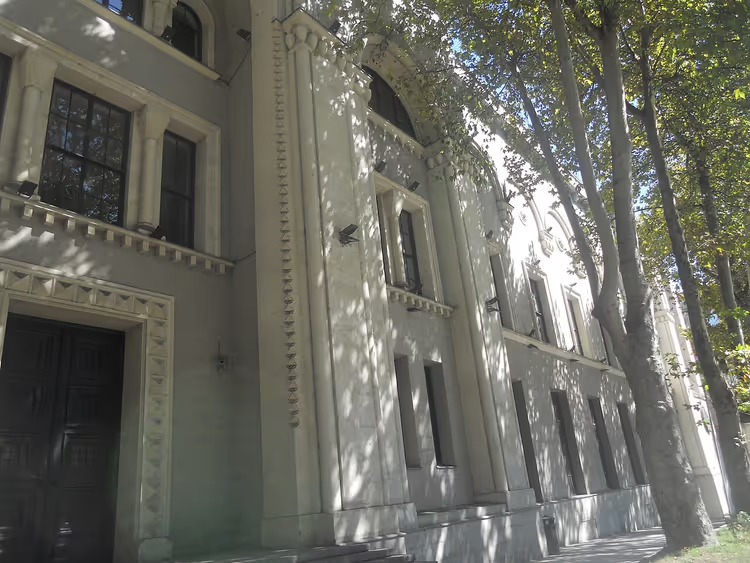 © Davit butulashvili · CC BY-SAPhoto: Davit butulashvili, CC BY-SA (https://creativecommons.org/licenses/by-sa/4.0), Wikimedia Commons
The large building on Rustaveli Avenue brings together several museums from a single state network. The Caucasian Museum, as it was formerly known, was founded in 1825. Over two centuries, the collection has been moved many times. The system includes 13 museums in total, and the main ones are located right here.
The first floor covers Georgia's ancient Iberian history. It displays finds from the Trialeti burial mound, which make up the museum's Gold Fund. Gold and silver goblets, ceramics, jewelry, coins, and ancient weapons sit alongside fossilized fragments of Homo ergaster. These remains, about 1.8 million years old, are considered the oldest evidence of human life outside Africa.
The second and third floors are occupied by the Museum of Soviet Occupation, opened after Georgia left the USSR. Exhibit commentary is provided in Georgian and English. The exhibition is debatable in its interpretations, but it covers the history of the 20th century in detail.
- Cost: tickets are sold at the ticket office and on biletebi.ge, the latter sold until 30 minutes before closing (according to the museum's official website, 09/2026).
- Hours: Tuesday through Sunday, closed Monday.
- Who it's for: those interested in archaeology and 20th-century history.
9. Melik-Azaryants House
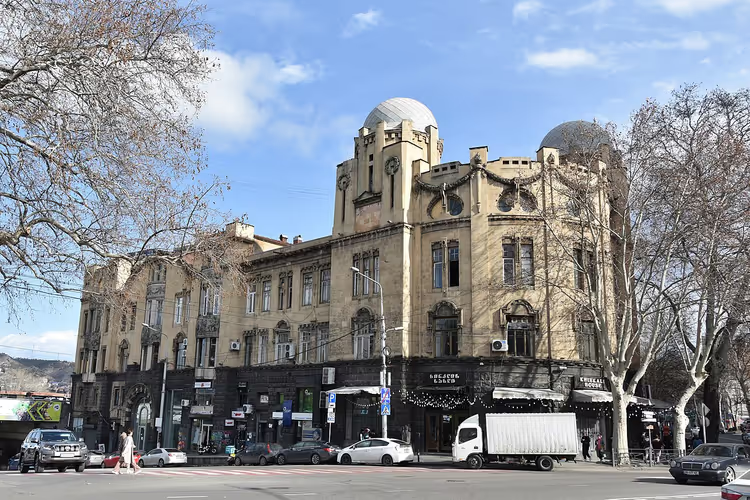 © Phyrexian · CC BY-SAPhoto: Phyrexian, CC BY-SA (https://creativecommons.org/licenses/by-sa/4.0), Wikimedia Commons
The apartment building of merchant Melik-Azaryants is called the Tiflis Passage for its length, stretching almost an entire block. The facades of rough stone are decorated with sculptural bas-reliefs, molded garlands, and wreaths. The wreaths were made as a sign of mourning for the owner's daughter. Corner turrets and ornate bay windows long made the building a record-holder for height and originality of design. The upper-tier windows are framed by openings shaped like teardrops.
The foundation is sunk deep into the ground and protected from groundwater by a casing of lead plates. Several underground floors formed beneath the house, where shops, a pharmacy, and a barbershop operated. After nationalization, the owner himself lived out his days in a semi-basement room.
- Getting there: Rustaveli Avenue, next to the National Museum.
- Who it's for: those who study facade details and enjoy urban legends.
10. Artsruni Caravanserai
The three-story building is typical of old Tiflis and universal in purpose. When the city was a center of crafts and trade, merchants needed space for lodging and goods. Hence the name: the caravanserai held 33 living rooms, 25 shops and stores, and 24 warehouses. Today the restored halls house the Museum of Georgian History.
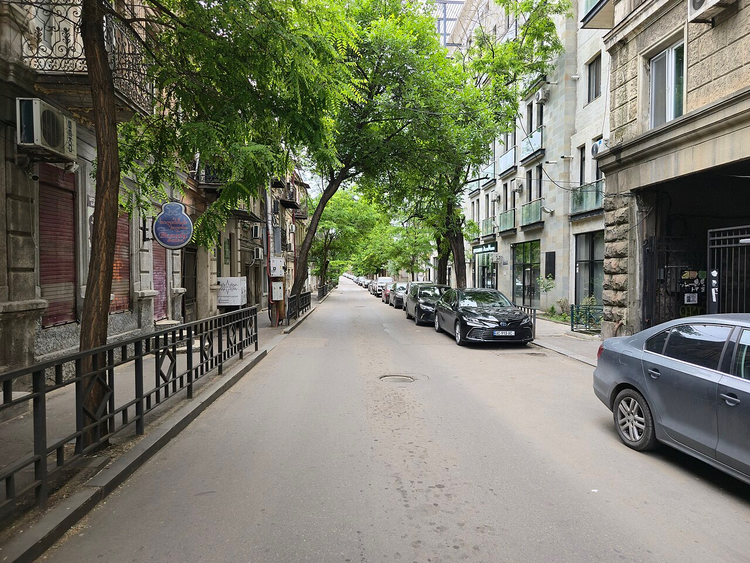 © David1010 · CC BY-SAPhoto: David1010, CC BY-SA (https://creativecommons.org/licenses/by-sa/4.0), Wikimedia Commons
- Getting there: Sioni Street, Old Town.
- Good to know: before your trip, compare insurance options in case of flight cancellation or illness.
- Who it's for: those who want to visit a history museum in the center of the Old Town.
11. Bridge of Peace
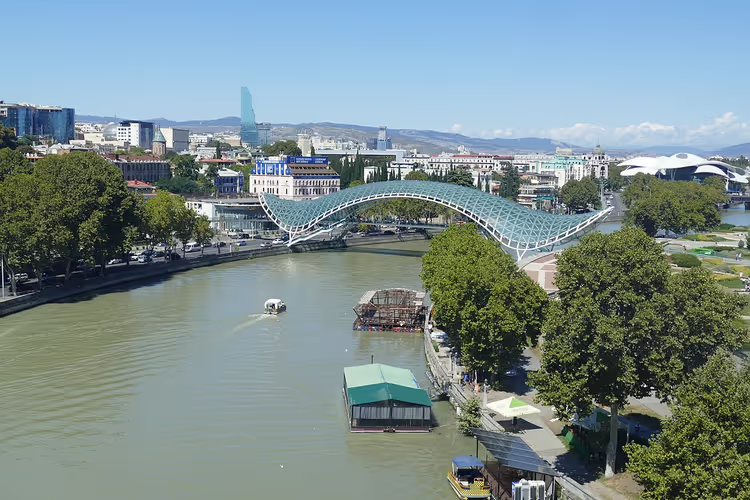
The Bridge of Peace spans the Kura River and connects the old districts of the city with the new neighborhoods. The steel and glass high-tech structure was created by European architects, with the project designed by Italian architect Michele De Lucchi. The translucent bluish arc has become a symbol of modern Tbilisi. Even those who initially opposed the project come in the evening to see the illumination. Every hour, 30,000 bulbs spell out in Morse code the names of the chemical elements that make up the human body.
- Getting there: walk downhill from Freedom Square toward the river.
- Cost: free to cross.
- Who it's for: those who want to see the evening illumination and cross into the Old Town.
12. Freedom Square
 © Andrew Milligan sumo · CC BYPhoto: Andrew Milligan sumo, CC BY (https://creativecommons.org/licenses/by/2.0), Wikimedia Commons
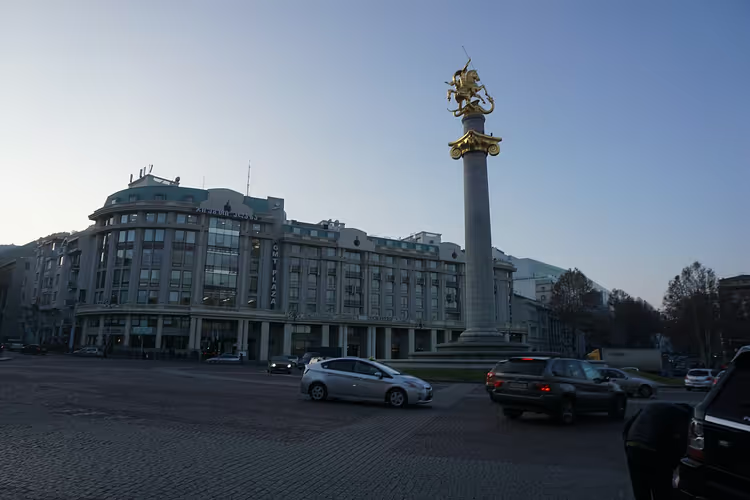
The city's main square has changed its name many times. In ancient times it occupied a plot in front of the Kojori Gate of the fortress and served as a place for visitors, which is why it was called Gostinichnaya. In the 19th century it was named after General Paskevich, and the perimeter was actively built up: the caravanserai of merchant Tamamshev and the city theater appeared here. At that time the square was called Theater Square.
In the 20th century it bore the names of the Transcaucasian Federation, Beria, and Lenin. For a long time a monument to the leader of the proletariat stood here; it was removed in the 1990s. The center of the square is now occupied by a 35-meter column with a gilded figure of Saint George trampling a dragon. The work was done by sculptor Zurab Tsereteli. This is a convenient starting point for a walk along Rustaveli Avenue.
- Getting there: Freedom Square metro station.
- Cost: free to visit.
- Who it's for: those starting a route through the city center.
13. Zoo
 © Sarah Murray from South Bend, IN, USA · CC BY-SAPhoto: Sarah Murray from South Bend, IN, USA, CC BY-SA (https://creativecommons.org/licenses/by-sa/2.0), Wikimedia Commons
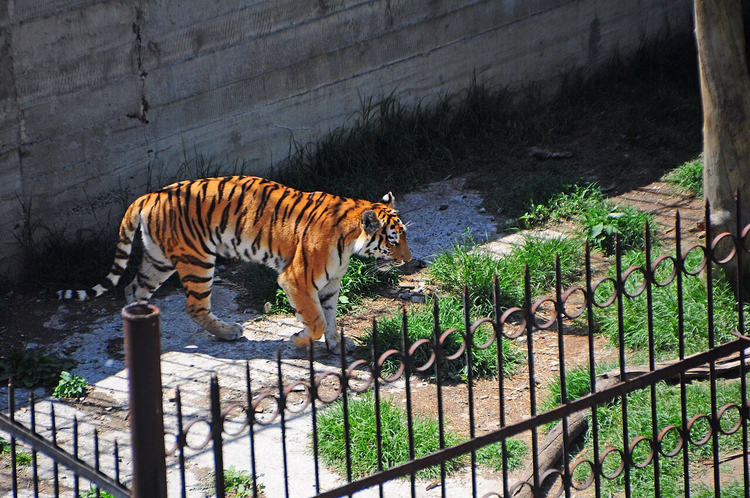
The Tbilisi Zoo is over 90 years old. Its history dates back to 1927, when a 100-hectare plot was allocated in the Vake and Saburtalo districts. The zoo was conceived not only as entertainment but also as a scientific center: animal behavior and acclimatization were studied here. The territory was divided into zones: Caucasian endemics, animals of the USSR's natural zones, and exotic fauna. An aquarium operated separately.
In 2015, the enclosures were destroyed by a flood, and some of the animals died. The zoo now operates as usual. Besides animals, there is an entertainment area with rides, horseback riding lessons, and cafes.
- Cost: paid entry, check ticket prices on the official website.
- Who it's for: those traveling with children or wanting to spend half a day in the park.
14. Mother of Kartli Monument
 © Mostafameraji · CC BY-SAPhoto: Mostafameraji, CC BY-SA (https://creativecommons.org/licenses/by-sa/4.0), Wikimedia Commons
The "Mother of Kartli" ("Mother of Georgia") sculpture was installed on Sololaki Hill in 1958 for the city's 1,500th anniversary. The sculptor was Elguja Amashukeli, who received the State Prize of the Georgian Republic in 1965 for this work. In the image of a woman with a sword and a cup of wine in her hands, the character of the people is evident: to warmly welcome friends and to be able to stand up for oneself.
The figure was originally made of wood. The material proved short-lived, and the statue was cast from aluminum alloy. In the 1990s, the monument was slightly altered: a headscarf and laurel leaves appeared on the woman's head. The 20-meter "Mother of Kartli" is clearly visible from various points in the city.
- Getting there: on foot from Narikala Fortress or by cable car.
- Cost: free to visit.
15. Botanical Garden
 © Mostafameraji · CC BY-SAPhoto: Mostafameraji, CC BY-SA (https://creativecommons.org/licenses/by-sa/4.0), Wikimedia Commons
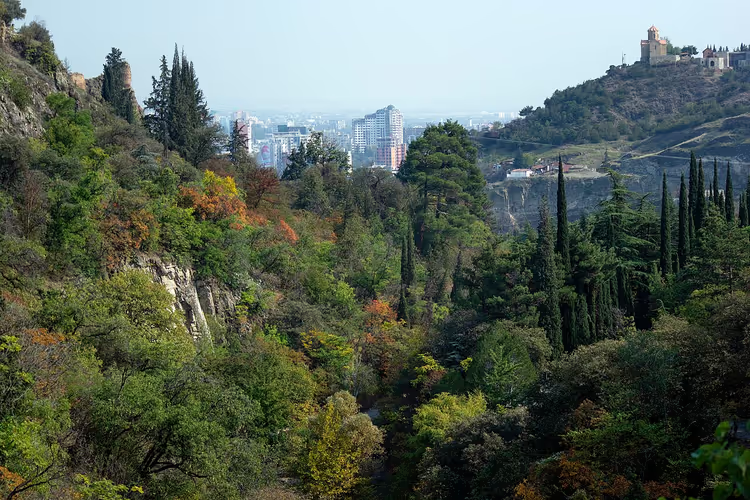
The botanical garden occupies the gorge of the Tsavkisistskali River just outside the old city. In the Middle Ages, fig thickets that belonged to the Georgian kings grew here. In 1845, by order of Count Vorontsov, the area was designated as a botanical garden. Today it covers 128 hectares, and its collection includes more than 3,500 plant species from around the world.
The garden is divided into zones. The rose garden and the apothecary garden with medicinal plants are popular with visitors, and the conifer section is a pleasant place to walk in hot weather. The garden is open year-round every day except Monday.
- Cost: paid entry; check the official website for the exact price.
- Who it's for: those who want to escape the city bustle in the shade of the trees.
- The catch: the garden lies in a gorge, so the paths are constantly going uphill.
16. Open-air ethnographic museum
 © Kober · CC BY-SAPhoto: Kober, CC BY-SA (https://creativecommons.org/licenses/by-sa/4.0), Wikimedia Commons
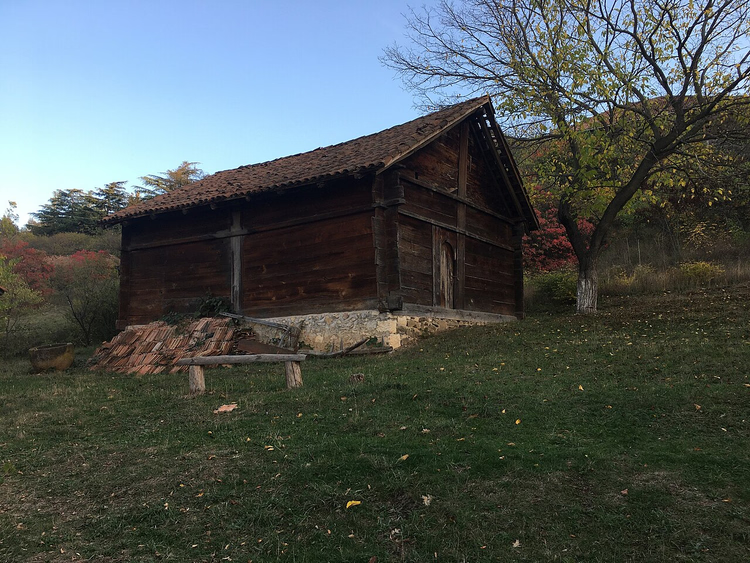
You can explore different corners of Georgia without leaving the city at the open-air ethnographic museum. It was established in 1966 on the initiative of Giorgi Chitaia on the slope of Mtatsminda. The exhibits were collected from across the country: traditional buildings from all regions stand on a 52-hectare site.
Inside the houses, the furnishings reflect the customs of the region they represent. Visitors can see household utensils, furniture, clothing, and agricultural tools, around 8,000 exhibits in total. A separate collection consists of gravestones with carved reliefs. Among the buildings are smithies, stables, and barns. A distinctive feature of the Georgian open-air museum is its wine cellars, where traditional wine storage conditions have been recreated.
- Getting there: on the slope of Mtatsminda, within walking distance from Turtle Lake.
- Who it's for: those who want to understand how people lived in a Georgian village.
17. Sameba (Holy Trinity Cathedral)
 © Mostafameraji · CC BY-SAPhoto: Mostafameraji, CC BY-SA (https://creativecommons.org/licenses/by-sa/4.0), Wikimedia Commons
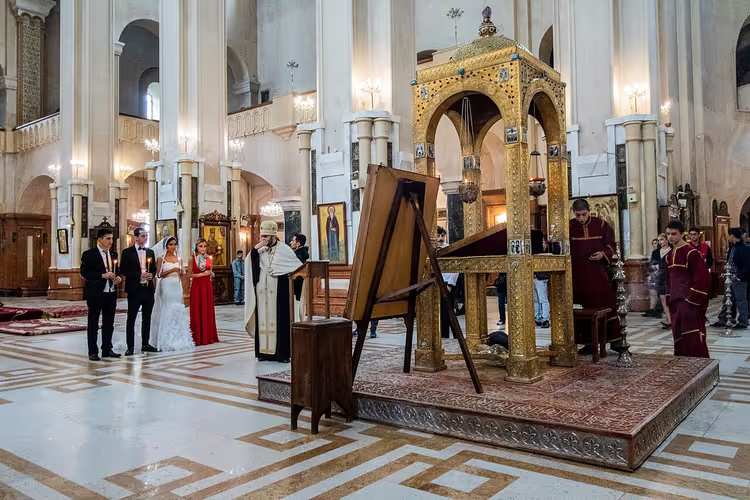
Sameba, or Tsminda Sameba, serves as the main cathedral of the Georgian Orthodox Church and is dedicated to the Holy Trinity. It was built on the hill of St. Elijah with donations from citizens and consecrated in 2004. The cathedral grounds cover 5,000 square meters, and the cathedral's height of about 100 meters puts it among the three tallest Orthodox churches in the world.
Inside, the cathedral is divided into 3 levels: one above ground and two underground. There are 9 chapels, 5 of them underground, and 13 altars. The lower floor houses the Church of the Annunciation with sarcophagi for the remains of Kings Vakhtang VI and Teimuraz II. The floor and columns are made of marble, and the wooden doors are covered with carvings. The icons depict 400 Georgian saints. Patriarch Ilia II of Georgia participated in the design.
Around the main building stand structures housing the patriarchal residence, a pilgrim house, monastic cells, and theological schools. For relaxation, there is a park area with a fountain and a small zoo, plus its own apiary and a small restaurant.
- Cost: admission is free, the cathedral is open to visitors daily.
- How to get there: by car or on foot uphill from the Avlabari district.
- Who it's for: those who want to see the country's main cathedral and a panoramic view of the city.
18. Rike Park
 © Clay Gilliland from Chandler, U.S.A. · CC BY-SAPhoto: Clay Gilliland from Chandler, U.S.A., CC BY-SA (https://creativecommons.org/licenses/by-sa/2.0), Wikimedia Commons
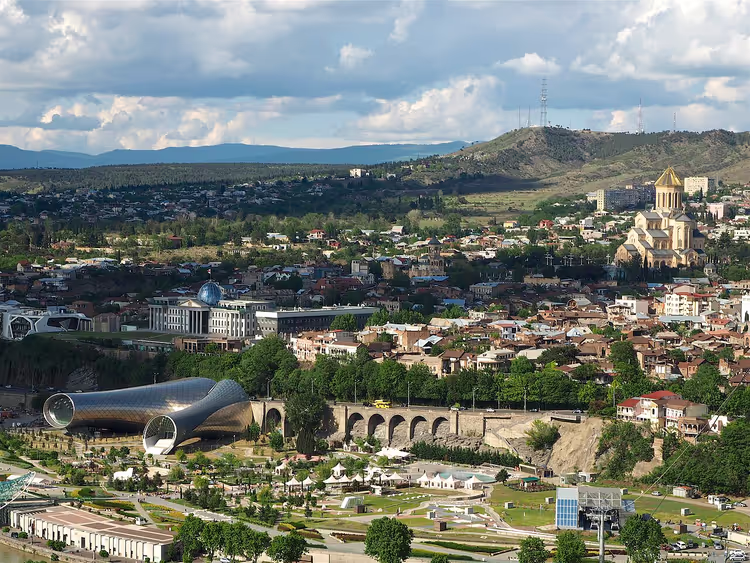
The name Rike Park translates from Georgian as "Sands" and refers to the former floodplain of the Kura River. The park area was developed relatively recently, in 2010. The young trees have not yet matured, so there is little shade here in summer. The landscape gets its expressiveness not from plants but from numerous art objects: a cubist-style fountain and a giant grand piano.
The most striking structure in the park is the concert and exhibition complex. Its appearance resembles two curved pipes, and the structure is made of glass and metal in a futuristic style. From here, a cable car climbs up to Narikala Fortress.
- How to get there: between the Bridge of Peace and Rustaveli Avenue.
- Cost: park admission is free.
- The catch: there is almost no shade in summer, so it's more comfortable to walk in the morning or evening.
19. Metekhi Church
 © Alexxx1979 · CC BY-SAPhoto: Alexxx1979, CC BY-SA (https://creativecommons.org/licenses/by-sa/4.0), Wikimedia Commons
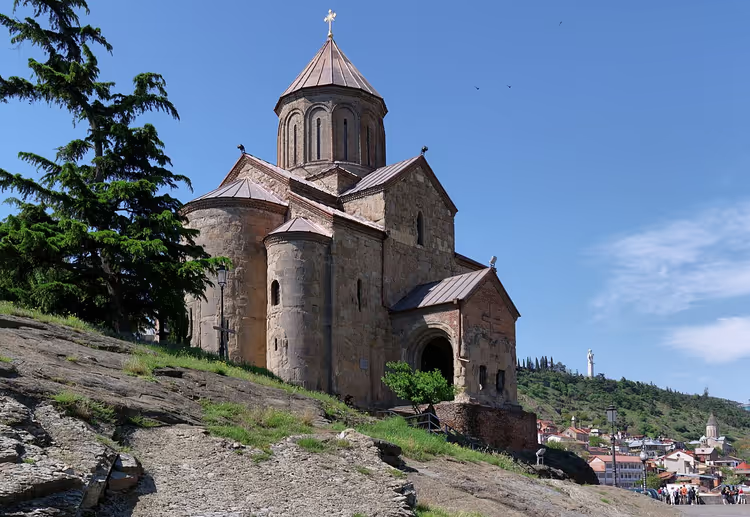
Metekhi (Church of the Assumption of the Virgin Mary) dates back to the 12th century and is one of the city's oldest religious buildings. According to tradition, Queen Tamar often came here to pray. During the Mongol invasion, the building was destroyed and fully restored in the late 13th century. Later, the church changed its purpose several times: it housed a gunpowder warehouse, a prison, and a youth theater. Its original functions were restored only in the 1990s.
On the iconostasis, the central place is occupied by the faces of Georgia's great martyrs, Saint Shushanik and Abo of Tbilisi. In front of the building, on a pedestal, stands the city's founder Vakhtang Gorgasali on horseback.
- How to get there: on the bank of the Kura River, below Freedom Square.
- Cost: admission is free.
- Who it's for: those who want to see a church on a cliff directly above the river.
20. Mtatsminda Mountain

Mtatsminda, Tbilisi's highest point at 730 meters, also serves as a sacred place. David Gareji, revered in Georgia, settled in a cave on the wooded slope back in the 6th century. On the site of his prayers, the Church of Mama Daviti was built in the 19th century. Every year, a festival in honor of the ascetic, Mamadavitioba, takes place here. Nearby, 3 springs emerge from the ground, and their water is considered healing.
The top of the mountain is occupied by a city park. A large wall fresco, "Dedication to Pirosmani," on the wall of a restaurant draws attention. Above the park rises a television tower 277.4 meters tall. From the observation decks, the entire city is visible.
- How to get there: by funicular from the foot of the mountain or on foot up the slope.
- Cost: the funicular ride is paid, park admission is free.
- Who it's for: those who want a panoramic view of the city and an evening park with rides.
21. Jumah Mosque
 © Reda Kerbush · CC BY-SAPhoto: Reda Kerbush, CC BY-SA (https://creativecommons.org/licenses/by-sa/4.0), Wikimedia Commons
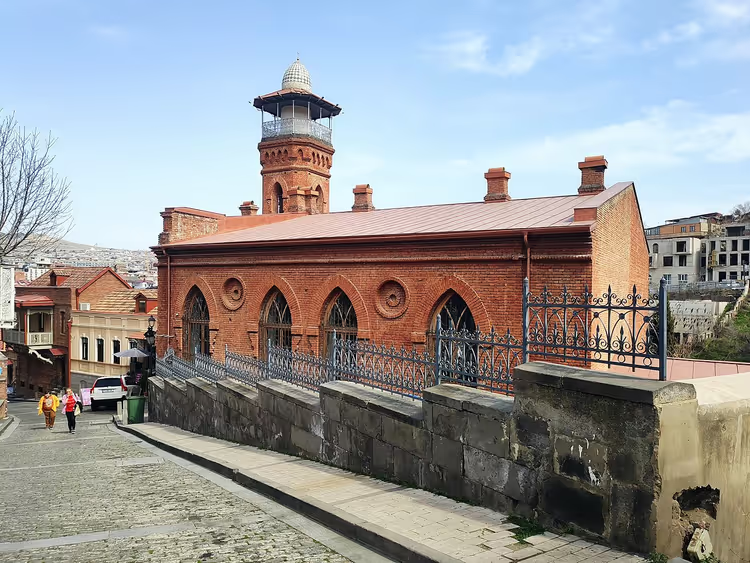
Among the city's Christian churches, the Muslim mosque stands apart. It is the only surviving stronghold of Islam in Tbilisi. The first religious building was erected by the Turks in the 1720s-1730s. The updated version was designed by the Italian G. Scudieri, who gave the building neo-Gothic features. The structure was built in the 1840s-1850s, and a minaret tower rises above the entrance.
Interestingly, services here are conducted by representatives of two branches of Islam, Sunnis and Shiites. That is why separate mihrabs and minbars are set up inside for each community.
- How to get there: Botanikuri Street, next to the sulfur baths.
- Cost: admission is free.
- Who it's for: those who want to see how different religions coexist in one city.
22. Anchiskhati Church
 © კოლხი · CC BY-SAPhoto: კოლხი, CC BY-SA (https://creativecommons.org/licenses/by-sa/4.0), Wikimedia Commons
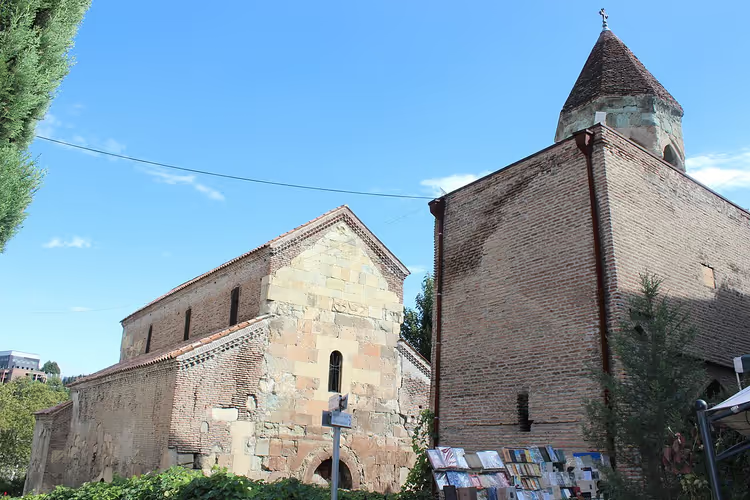
The unassuming stone structure on Shavteli Street is considered the city's oldest church, with an age of 15 centuries. Georgian chronicles report that the church in honor of the Nativity of the Virgin Mary was built by order of the Iberian ruler Dachi Ujarmeli. He made the city the capital and the church its main one. In 1675, the cathedral was renamed: the new name Anchiskhati refers to the Anchi icon of the Savior, made using the encaustic technique.
The building was rebuilt several times, and the tuff stone was replaced with brickwork. In the late 18th century, a brick bell tower was built next to it. The interior of the basilica is divided into 3 naves, and the walls and vault are decorated with frescoes and icons from the 19th century.
- How to get there: Shavteli Street, Old Town.
- Cost: admission is free.
- Who it's for: those who want to see the oldest functioning church in Tbilisi.
23. Flea market at the Dry Bridge
 © Alexkom000 · CC BYPhoto: Alexkom000, CC BY (https://creativecommons.org/licenses/by/4.0), Wikimedia Commons
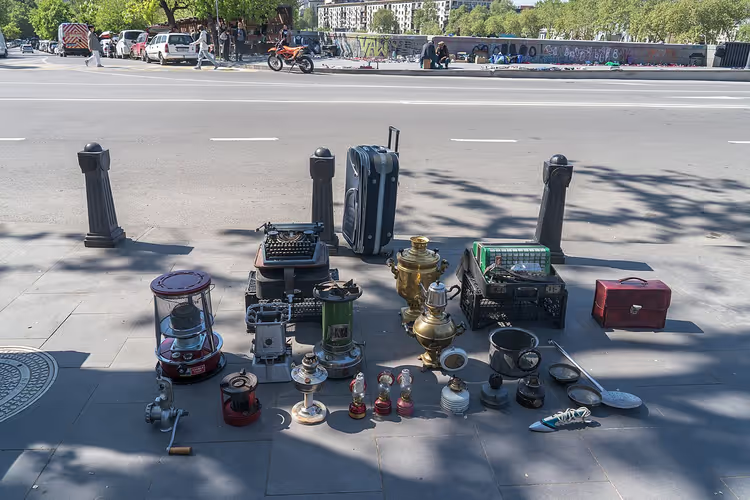
The bridge over the dried-up bed of the Kura River is called Mshrali Khidi, meaning Dry Bridge. The crossing was built according to a design by G. Scudieri and has connected the banks for over 160 years. On the left bank in the 1980s, a spontaneous market emerged, which over time turned into Georgia's most popular flea market.
Almost everything is sold here. Factory-made goods sit side by side with handmade crafts, and you can find genuine antiques and many Soviet-era items. Collectors look for porcelain figurines, smoking pipes, glass holders, and badges. For the home, you can buy a painted carpet or embossed metal wall art. Vendors gather daily, but the largest selection is on weekends.
- How to get there: Kura River embankment, at the Dry Bridge.
- Cost: admission is free, bargaining is appropriate.
- Who it's for: those who love vintage items and leisurely bargaining.
24. Rezo Gabriadze Marionette Theater
 © Gerd Eichmann · CC BYPhoto: Gerd Eichmann, CC BY (https://creativecommons.org/licenses/by/4.0), Wikimedia Commons
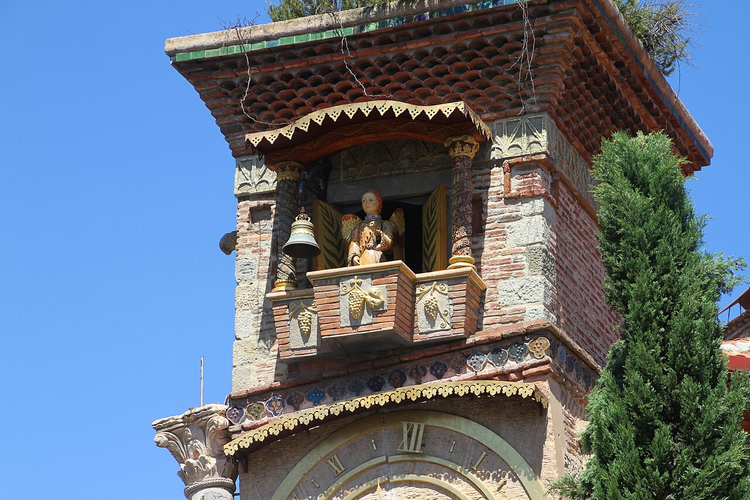
The Rezo Gabriadze Marionette Theater is located in the old part of the city, right by the Kura River. It was created in the 1980s on the initiative of cultural figure and artist Rezo Gabriadze. The small building with an 80-seat hall fits well into the city landscape. In 2010, the main building was complemented by a tower with a clock mechanism.
The arrival of a new hour is announced by a hammer striking a bell. Twice a day, at 12 and 18 o'clock, spectators gather around the tower to watch a performance with miniature figures. The pantomime is called "The Cycle of Life." Most of the puppets were created by Gabriadze himself.
- How to get there: Shavteli Street, Old Town.
- Cost: watching the tower performance is free, tickets to the hall are sold separately.
- Who it's for: those traveling with children or who love puppet theater.
25. Monument to the characters from the film Mimino
Georgiy Daneliya's lyrical comedy "Mimino" was filmed in 1978. The film tells the story of a small-aircraft pilot, Valiko Mizandari, nicknamed Mimino. The characters turned out to be so vivid that people perceive them as acquaintances. Sculptor Zurab Tsereteli decided to immortalize the images: he recreated the main characters in bronze.
 © David1010 · CC BY-SAPhoto: David1010, CC BY-SA (https://creativecommons.org/licenses/by-sa/4.0), Wikimedia Commons
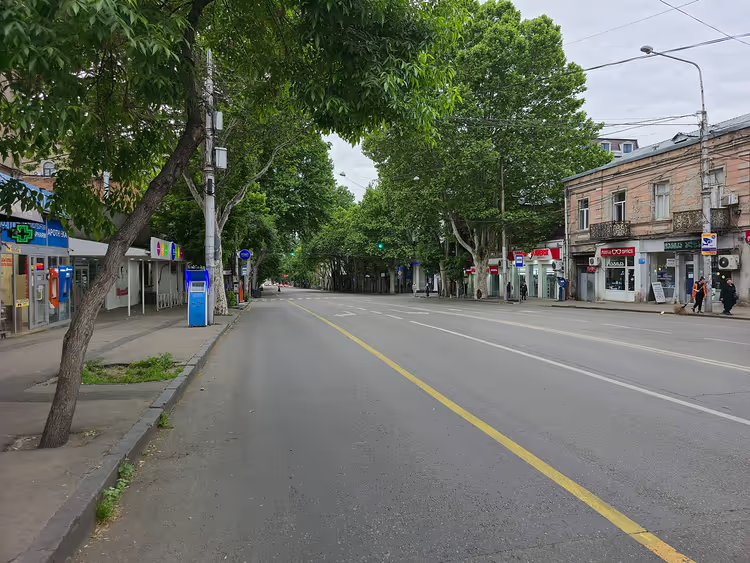
Since 2011, at the entrance to the Avlabari metro station, you can meet pilot Mimino, driver Rubik Khachikyan, and veteran Ivan Volokhov. Watching over the trio is director Georgiy Daneliya.
- How to get there: Avlabari metro station.
- Cost: viewing is free.
- Who it's for: those who love Soviet cinema and want to take a photo.
26. Monument "History of Georgia"
 © Alexkom000 · CC BYPhoto: Alexkom000, CC BY (https://creativecommons.org/licenses/by/4.0), Wikimedia Commons
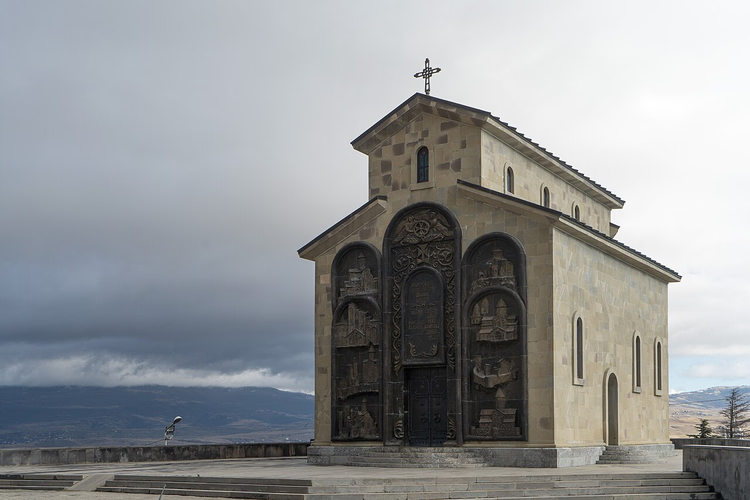
The Monument "History of Georgia" rises 13 km from the city center, near the Tbilisi Sea. Construction of the complex began in 1985 and is still not fully complete. According to the vision of sculptor Zurab Tsereteli, the complex consists of 16 enormous steles, each 35 meters tall. The stone pillars are topped with slabs featuring copper and bronze bas-reliefs.
Each element is visually divided into 3 parts: the lower section depicts biblical stories, the central section contains a portrait gallery of celebrated Georgian figures, and the upper section shows scenes of national traditions. A small church next to the monument serves as a reminder of Christianity. Locals have nicknamed the memorial the "Georgian Stonehenge."
- How to get there: by car, on the way to the Tbilisi Sea.
- Cost: free to visit.
- Who it's for: those willing to leave the city for a grand panorama.
27. Turtle Lake
 © Nino Ozbetelashvili from Georgia · CC BYPhoto: Nino Ozbetelashvili from Georgia, CC BY (https://creativecommons.org/licenses/by/2.0), Wikimedia Commons
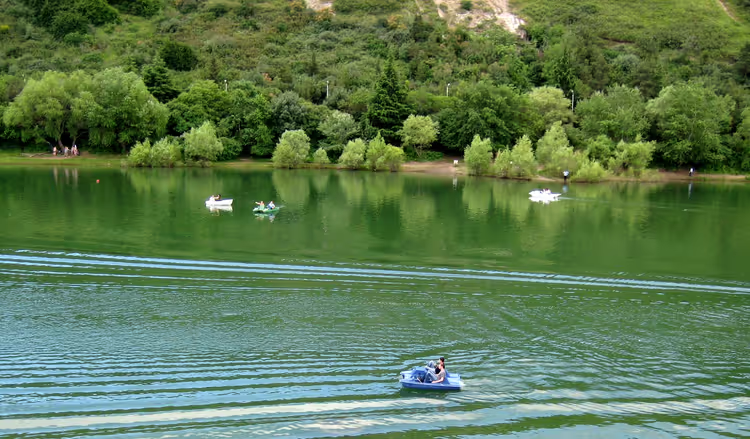
Turtle Lake, or Kus-tba, occupies a small hollow on the northern slope of Mtatsminda. It got its name from the abundance of turtles. The body of water is small: its area is less than half a square kilometer, and its depth does not exceed a few meters. A pebble beach stretches along the shore, and in summer families come here to swim.
Visitors can enjoy attractions, including catamaran rides. Cafes stand nearby, and on the western shore there is an open-air ethnographic museum.
- How to get there: by car or by cable car from Vake Park.
- Cost: admission is free, attractions are paid.
- The catch: the water warms up slowly and stays cool even in hot weather.
28. Funicular and Pantheon
 © Andrew Milligan sumo · CC BYPhoto: Andrew Milligan sumo, CC BY (https://creativecommons.org/licenses/by/2.0), Wikimedia Commons
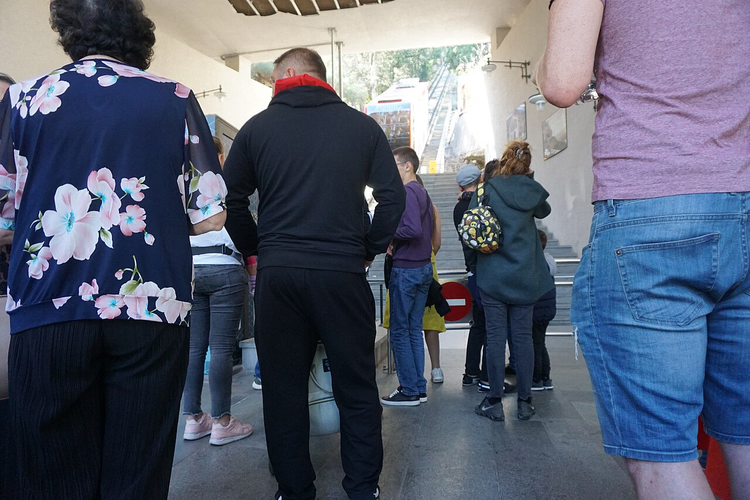
The funicular in Tbilisi was launched in 1905 and remains an unusual form of transport for the city to this day. The cars were designed by Belgian engineer A. Roby. The route runs from the foot of Mtatsminda to the top, covering 501 meters, with the ascent taking 5 minutes. There is one stop along the way at the Pantheon.
The Pantheon of celebrated Georgian figures was opened on the mountain slope in 1929. The memorial cemetery is the final resting place of 49 notable people: politicians, writers, and artists. Among them are writer Ilia Chavchavadze and Stalin's mother Ekaterine Geladze. A special place is held by the grave of Russian diplomat Alexander Griboyedov, who died in Persia. His widow insisted on burying his remains in Georgia and tended the grave for the rest of her life; she was buried next to her husband.
- How to get there: funicular from the foot of Mtatsminda, stop at the Pantheon.
- Cost: fare is paid, ascent and descent are paid separately.
- Who it's for: those who want to combine a city panorama with a historic cemetery.
29. Cable car
 © David1010 · CC BY-SAPhoto: David1010, CC BY-SA (https://creativecommons.org/licenses/by-sa/4.0), Wikimedia Commons
Tbilisi's terrain is hilly, so two cable car lines were built to reach the heights: one in Rike Park and one in Vake Park. The cable car from Rike Park to Sololaki Hill is popular with tourists. It operates 8 suspended cabins, each with a capacity of 8 people. The line is 508 meters long, and the ascent takes less than 2 minutes.
At the top, passengers can visit Narikala Fortress and the Mother of Kartli monument. The line in Vake Park is longer: the ascent takes 6-7 minutes, and the cabins offer views of the Saburtalo and Vake districts. The terminal station is near Turtle Lake. Both cable cars operate year-round, seven days a week, and the fare is paid.
- How to get there: stations at Rike Park and in Vake Park.
- Cost: fare is paid, check the price at the station.
- Who it's for: those who don't want to walk uphill.
30. Agmashenebeli Avenue
Agmashenebeli Avenue serves as the main thoroughfare of the left-bank part of the city and is named after King David the Builder. The street runs through the historic Chugureti district. Buildings in the eclectic style, erected in the late 19th century, line the sidewalks. The avenue became part of tourist routes thanks to its landmarks.
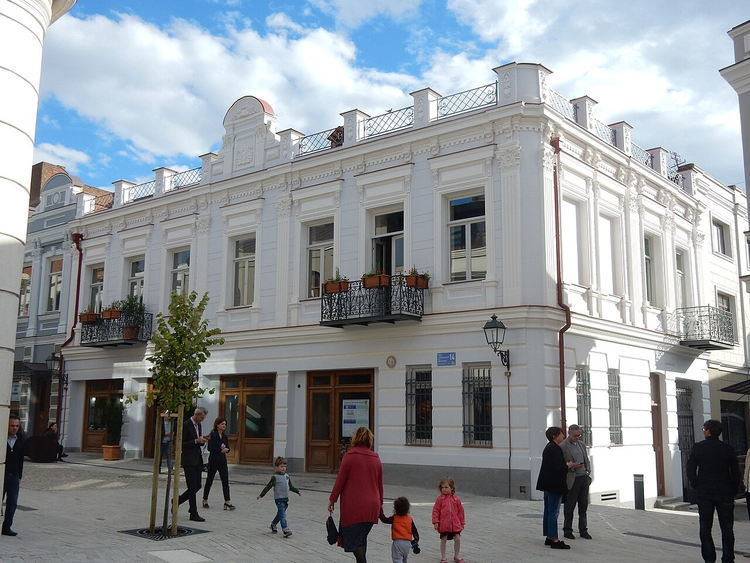 © Shuvaev · CC BY-SAPhoto: Shuvaev, CC BY-SA (https://creativecommons.org/licenses/by-sa/4.0), Wikimedia Commons
Of historical significance is house No. 52, where writer Leo Tolstoy stayed in 1851, and house No. 150, where Joseph Dzhugashvili lived from 1899 to 1901. Both addresses are marked with memorial plaques. From house No. 44, the avenue turns into a European-style pedestrian zone.
- How to get there: Marjanishvili and Rustaveli metro stations.
- Cost: walking is free.
- Who it's for: those who want to see left-bank Tbilisi and local cafes.
Tours and tickets in Tbilisi
Guided tours, skip-the-line tickets and activities — most offers can be cancelled free of charge.
See offers on TiqetsThe widget loads once you give your consent.
⁉️🤔 Frequently asked questions
How many days do you need to see Tbilisi?
Plan for 2-3 days. Spend the first day on the Old Town, Narikala, and the sulfur baths, and the second on Rustaveli Avenue, the National Museum, and the Botanical Garden. Distant spots like the Monument "History of Georgia" should be a separate trip by car.
What can you see in Tbilisi for free?
Narikala, Freedom Square, the Bridge of Peace, Rike Park, Metekhi Church, the Juma Mosque, Anchiskhati, Sameba, and Mtatsminda are free to visit. You only pay for the cable car and funicular rides, as well as entry to the Botanical Garden, the zoo, and the National Museum.
Do you need to buy tickets in advance?
Museum tickets are sold at the ticket office and online; lines mostly occur in summer and on weekends. For the cable car and funicular, it's more convenient to go in the morning. You should only think ahead about major museums and accommodation in high season.
What is the difference between the cable car and the funicular?
The cable car runs from Rike Park to Narikala Fortress, and the ascent takes less than two minutes. The funicular climbs from the foot of Mtatsminda to the park and the Pantheon in five minutes. These are two different lines with different routes and separate fares, so choose based on your hotel's location.
How do you get to Narikala Fortress?
The easiest way is by cable car from Rike Park; the ascent takes less than two minutes. An alternative is to walk up from the Old Town via staircases, which takes 15-20 minutes. Entry to the fortress grounds is free; you only pay for the cable car ride.
In short: what to book
If you only have two days, base yourself in the center between Freedom Square and the Old Town and choose a hotel on Trip.com. That way you can walk to half of the sights.
If you want to see the city in one day or take a trip to Kakheti, check out tours on GetYourGuide. And for trips to the Monument "History of Georgia" and the Tbilisi Sea, compare car rental prices.

A small editorial team writing guides for independent travel. We travel ourselves, but we haven’t been everywhere, so we check prices, opening hours and how to get there against official sources.