
















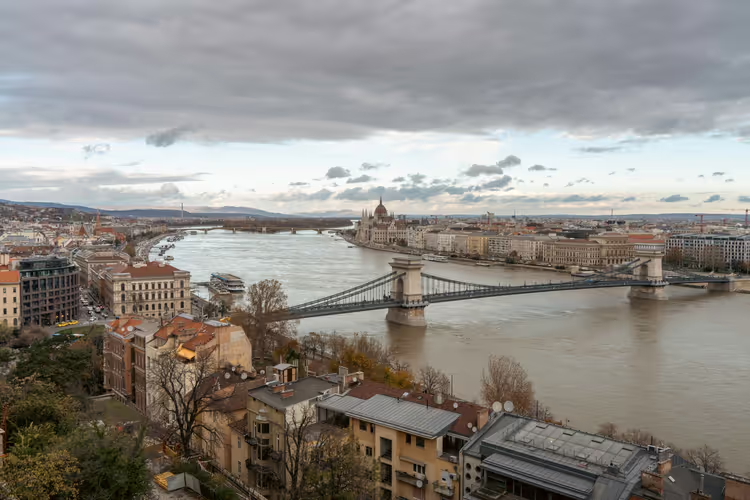
Budapest in 3 days on your own: a route along two banks of the Danube
Budapest sits on two banks of the Danube. In three days you can cover Buda Castle, Andrássy Avenue, and the Pest embankment. A bus, metro, or tram ride costs 500 Ft per ticket (as of 09/2026, BKK fares). A day ticket to Széchenyi Baths starts at 13,200 Ft (as of 09/2026, Széchenyi Baths website).
This route is designed for independent travelers without a guide. We arranged the sights so you spend less time in transit and more time exploring on foot. Each day starts on one bank and ends on the other.
Ad: this article contains affiliate links. We earn a commission if you book through them, at no extra cost to you.
Three days in Budapest: the plan
The Danube divides the city into two parts. Buda lies on a hill, home to the old fortress and narrow streets. Pest sits on flat ground: here you'll find boulevards, parks, and baths. Trams, the metro, and buses carry you between the banks on a single ticket. This sightseeing order saves you at least one trip per day.
Day | Main sights | Book ahead | Walking, km (on the map) |
|---|---|---|---|
1 | Buda Castle | Matthias Church | 4 |
2 | Heroes' Square and Andrássy Avenue | Széchenyi Baths | 6 |
3 | Parliament and the embankment | Parliament, baths | 5 |
💡 In short:
- Day 1: Castle Hill, Matthias Church, Fisherman's Bastion, and the Royal Palace.
- Day 2: Heroes' Square, Városliget, Széchenyi Baths, Andrássy Avenue, and the House of Terror.
- Day 3: Parliament, St. Stephen's Basilica, the Great Synagogue, and the baths.
- Prices and opening hours: 09/2026, verified on the official BKK website
How to get from the airport to the center

Budapest Airport is 16 kilometers from the center. Bus 200E runs from Terminal 2 to Kőbánya-Kispest metro station, where you continue on the blue M3 line. A ticket costs 500 Ft and is also valid on the metro (as of 09/2026, BKK website). Express bus 100E takes you directly to Deák Square but costs 2,500 Ft. Take it if you're traveling with a suitcase and don't want transfers.
A taxi will cost more than the bus. Take an official car from the counter in the arrivals hall or book in advance, and the driver will meet you with a sign. The ride takes 30-40 minutes, longer at rush hour. Some routes change at night; check the current schedule on the BKK website.
Tours and tickets in Budapest
Guided tours, skip-the-line tickets and activities — most offers can be cancelled free of charge.
See offers on KiwitaxiThe widget loads once you give your consent.
Day one: Buda Castle
The Buda side grew up on a hill above the Danube. It's a convenient place to start: from here you get a view over all of Pest.
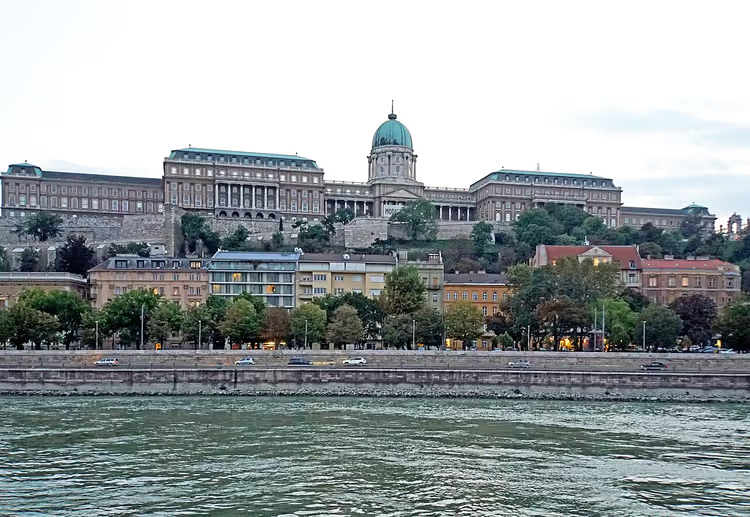 © Dennis G. Jarvis · CC BY-SAPhoto: Dennis G. Jarvis, CC BY-SA (https://creativecommons.org/licenses/by-sa/2.0), Wikimedia Commons
The Chain Bridge across the Danube leads up to the top. On the Pest side it comes out at Roosevelt Square, on the Buda side at Adam Clark Square. Locals call the hill itself by different names: Castle Hill, Buda Castle Hill, Buda Hill. It's worth climbing up here even just for the view of the city.
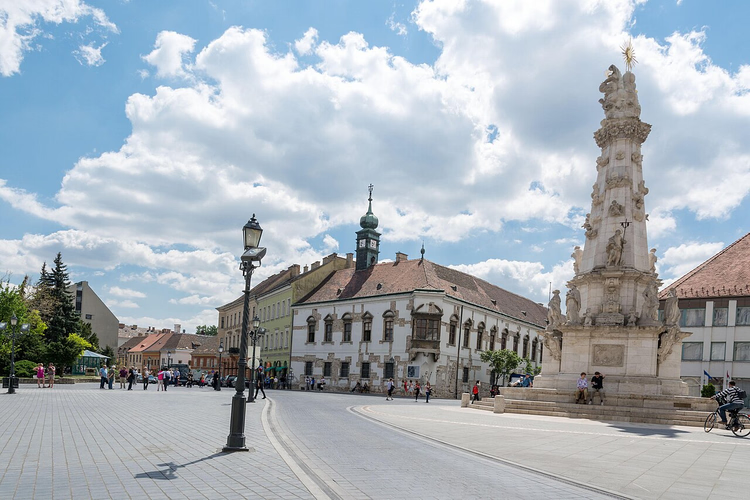
Holy trinity square and the plague column
At the top, Holy Trinity Square begins. Its layout dates back to the Middle Ages, and houses with Baroque facades have survived here. In the center of the square stands the Plague Column. Such monuments were erected in European cities after the plague epidemics of the 17th and 18th centuries. Hungary experienced several severe outbreaks that noticeably reduced the population. All the main sights of the castle district start from this square, and from here on you continue on foot.
 © Nikolai Karaneschev · CC BYPhoto: Nikolai Karaneschev, CC BY (https://creativecommons.org/licenses/by/3.0), Wikimedia Commons
Matthias Church
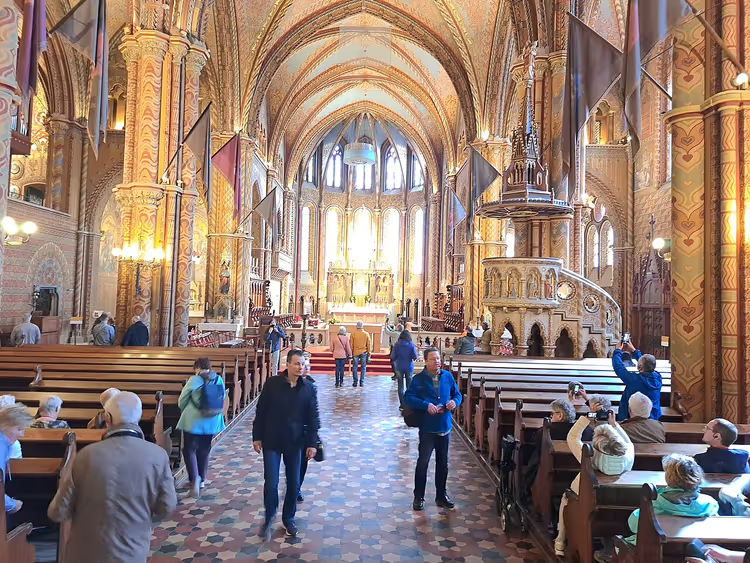
Matthias Church stands in the very center of the castle district. Officially it is the Church of the Assumption of the Buda Castle, but locals call it by the name of King Matthias Corvinus. The building is about 700 years old, and over that time it has been destroyed and rebuilt more than once. The restoration was timed to coincide with the national holiday, the millennium of the Hungarian conquest of the homeland.
 © Bybbisch94, Christian Gebhardt · CC BY-SAPhoto: Bybbisch94, Christian Gebhardt, CC BY-SA (https://creativecommons.org/licenses/by-sa/4.0), Wikimedia Commons
During the Ottoman years this was the main mosque of Budapest, and the church's interior was lost. Only at the end of the 19th century was the church returned to the Catholics and restored in the Gothic style. The tall bell tower and the roof of multicolored tiles, resembling a carpet, are visible from the other bank. Entry to the church is paid, tickets are sold at the entrance.
Fisherman's Bastion
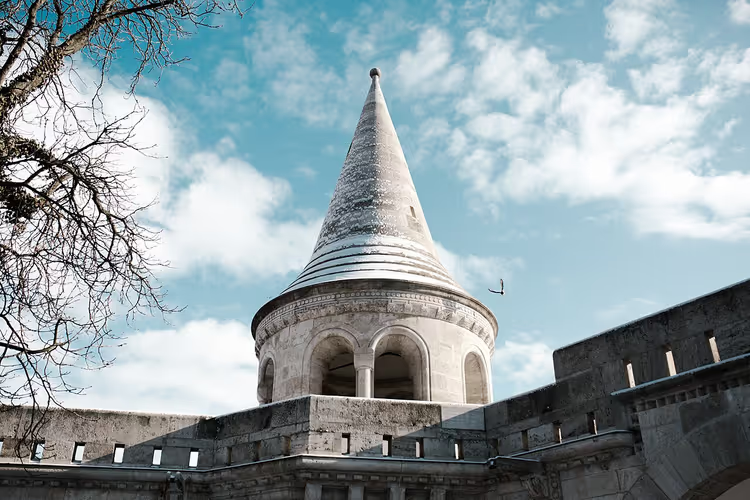
The Fisherman's Bastion was built of white stone to give the church a worthy backdrop and a viewing terrace. Until the early 20th century, a fish market bustled on this spot, hence the name. It was the fishermen who were supposed to defend the bastion in case of war. The structure is crowned by seven towers, symbolizing the seven Hungarian tribes. In front of the bastion stands a monument to Saint Stephen, the first king of the Hungarians, on horseback.
The lower terraces are always open and free; a separate ticket is required to go up to the upper towers. Come at opening time, in the morning the viewing platforms are noticeably less crowded.
Buda Castle
Buda Castle occupies the southern edge of the hill. The first royal residence appeared here back in the 13th century. In the 15th century the palace was rebuilt with the participation of the best architects and artists of Europe, and later Italian architects gave it Renaissance features. The decoration was rich: it used gilding and fine carving.
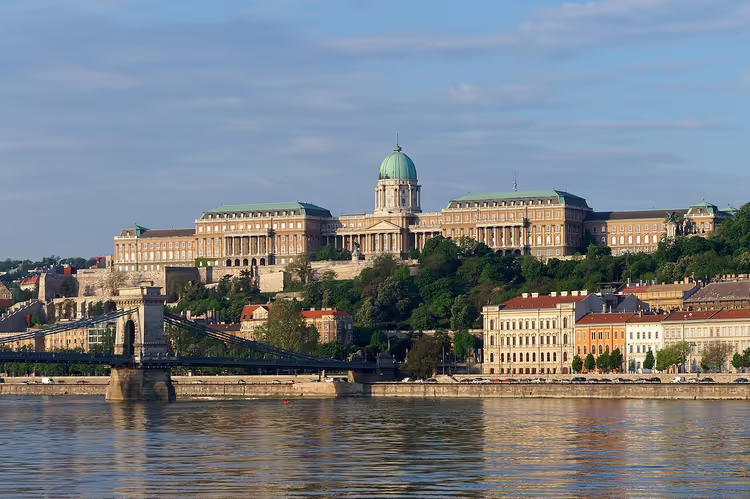 © Jakub Hałun · CC BY-SAPhoto: Jakub Hałun, CC BY-SA (https://creativecommons.org/licenses/by-sa/4.0), Wikimedia Commons
In the 16th century the palace was destroyed by the Turks, and in the 19th century it was restored. During World War II, bombing and artillery shelling again turned the building into ruins. The palace acquired its modern appearance in the second half of the 20th century. Museums now operate here, and you could spend a whole day exploring the halls.
You enter the inner courtyard through the Ornamental Gate. At the entrance stands a column with the Turul bird. According to legend, the mother of the country's first ruler gave birth to a son from this bird, and since then it has become a symbol of the ruling dynasty. Later the bird appeared in a dream to the leader of the Hungarian tribes and showed him where to move. That is why the image of the Turul is still dear to Hungarians.
King Matthias Fountain
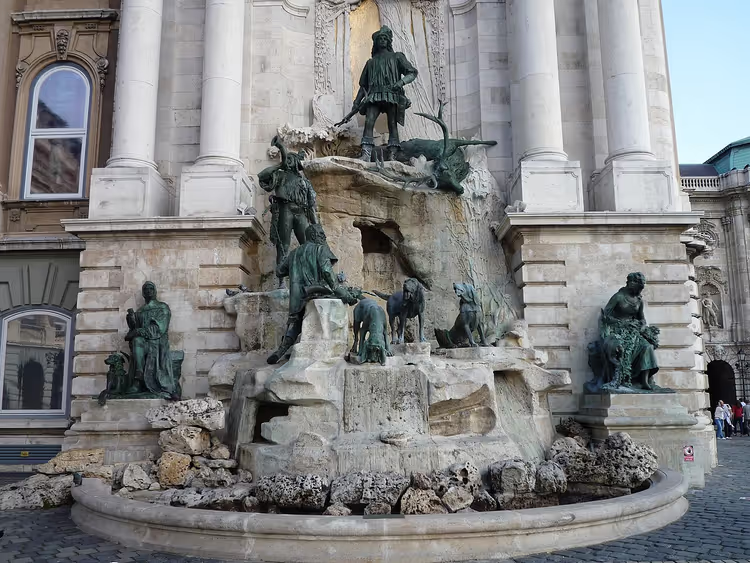
The King Matthias Fountain juts out directly from the palace wall. At the top stands the king himself, below are hunters and dogs, and on the right a girl with a fawn. According to legend, the king himself was hidden beneath the hunter, and the girl's name was Ilonka. She fell in love with the young man without knowing who he was, and quietly faded away from a hopeless feeling. The figure of the chronicler who preserved this story for posterity stands to the left of the main sculptures.
In summer the jets of water shoot out so that it looks as if the hunting dogs are drinking from the fountain. Come here for photos; the sculptural group looks best in the morning.
The castle wall begins next to the fountain. It is usually not crowded here. From it opens a wide panorama of Budapest, and below the Danube rolls its waters.
Where to eat on Buda Hill
After a long walk you'll get hungry. At Adam Clark Square there are kiosks with fresh pastries. For a full meal, head to the Ruszwurm cafe or the Alabárdos restaurant near the bastion. The interiors and cuisine here remember the 19th century, and lunch turns into a small excursion into the past.
Day two: Pest and Andrássy Avenue
Day two takes you through Pest. Start at Heroes' Square, then walk down Andrássy Avenue toward the center. By evening, the baths and a stroll along the Danube await.
Heroes' Square
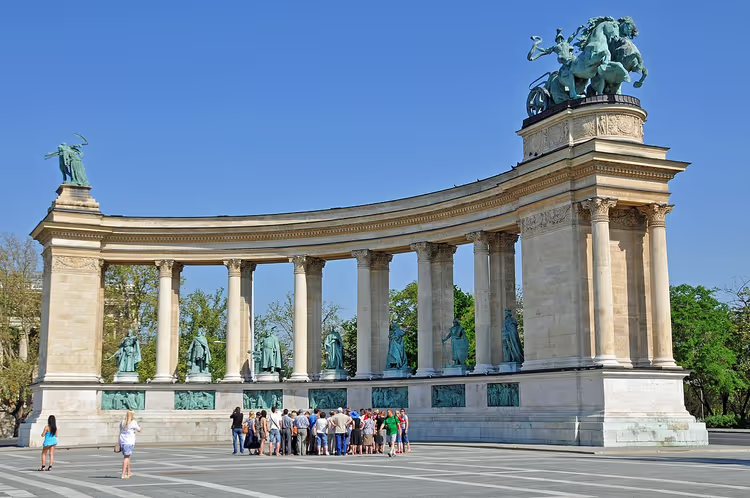
Heroes' Square is one of the city's main squares. The site has held significance for Hungarians since ancient times: it was once a field where state councils gathered and warriors assembled before the Crusade. The square itself and its first sculptures appeared in the late 19th century. The ensemble was inaugurated to mark the 1,000th anniversary of Hungarian statehood.
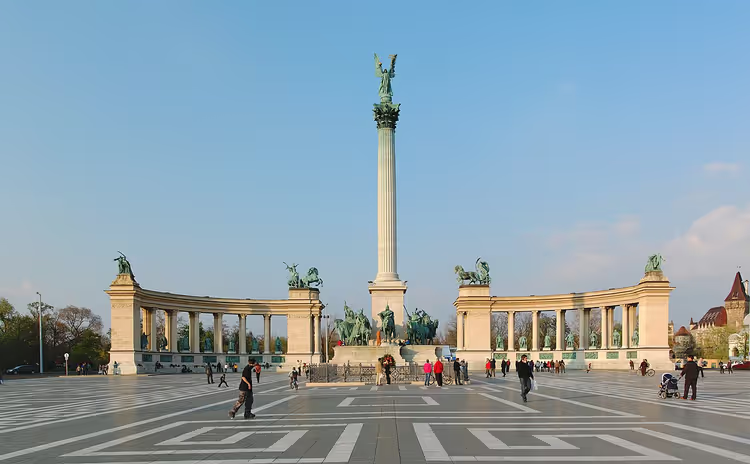 © User:Sveter (Please credit as ”Petr Šmerkl, Wikipedia” in case you use this outside WMF projects.) · CC BY-SAPhoto: User:Sveter (Please credit as ”Petr Šmerkl, Wikipedia” in case you use this outside WMF projects.), CC BY-SA (https://creativecommons.org/licenses/by-sa/3.0), Wikimedia Commons
The central column is topped by the figure of the Archangel Gabriel. According to legend, it was he who helped King Stephen embrace Christianity. Two semicircular colonnades are dedicated to the country's heroes, and monuments to Hungarian princes stand between the columns. Next to the square is the Műcsarnok exhibition hall; the art gallery opened here in 1895.
Heroes' Square is easy to reach by metro: the yellow M1 line runs here directly from the center. Buses 105, 20E, 30A, and 230 and trolleybuses 72, 75, and 79 also serve the area. The square is visible right from the metro exit, so getting lost is unlikely.
Városliget Park and Vajdahunyad Castle
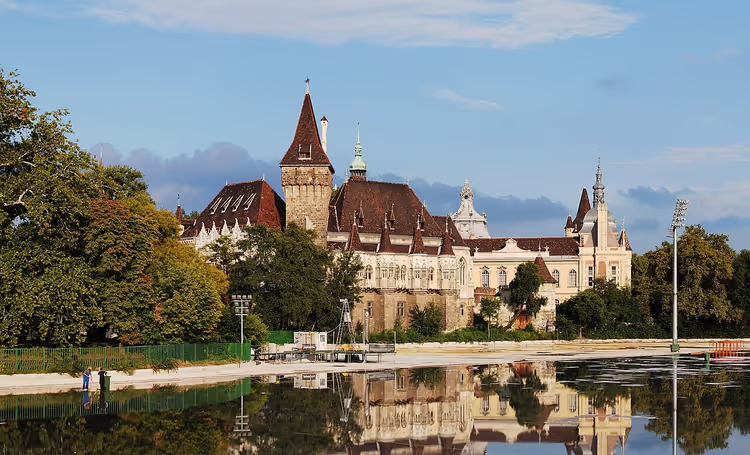
Városliget Park begins right behind the square. Both locals and tourists love it; it has a pond, tree-lined paths, and museums.
 © Felix König · CC BYPhoto: Felix König, CC BY (https://creativecommons.org/licenses/by/3.0), Wikimedia Commons
The park's main attraction is called Vajdahunyad Castle, built in 1908. It now houses the Museum of Agriculture. The castle was assembled from replicas of details from Hungarian buildings of different eras, which is why it looks older than it is and combines Romanesque, Gothic, and Baroque styles. Tourists take photos in front of it and joke that Count Dracula could have lived in such a castle.
Széchenyi Baths
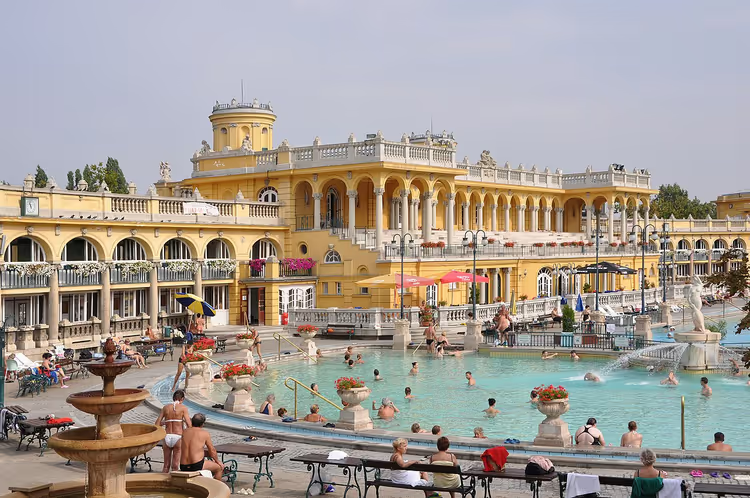
Széchenyi Baths stand in the same park and opened in the early 20th century. It is one of the largest bath complexes in Europe. It features outdoor pools, thermal baths, and a medical department where balneological treatments are provided on a doctor's recommendation.
 © Marc Ryckaert ( MJJR ) · CC BYPhoto: Marc Ryckaert ( MJJR ), CC BY (https://creativecommons.org/licenses/by/3.0), Wikimedia Commons
A day ticket with a locker costs 13,200 Ft on weekdays and 15,800 Ft on weekends (as of 09/2026, prices on the Széchenyi website). A morning ticket before 9 a.m. is cheaper at 10,500 Ft. Children are allowed at Széchenyi Baths. Bring a swimsuit, towel, and flip-flops in advance; rentals are available on site but cost more.
- The catch: on weekends, a day ticket costs more than on weekdays.
- Who it's for: those who want to combine sightseeing with relaxing in thermal water.
Skip-the-line Széchenyi Baths tickets on GetYourGuide
Andrássy Avenue
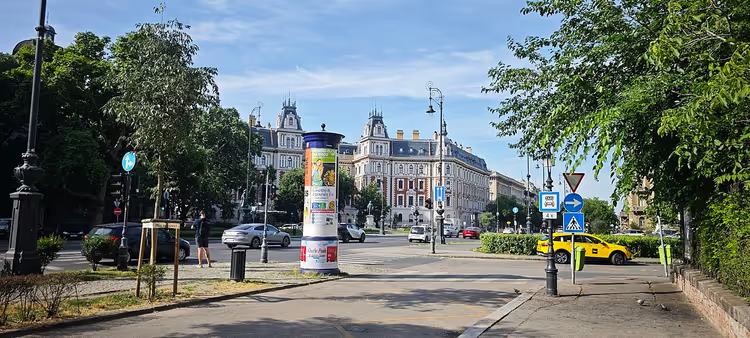
Andrássy Avenue connects Heroes' Square with Ferenc Deák Square. It is called the Hungarian Champs-Élysées and is listed as a UNESCO World Heritage Site. The avenue was named after Count Andrássy, the prime minister of the Hungarian government.
 © Elekes Andor · CC BYPhoto: Elekes Andor, CC BY (https://creativecommons.org/licenses/by/4.0), Wikimedia Commons
The buildings look old, but most were built in the late 19th century in a pseudo-historical style. There are shops, restaurants, and hotels here. Beneath the asphalt runs the yellow M1 metro line, the oldest in continental Europe. Because of it, the pavement underfoot vibrates slightly. Go down into the metro and check it out as an attraction in its own right.
The Postal Museum is located on the avenue. It holds a large archive of postal items; check opening hours before visiting.
Hungarian State Opera House
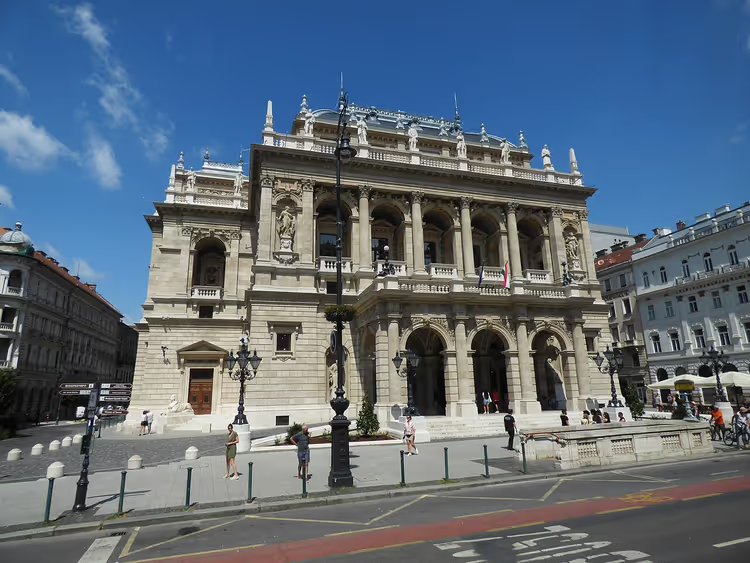
The Hungarian State Opera House opened in 1884. The building is designed in the Neo-Renaissance style, with many sculptures, paintings, and murals inside. Giacomo Puccini staged his operas on this stage several times, and ballet companies also perform here. The auditorium seats over a thousand spectators, and its acoustics are second only to the Paris Opera and Milan's La Scala.
 © Jeremy Oakley · CC BYPhoto: Jeremy Oakley, CC BY (https://creativecommons.org/licenses/by/2.0), Wikimedia Commons
Monuments to two Ferencs, Liszt and Erkel, stand in front of the entrance. During the day, you can visit the theater on a guided tour of the building.
Tours and concerts in Budapest on GetYourGuide
House of Terror
The House of Terror stands on Andrássy Avenue and is dedicated to two 20th-century regimes, the Nazi and the communist. The word terror is carved into the black metal cornice, a curtain of iron chains hangs opposite the entrance, and a concrete block stands nearby as a symbol of the Berlin Wall.
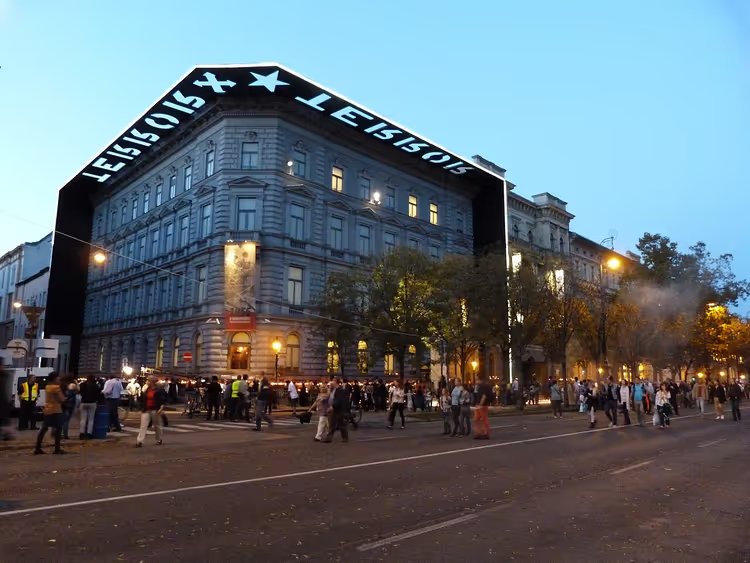 © Derzsi Elekes Andor · CC BY-SAPhoto: Derzsi Elekes Andor, CC BY-SA (https://creativecommons.org/licenses/by-sa/3.0), Wikimedia Commons
The museum opened in 2002, on the eve of the Day of Remembrance for Victims of the Communist Regime. During World War II, this building housed the headquarters of the Nazi Arrow Cross Party, and later the state security directorate. A full-price ticket costs 4,000 Ft, a reduced ticket 2,000 Ft (as of 09/2026, official website).
The exhibition occupies the basement and the upper halls. Downstairs you'll see the cells where prisoners were held, and a room whose floor is designed as a map of the USSR with markings showing the camps. An elevator slowly descends while visitors listen to an account of the torture. The museum has collected many photographs and personal files of victims of both regimes.
A Soviet tank stands in the museum's atrium. These vehicles were used to suppress the 1956 uprising. The investigators' offices are recreated so convincingly that it feels as if an interrogation could begin at any moment. The exhibition does not spare visitors' feelings; after seeing it, you're left with the thought that nothing like this should ever happen again.
- The catch: online tickets are not sold; you can only buy them at the museum ticket office.
Evening Danube cruise
A convenient way to end the second day is with a trip along the Danube. Locals use the river trams just as they use buses, and in the evening sightseeing boats travel along the river. A 24-hour BKK pass costs 2,750 Ft (as of 09/2026, BKK price list); with it you can get off at any stop and board the next boat.
A Danube cruise with dinner and live music takes you along the Danube in the evening. An evening candlelit cruise lasts longer and is an option for a special night out.
The boats come in single-deck and double-deck versions, open and enclosed. There are buffets on board, so you can grab a bite right during the trip. Choose the open deck for photos, or the enclosed one if you want to stay out of the rain.
Budapest Card and transport
If you're planning to visit many museums and take many trips, do the math on the Budapest Card. A 24-hour card costs 17,990 Ft, a 72-hour card 29,990 Ft (as of 09/2026, Budapest Card page on BKK). It includes a pass for all types of transport, free entry to major museums, tours, and discounts. The card is available for 24, 48, and 72 hours.
Budapest Card tourist card on GetYourGuide
If the card doesn't pay for itself, go with single tickets or a 24-hour pass. The hop-on hop-off bus in Budapest suits those who don't want to walk.
Tours and tickets in Budapest
Guided tours, skip-the-line tickets and activities — most offers can be cancelled free of charge.
See offers on GetYourGuideThe widget loads once you give your consent.
Day three: parliament and the embankment
Spend your third day on Pest's landmarks. They are easy to cover on foot along the embankment and through the inner districts.
Hungarian Parliament Building
The Parliament stands on the Pest embankment, facing Buda Hill. The building is neo-Gothic, richly decorated, and has long been the city's calling card. You can only go inside on a guided tour. The 45-minute tour is offered in several languages, including English and German (as of 09/2026, official Parliament website). Tickets are sold for specific time slots, and in summer they sell out in advance, so book on the official website.
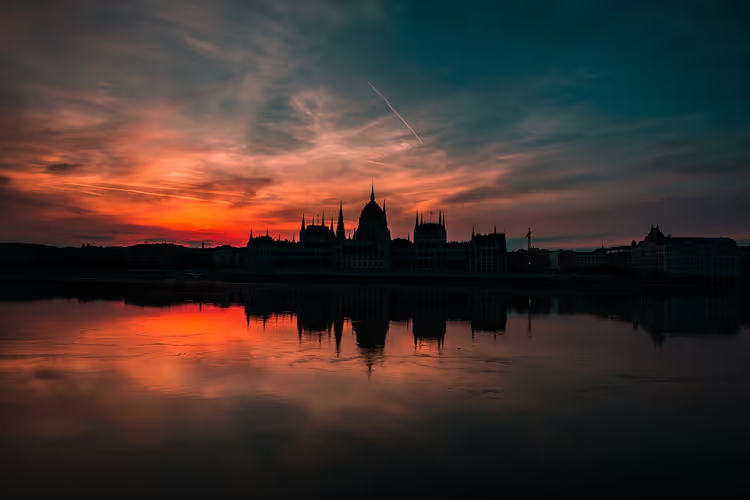
The best exterior view of the building is from the opposite bank and from the Buda castle wall.
The tour starts from Kossuth Square, where the ticket office is also located. The facade faces the Danube, so the whole building is only visible from the river.
St. Stephen's Basilica
St. Stephen's Basilica is considered the largest Catholic church in Budapest. It is almost one hundred meters tall. The basilica took several decades to build and was only consecrated in 1905. Believers come here to venerate the relics of Saint King Stephen.
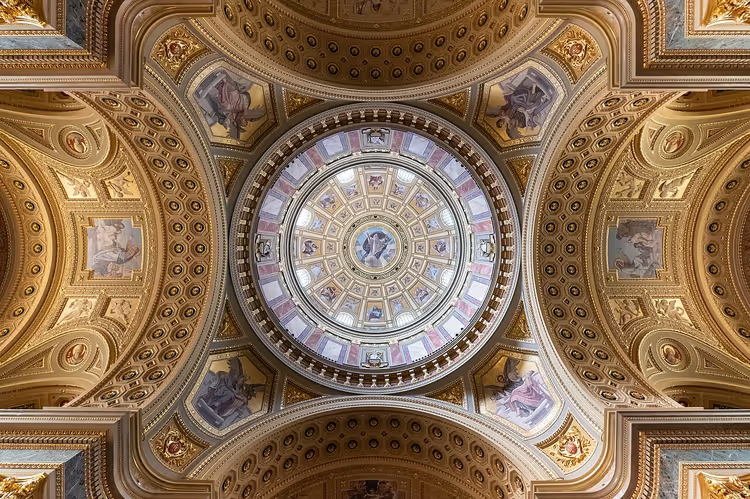 © Jules Verne Times Two · CC BY-SAPhoto: Jules Verne Times Two, CC BY-SA (https://creativecommons.org/licenses/by-sa/4.0), Wikimedia Commons
It's not only Catholics who go inside, but tourists as well. The church is open to visitors, and in the evening organ music is often performed here.
Organ concert at the Basilica on GetYourGuide
Great Synagogue
The Great Synagogue is one of the largest in Europe. It seats almost three thousand people, and the Jewish Museum is open in the courtyard. The synagogue was looted during World War II and restored by the end of the 20th century.
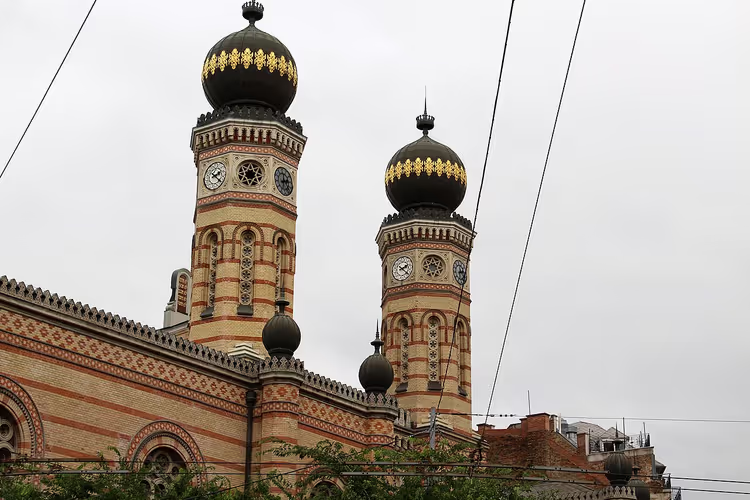 © Fred Romero from Paris, France · CC BYPhoto: Fred Romero from Paris, France, CC BY (https://creativecommons.org/licenses/by/2.0), Wikimedia Commons
The building stands in the Jewish Quarter, where narrow streets with bars and galleries have been preserved nearby.
Shoes on the Danube Bank
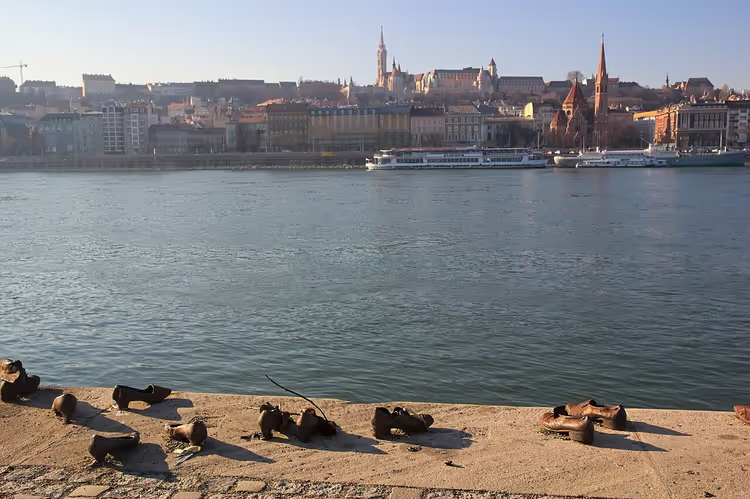
On the Danube embankment stands a memorial to the victims of the Holocaust. It is made up of dozens of metal shoes: men's, women's, children's. They were installed in memory of the people who were shot by the water during World War II. The names of the victims are engraved nearby.
 © Xosema · CC BY-SAPhoto: Xosema, CC BY-SA (https://creativecommons.org/licenses/by-sa/4.0), Wikimedia Commons
The monument moves even those who have seen many memorials. Visit it in the evening, when the embankment empties and the light becomes softer.
Gellért Hill
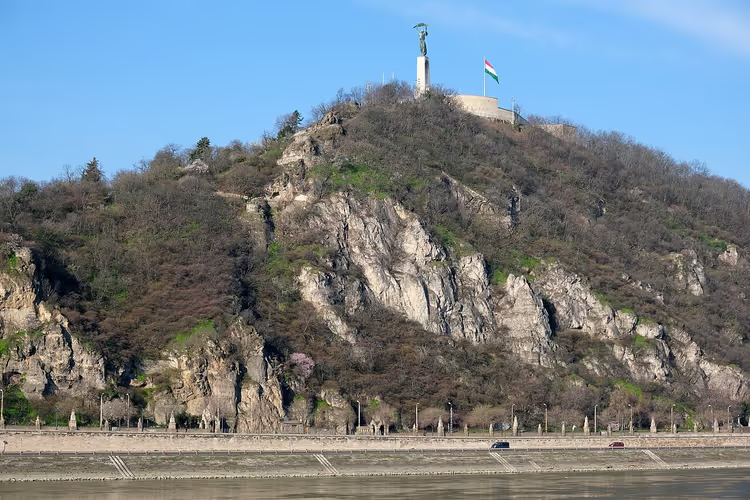
Gellért Hill is named after Saint Gellért, the patron saint of the city. At the top stand a 19th-century citadel and the Liberty Statue, which looks nothing like the American one. The Philosophers' Garden is also here, with sculptures of Jesus Christ, Buddha, and Akhenaten.
 © kallerna · CC BY-SAPhoto: kallerna, CC BY-SA (https://creativecommons.org/licenses/by-sa/4.0), Wikimedia Commons
Nearby is the sculptural composition "Buda Meets Pest" and a working cave church. Public transport does not go to the top; it only goes to the foot of the hill, and from there you walk. Metro M4 and buses stop at the foot of the hill.
Don't agree to street gambling games; card cheats operate here.
Brunswick Castle
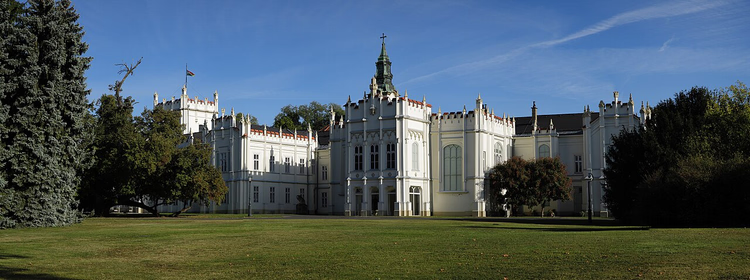
Thirty kilometers from Budapest stands Brunswick Castle. Both the castle itself and the park around it are beautiful. Most importantly, the castle is linked to the name of Ludwig van Beethoven, who often visited here. A memorial museum to the composer operates at Brunswick. You can get there by taxi.
 © Szvitek Péter · CC BYPhoto: Szvitek Péter, CC BY (https://creativecommons.org/licenses/by/2.5/hu/deed.en), Wikimedia Commons
Belváros and souvenirs
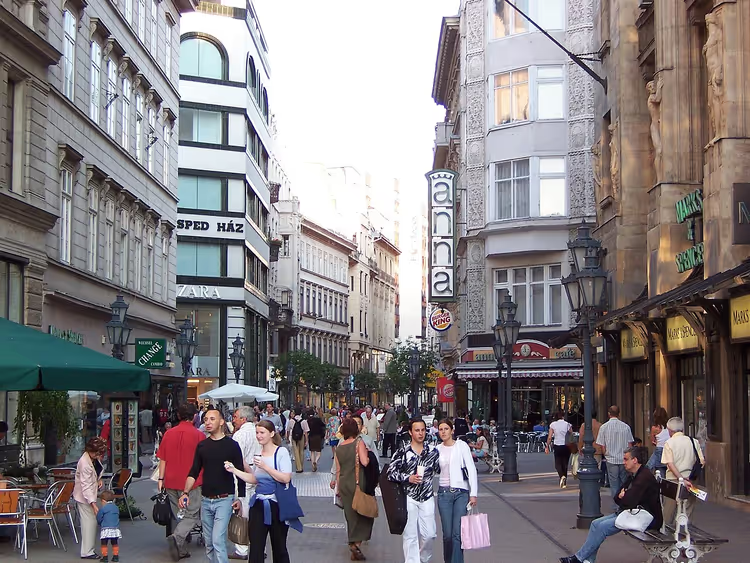
Belváros means "city within a city." This is the center of Pest, with souvenir shops and restaurants serving national cuisine. The Baroque Church of St. Michael also stands here, its clock tower rising above the neighboring buildings. Classical music concerts are regularly held in the church.
 © Unknown author · CC BY-SAPhoto: Unknown author, CC BY-SA (http://creativecommons.org/licenses/by-sa/3.0/), Wikimedia Commons
What to bring from Hungary: ground red paprika in small bags, Hungaria and Törley wines, smoked sausages. Handmade embroidery, woven goods, ceramics, porcelain, and marzipan figurines also make good gifts.
Baths
Baths are considered a calling card of Budapest. Besides Széchenyi, there are the Gellért Baths with artificial waves, Rudas, Király in Turkish style, as well as Lukács and Veli Bej. Choose the complex closest to your hotel.
 © Dennis G. Jarvis · CC BY-SAPhoto: Dennis G. Jarvis, CC BY-SA (https://creativecommons.org/licenses/by-sa/2.0), Wikimedia Commons
Prices vary by day and complex. In the morning there are fewer people in the baths, and you can swim almost alone.
Rudas is men-only for part of the week, which is worth considering when choosing. Each complex has its own rules for children, so check them before buying a ticket.
Full-day ticket to the Gellért Baths
Where to go on day four
If you have an extra day, choose Szentendre. It's an artists' town north of Budapest, served by a suburban train.
A day trip to Szentendre is convenient for those who don't want to deal with timetables.
3-Day Budapest itinerary on a map
All route points are collected on one map. Open it on your phone and follow the order.
What to see in Budapest in 3 days
Places on the map
- 1Chain Bridge Bridge across the Danube from Roosevelt Square to Adam Clark Square
- 2Holy Trinity Square Medieval castle square with the Holy Trinity Column
- 3Matthias Church Church in the middle of the castle, roof of colorful tiles
- 4Fisherman's Bastion Seven white stone towers and lookout terraces over the Danube
- 5Buda Castle Southern edge of the hill, museums and the Turul Bird column
- 6Heroes' Square Column of Archangel Gabriel and monuments to Hungarian princes
- 7Városliget (City Park) City park with a pond, avenues and museums
- 8Vajdahunyad Castle Replicas of Hungarian buildings from different eras, built in 1908
- 9Széchenyi Baths One of Europe's largest bathing complexes, in Városliget
- 10Andrássy Avenue UNESCO-listed avenue from Heroes' Square to Deák Square
- 11Hungarian State Opera House Neo-Renaissance building from 1884 with a hall for a thousand
- 12House of Terror Museum on the Nazi and communist regimes, ticket 4000 Ft
- 13Deák Ferenc Square End of Andrássy Avenue, express 100E from the airport stops here
- 14Hungarian Parliament Building Neo-Gothic building on the Pest embankment, inside only by tour
- 15St. Stephen's Basilica The city's largest Catholic church, about a hundred meters tall
- 16Great Synagogue One of the largest in Europe, with a Jewish Museum in the courtyard
- 17Shoes on the Danube Bank Holocaust memorial of iron shoes
- 18Gellért Hill Citadel, Statue of Liberty and Philosopher's Garden on top
- 19Rudas Baths Part of the week the complex is men-only
- 20Belváros (Inner City) Heart of Pest with souvenirs, restaurants and St. Michael's Church
- 21Brunszvik Castle Thirty kilometers from the city, a memorial museum to Beethoven
⁉️🤔 Frequently asked questions
How much money do you need for three days in Budapest?
A transport ticket costs 500 Ft per ride, a 24-hour pass costs 2,750 Ft (as of 09/2026, BKK tickets and passes). A day ticket to the Széchenyi Baths starts at 13,200 Ft. Add museum tickets and food. The total depends on how many baths and museums you choose.
How to get from the airport to the center?
Bus 200E runs from Terminal 2 to Kőbánya-Kispest metro station and costs 500 Ft (as of 09/2026, BKK timetable). Express 100E takes you directly to Deák Square for 2,500 Ft. A taxi is more expensive, but drops you off at your hotel door.
Is the Budapest Card worth buying?
A 24-hour card costs 17,990 Ft, a 72-hour card costs 29,990 Ft (as of 09/2026, Budapest Card terms). It pays off if you plan to visit several museums and take many trips. The pass, museum entries, and discounts add up to a significant amount.
When is the best time to visit Budapest?
The baths operate year-round, so the city works for a trip in any season. In summer, viewpoints and baths are crowded, so arrive at opening time. In spring and autumn, walking up the hill is more comfortable and lines are shorter.
What to see in Budapest for free?
The Fisherman's Bastion terraces, Heroes' Square, the Danube embankment with the Shoes memorial, and the climb up Gellért Hill are all free. You only pay for the upper bastion towers, museums, and baths.
In short: what to book
In three days you'll cover both banks and spend almost no time on transfers. Bath and tour tickets are best booked in advance: slots sell out in summer.
- If you want to relax after walking: get a day ticket to the Széchenyi Baths.
- If you're traveling with kids: a Danube boat cruise is a good fit.
- If it's your first time in the city: take a hop-on hop-off bus on day one.

A small editorial team writing guides for independent travel. We travel ourselves, but we haven’t been everywhere, so we check prices, opening hours and how to get there against official sources.