
















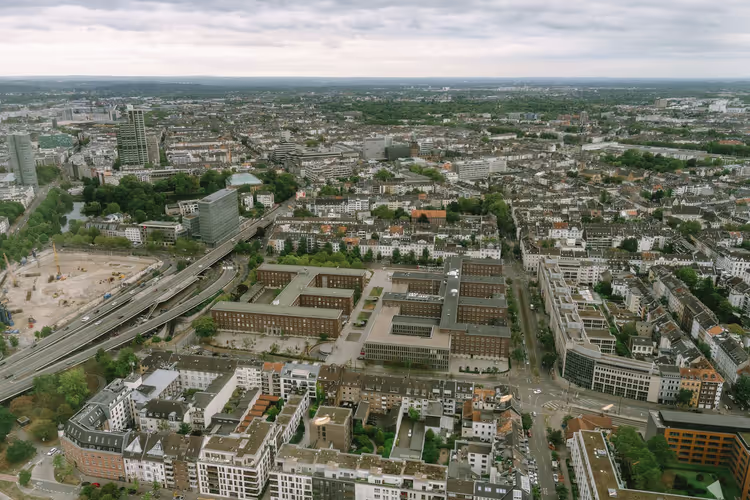
Dusseldorf in one day: 20 places from Schloss Benrath to Neanderthal Museum
Düsseldorf is more compact than it seems: the historic center can be walked in half a day. In one day you can see the Altstadt, a couple of museums, and go up the Rheinturm. The main mistake visitors make is trying to cover everything and spending the day on the tram.
We have put together 20 places: from Schloss Benrath in the south of the city to the Neanderthal Museum in Mettmann. You cannot cover all of them in one day, so pick the main ones according to the plan below. It is more convenient to buy museum tickets in advance, online.
Ad: this article contains affiliate links, we earn a commission if you book through them, at no extra cost to you.
What to fit in during one day in Düsseldorf
💡 In short:
- Start with the Altstadt: Königsallee, Altes Rathaus, and Basilika St. Lambertus are close together.
- In the afternoon, pick one or two museums: Kunstpalast or Goethe-Museum.
- End the day at the Rheinturm observation deck and a walk along the Rheinuferpromenade.
- Prices and opening hours: 09/2026, checked on the official tourist office website
The city is divided into two parts, and this simplifies your plan. The old Altstadt on the right bank of the Rhine can be fully explored on foot. The modern quarters around MedienHafen are also close to the center.
The outlying sights, Schloss Benrath and the Neanderthal Museum, are best placed at the edges of the day. Otherwise you will lose an hour on travel and return to the center tired.
Time of day | What to see | How much time |
|---|---|---|
Morning | Altstadt and the promenade | two or three hours |
Afternoon | Kunstpalast and Goethe-Museum | about three hours |
Evening | Rheinturm and Rheinuferpromenade | two hours |
This rhythm leaves you a break for lunch and does not turn the walk into a race. If you are in the city for the first time, stick to this order: it leads from the station through the center to the Rhine.
How to get from the airport to the center
Düsseldorf Airport sits right within the city limits, just seven kilometers from the historic center. All three terminals A, B, and C are under one roof, so you can walk between them. The free Sky Train connects the terminals with the parking area and the railway station and runs every few minutes.
The fastest way to the center is the S-Bahn. The station is at Terminal C, and the ride to the main station takes about twelve minutes. Buy your ticket from the machine on the platform and select Düsseldorf Hbf as your final stop. The price depends on fare zone A (as of: 09/2026, Rheinbahn).
Buses leave from a stop near the main airport hall, but they take longer to reach the station than the train. Taxis operate around the clock, and at night they remain the only alternative to bus routes. A taxi ride will cost noticeably more, but it will take you right to your hotel door.
If you are arriving with a lot of luggage or on a late flight, you can book an airport transfer to your hotel in advance. The driver will meet you in the arrivals hall and take you straight to the hotel.
Tours and tickets in Dusseldorf
Guided tours, skip-the-line tickets and activities — most offers can be cancelled free of charge.
See offers on KiwitaxiThe widget loads once you give your consent.
Schloss Benrath and its park
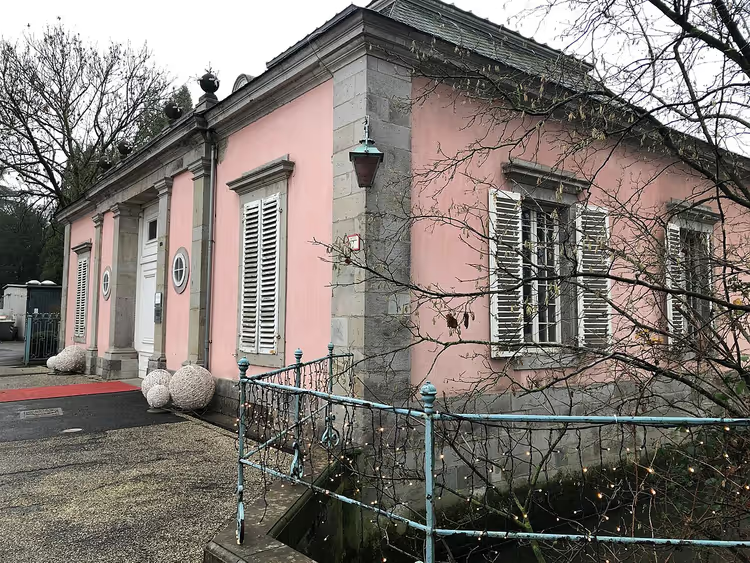 © Velopilger · CC BY-SAPhoto: Velopilger, CC BY-SA (https://creativecommons.org/licenses/by-sa/4.0), Wikimedia Commons
Schloss Benrath stands on the bank of the Rhine in the southern part of the city, on Benrather Schloßallee. The elegant palace was built in the second half of the 18th century for Elector Carl Theodor. The design was done by a French architect who combined fashionable rococo with details of the emerging neoclassical style. Next to the palace lies a large park in the French-English spirit.
The main building looks like a pavilion with a dome and side wings. Inside you will see wall paintings, marble decoration, statues, and paintings of the seasons. Separate halls house a natural history museum and the Museum of European Garden Art, so one hour will definitely not be enough.
- How to get there: take the S-Bahn to Benrath station, then walk along Benrather Schloßallee (see map).
- Cost: admission is paid, check the exact price on the official website.
- Opening hours: Tue-Sun from 10:00 to 18:00 in the warm season and from 11:00 to 17:00 in winter (as of: 09/2026, Stiftung Schloss und Park Benrath).
- The catch: the palace is closed on Mondays, and the park will take up additional time.
Rheinturm and the view over the city
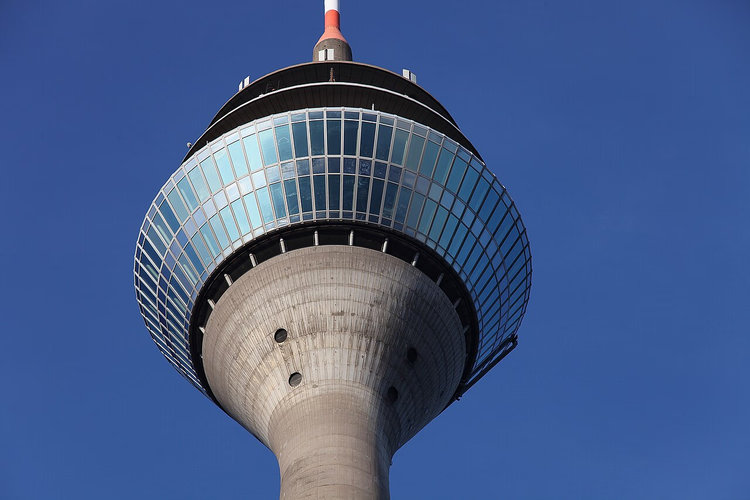 © Rick Ligthelm from Rotterdam, The Netherlands · CC BYPhoto: Rick Ligthelm from Rotterdam, The Netherlands, CC BY (https://creativecommons.org/licenses/by/2.0), Wikimedia Commons
The Rheinturm on the promenade rises 240 meters and remains the tallest structure in the city. The observation deck is at a height of 168 meters, and one floor above, the QOMO restaurant rotates (as of: 09/2026, Rheinturm website). The elevator takes you to the top in a matter of seconds.
The glass on the deck is tilted, and you can lean against it to take in the panorama from a comfortable angle. In clear weather, the view reaches as far as Cologne Cathedral. In the evening, the city below you glows with lights, and this is the best way to end the day.
The tower's special pride is the world's largest illuminated clock. The time is read from top to bottom: first hours, then minutes and seconds. You will not find this detail anywhere else.
- Cost: the tower climb is paid; check the current price on the tower website.
- Getting there: take the tram to the Rheinturm stop, then walk along the embankment (see map).
Königsallee: the city's main boulevard
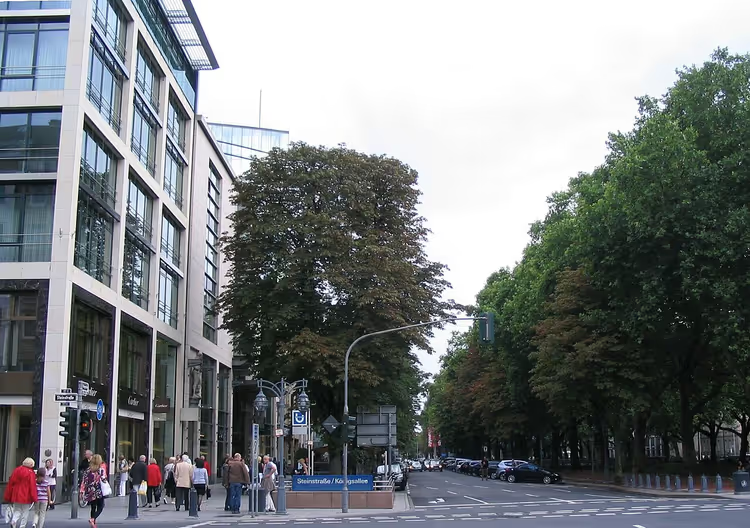
Königsallee runs north to south alongside the Altstadt. It is a wide boulevard lined with chestnut trees and split down the middle by a canal. The boulevard is a convenient place to start exploring the city if you arrive by train: it is a short walk from the main station.
Boutiques of famous fashion houses line both sides, which is why Königsallee is popular with shoppers. The Theatermuseum, the Deutsche Oper am Rhein, and the Schauspielhaus are also located here. Small bridges over the canal and wrought-iron benches invite you to linger for a few minutes.
If you are short on time, walk along the canal and then turn into the side streets of the Altstadt. That way you can see both the shop windows and the old streets in one go.
- Getting around: a sightseeing bus loops past the main sights; a hop-on hop-off ticket is a convenient option for the whole day.
Bismarck-Denkmal on Lutherplatz
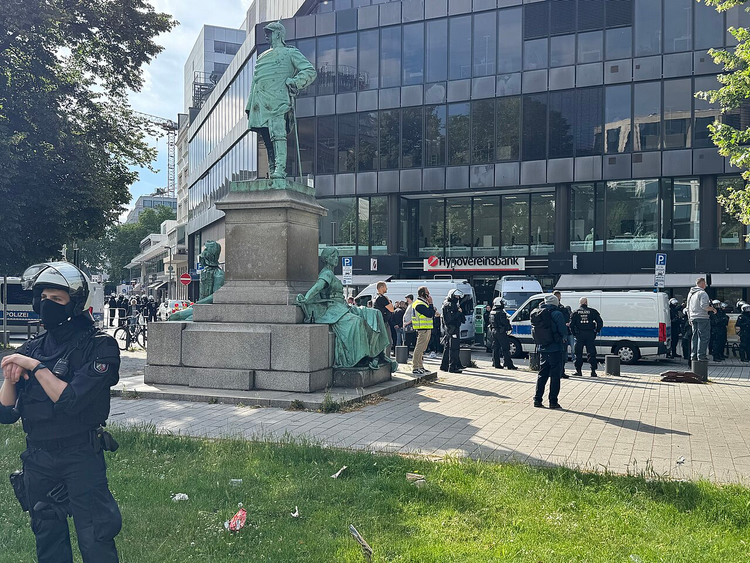
The copper Bismarck-Denkmal on Lutherplatz was erected in the late 19th century. It honors Otto von Bismarck, the first chancellor of the German Empire, who was nicknamed the "Iron Chancellor." The monument was unveiled next to a statue of Emperor Wilhelm I, whom the chancellor served loyally.
The chancellor stands at full height, leaning on a sword and looking forward. On the sides of the pedestal you will find two sculptures. A warrior holds a bundle of oak logs, a symbol of German unification, while a female figure with a hammer and an anchor at her feet personifies Germany itself.
The ensemble is completed by the neo-Gothic Johanneskirche. Together they make a convenient stop on the way to Königsallee, and the visit takes about ten minutes.
- Getting there: Lutherplatz, between the Altstadt and Königsallee, on foot (see map).
Tritonbrunnen on the canal
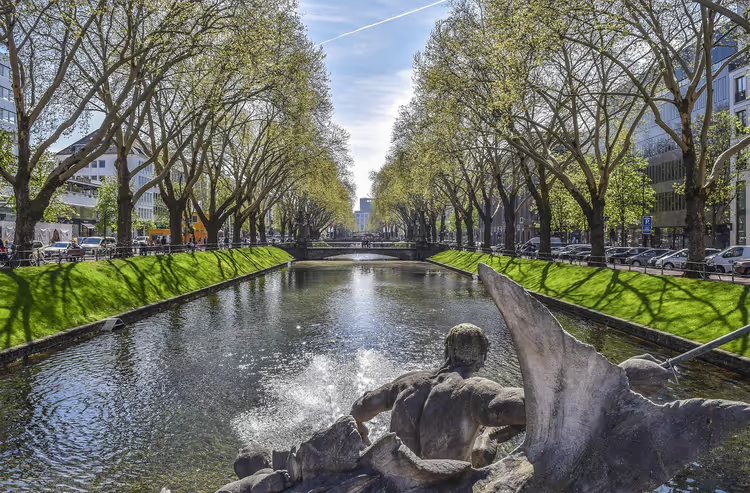
The Tritonbrunnen has adorned the northern end of the canal on Königsallee since the early 20th century. At the center of the composition, the sea god Triton drives his trident into the body of a huge sharp-toothed fish. Behind him, children hide from the monster, and their stone faces show fear.
The bench by the fountain is carved from the same stone as the sculpture itself. Tourists like to take photos at the Tritonbrunnen and watch the fish in the water. For you, it is a short but essential stop along the boulevard.
- Getting there: northern end of the canal on Königsallee, on foot from the Altes Rathaus (see map).
Neanderkirche in the Altstadt
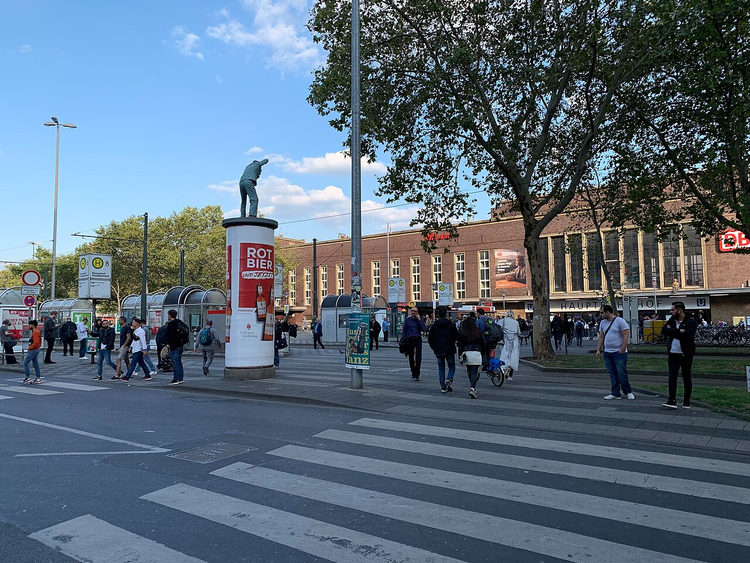
Neanderkirche stands back from Bolkerstraße, in the very heart of the Altstadt. The Protestant church was built in the late 17th century in the Baroque style. The building is small, with a tall central tower and attached wings on the sides.
 © Robot8A · CC BY-SAPhoto: Robot8A, CC BY-SA (https://creativecommons.org/licenses/by-sa/4.0), Wikimedia Commons
On the tower you will be greeted by a clock with an imposing dial. Inside it is bright and elegant: stucco on the vaults, walls, and columns, with statues of saints along the walls. The church is known for its unusual organ, built by Austrian craftsmen.
Both parishioners and tourists attend the organ concerts. Admission is free, so you can stop in for literally ten minutes.
- Getting there: walk along Bolkerstraße from Königsallee, about ten minutes (see map).
- Hours: Tue-Sat 10:00 to 18:00, free admission (as of 09/2026, tourist office website).
Monument to the city's 700th anniversary
On Burgplatz square stands a bronze monument to the 700th anniversary of the city's founding. It was created by sculptor Bert Gerresheim, and the composition consists of 17 historical scenes (as of 09/2026, city portal). The scenes read from left to right, like pages of a city chronicle.
At the center is a charter with the seals of Count Adolf von Berg, next to a shield with the "Lippe rose," the Berg lion, and an anchor. On the left, peasant militiamen and knights fight; on the right, a monk holds a reliquary with the relics of Saint Apollinaris. Modern objects are also woven into the triptych, symbolizing the connection between generations.
The monument stands right by the Rhine, so it's easy to see on the way to the Schlossturm. It will take you about five minutes.
- Getting there: Burgplatz between Altes Rathaus and Schlossturm, on foot (see map).
Altes Rathaus on Marktplatz
 © Helmlechner · CC BY-SAPhoto: Helmlechner, CC BY-SA (https://creativecommons.org/licenses/by-sa/3.0), Wikimedia Commons
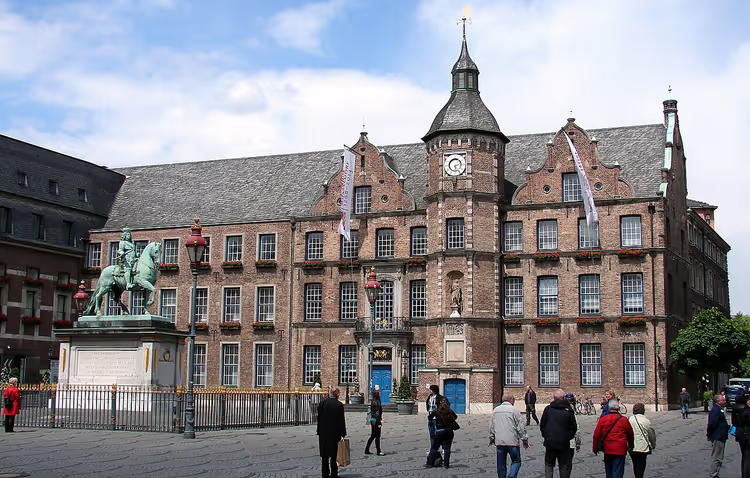
Altes Rathaus on Marktplatz square is recognizable by its red brick and the ivy on the facade. The ensemble consists of three buildings constructed at different times. That's why the building's appearance mixes late Gothic, Baroque, and Neo-Renaissance styles.
The central building dates back to the 16th century and has served as the mayor's workplace for several centuries. The Gothic octagonal tower with a statue, clock, and ornate gables on the pediments draws the eye. In the 18th century, the facade was decorated with pilasters and a balcony above the main entrance.
Inside, you'll find a portrait gallery of former mayors and a Goethe memorial room with a bust of the poet. You can only enter the town hall with a guided tour. Tours are held on Wednesdays at 3:00 PM (as of 09/2026, town hall information).
- Getting there: one block along the embankment from Schlossturm to the northwest (see map).
- The catch: you can't explore on your own; you can only get inside with a group.
Maximiliankirche and its organ
 © Maxplatz · CC BY-SAPhoto: Maxplatz, CC BY-SA (https://creativecommons.org/licenses/by-sa/3.0), Wikimedia Commons
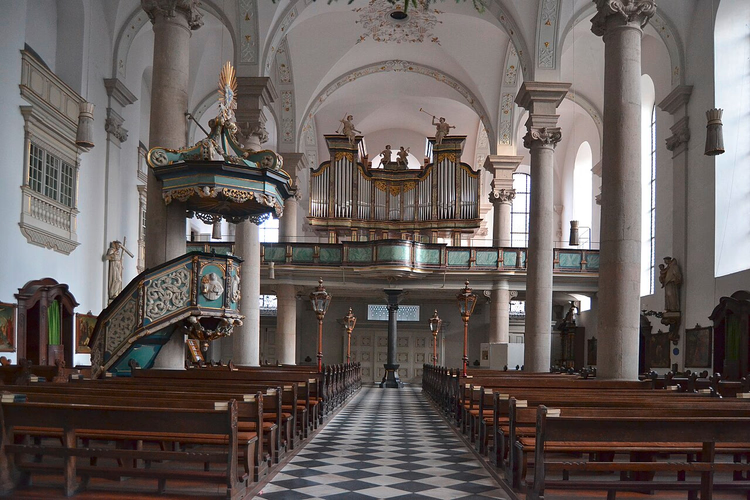
Maximiliankirche was founded by Franciscan monks in the mid-17th century. The church played a notable role in the city's spiritual life. A theological school operated alongside it, and the parish school still operates today. The poet Heinrich Heine attended this school.
People come here to hear the extraordinarily beautiful organ, decorated with figures of music-making angels. In the 19th century, Felix Mendelssohn Bartholdy and Robert Schumann played here at masses. The interior impresses with paintings by Rubens and other artistic masterpieces.
In an unassuming chapel of the church, you'll see the icon "Madonna with the Merciful Eyes" by Rubens. The church is open all week from 10:00 AM to 5:00 PM (as of 09/2026, tourist office data). Evening masses are held on Saturdays and Sundays at 6:00 PM.
- Getting there: by tram to the Benrather Straße stop, then on foot (see map).
Goethe-Museum in Schloss Jägerhof
 © Jörg Wiegels · CC BY-SAPhoto: Jörg Wiegels, CC BY-SA (https://creativecommons.org/licenses/by-sa/3.0), Wikimedia Commons
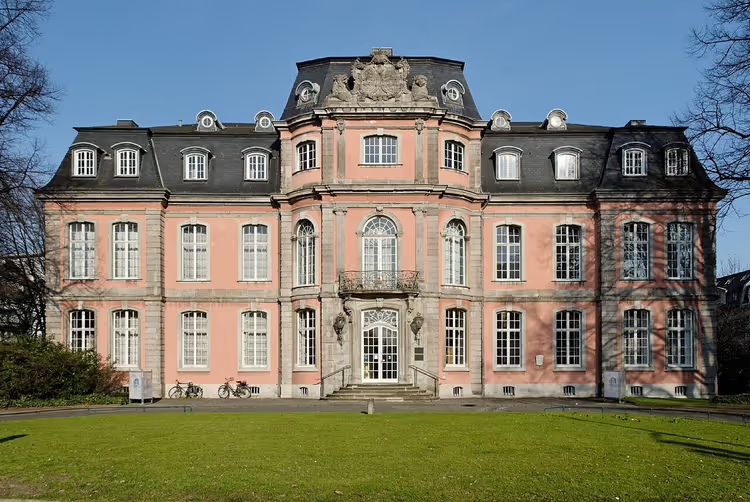
Goethe never lived in Düsseldorf, but a museum dedicated to him opened in the mid-20th century in the elegant Schloss Jägerhof. The Rococo palace was built in the mid-18th century. It adorns Jacobistraße across from Hofgarten park.
When the poet visited the city, he stayed at the Jacobi family home not far from the palace. That's why the authorities decided to open the museum here. The core of the exhibition came from the private collection of Leipzig publisher Anton Kippenberg, which his heirs gave to the city.
In the halls, you'll see over 50,000 18th-century exhibits: paintings, medals, busts, coins, manuscripts, and letters. Separately stored are 17,000 books and 3,000 pieces of sheet music (as of 09/2026, official city information). Of particular value is the collection of minerals that Goethe collected himself. The "Faust" hall is dedicated to illustrations by Peter Cornelius, lithographs by Delacroix, and etchings by Salvador Dalí.
- Cost: you can easily compare tickets to the city's museums on Tiqets.
- Hours: Tue-Fri and Sun from 11:00 AM to 5:00 PM, Sat from 1:00 PM to 5:00 PM (as of 09/2026, city data).
Kunstpalast: museums on Ehrenhof
 © Paul Hermans · CC BY-SAPhoto: Paul Hermans, CC BY-SA (https://creativecommons.org/licenses/by-sa/3.0), Wikimedia Commons
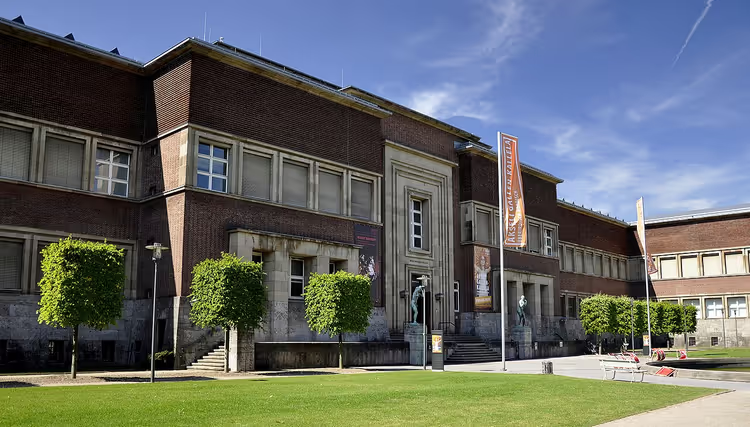
On Ehrenhof square stands a U-shaped building from the early last century in the Expressionist style. It houses Kunstpalast, one of Germany's significant museums. The core of the collection was established with works by Elector Johann Wilhelm of the Palatinate and his wife Anna de' Medici.
Today the collection holds almost 100,000 exhibits: paintings, sculpture, prints, glass, and contemporary art (as of 09/2026, Kunstpalast). In the picture gallery, Rubens' "Venus and Adonis" and "The Assumption of the Virgin" are especially valuable.
The prints room displays 70,000 works from the 15th to the 20th century, including sheets by Raphael, Michelangelo, and Veronese. A separate exhibition shows crystal and glass used by monarchs and nobility.
- Hours: Tue-Sun 11:00 to 18:00, closed Mondays (as of 09/2026, official website).
- Admission: the DüsseldorfCard gives you museum discounts and free public transit.
Schlossturm and the shipping museum
 © Sascha Brück · CC BY-SAPhoto: Sascha Brück, CC BY-SA (http://creativecommons.org/licenses/by-sa/3.0/), Wikimedia Commons
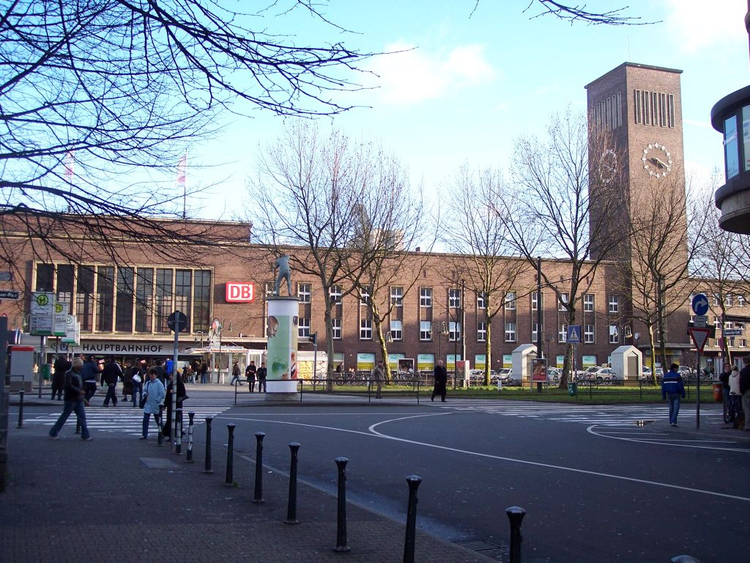
When Düsseldorf received its town charter in 1288, construction began on a castle with Burgplatz square inside. Over the centuries fires destroyed it, and the last one, in the 19th century, wiped out the fortress completely. Only the Schlossturm, built in the 14th century, survived from the castle.
Today the tower houses the museum of the history of shipping on the Rhine. It displays more than 120 models of boats and steamships, from ancient times to the present day (as of 09/2026, city portal). The museum is open from 11:00 to 18:00.
In the tower's "Lantern" you can relax in a panoramic restaurant. From there you get a 360-degree view of the Altstadt, the embankment, and the Rheinturm.
- Getting there: Burgplatz on the Rhine, a short walk from Altes Rathaus (see map).
Basilika St. Lambertus

Basilika St. Lambertus is the oldest building in Düsseldorf. Its history begins with a small chapel built where the Düssel river flows into the Rhine. Seven centuries later, the basilica on Stiftsplatz draws the eye with its portal sculptures.
One portal shows Golgotha with the crucified, another depicts the Battle of Worringen. Inside, the church impresses with its baroque altar, a statue of the Virgin Mary on a column, and 15th-century murals.
The basilica's revered relics include those of Saint Apollinaris of Ravenna, the city's patron saint. The basilica is open daily from 9:00 to 18:00 (as of 09/2026, tourist office guide). You can get there by subway, getting off at Heinrich-Heine-Allee station.
- The catch: during services, tourist access is limited.
Hofgarten: a park in the city center
 © Remi Mathis · CC BY-SAPhoto: Remi Mathis, CC BY-SA (https://creativecommons.org/licenses/by-sa/3.0), Wikimedia Commons
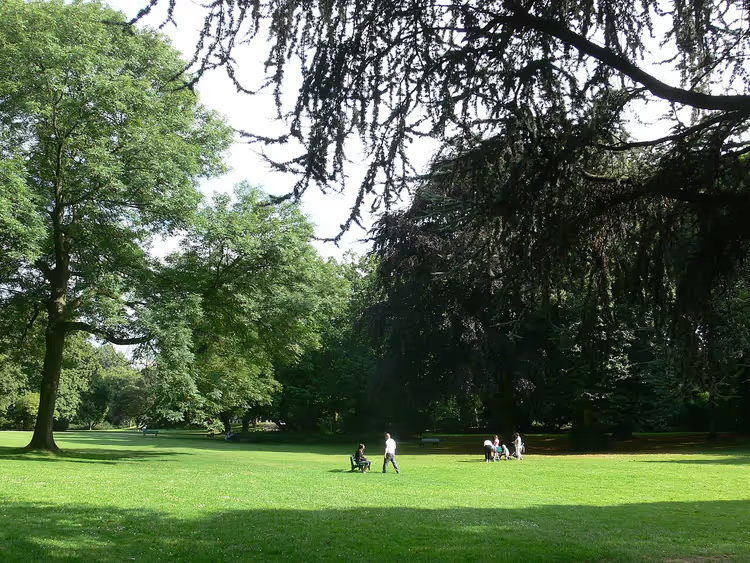
The Hofgarten was founded in the 18th century, and today it is the city's central park. It is laid out in the English style with late baroque forms. At the entrance you are greeted by a monument to the painter Peter Cornelius.
Further on, shady paths lead to ponds with black swans and cozy spots for relaxing. It's a pleasant place to watch green parakeets and tame squirrels. On summer evenings, the path to the hunting lodge is lit with neon, and the atmosphere becomes completely different.
The paths are decorated with sculptures of heroes and events from past eras. Fountains and the shore of the Landskrone pond add special charm to the landscape.
- Getting there: by tram to the Sternstraße stop, then walk (see map).
Tonhalle: concert hall
 © Lyzzy · CC BYPhoto: Lyzzy, CC BY (https://creativecommons.org/licenses/by/2.5), Wikimedia Commons
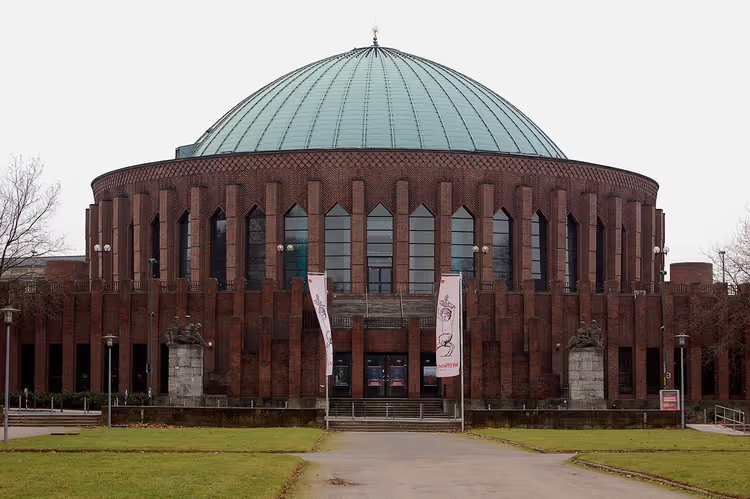
The Tonhalle doesn't look like a typical philharmonic hall. The building was constructed in the 1920s as a planetarium, designed by architect Wilhelm Kreis. After the war it was converted into a concert hall, preserving the central dome.
The dome glows from within like a precious stone and is considered a masterpiece of modern art. In the center hangs a chandelier with many mirrors, created from sketches by artist Adolf Luther. The spacious foyer with its mosaic floor is flooded with light from original fixtures.
The Tonhalle hosts symphony orchestras, opera stars, and pop performers. The hall has even been nicknamed the "Colosseum of the 20th century."
- Getting there: by subway to Tonhalle/Ehrenhof station, then walk (see map).
Sternwarte Düsseldorf-Bilk
 © Velopilger · CC BY-SAPhoto: Velopilger, CC BY-SA (https://creativecommons.org/licenses/by-sa/4.0), Wikimedia Commons
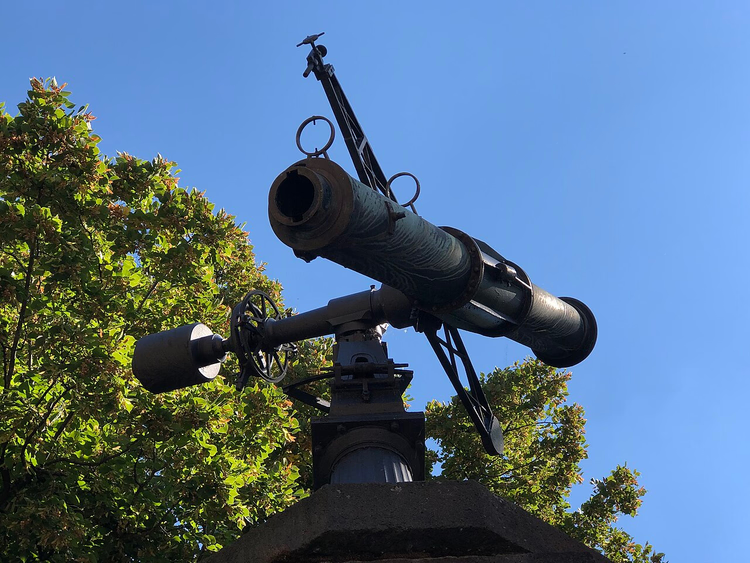
Sternwarte Düsseldorf-Bilk was founded by Johann Friedrich Benzenberg and began operating in the mid-19th century. Three years after the founder's death, the observatory became city property. Stars were observed here first with a long-focus refractor and later with a powerful equatorial telescope by Carl Bamberg.
Using these telescopes, 24 asteroids were discovered in the 19th century (as of 09/2026, city archive). Astronomers called them the "24 Düsseldorf planets." One asteroid was named Bilk in honor of the observatory.
During World War II, the building burned down in a bombing raid. Today, a tall monument in the shape of a burned telescope stands on the site of the observatory on Bachstraße (as of 09/2026, municipal data).
- Getting there: Bilk district south of the center, take the subway to Auf'm Hennekamp station (see map).
Golzheimer Friedhof: a historic cemetery
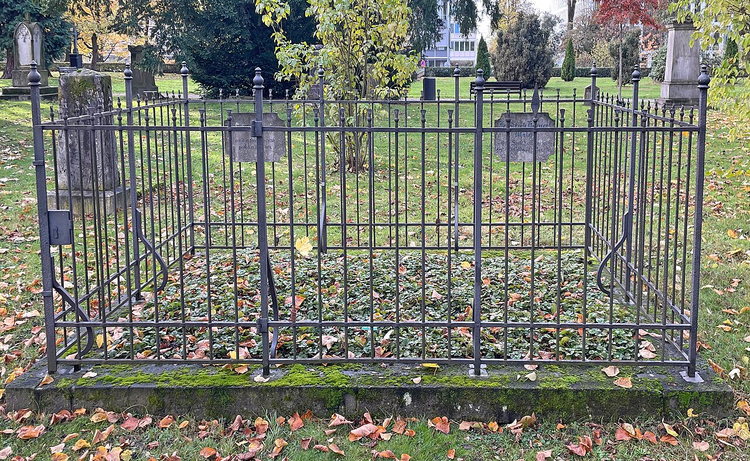
Golzheimer Friedhof lies in a picturesque landscaped area in the north of the city. This burial ground with more than 50,000 graves is called the history book of Düsseldorf (as of 09/2026, municipal portal). Most of the gravestone sculptures are over a century old.
Nearby you will see the graves of the cultural and political elite, as well as the Riemenschneider family mausoleum. At the main entrance, not far from the Theodor-Heuss-Brücke bridge, stands a neo-Gothic chapel. It marks the start of a scenic walk and also serves as your landmark.
- Getting there: take the subway to Theodor-Heuss-Brücke station, then about 700 meters on foot (see map).
- The catch: this is a cemetery, not a park, so behave accordingly. Burials stopped here in 1897.
Aquazoo Löbbecke Museum
 © Helfmann · CC BY-SAPhoto: Helfmann, CC BY-SA (https://creativecommons.org/licenses/by-sa/3.0), Wikimedia Commons
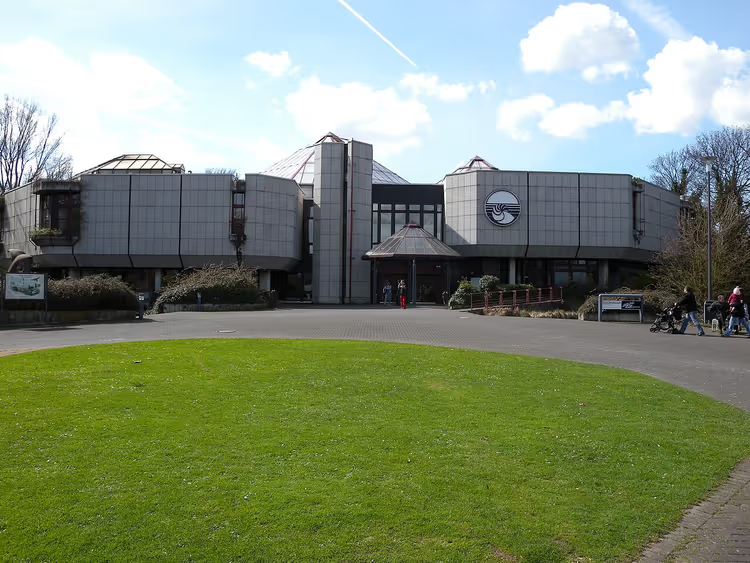
Aquazoo Löbbecke Museum is a single complex in Nordpark. The aquariums are home to fish, reptiles, sharks, and turtles. Sea lions and penguins have taken a liking to the shorelines, which are protected from visitors. A tropical forest, terrariums, and aquariums are all under one roof, so the weather won't get in your way.
In the terrariums you can observe snakes and other reptiles. In the tropical forest, hummingbirds and bright butterflies fly overhead, while crocodiles doze in the lakes.
The Löbbecke museum collection includes more than 250,000 mollusks and 650,000 insects from around the world (as of 09/2026, Aquazoo). The themed halls trace the evolution of the animal kingdom and showcase the natural habitats of animals. The complex is open every day from 10:00 to 18:00, so you can easily plan your day in Düsseldorf around it.
- Getting there: take the subway to Aqua-Zoo stop, then walk (see map).
Rheinuferpromenade
 © Островский Александр, Киев · CC BY-SAPhoto: Островский Александр, Киев, CC BY-SA (https://creativecommons.org/licenses/by-sa/3.0), Wikimedia Commons
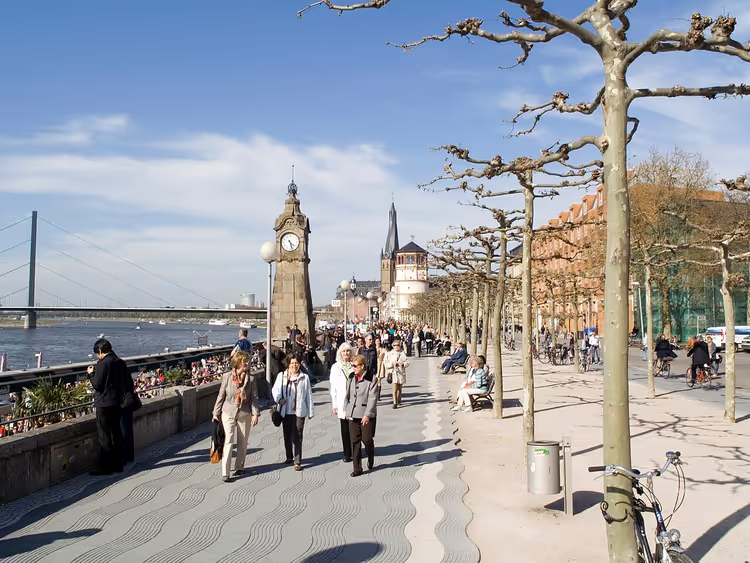
Rheinuferpromenade stretches for two kilometers along the right bank of the Rhine. The promenade passes through the Altstadt, Carlstadt, and Unterbilk districts. It was laid out at the end of the last century and is considered the country's best example of urban planning (as of 09/2026, city tourist office).
North of the Oberkasseler Brücke, the embankment leads to the Tonhalle. To the south begins a two-level section with an avenue and a "living roof" of interwoven trees. Further on, you come out onto Burgplatz with a balcony overlooking the lower embankment, the river, and both bridges. The Rathaus section of the promenade runs from Burgplatz to Bäckerstraße and the former harbor. This is where Altes Rathaus and the equestrian monument to Elector Johann Wilhelm stand on Marktplatz.
This stretch is home to the Schlossturm and the Ferris wheel. The southernmost part of the promenade is considered a respectable area: it is home to the state parliament of North Rhine-Westphalia and the Rheinturm next to a modern glass building. Near the tower, an unusual building that resembles a block of ice draws attention. You can reach the embankment by subway, getting off at Heinrich-Heine-Allee station.
- How to get there: take the subway to Heinrich-Heine-Allee, then walk toward the Rhine (see map).
Neanderthal Museum in Mettmann
 © Heiko Tomaszewski -- Darkstar1970 20:01, 19 August 2007 (UTC) · CC BY-SAPhoto: Heiko Tomaszewski -- Darkstar1970 20:01, 19 August 2007 (UTC), CC BY-SA (http://creativecommons.org/licenses/by-sa/3.0/), Wikimedia Commons
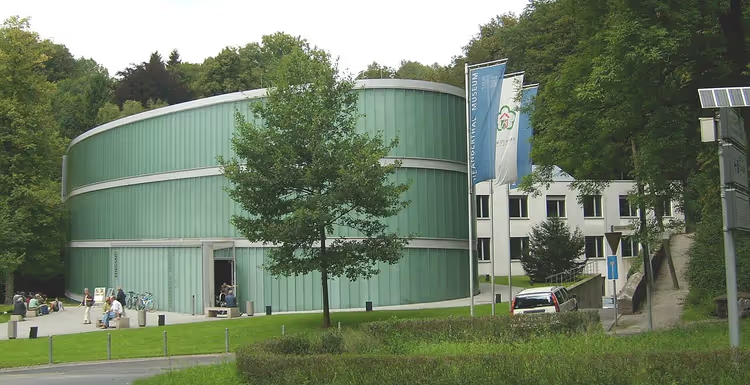
The Neanderthal Museum came about thanks to excavations in the Düssel river valley. In the mid-19th century, a cave with the remains of an ancient human was found here. The museum itself opened in the 1990s near this site, deep in the forest between Erkrath and Mettmann (as of 09/2026, Neanderthal Museum).
The main exhibition is arranged in a spiral and shows the stages of human development. Digital and 3D technologies recreate everyday scenes of Neanderthals, their tools, and dwellings. You will see life-size figures of ancient ancestors dressed in modern-day clothing.
In a workshop designed like the Stone Age, you can take part in hands-on classes. A separate trail leads to the cave where traces of ancient human presence were found. Inside, you enter a Neanderthal dwelling recreated through an installation.
From the main train station, take the S-Bahn toward Hagen to the Hochdahl stop, then walk for about fifteen minutes. A second option: take the S-28 train to Neanderthal station and walk another seven minutes.
- Hours: Tue-Sun 10:00 to 18:00, cave entry until 17:00 in summer and 16:00 in winter (as of 09/2026, official website).
Düsseldorf route on the map
Below, the entire route is put together on one map to make it easier to orient yourself throughout the day. The logic is this: morning in the Altstadt, museums in the afternoon, Rheinturm and the embankment in the evening. Mark a couple of points in advance and you will barely need your phone.
What to see in Düsseldorf in 1 day
Places on the map
- 1Schloss Benrath Rococo-style palace from the 18th century with a park in the south of the city
- 2Rheinturm Viewing platform at 168 meters, revolving restaurant QOMO
- 3Königsallee The city's main boulevard with a canal and boutiques
- 4Bismarck-Denkmal Monument to the chancellor on Lutherplatz
- 5Tritonbrunnen Fountain with Triton at the northern end of the canal
- 6Neanderkirche Baroque Protestant church on Bolkerstraße
- 7Monument to the city's 700th anniversary Bronze composition of 17 historic scenes on Burgplatz
- 8Altes Rathaus Town hall on Marktplatz, a blend of Gothic, Baroque and Neo-Renaissance
- 9Maximiliankirche Franciscan church with an organ and paintings by Rubens
- 10Goethe-Museum Museum in Schloss Jägerhof, the Anton Kippenberg collection
- 11Kunstpalast Painting, sculpture and glass at Ehrenhof
- 12Schlossturm Surviving 14th-century castle tower, now a shipping museum
- 13Basilika St. Lambertus The city's oldest building on Stiftsplatz
- 14Hofgarten Central park in English style with ponds and swans
- 15Tonhalle Concert hall in the former planetarium building with a glowing dome
- 16Golzheimer Friedhof Historic cemetery with 19th-century gravestones
- 17Aquazoo Löbbecke Museum Aquarium, terrarium and tropical forest in Nordpark
- 18Neanderthal Museum Museum of the Neanderthal find in Mettmann, out of town
⁉️🤔 Frequently asked questions
How much does the DüsseldorfCard cost and what does it include?
The card works as a transit pass for buses and trains in Düsseldorf and the surrounding area. It gives free or reduced admission to dozens of museums, as well as discounts on tours and city walks. The 24, 48, and 72-hour options differ in price, so check current prices on the tourist office website (as of 09/2026, visitduesseldorf.de).
Can you walk the entire route on foot in one day?
You can cover the center on foot without any problem: Königsallee, Altes Rathaus, and Basilika St. Lambertus are only a couple of blocks apart. Schloss Benrath and the Neanderthal Museum are far from the center, so it is more convenient to take the S-Bahn there and back. The trip will take you about an hour each way.
Which museums are closed on Mondays?
Kunstpalast and the Goethe-Museum are closed on Mondays, as is Schloss Benrath palace. Plan these sights for another day of the week or change the order. Aquazoo Löbbecke Museum is open every day, so you can dedicate Monday to it.
Is it better to go up the Rheinturm during the day or in the evening?
During the day you get a better view of the city and the Rhine, and in clear weather the panorama stretches far beyond the horizon. In the evening, the tower turns into a viewing platform with lights, and it makes a great finale to your walk. If the weather is overcast, it is better to postpone the ascent: haze will block the view.
What to do in Düsseldorf with kids?
Kids usually enjoy the Aquazoo Löbbecke Museum with its sharks, penguins, and tropical forest. In the Hofgarten you can see black swans and tame squirrels. Another option: the Neanderthal Museum with its Stone Age workshop and cave.
In short: what to book
The one-day route is built around the center, so it is more convenient to book a hotel between the Altstadt and Königsallee. If you are short on time: take a hop-on hop-off bus for the whole day and one museum. If you are traveling with kids: choose the Aquazoo Löbbecke Museum and the Hofgarten.
For a family trip: hotels in central Düsseldorf. For a first visit: tours and tickets. Check opening hours before heading out, and the route will come together without rushing.

A small editorial team writing guides for independent travel. We travel ourselves, but we haven’t been everywhere, so we check prices, opening hours and how to get there against official sources.