
















Where to go from Rimini for 1 day: 10 cities and routes
From Rimini, it's easy to head inland into Italy for a day. Regional trains and buses run along the coast almost every hour, so you don't need a car. The only question is where exactly to go and what you can fit in before evening.
In a day from Rimini, you can realistically see the Byzantine mosaics of Ravenna, the ducal Urbino, or independent San Marino. The trip to Bologna takes about an hour, and a Regionale ticket costs in the low double digits (as of 09/2026, Trenitalia). We've put together ten towns worth visiting without rushing: with travel times, prices, and honest catches.
Ad: this article contains affiliate links, we earn a commission if you book through them, at no extra cost to you.
How to get from Rimini to other towns
💡 In short:
- All ten towns are reachable without a car: by Regionale train or bus.
- Buy tickets at the station machine or in the Trenitalia app.
- For San Marino and Gradara, part of the route is by bus.
- Schedules and prices: 09/2026, checked on the Trenitalia website.
The most convenient way to travel from Rimini is by Trenitalia regional trains. The line runs along the Adriatic: north to Bologna, Ravenna, and Ferrara, south to Pesaro and Ancona. Regionale tickets are not tied to a specific train, so you can board any suitable departure (as of 09/2026, official Trenitalia website).
Our picks for a day trip:
Town | Main draw | Travel time from Rimini (as of 09/2026, Trenitalia app) |
|---|---|---|
Bologna | porticoes, Piazza Maggiore, Two Towers | about 1 hour |
Ravenna | eight UNESCO monuments and mosaics | about 1 hour |
San Marino | Monte Titano and fortress towers | about an hour by bus |
Santarcangelo di Romagna | the arch and tuff grottoes | about 10 minutes |
Gradara | Rocca di Gradara above the hills | about 30 minutes |
Urbino | Palazzo Ducale and Raphael's birthplace | about 2 hours with a transfer |
Ancona | San Ciriaco Cathedral and Trajan's Arch | about 1 hour 15 minutes |
Ferrara | Renaissance UNESCO center | about 2 hours with a transfer |
Bergamo | Colleoni Chapel and the upper town | over 4 hours |
Pesaro | Rossini's birthplace and the ducal palace | about half an hour |
In practice, it's better to pick two or three towns on different days rather than trying to cover everything at once. Rimini sits in the middle of Romagna, so in one direction you head to the mosaics of Ravenna, and in the other to the hills of the Marche.
1. Bologna
 © Ввласенко · CC BY-SAPhoto: Ввласенко, CC BY-SA (https://creativecommons.org/licenses/by-sa/3.0), Wikimedia Commons
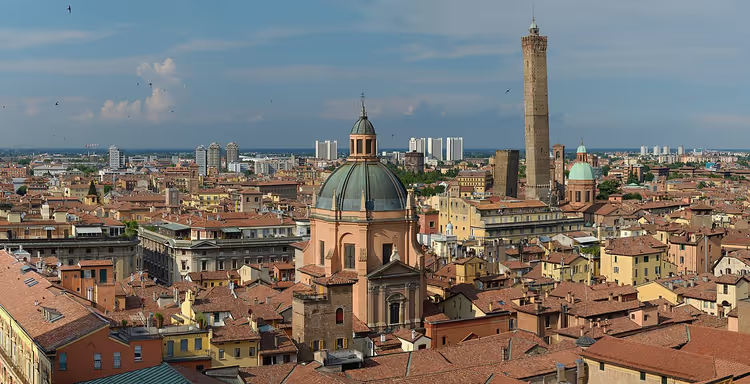
Bologna is bigger than Rimini and nothing like a resort town. It's home to Europe's oldest university, kilometers of porticoes, and red-terracotta rooftops. The historic center is compact: from the station to Piazza Maggiore you can walk in about twenty minutes. According to Bologna Welcome, the city's main sights are Piazza Maggiore with the Basilica of San Petronio and the two leaning Due Torri towers (as of 09/2026).
- How to get there: by regional train from Rimini, services run frequently, the journey takes about an hour (as of 09/2026, Trenitalia). Trains also run late in the evening, so getting back to Rimini is easy.
- Who it's for: those who want a big, lively city, food, and museums in one day.
- Not for: those coming for the sea and the beach, the coast is far from here.
2. Ravenna
 © Incola · CC BY-SAPhoto: Incola, CC BY-SA (https://creativecommons.org/licenses/by-sa/3.0), Wikimedia Commons
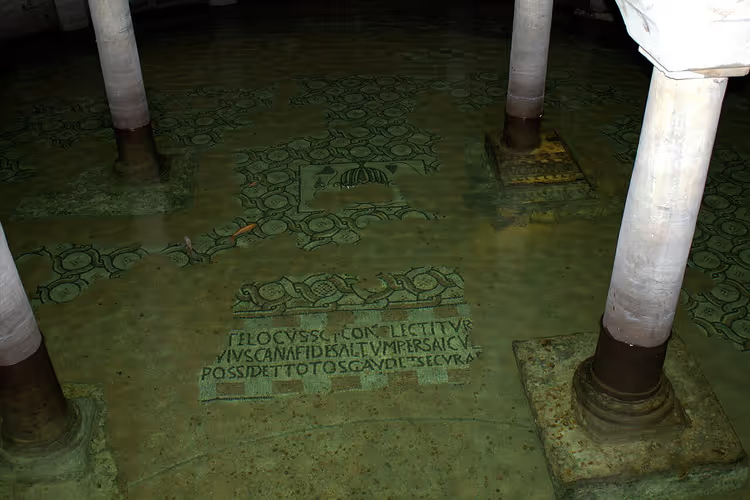
Ravenna is known for its mosaics, and in one day you can see the best of them. In antiquity this was a military port founded by Octavian Augustus, and later the city became the capital of the Western Roman Empire and the Ostrogothic Kingdom. Eight early Christian monuments are on the UNESCO list (as of 09/2026, Turismo Ravenna). Dante's tomb and the house where Byron lived are also here.
The historic center is small, roughly two by two kilometers. You can walk from the station to the main basilicas, you won't need transport.
The Mausoleum of Galla Placidia was built for the daughter of a Roman emperor in 425-437. It is the most important monument of fifth-century Christian art, with walls and dome covered in mosaics in the ancient Roman-Hellenistic tradition. Look up: the starry sky in the dome is made of blue mosaic tiles.
The Basilica of San Vitale is considered a priceless sixth-century monument. The facade is plain outside, but inside you are greeted by Byzantine mosaics with portraits of Emperor Justinian and Empress Theodora. The Mausoleum of Galla Placidia stands next to the basilica, so they are convenient to see together. The Baptistery of Neon and the Archiepiscopal Museum are near the cathedral.
Near the port of Classe, five kilometers from the center, stands the old Basilica of Sant'Apollinare in Classe. And in the center you will find the Basilica of Sant'Apollinare Nuovo from the fifth-sixth centuries, built under Theodoric the Great. It received the name of Apollinaris in the ninth century, when the saint's relics were moved here.
- How to get there: by regional train from Rimini, the journey takes about an hour (as of 09/2026, Trenitalia). The schedule is dense in both directions, so you can easily get back in the evening.
- Cost: a combined ticket for several sites costs in the lower double-digit range (as of 09/2026, official Ravenna tourism portal), check the price on the website.
- Who it's for: those who love early Christian art and mosaics.
3. San Marino
 © Commonists · CC BY-SAPhoto: Commonists, CC BY-SA (https://creativecommons.org/licenses/by-sa/4.0), Wikimedia Commons
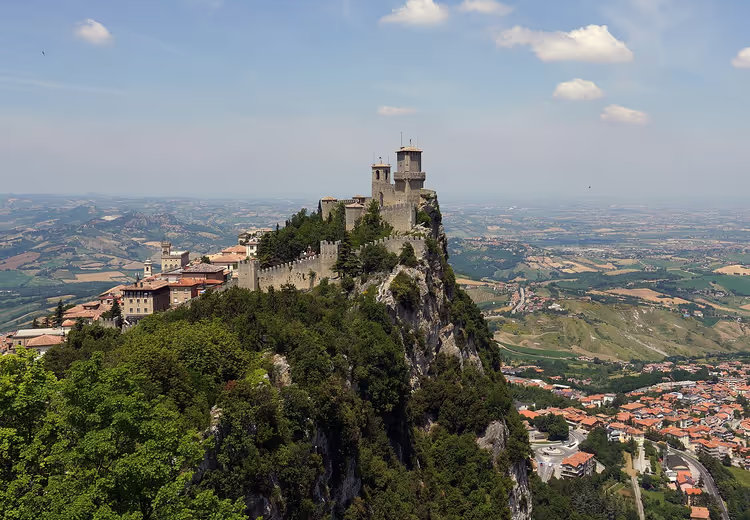
San Marino sits on the slope of Mount Titano and is surrounded on all sides by Italy. It is one of the smallest states in the world, with its own army, laws, and postage stamps. The territory is tiny, but it holds nine castle towns connected by roads (as of 09/2026, Visit San Marino). Each castle is interesting as a monument, and local workshops produce wines, liqueurs, and ceramics.
You can walk around the historic center in a few hours. The main thing here: the panorama from the fortress towers, on a clear day you can see all of Romagna and the Adriatic.
- Getting there: by bus from Rimini station, about an hour (as of 09/2026, Bonelli Bus). The carrier recommends buying tickets in advance, as buses fill up in summer.
- Who it's for: those who want an unusual country, fortresses and views without a visa or border crossing.
- The catch: there are fewer bus runs than trains, so check the last bus back for your return trip.
San Marino tours on GetYourGuide
4. Santarcangelo di Romagna
 © N.monte · CC BY-SAPhoto: N.monte, CC BY-SA (https://creativecommons.org/licenses/by-sa/3.0), Wikimedia Commons
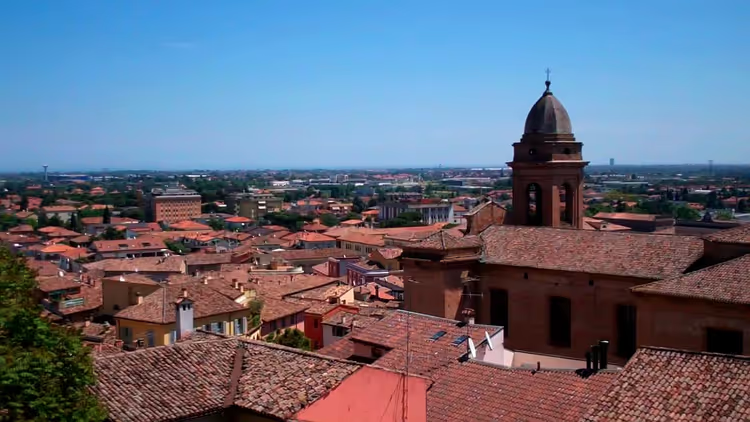
Santarcangelo di Romagna is ten minutes by train from Rimini and looks like an open-air museum. The town sits on a hillside, with the Malatesta fortress and the remains of a medieval wall rising above it. There is a tourist office on the main square: you can pick up a city map and brochures with routes there.
The first stop is the Triumphal Arch by the architect Morelli. It was erected in 1769 in honor of Pope Ganganelli, who was born in Santarcangelo (as of 09/2026, Santarcangelo di Romagna). Locals call it the "arch of cuckolds," and they are in no hurry to explain why.
Tuff grottoes run beneath the historic center. Their exact purpose is unknown; for centuries locals used them as cellars. The Archaeological Museum houses finds from different eras: icons and paintings, household items, jewelry. The bell tower deserves special attention, decorated with battlements and a weather vane with the figure of Saint Michael.
Another point of interest: a museum-workshop where linen and cotton fabrics are decorated with patterns on an antique calender press. It once handled orders for Princess Diana and Princess Margaret. Later you will walk along a wide street lined with greenery-covered houses and find yourself in the very heart of the town.
- Getting there: by train from Rimini, the trip takes about ten minutes; from the station there is an uphill walk to the center (as of 09/2026, Trenitalia). Buses also run from Rimini and climb right up to the center.
- Who it's for: those who want a small town with genuine history right next to Rimini.
- The catch: the walk up to the historic center is a long climb along the street.
Santarcangelo di Romagna tours on GetYourGuide
5. Gradara
 © Santista1982 · CC BY-SAPhoto: Santista1982, CC BY-SA (https://creativecommons.org/licenses/by-sa/4.0), Wikimedia Commons
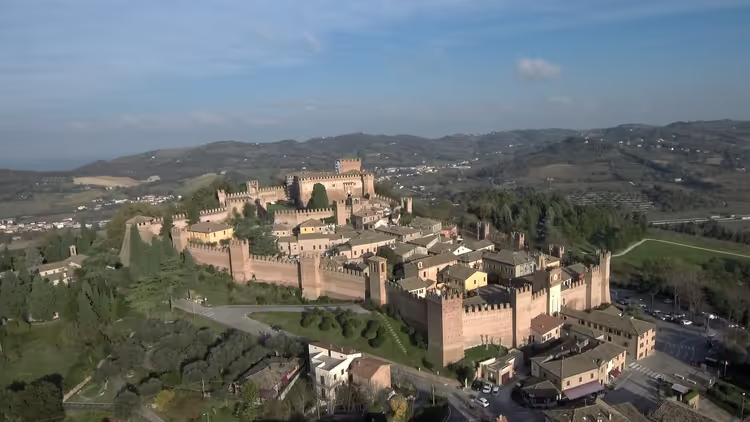
Gradara is one of Italy's "borghi": historic settlements that have preserved their medieval appearance. The town's main attraction is the Rocca di Gradara fortress, standing 142 meters above sea level (as of 09/2026, Gradara). Construction of the fortress began back in the twelfth century by the Griffo brothers, and it later passed to the Malatesta dynasty.
The medieval interior has been preserved inside: old fireplaces, mosaic floors, furniture, portraits, and frescoes. The fortress is tied to the myth of Paolo and Francesca, which inspired numerous books, paintings, and operas.
The towers offer panoramic views of the Romagna hills and the sea. In summer, the fortress hosts historical costume festivals.
- How to get there: by train to Cattolica station in 15-20 minutes, then by bus to Gradara (as of 09/2026, Trenitalia). Buy the bus ticket with coins from the machine at the stop.
- Who it's for: those who love fortresses and medieval interiors.
- The catch: there are many souvenir kiosks and stalls near the entrance, and they spoil the view of the fortress.
6. Urbino
 © Il conte di Luna · CC BY-SAPhoto: Il conte di Luna, CC BY-SA (https://creativecommons.org/licenses/by-sa/2.0), Wikimedia Commons
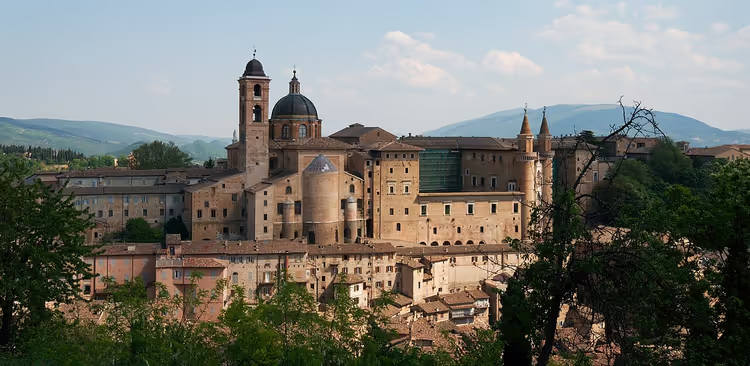
Urbino is known as the birthplace of the painter Raphael and as a Renaissance city. The entire historic center is a UNESCO World Heritage Site, and almost every building here is considered a monument (as of 09/2026, Comune di Urbino). The heart of the city is the Palazzo Ducale with its lavish halls and art gallery.
Urbino is also a city of festivals. The main one is the costumed Festa del Duca in the second half of August, a reenactment of the city's historic victory. Festival tickets sell out in advance, so plan your trip a month ahead.
- How to get there: by train to Pesaro in about half an hour, then by bus from the station for about forty-five minutes. The whole trip with the transfer takes about two hours (as of 09/2026, Trenitalia trains). Buses do not run around the clock, so plan your return trip.
- Who it's for: those interested in Renaissance painting and architecture.
7. Ancona
 © Giacomus · CC BY-SAPhoto: Giacomus, CC BY-SA (https://creativecommons.org/licenses/by-sa/2.5/it/deed.en), Wikimedia Commons
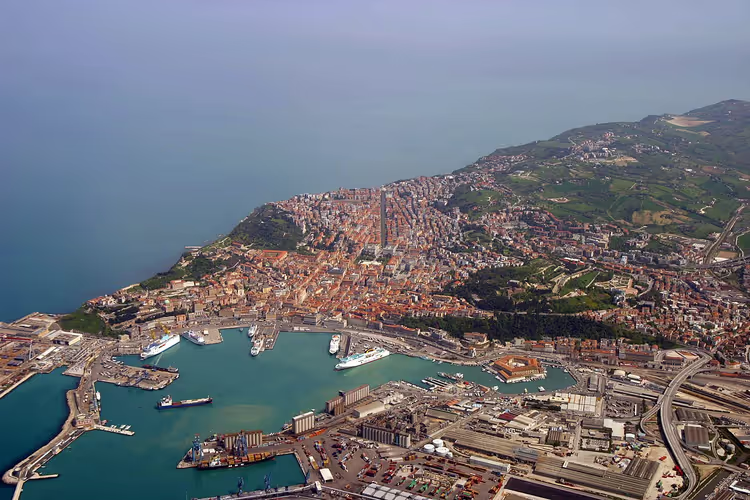
Ancona, the capital of the Marche region, is named after a Greek word that translates as "elbow." That is how the shape of the cape protecting the city harbor from storms was described. Today it is a major port and industrial center, but there are plenty of historic monuments here too (as of 09/2026, Comune di Ancona).
The old town climbs the hills toward the Cathedral of San Ciriaco on Guasco Hill. Right by the port stands the 18-meter-high marble Arch of Trajan. Nearby you will find the National Archaeological Museum and the Diocesan Museum with a large collection of artifacts. The Pinacoteca Podesti in the Palazzo Bosdari displays works by Italian masters.
Higher up the hill stand the churches of Santa Maria della Piazza and San Francesco alle Scale, as well as three Gothic palaces: Palazzo Benincasa, Palazzo del Senato, and Loggia dei Mercanti. In the outskirts is the Basilica della Santa Casa in Loreto, which draws pilgrims from all over Europe. In summer, Adriatic cruises depart from the port.
- Getting there: by regional train from Rimini along the coast, about an hour and fifteen minutes (as of 09/2026, Trenitalia).
- Who it's for: those who want a large port city and panoramic views from the hills.
tours in Ancona on GetYourGuide
8. Ferrara
 © Gianni Careddu · CC BY-SAPhoto: Gianni Careddu, CC BY-SA (https://creativecommons.org/licenses/by-sa/4.0), Wikimedia Commons
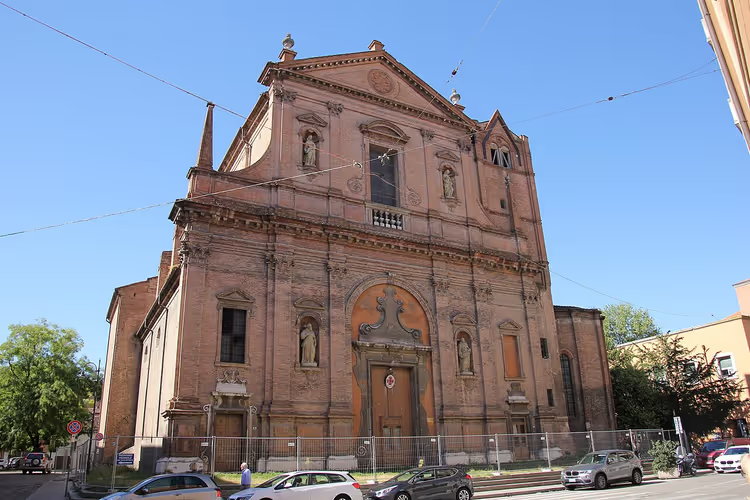
Ferrara preserves the look of the Renaissance: its palaces and cathedrals date from the fourteenth to the sixteenth centuries. The city's golden age began under Duke Ercole d'Este, who worked with the architect Rossetti to create a new look for the center. The historic center is a UNESCO World Heritage Site (as of 09/2026, Ferrara Terra e Acqua).
The Cathedral of Saint George is built of pink marble. Its facade with tiers of arches is considered one of the finest examples of Romanesque architecture in the region. Nearby stand the ducal palaces of the d'Este family, each trying to outdo its neighbors in splendor.
Set apart is Casa Romei with its cozy inner courtyard, home to the Museum of Painting and Sculpture. Palazzo Costabili, built for the ambassador Costabili, now houses the National Archaeological Museum. Ferrara's streets and squares are laid out very clearly, so getting lost here is difficult.
- Getting there: by direct train from Rimini it runs rarely, more often with a change in Bologna or Ravenna, total time about two hours (as of 09/2026, Trenitalia Regionale). For a day trip, take a morning train.
- Who it's for: those who love quiet Renaissance cities.
tours in Ferrara on GetYourGuide
9. Bergamo
 © RiccardoT · CC BYPhoto: RiccardoT, CC BY (https://creativecommons.org/licenses/by/3.0), Wikimedia Commons
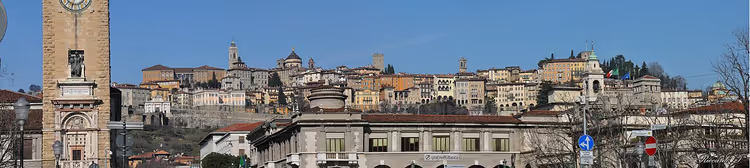
Bergamo consists of two parts: the upper city stands on a hill behind fortress walls, the lower city spreads out at its foot. The ancient quarters of the Upper City have preserved narrow streets and a square where the Colleoni Chapel and the Basilica of Santa Maria Maggiore stand side by side (as of 09/2026, Comune di Bergamo). The composers Donizetti and Mayr are buried in Santa Maria Maggiore.
The Colleoni Chapel was built as a lavish Renaissance mausoleum, and it is one of the most powerful places in the city. Nearby is a botanical garden with hundreds of plant species, and in the lower city the Accademia Carrara gallery displays works by Botticelli, Raphael, and Tiepolo.
The easiest way to travel between the two parts of the city is by funicular, while walking up takes more time and effort.
- How to get there: by Regionale trains with transfers, the trip takes more than four hours (as of 09/2026, Trenitalia). Buses do not run every day, so the train is more reliable.
- Who it's for: those willing to make a long trip for a remarkable city.
- The catch: it is tough for a day trip, Bergamo is better visited with an overnight stay.
tours in Bergamo on GetYourGuide
10. Pesaro
 © Florian Prischl · CC BY-SAPhoto: Florian Prischl, CC BY-SA (https://creativecommons.org/licenses/by-sa/3.0), Wikimedia Commons
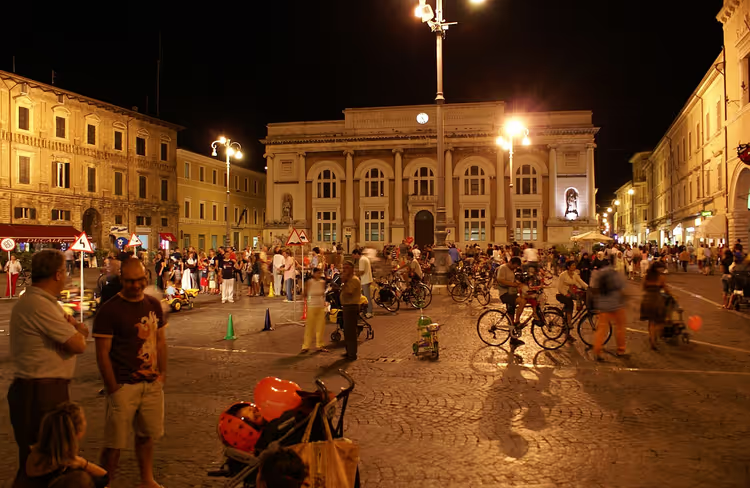
Pesaro is quieter and calmer than the neighboring resorts, but it is the birthplace of composer Gioachino Rossini. Much here is tied to his name: the memorial museum, the opera house, and a street in the center. Every August the city hosts an opera festival that draws singers from around the world (as of 09/2026, Pesaro Turismo).
Palazzo Ducale stands on the central Piazza del Popolo. In front of the palace, a fountain with figures of tritons and sea horses plays. Do not miss the cathedral with its ancient mosaic floor, which has been carefully restored.
The city's palaces and villas recall the noble families of Rovere, Sforza, and Malatesta. A walk through the old center takes a couple of hours, and then you can head to the sea.
- How to get there: by regional train from Rimini in half an hour (as of 09/2026, Trenitalia). Because of the short trip, Pesaro is easy to combine with Urbino.
- Who it's for: those who want to combine the sea and a walk through an old town.
tours in Pesaro on GetYourGuide
One-day route from Rimini on the map
Where to go from Rimini for a day trip
Places on the map
- 1Bologna Porticoes, Piazza Maggiore and the Due Torri towers, about an hour by train from Rimini
- 2Ravenna Eight UNESCO monuments, Byzantine mosaics of San Vitale, Dante's tomb
- 3San Marino Independent state on Monte Titano, panorama from the fortress towers
- 4Santarcangelo di Romagna Triumphal arch and tufa caves beneath the historic centre
- 5Gradara Rocca di Gradara fortress at 142 m, the myth of Paolo and Francesca
- 6Urbino Raphael's birthplace, Palazzo Ducale and a historic centre listed by UNESCO
- 7Ancona Port capital of Marche, San Ciriaco cathedral and the Arch of Trajan
- 8Ferrara Renaissance UNESCO centre, cathedral and the Este palaces
- 9Bergamo Upper and lower town, the Colleoni Chapel and the Accademia Carrara gallery
- 10Pesaro Rossini's birthplace, Palazzo Ducale and an opera festival in August
This map shows all the cities from the list. Open it on your phone before the trip and check your transfers.
⁉️🤔 Frequently asked questions
Where is the closest and cheapest place to get to from Rimini?
The closest destinations are the towns along the coast and foothills: Pesaro, Santarcangelo di Romagna, and Ravenna. The trip takes from ten minutes to an hour, and tickets for these short stretches are the most affordable (as of 09/2026, Trenitalia). San Marino requires a bus, which also takes about an hour.
How much does a day in another city cost?
The main expenses are transportation and entry tickets. For short stretches, a Regionale ticket costs very little, while for far-off Bergamo the price is already noticeable. Check the exact amount on the carrier's website before purchasing.
Do I need to book the bus to San Marino in advance?
Yes. The carrier recommends buying tickets in advance, especially in summer when trips fill up (as of 09/2026, Bonelli bus carrier).
Can I fit two cities into one day?
Yes, if you choose nearby pairs: Pesaro and Urbino, Bologna and Ferrara, Ravenna and Santarcangelo. It's easy to transfer between them by rail. Far-off Bergamo can't be combined this way; it's better to go there separately.
What if I'm driving?
Then you have more options: Gradara, San Marino, and the Marche hills become closer. Keep in mind toll roads and parking, which is paid almost everywhere in city centers. In Rimini, it's convenient to leave your car at the hotel and travel by train from there.
In short: what's worth booking
Rimini works well as a base: you leave in the morning and return by dinner. If you plan to stay for several nights, check out hotels in Rimini on Trip.com.
If you're short on time: go for Ravenna with its mosaics and Pesaro with Urbino. If you want something unusual: head to San Marino. If you're up for a long trip: choose Bergamo.

A small editorial team writing guides for independent travel. We travel ourselves, but we haven’t been everywhere, so we check prices, opening hours and how to get there against official sources.