
















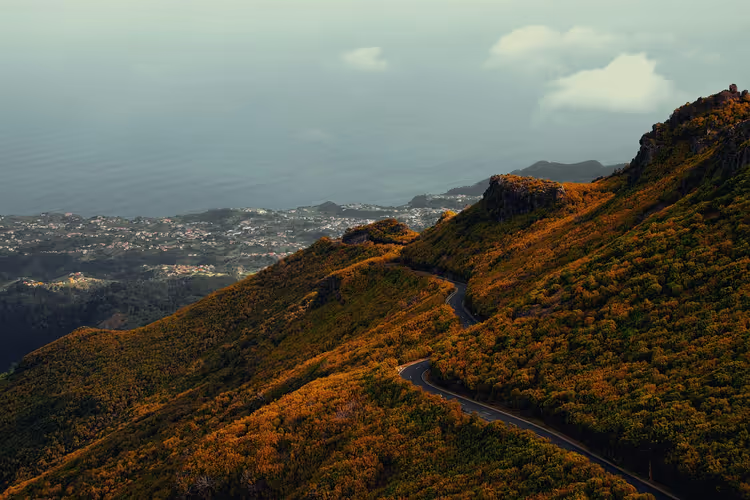
Winter Portugal: 7 things to do without the summer crowds
In winter, Portugal runs in a different mode. Daytime temperatures hover around +15 °C, and in the south they can reach +20 °C (as of 09/2026, Portuguese weather service). Rain does fall, but it passes quickly, and there are noticeably fewer lines and tourists.
One challenge remains, though: housing. Before booking, always ask about heating, because central heating is far from standard in every house and apartment.
Here are seven activities that work better in winter than in summer: Christmas markets in Óbidos, snow in Serra da Estrela, the thermal baths of São Pedro do Sul, hiking trails, the Algarve without the crowds, giant waves in Nazaré, and the palaces of Sintra. All you need to do is pick the order and book a couple of things in advance.
Ad: this article contains affiliate links, we earn a commission if you book through them, at no extra cost to you.
1. Christmas markets in Óbidos
💡 In short:
- Markets open from late November, mulled wine is served only in winter.
- For snow in Portugal, head to Serra da Estrela.
- Thermal baths operate in winter, but with fewer sessions.
- The Algarve and Nazaré beat summer in winter.
- Prices and opening hours: 09/2026, verified on the official website.
Activity | Best time | What to book in advance |
|---|---|---|
Óbidos markets | late November - early January | ticket for a season date |
Skiing in Serra da Estrela | when there is snow, usually December | lesson with an instructor |
São Pedro do Sul thermal baths | quieter in winter | pool session |
Hiking trails | November - April | nothing |
Algarve | winter months | accommodation near the coast |
Waves in Nazaré | based on storm forecasts | car and overnight stay |
Sintra palaces | December - February | Pena Palace time slot |
Portuguese Christmas looks more modest than German, but you will find markets and string lights in almost every town. Mulled wine is served only in winter. That alone is worth a December trip.
The main point on the holiday map: Óbidos (open on map). Behind the fortress walls lie cobblestone streets and white houses with yellow trim, and you can walk the entire perimeter along the top of the wall. Local cafés serve ginja, a cherry liqueur in a chocolate cup.
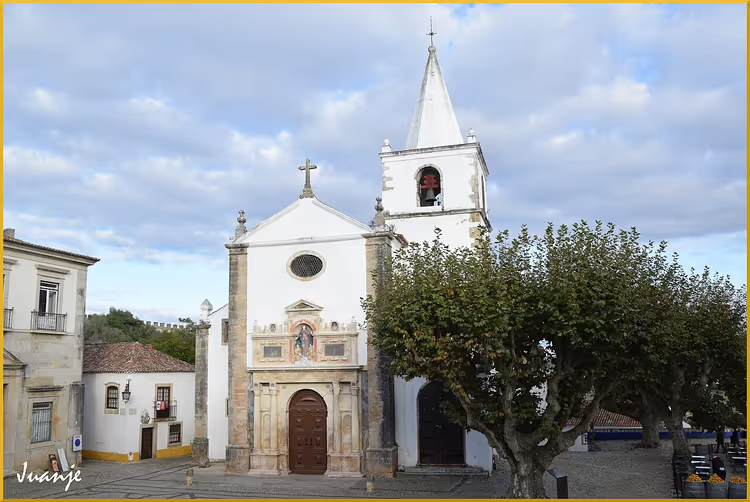 © Juanje Orío from Logroño, España (Europa) · CC BY-SAPhoto: Juanje Orío from Logroño, España (Europa), CC BY-SA (https://creativecommons.org/licenses/by-sa/4.0), Wikimedia Commons
Last year's market season ran from November 28 to January 4 (as of 09/2026, Óbidos municipality). By December, the town opens an outdoor ice rink, switches on the lights, and turns the castle into Santa's house.
- How to get there: Óbidos sits between Lisbon and Leiria; from the capital you can drive or take a bus (see map).
- Cost: market tickets are sold for specific season dates on the Óbidos Vila Natal website (as of 09/2026).
- Who it's for: families with children, because part of the winter program is designed for kids.
- The catch: most markets close by Christmas, so December beats January.
Óbidos is compact: the entire old town can be walked in a couple of hours (see map).
Off-season, Óbidos is still worth visiting. The walls, castle, and viewpoints are open year-round.
2. Skiing and snowboarding in Serra da Estrela
For snow in Portugal, look only to the mountains. The country's only ski resort sits at the highest point of the mainland, next to the Torre tower (open on map). The tower was built to reach the round mark of two thousand meters.
You don't need experience: the slope is gentle. A separate low hill is set aside for tubing, and gear is available to rent. A lesson with an instructor lasts an hour, the first session starts at 09:30, the last one begins at 15:30 (as of 09/2026, ticket operator).
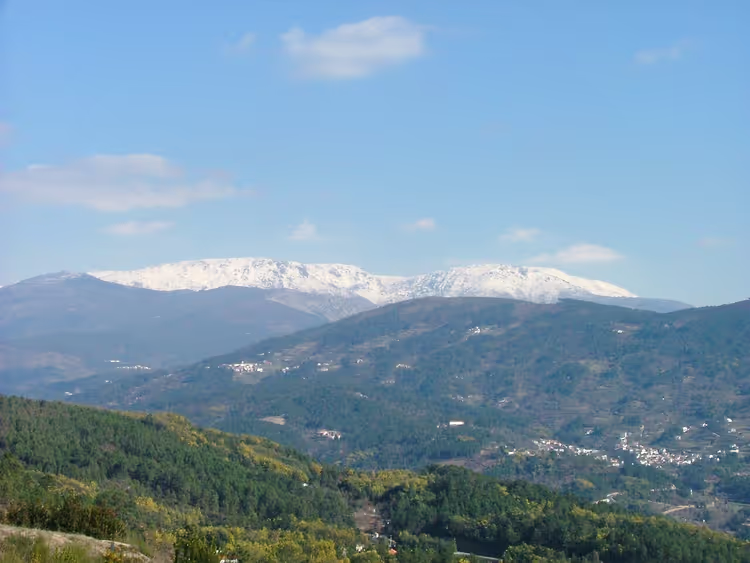 © pt:Usuário:Marco.veloso · CC BY-SAPhoto: pt:Usuário:Marco.veloso, CC BY-SA (http://creativecommons.org/licenses/by-sa/3.0/), Wikimedia Commons
A restaurant and a covered market operate next to the slope: presunto, cheeses, honey, wool and cork products. People come here for this selection even if they never put on skis.
- Who it's for: beginners and families, because the slope is gentle and there's tubing.
- The catch: the resort only opens when there's enough snow, so keep your dates flexible (as of 09/2026, official website).
3. Thermal baths of São Pedro do Sul
Mountainous Portugal is rich in thermal water. The country's largest and oldest spa resort operates in São Pedro do Sul (open on map). The local springs are used for respiratory, rheumatic, metabolic and muscular conditions.
You don't have to be undergoing treatment. You can simply lie in the hydromassage pool for half an hour; admission costs €10 (as of 09/2026, Termas booking). In winter there are fewer sessions, so book your spot in advance.
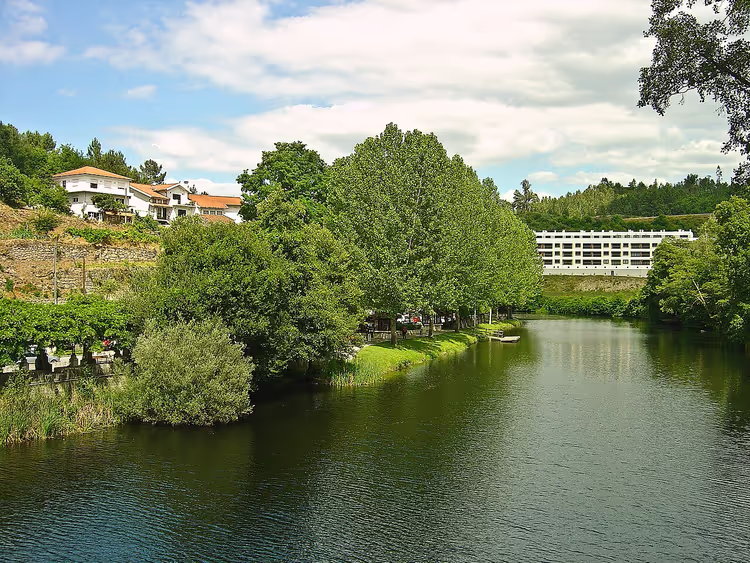 © Vitor Oliveira from Torres Vedras, PORTUGAL · CC BY-SAPhoto: Vitor Oliveira from Torres Vedras, PORTUGAL, CC BY-SA (https://creativecommons.org/licenses/by-sa/2.0), Wikimedia Commons
If the pool isn't enough for you, there are hour-long sessions with saunas nearby and a large spa center across from the balneotherapy clinic. Check current prices in the Termas price list.
Two cycling routes lead from the thermal town to the historic center. The Ecopista do Vouga runs along the river for about four kilometers one way (according to the map), so this route is also walked. At the old arched bridge next to the former railway station, turn into the city park, and from the park head to the historic center. It's convenient to return via Santa Luzia street, which makes a loop.
- Who it's for: those who want to combine a pool visit with a walk, because an ecopista runs from the baths to the center (according to the map).
- The catch: in winter the schedule is shorter than in summer, so choose your session in advance (according to Termas).
4. Hiking trails along the ocean and in the mountains
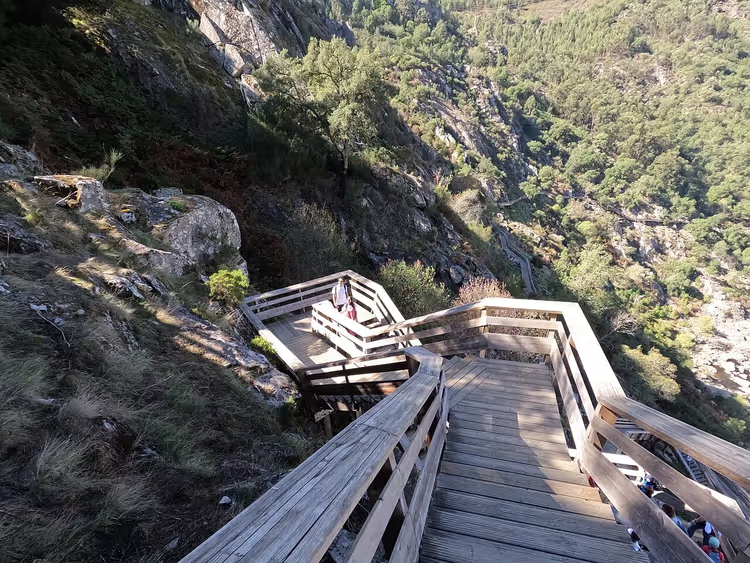
Hiking in Portugal is almost a national habit. Trails of varying length and difficulty are marked throughout the country, and some routes run along wooden boardwalks with steps on slopes.
 © Joseolgon · CC BY-SAPhoto: Joseolgon, CC BY-SA (https://creativecommons.org/licenses/by-sa/4.0), Wikimedia Commons
In winter, hiking is easier than in summer: the sun doesn't scorch open slopes, while rivers and waterfalls are full of water. Choose a trail by the ocean or in the mountains; in winter, regular sneakers will be enough.
- Who it's for: those who want to walk a lot, because winter trails are free of crowds.
- The catch: in winter daylight hours are short, so plan your route before dark.
5. The Algarve without the summer crowds
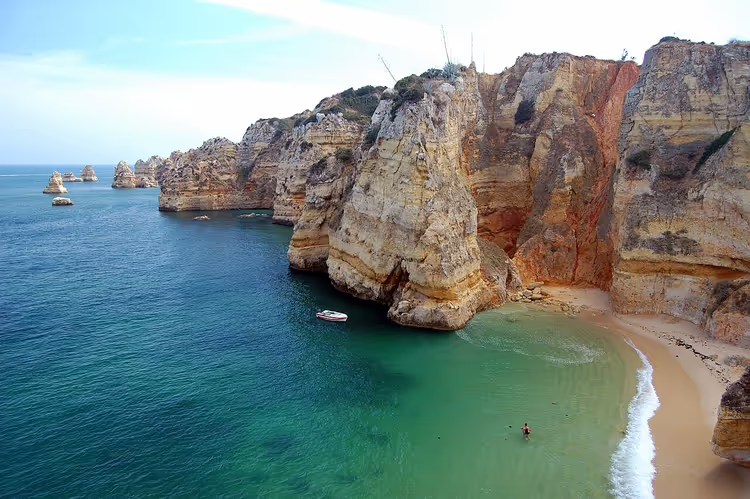
In summer the Algarve is packed, and high-season prices skyrocket. In winter you'll see the same coastline without the crowds: striped cliffs, rocks in the ocean, caves with hidden beaches and white houses under terracotta roofs.
The Algarve held the title of Europe's best beach destination at the World Travel Awards for many years, and in 2025 the award went to a Greek resort (as of 09/2026, World Travel Awards). The Portuguese coast didn't get any worse because of it.
 © Steven Fruitsmaak · CC BY-SAPhoto: Steven Fruitsmaak, CC BY-SA (https://creativecommons.org/licenses/by-sa/3.0), Wikimedia Commons
In the winter months, the air in the Algarve warms above +20 °C, and some tourists sunbathe on the sand (as of 09/2026, IPMA). Swimming in the Atlantic without a wetsuit is uncomfortable almost all year: the water stays cold.
- Who it's for: those who want the sea without the heat and the crowds, because in winter the beaches are almost empty.
- The catch: the ocean is cold, you need a wetsuit for swimming.
6. Giant waves in Nazaré
The big wave season in Nazaré opens in October and lasts until March, with the strongest surf usually from November to February (as of 09/2026, bigwaves-nazare). On peak days, waves rise above twenty meters.
The force of the elements cannot be predicted in advance. If you are chasing waves, check the Praia do Norte webcams: if you spot a surge in activity, get in the car and drive to Nazaré (open on map).
 © Carlos Eduardo Joos · CC BYPhoto: Carlos Eduardo Joos, CC BY (https://creativecommons.org/licenses/by/2.0), Wikimedia Commons
Surfing here works the same way: spots depend on the season, wind, and tide. Surf lessons and wave tours are easy to find on GetYourGuide.
- Who it's for: those who want to see big waves with their own eyes.
- The catch: the waves depend on Atlantic storms, there is no guarantee for a specific date.
7. Sintra palaces without the lines
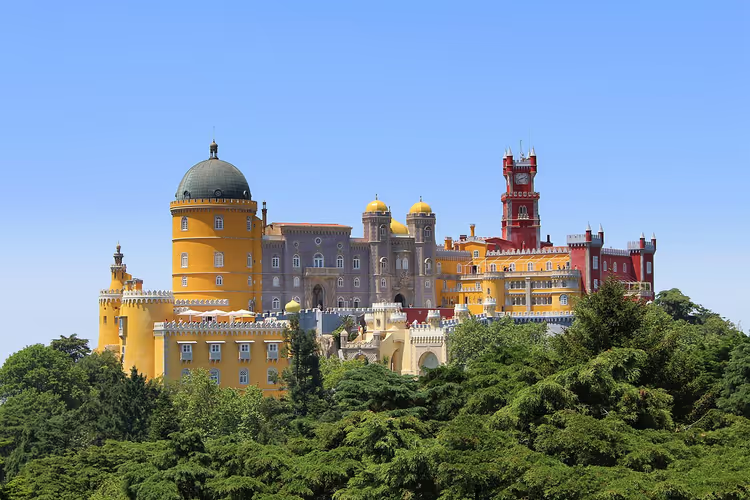
In winter, Sintra has fewer tourists, and the palaces feel calmer. One town is home to Pena Palace (Palácio da Pena), Quinta da Regaleira, the National Palace of Sintra, Monserrate Palace, and the Moorish Castle (open on the map).
Pena Palace sells timed-entry tickets: pick your day and hour on Parques de Sintra (as of 09/2026). At Quinta da Regaleira, a time slot is also a good idea, and tickets for Sintra's palaces are easier to find on Tiqets.
 © Singa Hitam · CC BYPhoto: Singa Hitam, CC BY (https://creativecommons.org/licenses/by/2.0), Wikimedia Commons
Lisbon also benefits in winter: walking the hills is more pleasant without the punishing heat, and the viewpoints are less crowded. Two days in the capital are enough for the main neighborhoods (see map).
- Who it's for: those who came for the architecture, because in winter the ticket lines are shorter.
- The catch: it gets dark early in winter, so don't plan palaces for the second half of the day.
⁉️🤔 Frequently asked questions
Is Portugal worth visiting in winter?
Yes, if you don't need beach heat. Daytime temperatures are around +15 °C, and in the south they can reach +20 °C (as of 09/2026, Portugal's meteorological service). There are fewer tourists, accommodation is cheaper, and thermal baths and fairs run on winter schedules.
Where is there snow in Portugal in winter?
In Serra da Estrela. The country's only ski resort sits at the highest point of mainland Portugal (as of 09/2026, the resort's official website). The season opens when there is enough snow, usually in December.
How much do the São Pedro do Sul thermal baths cost?
Access to the hydro-massage pool costs €10 (as of 09/2026, thermal spa online booking). In winter there are fewer sessions, so book ahead. The current price list is on the Termas pricing page.
Can you swim in the ocean in winter?
Swimming in the Atlantic without a wetsuit is uncomfortable almost all year: the water stays cold. In the Algarve in winter the air warms above +20 °C, but it is mostly surfers who get in the water (as of 09/2026, IPMA, water temperature). For big waves people head to Nazaré: the season runs from October to March (as of 09/2026, Nazaré wave forecast).
When do Christmas markets open in Portugal?
Markets open in late November and run until Christmas, and in Óbidos the 2025/26 season ran from November 28 to January 4 (as of 09/2026, Óbidos municipality). Plan for December: in January only a few locations remain.
In short: what to book
If you have a couple of winter days, go with Lisbon and Sintra. If you have a week, add Óbidos, the São Pedro do Sul thermal spa, and a couple of days in the Algarve. If you are going for snow, keep your dates flexible and watch the reports from Serra da Estrela.
Hotels in Lisbon and the Algarve are cheaper to book in advance: see hotels in Portugal on Trip.com.

A small editorial team writing guides for independent travel. We travel ourselves, but we haven’t been everywhere, so we check prices, opening hours and how to get there against official sources.