
















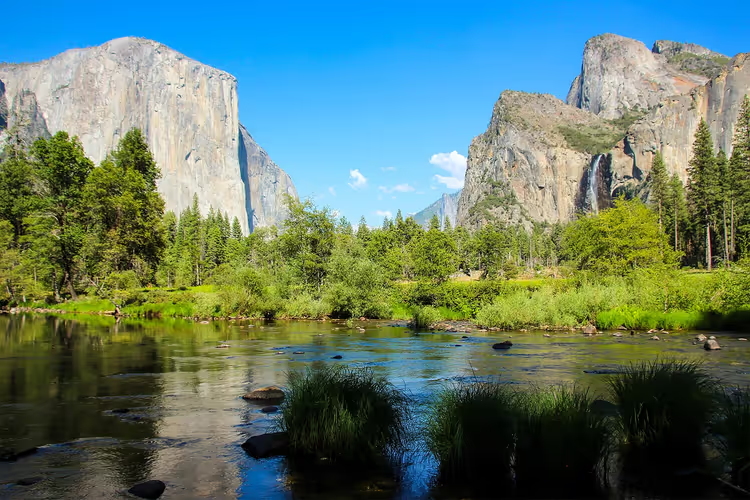
Yosemite in California: entrance, waterfalls and sequoia groves in 2026
Entry to Yosemite is open 24 hours a day. But by ten in the morning, the parking lots in the valley are already full, and you end up circling the lot instead of hiking. The park lies in the Sierra Nevada mountains in California, about 300 km from San Francisco (as the map shows). Car entry costs $35 for seven days (as of 09/2026, official park website).
Below is everything you need for a first trip: the main points of the valley, waterfalls and sequoia groves, entry fees, and two routes from San Francisco and Los Angeles.
Ad: this article contains affiliate links, we earn a commission if you book through them, at no extra cost to you.
Where Yosemite National Park is located
💡 In short:
- A national park in central California, on the western slope of the Sierra Nevada.
- Inside: Yosemite Valley, a 740 m waterfall, granite walls, and groves of giant sequoias.
- Entrances are open 24 hours a day.
- Prices and hours verified against the fees section in 09/2026.
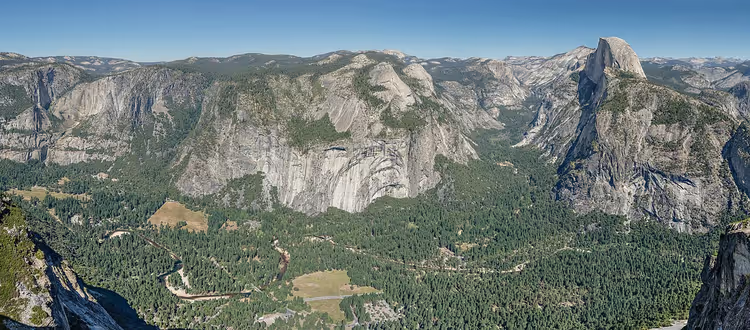
Yosemite lies in central California, on the western slope of the Sierra Nevada mountains. The nearest major cities are San Francisco to the west and Los Angeles to the south. The park is a UNESCO World Heritage Site and remains one of the most visited national parks in the US.
The main part of the park is Yosemite Valley. Its granite walls rise nearly a kilometer above the valley floor, and El Capitan climbs more than 900 m (as of 09/2026, park service on El Capitan). Yosemite Falls and the Tunnel View overlook are also here.
The rest of the territory is almost empty of people. Instead of pavement, there are ridges, plateaus, and alpine meadows, and the few roads lead to distant viewpoints. So by car you can see different parts of the park, while on foot you will only cover the valley.
Park history: the Ahwahneechee and the Gold Rush
For a long time, the Ahwahneechee people lived in the valley. They led a measured life in untouched nature and did not build large settlements.
 © Tuxyso · CC BY-SAPhoto: Tuxyso, CC BY-SA (https://creativecommons.org/licenses/by-sa/3.0), Wikimedia Commons
Everything changed in the mid-19th century, during the California Gold Rush. Americans of European descent came into the valley, and clashes with the local people began. Militia units burned Ahwahneechee settlements, and they retreated down the river to wait things out in safety.
When the clashes subsided, the Native Americans returned to their former lands, but their rights to the land were no longer recognized. The number of tourists grew, and nature suffered from logging and livestock grazing. To stop the destruction, the authorities placed the valley under protection, and in the second half of the 19th century Yosemite received national park status.
Climate and when to go
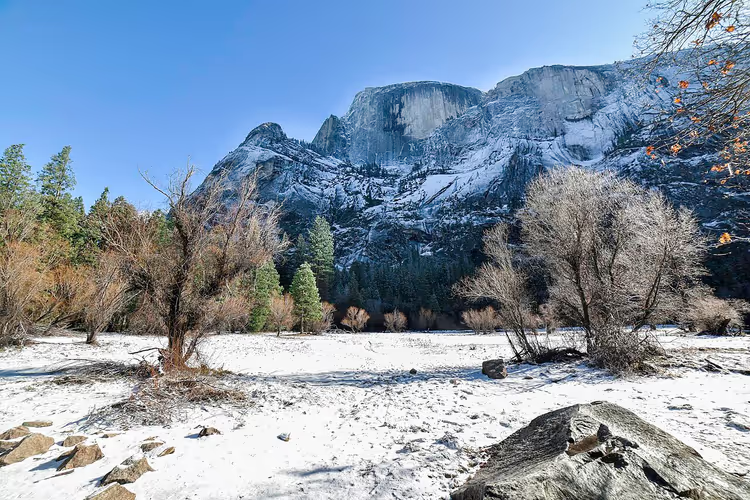
The climate in the park is Mediterranean: most precipitation falls in winter, and summers here are dry and hot. Snow settles on the mountain slopes by late fall and lasts until mid-spring.
 © Rachelle Haun · CC BYPhoto: Rachelle Haun, CC BY (https://creativecommons.org/licenses/by/2.0), Wikimedia Commons
In winter, the valley is cold, with nighttime temperatures dropping below freezing. In summer, the air heats up, and by midday the valley becomes stuffy. For a comfortable hike, fall is better: the heat is gone, but so is the cold, the rivers and lakes are calm, and the views open up more clearly than in summer.
Waterfalls are a different story. They stay full from November through July, with the peak in May (as of 09/2026, waterfalls page on NPS). In fall, the flow weakens, so if you want powerful streams of water, go in spring or early summer. Rain can start here at any moment, so bring a rain jacket.
Landscape: granite walls and waterfalls
The valley is surrounded by smoothed domes and walls of gray granite. Rivers have carved deep canyons into the rock, and their walls rise hundreds of meters in places.
 © Diliff · CC BY-SAPhoto: Diliff, CC BY-SA (https://creativecommons.org/licenses/by-sa/3.0), Wikimedia Commons
The landscape was shaped by large glaciers. They slid down the valley and cut away the rock, leaving sheer walls and a wide floor. Where the ice retreated, forests grew, and higher up the slopes, alpine meadows spread out.
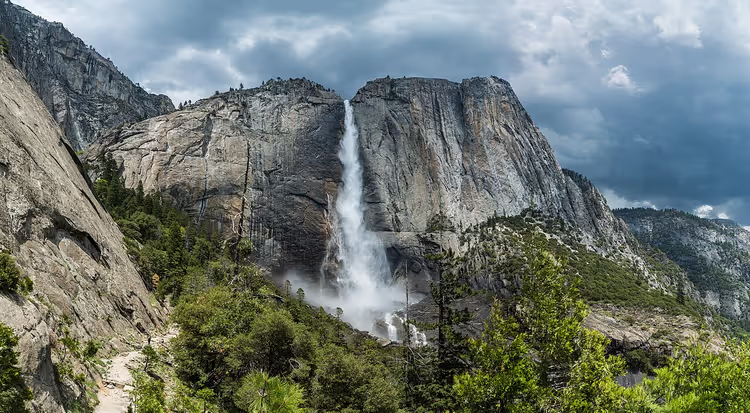
The park's calling card: Yosemite Falls. Its total height is 740 m, making it the tallest in North America (as of 09/2026, waterfall page on NPS). The waterfall has three tiers, and you can see it at full force in May and June.
Tickets and hours
All park entrances except Hetch Hetchy are open 24/7 (as of 09/2026, entry rules). Cash is not accepted here; payment is by card or phone only.
Who enters | Fee | Duration |
|---|---|---|
Passenger car | $35 | 7 days |
Motorcycle | $30 | 7 days |
On foot or by bicycle | $20 per person | 7 days |
Children under 16 | free |
|
Yosemite Annual Pass | $70 | 12 months |
Foreign tourists over 16 pay an additional $100 per person fee on top of the ticket (as of 09/2026, more details from NPS). The park's annual pass costs $70 and pays for itself after two trips.
Starting in 2026, the timed entry reservation system has been suspended: a separate timed reservation is no longer required (as of 09/2026, reservation terms). You just need to pay for entry or show an America the Beautiful Pass. In 2026, free entry applies on select dates, such as May 25 and July 3-5.
If you don't want to deal with parking yourself, book a ready-made valley program: Yosemite tickets and guided tours.
Tours and tickets in Yosemite
Guided tours, skip-the-line tickets and activities — most offers can be cancelled free of charge.
See offers on GetYourGuideThe widget loads once you give your consent.
Activities and attractions
The park has hundreds of kilometers of trails, but most visitors never go beyond the valley. Below are the main points people come here for.
El Capitan
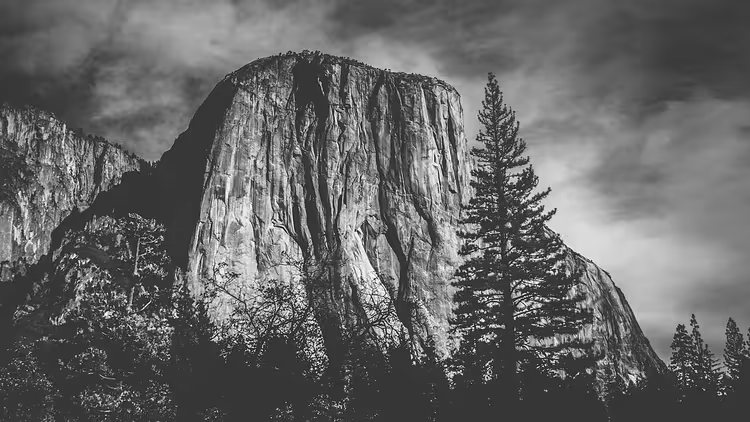
El Capitan, a granite wall above the western part of the valley. It rises more than 900 m above the valley floor and is considered the benchmark for experienced climbers (as of 09/2026, rock description). The best views are from Tunnel View and El Capitan Meadow. In summer, parking spots there fill up well before noon, so plan an early start.
Tuolumne meadows and the Clark range
In the eastern part of the park lie Tuolumne Meadows and Dana Meadows. In summer they are covered with wildflowers, and in winter they disappear under snow. Nearby stretch the Clark Range and the peaks of Cathedral Peak and Kuna Peak. Two long-distance routes pass through the park: the Pacific Crest Trail and the Sierra Crest. These are trails for experienced hikers: you won't complete them in a single day.
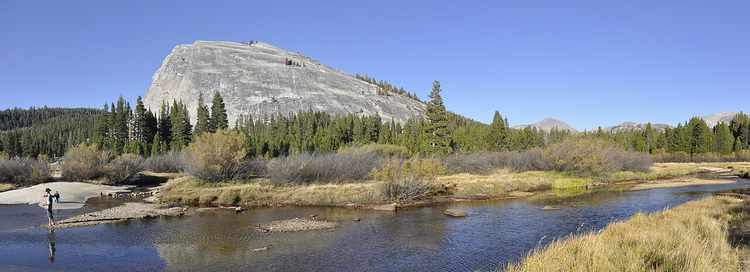 © Jarek Tuszyński · CC BYPhoto: Jarek Tuszyński, CC BY (https://creativecommons.org/licenses/by/4.0), Wikimedia Commons
Giant sequoia groves
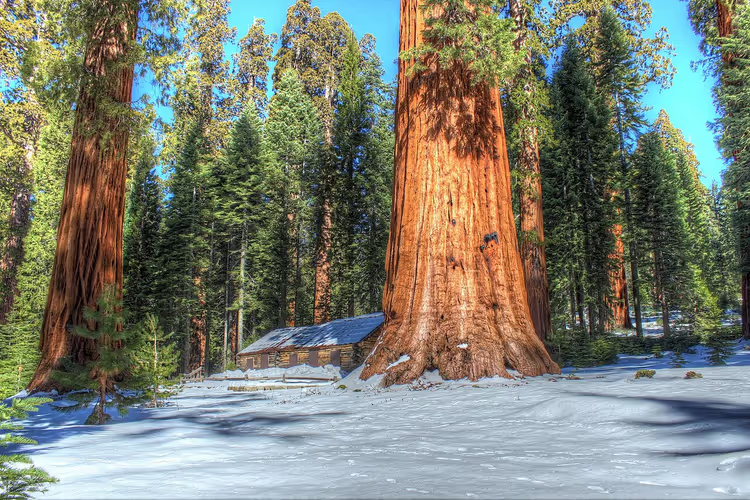 © Dameon Hudson · CC BYPhoto: Dameon Hudson, CC BY (https://creativecommons.org/licenses/by/3.0), Wikimedia Commons
Giant sequoias grow only in California, and Yosemite has three groves of them. The largest is Mariposa Grove, home to most of the park's mature trees. Tuolumne Grove and Merced Grove are noticeably smaller. Paved trails lead to the groves, and you can walk them at a leisurely pace in an hour or two.
There are shops with food and water at the entrances, and you can grab a bite at restaurants inside the park. It's better to stock up before you enter: the selection inside is more limited and prices are higher.
How to get to Yosemite National Park
 © Mike McBey · CC BYPhoto: Mike McBey, CC BY (https://creativecommons.org/licenses/by/2.0), Wikimedia Commons
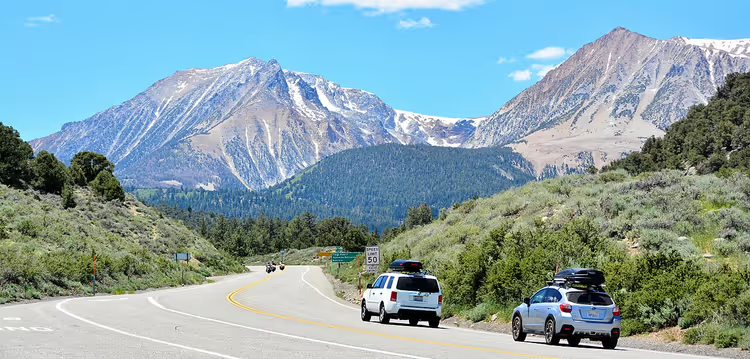
Driving is the most convenient option. From San Francisco to the western entrance it's about 300 km, and the drive takes over three hours (on the map). From Los Angeles the route is longer: about 500 km and five to six hours (on the map). From either city's airports you can get there by bus, train, or rental car.
The easiest way to rent a car is right at the airport: compare car rental prices. After you exit the highway, the roads in the park are winding, and in winter some passes close due to snow.
Without a car, the remaining option is a guided tour from San Francisco or Los Angeles. Buses take longer, but you won't have to worry about parking and gas. Just keep in mind that in high season tour spots sell out well in advance.
Where to stay near the park
There are campgrounds and a few hotels inside the park, but spots get booked months ahead. Outside the park there are more options: motels, lodges, and cabins near the entrances. Check out options in Mariposa, Oakhurst, or Groveland: from there it's less than an hour to the entrance (on the map).
Booking accommodation in advance is easier on Trip.com: you can see how much hotels and lodges near the park entrances cost. Keep in mind that from your lodging to the valley there's still an hour of driving, so head out early in the morning.
Yosemite National Park on the map
The park is large, and without a map it's easy to rack up extra miles. Mark the spots you want to visit in advance so you don't end up driving in circles.
⁉️🤔 Frequently asked questions
Do I need a reservation to enter Yosemite in 2026?
Starting in 2026, a separate timed reservation for daytime entry is no longer required (as of 09/2026, official terms). Read about entrance fees in the "Tickets and hours" section. On holiday dates, entry is free, but parking lots still fill up early.
How much does it cost to enter Yosemite?
A passenger car pays $35 for seven days, and the ticket covers the driver along with all passengers (as of 09/2026, official website). Other rates and the fee for international visitors are listed in the table in the "Tickets and hours" section.
When is the best time to visit Yosemite?
For waterfalls, plan for May and June: that's when the flow is at its strongest (as of 09/2026, waterfall season). For a relaxed visit, choose fall: the heat is gone, there are fewer people, and the views stay clear. In winter, some roads close, but the valley looks completely different.
Is one day enough for the park?
One day is genuinely enough for the valley: the waterfall, El Capitan, and Tunnel View are all close together. The sequoia groves need another day because they lie away from the valley. If you only have one day, don't try to cover everything: you'll spend it in the car.
Do I need a car for a trip to Yosemite?
Yes, having your own car is noticeably more convenient. Buses and trains only get you to the entrances, and getting around inside the park is slow. Rent a car right at the San Francisco or Los Angeles airport. Without a car, the only option is guided tours from the city.
In short: what to book
If you have one day: stick to the valley, Yosemite Falls, and Tunnel View. If you're going for two days: add Mariposa Grove or Tuolumne Meadows. If you want to go without a car: look for a tour from San Francisco. If you're staying overnight: choose a hotel near the entrance rather than in the center of the park.
Lodging near the entrances gets booked up months in advance, so reserve early. Find a hotel or lodge near the park on Trip.com, pay the entrance fee by card, and check the weather forecast before you head out.

A small editorial team writing guides for independent travel. We travel ourselves, but we haven’t been everywhere, so we check prices, opening hours and how to get there against official sources.