
















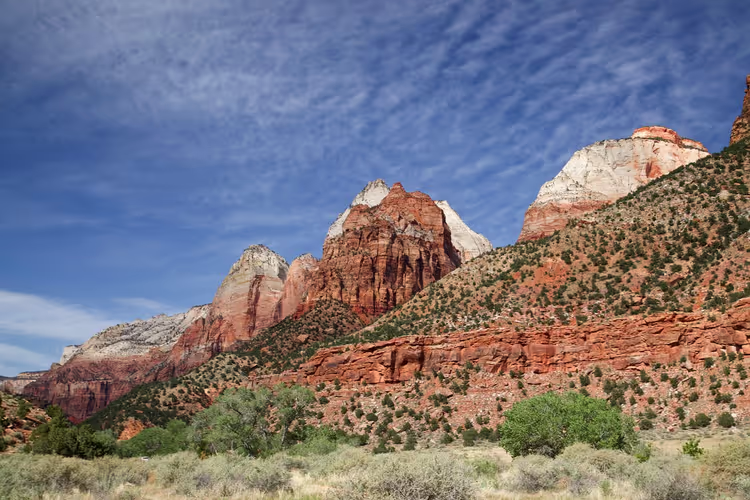
Zion National Park in Utah: entrance, shuttles and Angels Landing permit
Zion Park in Utah welcomes about 5 million visitors a year (as of 2025, National Park Service statistics). Starting in 2026, a mandatory $100 fee for foreign visitors over 16 was added to the entrance fee (as of 09/2026, official park rates). Tickets and shuttles here follow a seasonal schedule, so it's best to plan your trip in advance.
The main draws of Zion: a narrow canyon with red sandstone, free shuttles, and a trail with chains above a cliff. Below you'll find the shuttle schedule, entrance prices, pass requirements, and the list of places people come here for.
Ad: this article contains affiliate links, we earn a commission if you book through them, at no extra cost to you.
History of Zion Park
💡 In short:
- Car entry costs $35 and is valid for 7 days, pedestrians pay $20 (as of 09/2026, park rates).
- The canyon shuttle is free, with 5-10 minute intervals (as of 09/2026, shuttle schedule).
- Angels Landing and wilderness zones require a separate permit (as of 09/2026, park conditions).
- Prices and hours of operation: 09/2026, verified on the official website.
The first people came to the canyon about eight thousand years ago. Artifacts of the Pueblo people are found in caves here: men hunted, women gathered edible plants. Later, agriculture and pottery emerged in these places.
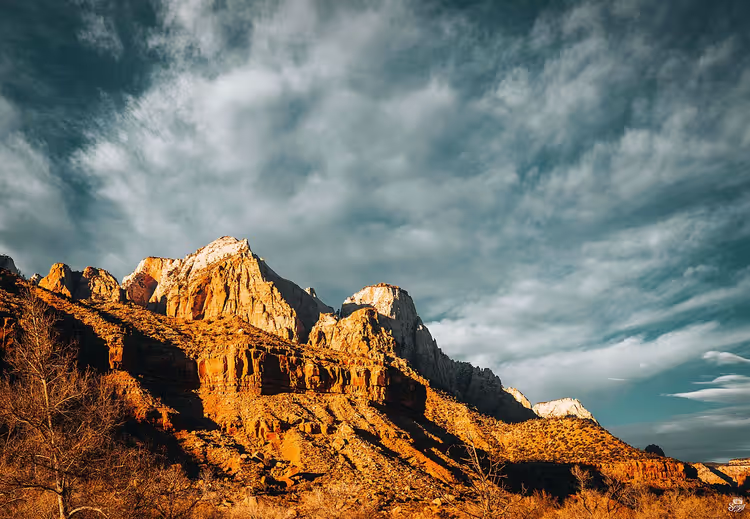 © Sergiy Galyonkin from Raleigh, USA · CC BY-SAPhoto: Sergiy Galyonkin from Raleigh, USA, CC BY-SA (https://creativecommons.org/licenses/by-sa/2.0), Wikimedia Commons
When the climate changed and droughts began alternating with heavy rains, people left the canyon for a long time. In the second half of the 19th century, Mormons arrived and established the Little Zion settlement. The settlement's name carried over to the canyon, and it received national park status shortly after World War I.
The canyon was carved by the Virgin River. Sandstone layers rose, water and wind smoothed the hard rock, and over millions of years a gorge formed with sculpted walls, side canyons, and waterfalls. Iron and manganese oxides tinted the sandstone red and bronze.
Zion canyon and the virgin river
The canyon itself is the park's main attraction. The red and bronze sandstone shifts its shade throughout the day: walls are pink in the morning and turn purple by sunset. Visitors come here for the panoramas and for the narrow passages where the walls almost touch.
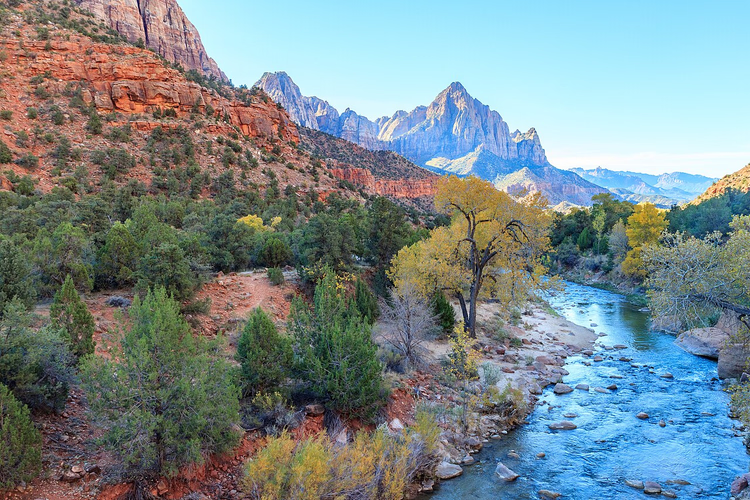 © Andrew Parlette from Elkridge,MD, US · CC BYPhoto: Andrew Parlette from Elkridge,MD, US, CC BY (https://creativecommons.org/licenses/by/2.0), Wikimedia Commons
The Narrows route along the canyon floor goes right through the water. You don't need a permit for it if you hike upstream from Temple of Sinawava (as of 09/2026, shuttle page). In summer this trail is a relief from the heat: green gardens of moss and ferns hang above the water. Sometimes a California condor, the rarest bird in North America, circles over the canyon.
The upper trail is longer and more dangerous: it runs right along the cliff edge, and without experience it's best not to go there. Hold onto the chain and don't pass other groups on narrow sections.
Sights and viewpoints
The park's rock formations have their own names, and almost every one is tied to the appearance of the rock. Below are the spots that most often end up on itineraries.
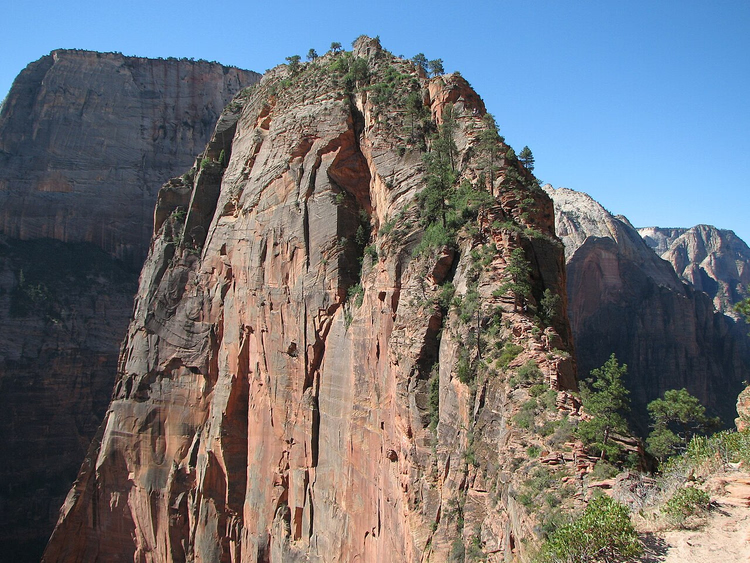
Angels Landing
A narrow ledge above the canyon, known for its chain trail: the final section runs along a ridge with drop-offs on both sides. The catch: you need a permit for this section, so plan the hike in advance (as of 09/2026, permit rules). You can reach the viewpoint at the base without a permit.
Great white throne and court of the patriarchs
The white rock of Great White Throne is visible from the road and from the visitor center. Nearby rise the three peaks of Court of the Patriarchs, named after biblical patriarchs, with Castle Dome looming above them.
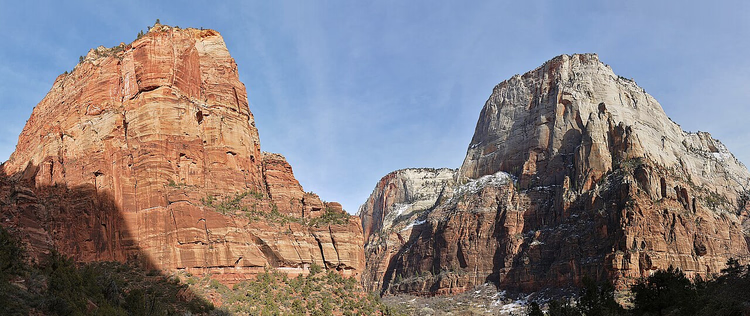 © Óðinn · CC BY-SAPhoto: Óðinn, CC BY-SA (https://creativecommons.org/licenses/by-sa/2.5/ca/deed.en), Wikimedia Commons
Checkerboard Mesa at the east entrance
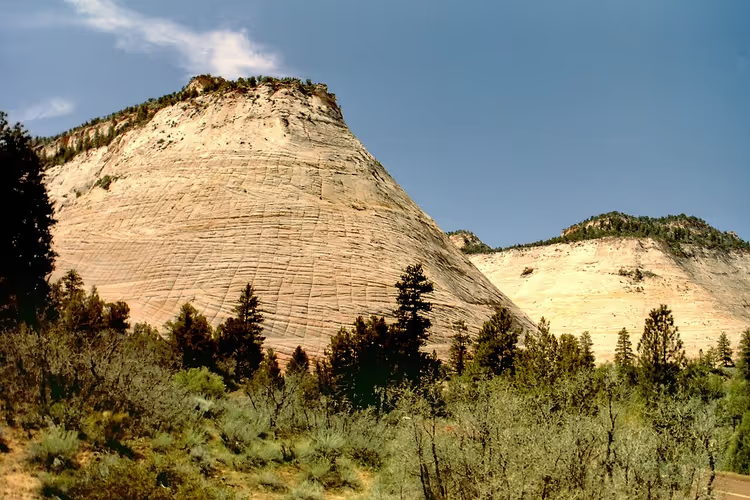
At the east entrance stands Checkerboard Mesa: vertical and horizontal erosion grooves have made it look like a chessboard. The catch: shuttles don't run to this part of the park, so a car is required (as of 09/2026, shuttle map). You can reach the east entrance by highway through the tunnel.
Weeping rock and emerald pools
Water seeps out of the sandstone in thin streams: Weeping Rock drips from the ledge like tears, and further down the canyon lie the Emerald Pools, green pools with waterfalls. After rain the waterfalls intensify and the colors of the rocks become more saturated.
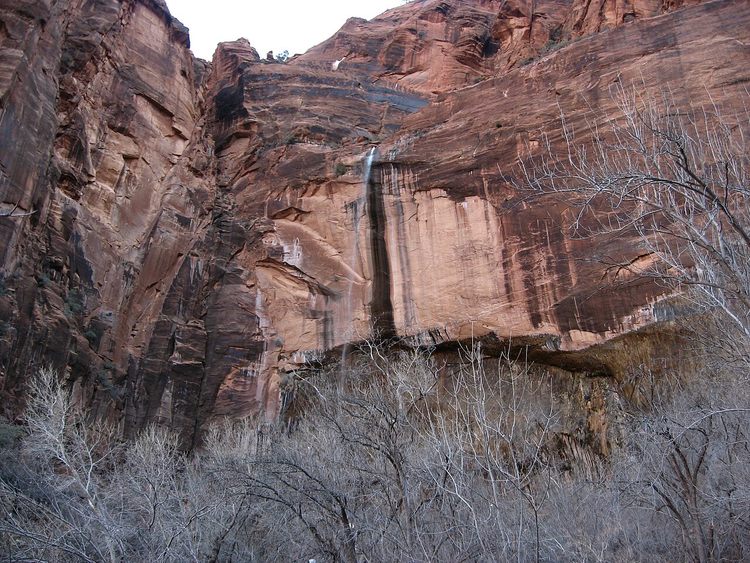 © Ken Lund from Reno, Nevada, USA · CC BY-SAPhoto: Ken Lund from Reno, Nevada, USA, CC BY-SA (https://creativecommons.org/licenses/by-sa/2.0), Wikimedia Commons
Trails and hiking routes
The park's trails are divided by difficulty. Riverside Walk is paved and works well for a short stroll. The trail to Angels Landing starts at The Grotto stop and ends with chains above the cliff. The route along the upper rim of the canyon runs along the edge, so without experience and gear it's best not to go there.
Plan your hike for the morning. The first shuttle leaves the visitor center at 7:00, and by midday you can finish the most exposed part of the route (as of 09/2026, shuttle schedule). Bring water, a hat, and shoes with good traction.
If you don't want to plan on your own, check out guided canyon tours on GetYourGuide.
Other US national parks: Everglades, Glacier, and Yellowstone.
Climate and nature of the park
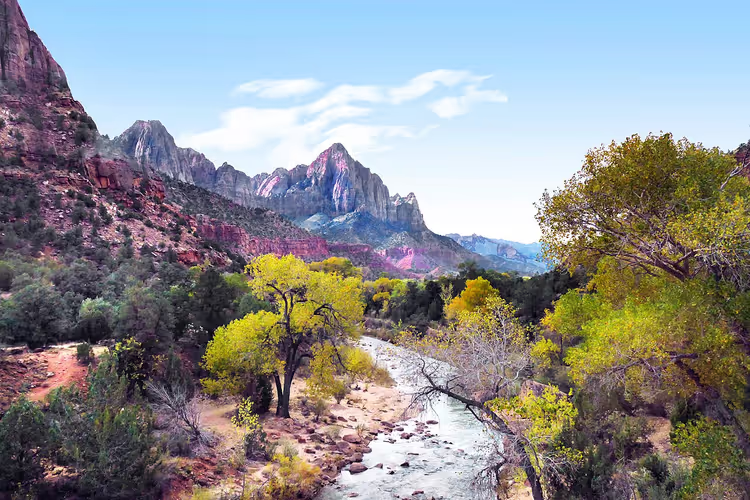
Elevation changes divide the park into climate zones. Pines, cacti, and yuccas grow on the plateau, while willows and maples hold on near the rivers. In spring the slopes are covered with flowers, in fall the rocks stand in gold, and in winter snow settles on the plateau.
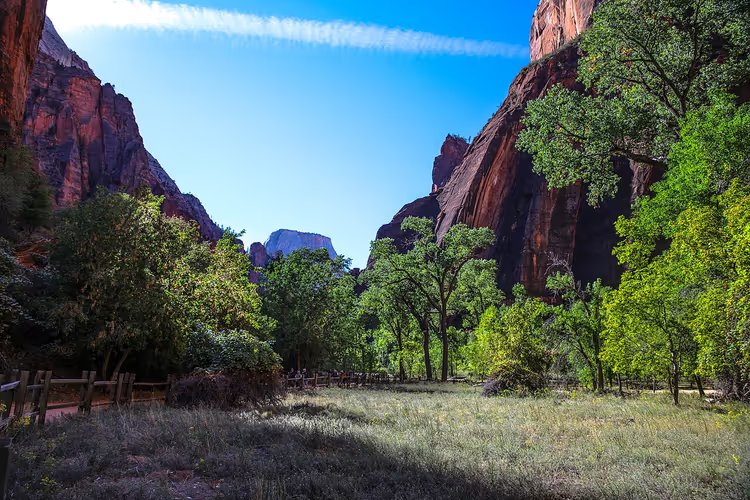 © Murray Foubister · CC BY-SAPhoto: Murray Foubister, CC BY-SA (https://creativecommons.org/licenses/by-sa/2.0), Wikimedia Commons
The daily temperature difference here exceeds 30 °F, or about 17 °C (as of 09/2026, weather and climate in the park). Bring a jacket even on a hot day: it gets cool in the canyon in the evening.
Over thousands of years, water has carved niches and caves into the sandstone. Birds nest in them, small mammals hide there, and insects live inside. The park has recorded hundreds of bird species and dozens of mammal species; among the larger animals here are mountain lions and deer, and desert reptiles crawl along the rocks.
Entrance, tickets and hours
The park is open year-round, and you only pay for entry. Prices and conditions were checked on 09/15/2026 on the official fees page.
Pass | Price | Who it's for | Duration |
|---|---|---|---|
Passenger car | $35 | Up to 15 passengers | 7 days |
Motorcycle | $30 | Up to 4 passengers | 7 days |
Pedestrian or cyclist | $20 | Ages 16 and up | 7 days |
Zion annual pass | $70 | No restrictions | 12 months |
America the Beautiful | $80 | All federal parks | 12 months |
America the Beautiful for non-residents | $250 | All federal parks | 12 months |
Fees are collected at the entrance, and paying by card is more convenient than cash (as of 09/2026, park fees page). Foreign visitors over 16 pay an additional $100 per person on top of any option except the annual pass or America the Beautiful (as of 09/2026, official park rates). Children under 15 enter free.
In 2026 there are free entry days, but they apply only to US citizens and residents (as of 09/2026, free days calendar).
A separate permit is required not only for Angels Landing, but also for wilderness camping, canyoneering, and The Subway route (as of 09/2026, conditions and permits).
A free shuttle runs through the canyon, and during the season private cars are not allowed on Zion Canyon Scenic Drive (as of 09/2026, shuttle information). The shuttle runs every 5-10 minutes, and the ride from the visitor center to the Temple of Sinawava takes about 45 minutes, so a round trip takes roughly an hour and a half.
Dates | First shuttle from visitor center | Last from visitor center | Last from canyon |
|---|---|---|---|
May 17 - September 12 | 7:00 AM | 7:00 PM | 8:15 PM |
September 13 - October 24 | 7:00 AM | 6:00 PM | 7:15 PM |
October 25 - November 28 | 7:00 AM | 5:00 PM | 6:15 PM |
November 29 - December 25 | No shuttle service | none | none |
December 26 - January 2 | 8:00 AM | 4:30 PM | 5:45 PM |
The schedule is updated by the park service, so check the official schedule before your trip. After January 2, shuttles do not run until spring. For spring start dates before May 17, check the park schedule. In winter, the canyon road is open to private cars, and you can drive to the trailhead yourself.
Parking at the visitor center fills up early, so people often leave their car in Springdale and ride to the entrance on the free Springdale Line town shuttle (as of 09/2026, route map).
Tours and tickets in Zion
Guided tours, skip-the-line tickets and activities — most offers can be cancelled free of charge.
See offers on GetYourGuideThe widget loads once you give your consent.
Zion National Park on the map
The park lies in southwestern Utah, near the town of Springdale. The visitor center is at the south entrance, and the east entrance leads to the highway through a tunnel. Below is a map: it's handy for estimating how long it takes to drive from Springdale to the viewpoints.
⁉️🤔 Frequently asked questions
How much does it cost to enter Zion National Park?
A vehicle with up to 15 passengers pays $35 to enter, pedestrians and cyclists pay $20 each, and the pass is valid for 7 days (as of 09/2026, official rates). Foreign visitors over 16 pay an additional $100 per person if they don't have an annual pass or America the Beautiful (as of 09/2026, official park fees). Children under 15 enter free.
Do you need a permit for Angels Landing?
Yes, the final section of the trail is open only with a permit, so you need to reserve a slot in advance (as of 09/2026, park rules). If you don't have a permit, hike to the overlook at the base: you still get a panoramic view of the canyon from there. Start in the morning while the trail is quiet.
When is the best time to visit Zion?
Every season has its own advantages (as of 09/2026, seasons in the park). In spring, cacti and yucca bloom; in fall, the cliffs glow gold; in winter, snow settles on the plateau. In summer, the canyon gets hot, so hikes are done before noon and you should bring water with you.
Do shuttles run in winter?
From November 29 to December 25, shuttles do not run, and from December 26 to January 2 they operate on a reduced schedule (as of 09/2026, seasonal schedule). After January 2, shuttles do not run until spring; check the park schedule for restart dates.
How do you get to the park without a car?
Stay in Springdale: a free Springdale Line shuttle runs from town to the entrance, with nine stops (as of 09/2026, shuttle route map). Inside the canyon you don't need a private car, because during the season the road is closed to vehicles.
In short: what's worth booking
If you have one day: arrive for the first shuttle at 7:00 and ride to the Temple of Sinawava. From there, walk the Riverside Walk to the start of The Narrows. If you have two or three days: add Angels Landing with a permit and Checkerboard Mesa at the east entrance. If you're traveling without a car: stay overnight in Springdale and use the town shuttle. Compare hotel prices in Springdale on Trip.com in advance: during the season, available rooms nearby are scarce.

A small editorial team writing guides for independent travel. We travel ourselves, but we haven’t been everywhere, so we check prices, opening hours and how to get there against official sources.