
















What to see in Frankfurt am Main: 20 places and ticket prices
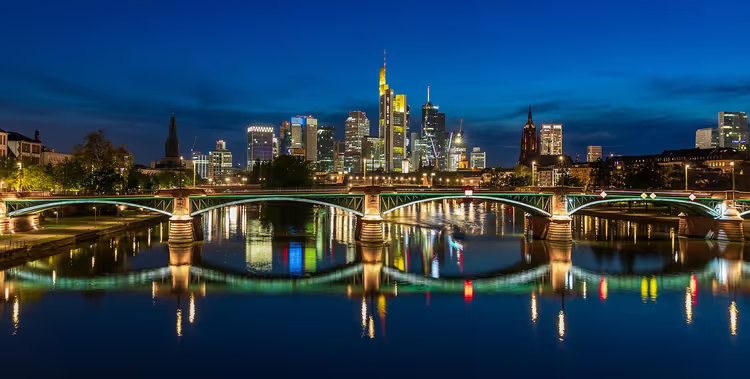
Frankfurt am Main surprises with its contrasts. The glass towers of the business district stand just steps away from the half-timbered houses of the old town. In one day you can cover the compact center on foot, and over a weekend you can add museums, the zoo, and parks. Below are twenty places worth putting at the top of your plan.
Let's start with specifics. A ticket to the MAIN TOWER observation deck costs €9 (as of 09/2026, maintower.de). The cathedral, Römerberg, and both bridges, on the other hand, are free to visit. This list will help you decide what to pay for and what to see for free.
Ad: this article contains affiliate links, we earn a commission if you book through them, at no extra cost to you.
What to see in Frankfurt am Main
💡 In short:
- The center is walkable: Römerberg, Römer, Hauptwache, and the cathedral are all within a kilometer radius.
- You pay for tickets at museums, the observation deck, and the zoo; everything else is free.
- Prices and opening hours: 09/2026, verified on the official websites of the venues.
1. The banking district
 © Epizentrum · CC BY-SAPhoto: Epizentrum, CC BY-SA (https://creativecommons.org/licenses/by-sa/3.0), Wikimedia Commons
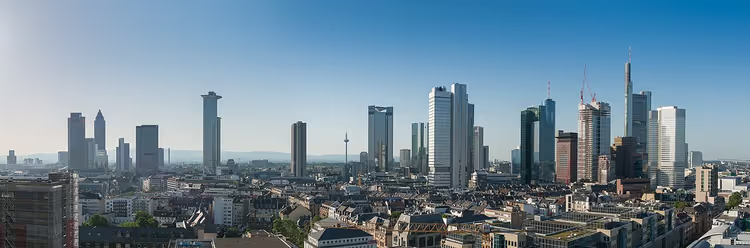
The banking district (Bankenviertel) is called the business heart of Frankfurt and one of Europe's largest financial markets. The area has no clear boundary: it covers the west of Innenstadt, the south of Westend, and the eastern part of the station district (Bahnhofsviertel). Its central square is called Opernplatz.
Commerzbank and Helaba offices are located here, and branches of foreign banks operate nearby. The district's tallest tower, Commerzbank Tower, rises noticeably above its neighbors, but there is no observation deck inside. You view these towers from the street or from the Main river embankment.
- Who it's for: anyone interested in modern architecture and the business rhythm of the district.
- The catch: tourists are not allowed inside the offices, and the district has no observation deck of its own.
2. Römerberg square
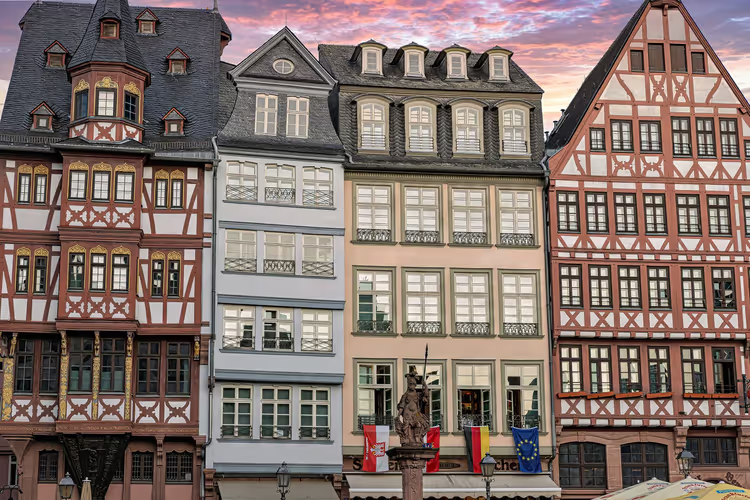
Römerberg is considered the historic center of the city, and you recognize it from postcards even before your trip. In the early Middle Ages, fairs, tournaments, and coronations took place here, and later the city government established itself on the square.
In the center stands the Fountain of Justice with a statue of Justitia. A few steps away you will find a memorial plaque commemorating the books burned by the National Socialists. The eastern row of houses consists of half-timbered buildings reconstructed from historical drawings.
- The catch: in summer the square is packed with tour groups, so you will only get a calm photo in the morning.
3. Römer
 © DXR · CC BY-SAPhoto: DXR, CC BY-SA (https://creativecommons.org/licenses/by-sa/4.0), Wikimedia Commons
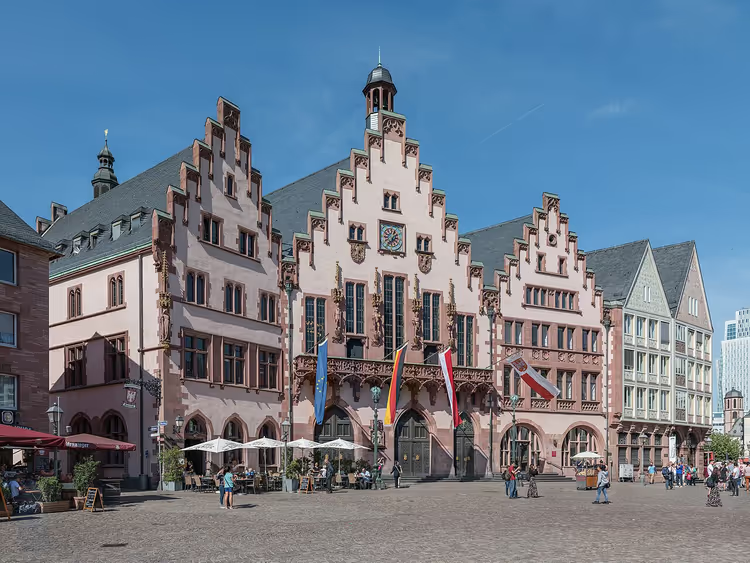
Römer, Frankfurt's oldest city hall, gave the entire square its name. The name translates as "Roman." The city council bought these houses from a merchant back in the early 15th century, and over the centuries nine more buildings and several inner courtyards were added.
The city hall was heavily damaged in World War II: reconstruction began immediately after 1945, and it reopened a decade later. Take a look at the gallery with portraits of the emperors on the second floor. German leaders greeted crowds from the Römer balcony, and it offers a good view of the square.
- The catch: some halls are closed for official city receptions, so access can be limited.
4. Hauptwache square
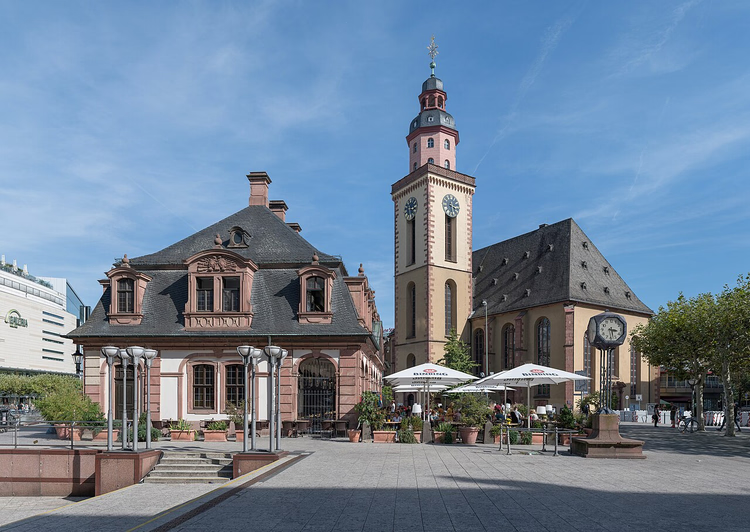 © DXR · CC BY-SAPhoto: DXR, CC BY-SA (https://creativecommons.org/licenses/by-sa/4.0), Wikimedia Commons
Hauptwache is considered Frankfurt's central and most recognizable square. Until the early twentieth century it was called Schillerplatz. The main architectural feature here is a Baroque building that once housed the headquarters of the city guard.
The square has been rebuilt several times. In its current form, you descend a sunken terrace to an underground pedestrian zone with shops and a transit station. St. Catherine's Church stands nearby, and around it new buildings have risen on the sites of those destroyed in the war.
- The catch: the underground level looks like an ordinary shopping mall, with no historic character.
5. Museum embankment
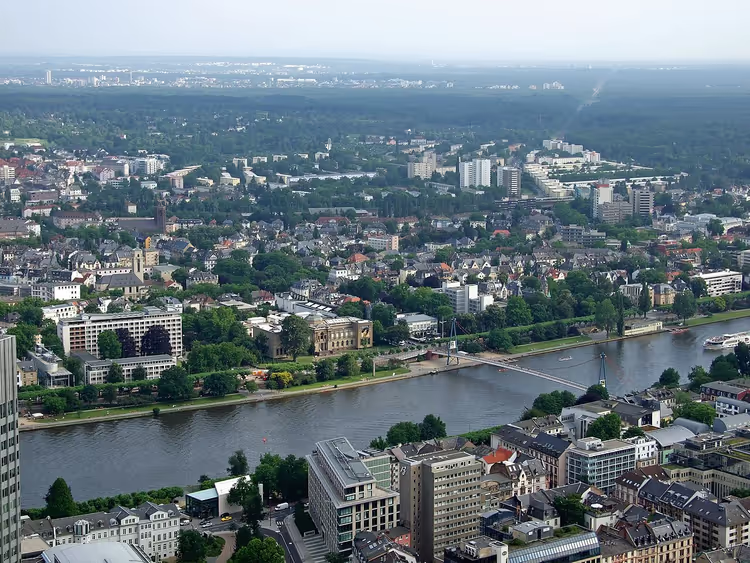 © dontworry · CC BY-SAPhoto: dontworry, CC BY-SA (http://creativecommons.org/licenses/by-sa/3.0/), Wikimedia Commons
The museum embankment (Museumsufer) brings together the city's art collections on the south bank of the Main. Nine exhibition buildings stand side by side here, from classical painting to architecture and film. A walk along the embankment and a visit to one museum will fill half a day.
Once a year, usually in August, the museums open their doors for the "Night of the Museums," when a single ticket gives you access to several buildings. Each museum has its own opening hours and prices, so check them on the official websites.
6. Senckenberg Museum
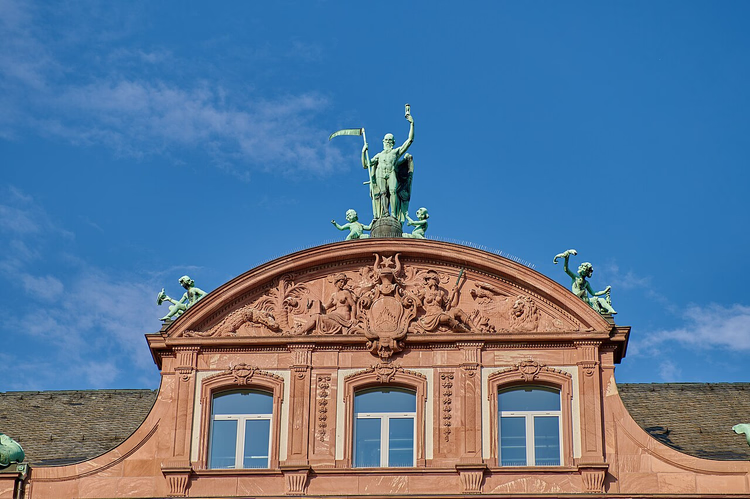 © Tilman2007 · CC BY-SAPhoto: Tilman2007, CC BY-SA (https://creativecommons.org/licenses/by-sa/4.0), Wikimedia Commons
The Senckenberg Natural History Museum (Senckenberg Naturmuseum) is one of the most visited museums in Frankfurt. It houses one of Europe's largest collections on the history of the planet and evolution, including dinosaur skeletons.
Kids are usually impressed by the reconstructions of ancient reptiles and the hall with the "Lucy" skeleton. The official website recommends coming in the afternoon or on Wednesday evening, when the halls are quieter. Museum tickets with a time slot are easy to buy online, so you don't have to wait in line at the ticket office.
- Cost: adult ticket 12 €, children 6-17 years 6 €, under 5 free (as of 09/2026, official website).
- Hours: weekdays 9:00 to 17:00, Wednesday until 20:00, weekends 9:00 to 18:00.
- The catch: on weekend mornings, school groups gather at the entrance.
7. Goethe House Museum
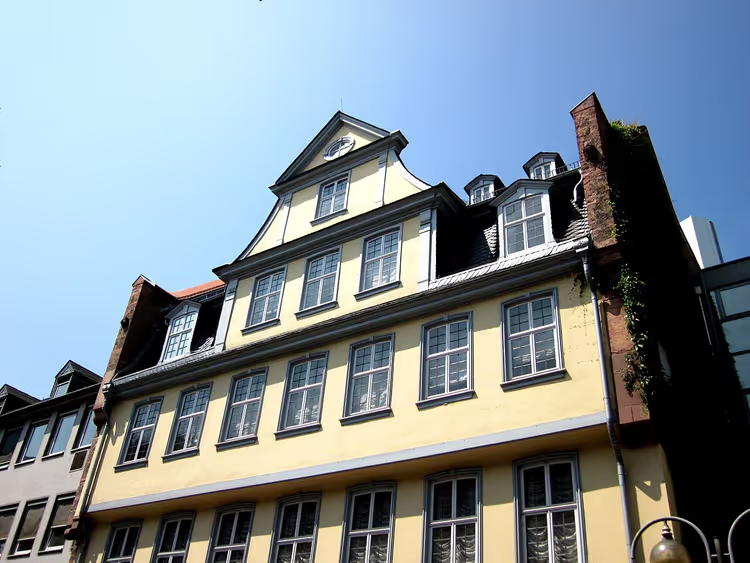 © Munin2005 · CC BYPhoto: Munin2005, CC BY (https://creativecommons.org/licenses/by/3.0), Wikimedia Commons
The Goethe House Museum stands in the poet's birthplace, exactly where it belongs. The 17th-century building was destroyed in a bombing raid, but after the war it was restored as close to the original as possible. The kitchen, living room, and reception rooms convey the everyday life of a wealthy family in the late Baroque era.
This is where Goethe wrote "Faust" and "The Sorrows of Young Werther." In the museum you'll see a collection of paintings, sketches, and busts from the 18th and 19th centuries. The ticket also gives you entry to the neighboring German Romantic Museum, so plan at least two hours for the visit. Tickets to the Goethe House and the Romantic Museum are sold at the ticket office and online.
- Cost: adult ticket 12 €, students 7 €, children under 6 free (as of 09/2026, official website).
- Hours: Monday through Saturday 10:00 to 18:00, Thursday until 21:00.
- The catch: the historic rooms are accessed via staircases, and the old house has no elevator.
8. Alte Oper
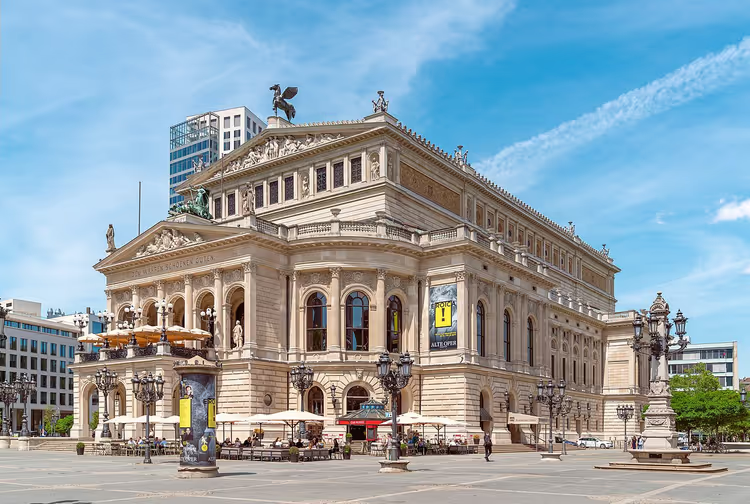 © Thomas Wolf , www.foto-tw.de · CC BY-SAPhoto: Thomas Wolf , www.foto-tw.de, CC BY-SA (https://creativecommons.org/licenses/by-sa/3.0/de/deed.en), Wikimedia Commons
The Alte Oper (Old Opera House) was reborn thanks to the city's residents: after the bombing, they defended the building through protests and raised donations for its repair. Since then, concerts, musicals, and jazz evenings have been held here year-round. The season opens with the contemporary music festival "Auftakt."
National and international ensembles perform in the Great Hall, while the Mozart Hall is dedicated to chamber and symphonic programs. Even without a ticket, it's worth approaching the building in the evening: the illuminated facade and the square in front of it create a grand view.
- Who it's for: for those who want to combine a walk through the city center with a concert.
- The catch: for popular evenings, cheap seats sell out early, so check the program on the website.
9. Frankfurt Cathedral
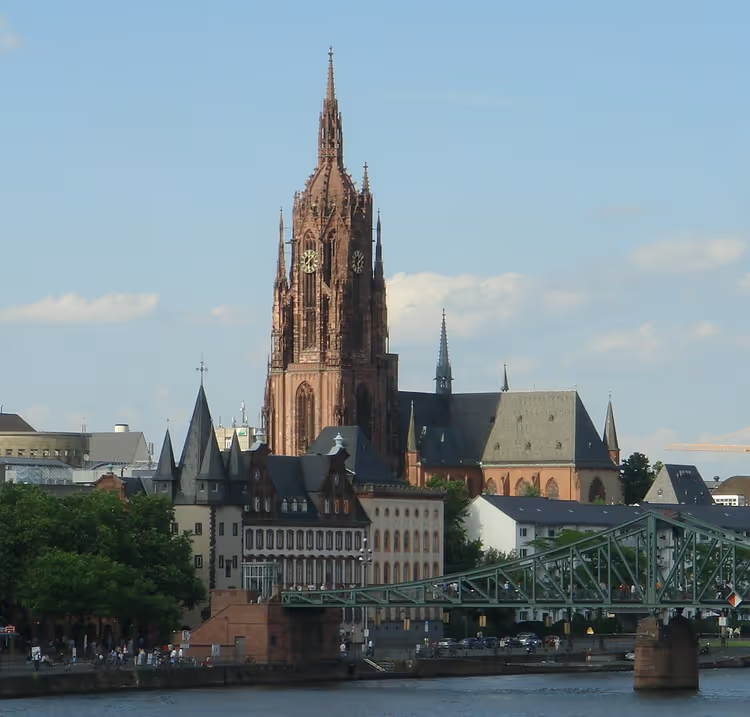 © rupp.de · CC BY-SAPhoto: rupp.de, CC BY-SA (http://creativecommons.org/licenses/by-sa/3.0/), Wikimedia Commons
Strictly speaking, Frankfurt Cathedral (Kaiserdom St. Bartholomäus) is not actually a cathedral, since it was never the main church of a bishop. But it was here, starting in the mid-14th century, that kings were elected by decree of Charles IV. Later, ten monarchs received the imperial title here.
The current church is already the fifth one on this site. After a major fire, it was restored in the neo-Gothic style and given a spire 95 meters high. From April to October you can climb the tower, which means tackling 324 steps. Morning and evening services are held in the cathedral, and visitors are welcome to attend those too.
- Cost: entry to the cathedral is free, climbing the tower costs a couple of euros.
- The catch: the climb goes up a narrow spiral staircase with no elevator, which is tiring in hot weather.
10. St. Paul's Church
St. Paul's Church (Paulskirche) was first consecrated in 1833 as the city's main Evangelical Lutheran church. Red sandstone and an elliptical hall make it unlike Gothic churches. The first all-German parliamentary assembly met here, so the building is considered a symbol of the beginning of German democracy.
In 1944 the church was completely destroyed, and a new consecration took place in 1948, for the centenary of the National Assembly. Today, public exhibitions are held from time to time on the lower floor, while the hall itself serves for city and state ceremonies.
- Who it's for: for those interested in the modern history of Germany.
11. St. Justin's Church
St. Justin's Church (Justinuskirche) stands in the Höchst district and is considered the oldest building in Frankfurt. Its three-nave basilica was founded around the 9th century and has survived to this day. It is a rare example of a fully preserved early medieval church.
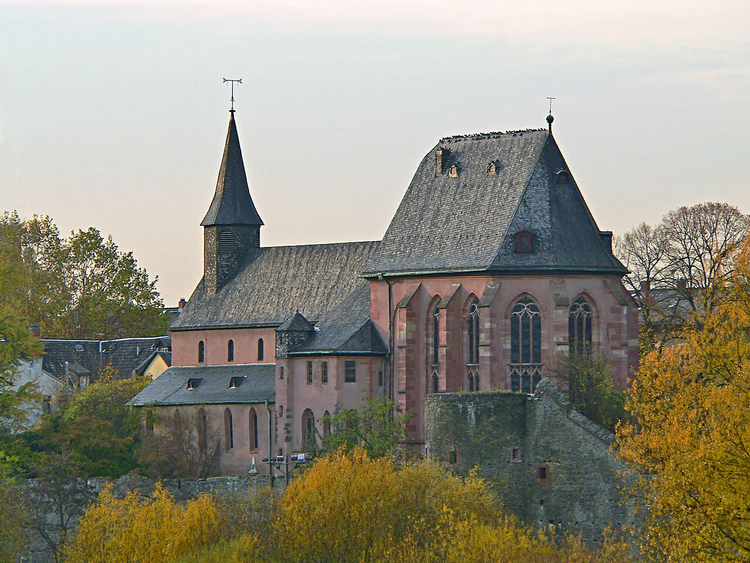 © Eva K. / Eva K. · CC BY-SAPhoto: Eva K. / Eva K., CC BY-SA (https://creativecommons.org/licenses/by-sa/2.5), Wikimedia Commons
The interior combines medieval forms and baroque. In the western part you will find a baroque crucifix. The Höchst district lies away from the center, so people stop here on the way to the old streets along the Main.
- Opening hours: from April to October from 2:00 pm to 5:00 pm, from November to March until 4:00 pm, closed on Mondays.
12. Europaturm
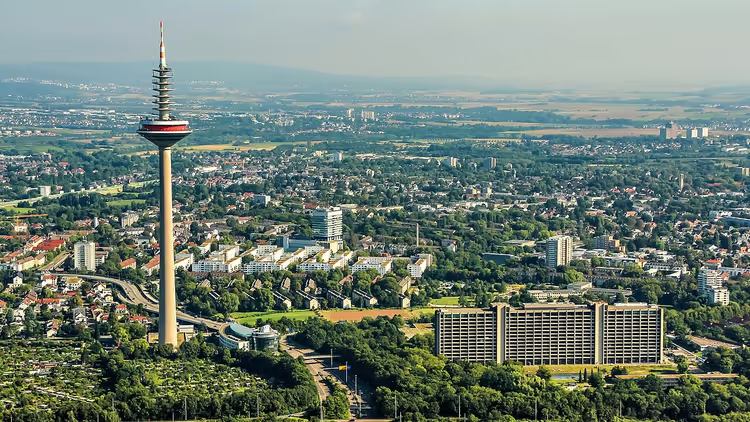 © Dr. Thomas Liptak · CC BY-SAPhoto: Dr. Thomas Liptak, CC BY-SA (https://creativecommons.org/licenses/by-sa/4.0), Wikimedia Commons
Europaturm rises above the city as a television tower. It was designed by Erwin Heinle, and construction began in 1974. The upper part of the tower can rotate, and the platform used to offer a panoramic view of the Rhine.
But since 1999 Europaturm has been closed to visitors: the restaurant and club at the top are not operating. The tower belongs to T-Systems, and its evening lighting is done in the company's signature purple. You can only admire it from the outside; for a city panorama, the Main Tower platform is a good choice.
- The catch: you can't get inside, the tower is only available for viewing from the outside.
13. Main Tower
 © Geographer · CC BY-SAPhoto: Geographer, CC BY-SA (https://creativecommons.org/licenses/by-sa/4.0), Wikimedia Commons
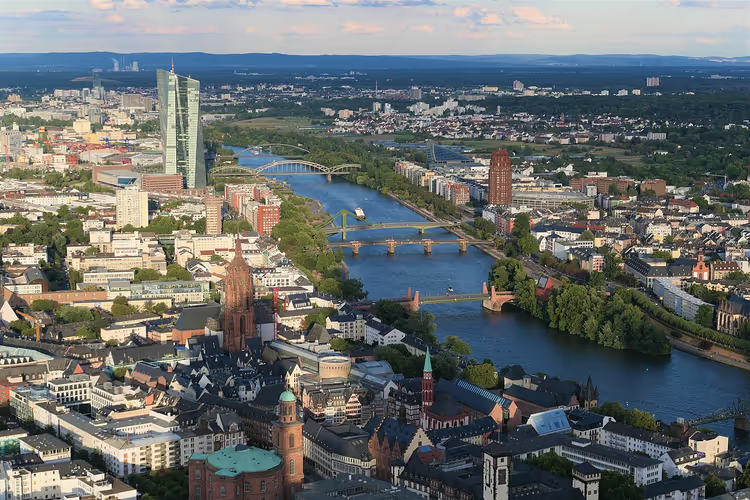
Main Tower was completed in 1999, and locals, accustomed to the city's high-rises, were still impressed. It is the first office building in Europe with a fully glass facade. Essentially, the complex consists of two towers: one square, the other rounded and slightly taller.
The observation deck at the top is open to everyone, and it is the only such spot in the city with a restaurant attached. Popular radio and television studios operate on the upper floors. Get tickets for the observation deck in advance; the line gets longer toward sunset.
- Cost: adult ticket 9 € (as of 09/2026, maintower.de).
- Opening hours: in winter from 10:00 am to 7:00 pm, on Fridays and Saturdays until 9:00 pm.
- The catch: the last elevator ride up is allowed 45 minutes before closing.
14. Eschenheim Tower
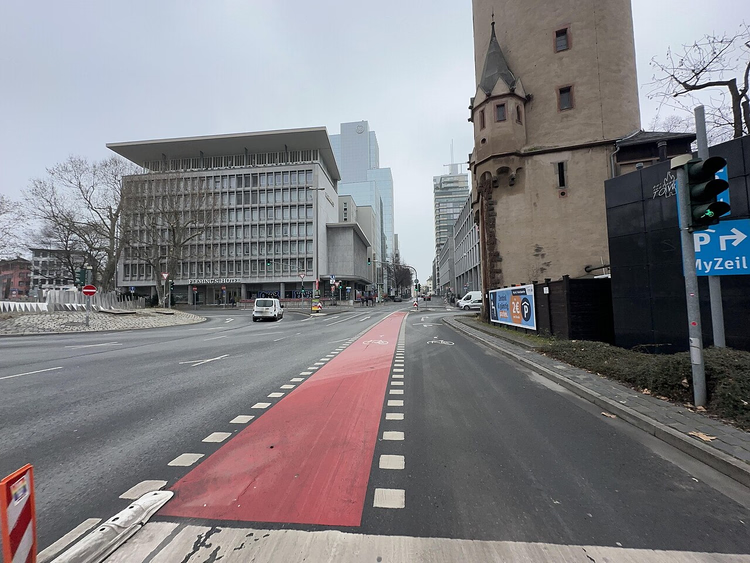
Eschenheim Tower (Eschenheimer Turm) stands at the end of Bockenheimer Anlage park. It was once one of forty-two watchtowers on the city wall, built in 1428. The tower is about 47 meters high, with eight levels and two attics inside.
 © TDS_ReLUT · CC BY-SAPhoto: TDS_ReLUT, CC BY-SA (https://creativecommons.org/licenses/by-sa/4.0), Wikimedia Commons
A guard lived in the tower, and these rooms were used until the mid-20th century. Today a bar and restaurant operate inside, attracting both tourists and locals. The tower has survived almost in its original form, so it looks unusual amid the city bustle.
- Who it's for: for those who want to have dinner inside a real medieval tower.
15. My Zeil shopping center
 © Mbn 1969 · CC BY-SAPhoto: Mbn 1969, CC BY-SA (https://creativecommons.org/licenses/by-sa/4.0), Wikimedia Commons
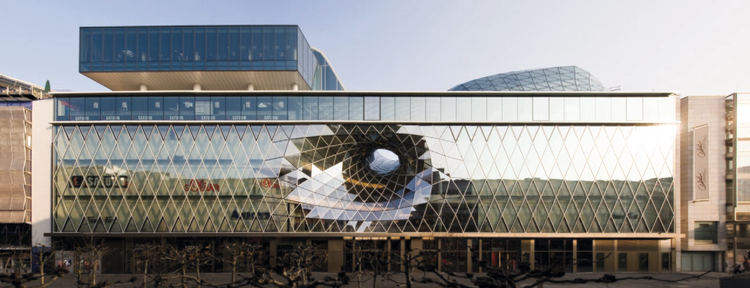
The My Zeil shopping center opened on Zeil street in 2009, designed by architect M. Fuksas. The building features an unusual glass "vortex" that lets soft daylight inside. More than eighty stores operate inside, from mass-market brands to boutiques.
Zeil is the city's busiest shopping street, so people come here both to shop and simply to look at the architecture. You also get into a covered space if it starts raining.
- Opening hours: Monday through Saturday from 10:00 am to 9:00 pm, closed on Sundays.
16. Frankfurt's Old Bridge
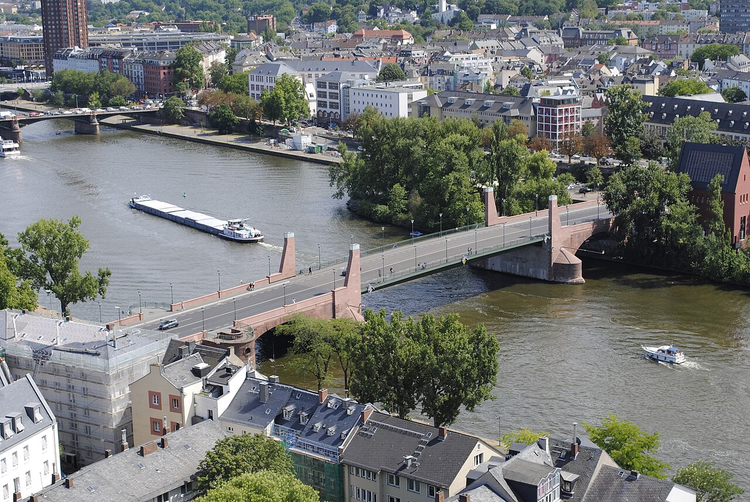
Frankfurt's Old Bridge (Alte Brücke) got its familiar look in 1926. The previous structure was replaced then, and the bridge was later reconstructed. Until the end of the 19th century it was essentially the city's only bridge across the Main.
 © Daviidos · CC BY-SAPhoto: Daviidos, CC BY-SA (https://creativecommons.org/licenses/by-sa/4.0), Wikimedia Commons
There is a legend about its construction: the master supposedly made a deal with the devil and sent a rooster across first to deceive him. The modern bridge is almost 20 meters wide and about 237 meters long. After the war, several red sandstone spans were replaced with metal structures.
- The catch: little remains of the historic appearance; part of the bridge is assembled from metal.
17. Eiserner Steg pedestrian bridge
 © Simsalabimbam · CC BY-SAPhoto: Simsalabimbam, CC BY-SA (https://creativecommons.org/licenses/by-sa/3.0), Wikimedia Commons
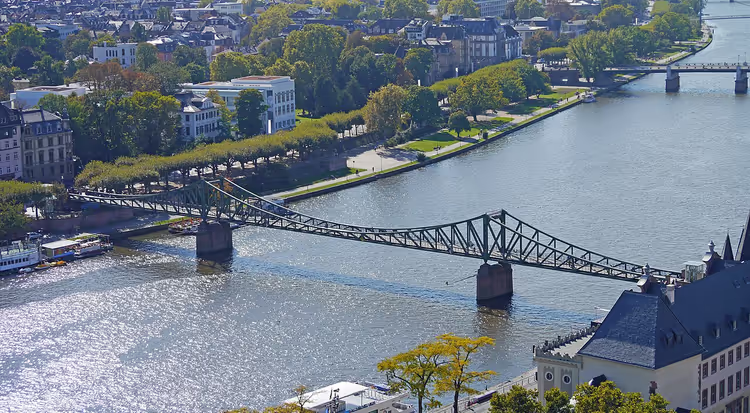
Eiserner Steg was built in 1868-1869 as the third bridge across the Main, and from the start it was for pedestrians only. The reason was simple: there was not enough space on the Frankfurt bank for the ramps of a road bridge. A toll was initially charged for crossing to cover the construction costs.
The fee was abolished when the bridge came under city control. The bridge is about 170 meters long; it was rebuilt in 1911 and restored in 1946 after being blown up. Today it is the most convenient route from Römer to the museum embankment, and the skyline views from here are the best.
- The catch: in the evening and on weekends the bridge is crowded with people and "locks" on the railings.
18. Frankfurt Zoo
 © Melkom · CC BY-SAPhoto: Melkom, CC BY-SA (http://creativecommons.org/licenses/by-sa/3.0/), Wikimedia Commons
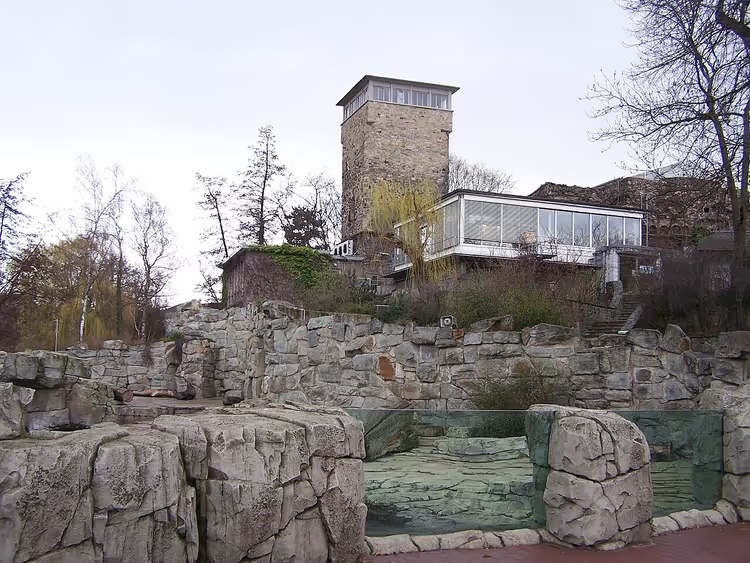
Frankfurt Zoo (Zoo Frankfurt) was founded in 1858, which makes it one of the oldest in the world. Thousands of animals live in open enclosures and specially designed pavilions, and the most famous attraction here is Europe's largest nocturnal animal house.
The Exotarium deserves special attention: it houses penguins, reptiles, marine and freshwater fish, and through a grotto you can even watch the inhabitants underwater. Buy zoo tickets online, then you can enter through a separate entrance.
- Hours: the zoo is open longer in summer than in winter; check the exact schedule and ticket prices on the official website.
19. Bethmann Park
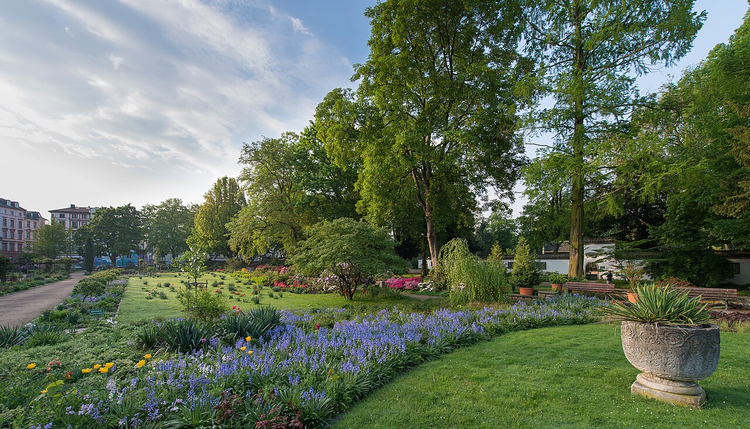
Bethmann Park (Bethmannpark) was laid out by the Bethmann banking family around their house in the late 18th century. By the 1940s the garden passed to the city, and since 1952 it has been open to visitors. The park's main treasure is a Chinese garden with a marble bridge, pavilions, a pond and a waterfall.
 © Epizentrum · CC BYPhoto: Epizentrum, CC BY (https://creativecommons.org/licenses/by/3.0), Wikimedia Commons
The garden was designed after the gardens of Huizhou County, so East Asian aesthetics reign here. Thick walls shut out the city noise. In summer you'll find shade and quiet here, ten minutes from the busy Zeil.
- The catch: the Chinese garden is intimate, and on weekends the small area gets crowded.
20. Palm Garden
 © Sdkb · CC BY-SAPhoto: Sdkb, CC BY-SA (https://creativecommons.org/licenses/by-sa/4.0), Wikimedia Commons
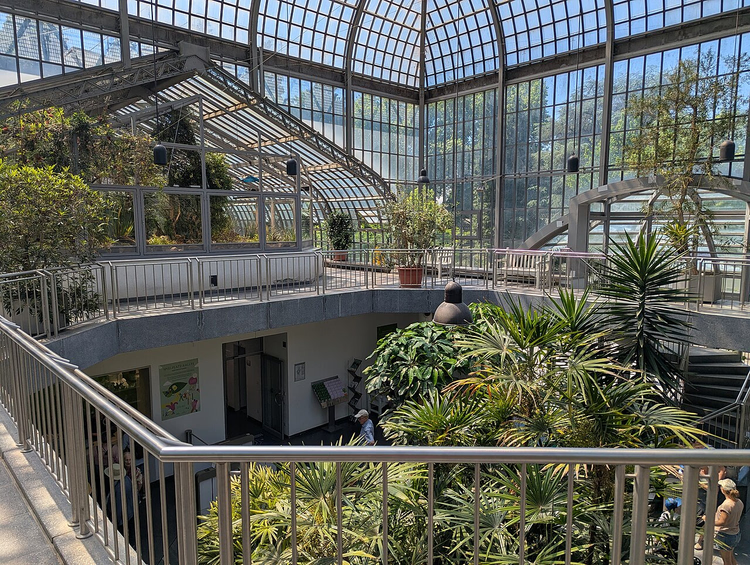
The Palm Garden (Palmengarten) in the center of the metropolis has gathered plants from all over the world, so you step into the exotic without leaving the city. One of the main highlights here is the Tropicarium with landscapes of savannas, deserts and monsoon jungles. At the center stands a flower house where plants bloom year-round across an area of about 200 square meters.
The garden constantly hosts exhibitions and concerts, and in summer there's a playground, a pond with little boats, mini golf and a small railway. Buy Palm Garden tickets online, which is convenient during the blooming season.
- Cost: an adult ticket is about €9 (as of 09/2026, rheinmain4family.de), and on weekdays after 6:30 pm an evening rate applies.
- Hours: the garden is open year-round, with hours depending on the season (official website).
Frankfurt am Main attractions on the map
It's easier to build a route from this list on a map: the center is compact, and you can cover most of the points in one day. Start at Römerberg, go up the Main Tower and finish at the museum embankment. That way you'll see the old town, the skyline and the Main riverbank without unnecessary travel.
Landmarks of Frankfurt am Main
Places on the map
- 1Banking District The city's business heart, offices of Commerzbank and Helaba
- 2Römerberg Square Historic city centre, the "Justice" fountain
- 3Römer (Old Town Hall) Frankfurt's oldest town hall, gallery with portraits of emperors
- 4Hauptwache Central square, Baroque building of the former guardhouse
- 5Museum Embankment Nine museums in a row on the southern bank of the Main
- 6Senckenberg Museum Dinosaur skeletons and a hall with the skeleton of "Lucy"
- 7Goethe House Museum The house where Goethe wrote "Faust" and "The Sorrows of Young Werther"
- 8Old Opera House Concert hall rebuilt with donations from the citizens
- 9Frankfurt Cathedral Kaiserdom, where kings were elected from the 14th century
- 10St. Paul's Church Paulskirche, a symbol of the birth of German democracy
- 11St. Justinus Church Frankfurt's oldest building, a 9th-century basilica
- 12Europaturm TV tower, closed to visitors since 1999
- 13Maintower Observation deck with a restaurant, the best view of the skyline
- 14Eschenheim Tower Medieval watchtower from 1428, now a bar and restaurant
- 15MyZeil My Zeil shopping centre with a glass "whirlpool"
- 16Old Bridge (Alte Brücke) Historic bridge over the Main, a legend about a deal with the devil
- 17Eiserner Steg Pedestrian bridge from 1869, the best views of the skyline
- 18Frankfurt Zoo One of the world's oldest zoos, home of nocturnal animals
- 19Bethmann Park Chinese garden with a marble bridge and waterfall
- 20Palm Garden Botanical garden with a tropicarium and flower house
Tickets for the observation deck, museums and the zoo should be bought in advance, especially on weekends. Check tickets and tours on GetYourGuide when you don't want to compare schedules for each attraction.
Tours and tickets in Frankfurt
Guided tours, skip-the-line tickets and activities — most offers can be cancelled free of charge.
See offers on TiqetsThe widget loads once you give your consent.
⁉️🤔 Frequently asked questions
What can you fit into one day in Frankfurt?
Start with Römerberg, the Römer, and Hauptwache: they're close together, and you can cover them in a couple of hours. In the afternoon, go up the Main Tower, then cross the Eiserner Steg to the museum embankment. Catch the sunset from the bridge or the observation deck: the skyline views from there are the best.
How much do tickets to the main sights cost?
An adult ticket to the MAIN TOWER observation deck costs 9 €, the Senckenberg Museum 12 €, the Goethe House 12 €, the Palm Garden about 9 € (as of 09/2026, official websites). The cathedral, Römerberg, and both bridges are free to enter.
Is the Europaturm observation deck open?
No, the Europaturm has been closed to visitors since 1999. For a panoramic view of the city, the Main Tower observation deck works well.
What to see in Frankfurt with kids?
Kids usually enjoy the zoo and the Palm Garden: the zoo has a nocturnal animal house and the Exotarium, and the Palm Garden has a playground, mini golf, and a small railway. On rainy days, the Senckenberg Museum with its dinosaurs is a good fallback.
Where's the best place to photograph the skyline?
The best shots with the towers come from the Eiserner Steg and the Main Tower observation deck. During the day, head to the museum embankment; in the evening, shoot the illuminated skyline from the bridge. For the romantic "padlock" on the railing, go to the pedestrian bridge over the Main.
If you want to see the city in advance, watch a short video overview of the route.
In short: what's worth booking
If you're traveling with kids: add the zoo and the Palm Garden. If you're more into art: two museums on the embankment are enough, and you can see the rest from outside.
Book observation deck and museum tickets in advance, weekend slots sell out faster. Hotels in Frankfurt on Trip.com can help you pick a base in the center, near Römerberg.

A small editorial team writing guides for independent travel. We travel ourselves, but we haven’t been everywhere, so we check prices, opening hours and how to get there against official sources.