
















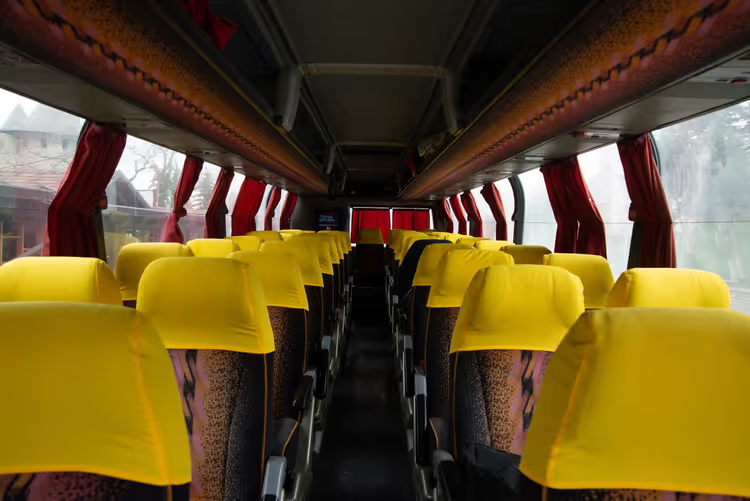
Bus tour: how to choose the cabin class and not get tired on the road
A bus tour replaces several flights and hotels with one price. But comfort on such a trip depends not on the amount you pay, but on the details.
Seats in tour buses vary. A seat pitch of 77 cm and a pitch of 94 cm are two completely different levels of travel. If you are on the road all day, the difference becomes noticeable almost immediately.
Here is what you should check before paying for a tour: bus class, route and borders, luggage, food, and passenger rights in the EU. The rules were checked on 09/14/2026 on official EU pages.
Ad: this text contains affiliate links, we earn a commission from them, the price for you does not change.
How to choose a bus by comfort class
💡 In short:
- Ask about the cabin class: tourist, comfort, or business.
- Check the seat pitch in centimeters, and whether there is a toilet and a kitchen.
- Take seats in the middle of the cabin if you get motion sickness.
- Carriage rules and passenger rights: 09/2026, checked on the official EU page
Carriers divide tour buses into classes, like hotels by stars. The seat pitch in the basic class is about 77 cm, in the business version up to 94 cm, and the backrest reclines up to 45 degrees (according to carrier data, 09/2026).
Comfort class adds a footrest and more space. It is the middle ground between the basic and business versions. Compare the three levels by space and equipment.
Class | Space | Equipment |
|---|---|---|
Tourist | pitch about 77 cm | air conditioning, TV, toilet |
Comfort | more space | footrest |
Business | pitch up to 94 cm | backrest reclines up to 45 degrees |
A description like "comfortable bus" without numbers means nothing. Ask for specifics. If the tour promises an overnight transfer, check the cabin class in advance.
Route: countries, borders, and travel time
The more countries on the route, the more impressions and the more hours at the border. A circular tour through three or four countries makes for a vivid trip. It also adds hours at passport control.
Within Schengen there are no border checkpoints, but controls are sometimes reintroduced. Between Schengen and its neighbors you go through a full check. In high season you can lose several hours at the border (checked 09/14/2026, Schengen rules).
Traffic jams and late fellow travelers shift the schedule. A good operator builds time buffers between stops. A program without hours means a risk of arriving at the hotel at night. Check your own transfers to the meeting point against train and bus schedules.
What to take with you into the cabin
Take only what you need: that way your bag does not bother you or your neighbor. A compact bag that fits under your feet or on the shelf works well in the cabin.
A minimum of items is enough: hygiene products, a change of clothes, and any medications you take regularly. Take the rest only if you want to. From our travel experience: a charger and a power bank matter more than a second sweater.
Bring your devices fully charged. There are usually no outlets at every seat. A power bank solves this problem. A book and board games help on long stretches.
Do not forget lozenges or candy. Air conditioning dries the air over time, and your mouth gets dry. For children, a supply of candy is essential. Within the EU, mobile internet works at your home network rates. Outside the EU, an eSIM comes in handy; install it before departure.
Food on the road and at stops
Full meals are usually provided at hotels and during city walks. On the bus, the schedule gets disrupted, and you have to snack. Bring food that does not spoil on the road.
Fruit, nuts, cookies, and ready-to-eat products work well. A thermos of tea helps in cold months. Take your trash with you: not all stops have trash bins.
Breakfast on the program can be early. Check the breakfast time at the hotel if the group leaves early in the morning. Sometimes the kitchen is still closed. Then your own food supply will save you.
Passenger rights in case of delay and cancellation
On regular long-distance services in the EU, Regulation 181/2011 applies. It gives passengers the right to information, assistance, and compensation in case of disruption (checked 09/14/2026, text of the regulation).
If departure is delayed by more than 120 minutes on a route of 250 km or more, the carrier must offer a choice: a refund or another trip. If no choice was offered, you are entitled to compensation of 50% of the ticket price (EU Regulation 181/2011). In case of cancellation, you choose between a refund and rebooking on another trip.
The rules apply to regular services, not sightseeing tours. In a package tour, the relationship is governed by the contract with the operator. Read the cancellation terms before paying. That is your protection.
How to choose a seat on the bus
Your seat in the cabin affects the trip no less than the bus class. Up front you are closer to the guide and their microphone. In the back, the ride is bumpier.
If you get motion sickness, take a seat in the middle of the cabin. The amplitude of motion is minimal there. Near the toilet it is usually noisier because of the line and the slamming door. The first row by the partition gives the best view.
Safety rules often prohibit sitting next to the driver. If you like looking out the window, take a window seat. But in summer, the sunny side will be hot. Check the seating arrangement with the operator in advance.
Documents and insurance
A passport, an EHIC card, and a medical policy cover the basic formalities of the trip. Check your passport expiration date. Many countries require several months of validity after your return.
The EHIC card covers only public healthcare; everything else you pay for yourself without a policy. So it is worth comparing insurance options in advance, not on the day of departure. Check that the policy is valid in all countries on the route.
Take copies of your documents on your phone and on paper. Keep them separate from the originals. That way you will resolve the issue faster if you lose them.
⁉️🤔 Frequently asked questions
How many countries can you realistically cover on a week-long bus tour?
A circular route through several countries takes about a week. The more countries, the more hours you spend at borders and on transfers. For a first trip, two or three countries is enough. You will only see the rest from the bus window.
What should you do if the bus is delayed or the trip is canceled?
On regular long-distance services in the EU, Regulation 181/2011 applies. In case of a long delay, you are entitled to assistance and compensation. In case of cancellation, you choose between a refund or rebooking. On a sightseeing tour, the terms of the contract with the operator apply.
Should you bring food with you?
Yes, some meals have to be handled on the road. Hot food usually awaits at the hotel or at a stop.
How do you choose a seat if you get motion sickness?
Take a seat in the middle of the cabin. The motion is least noticeable there.
Do you need insurance for a bus tour?
Yes, it is worth it. The EHIC card covers only public healthcare in EU countries. A policy adds private treatment and repatriation.
In short: what to book
Before paying for a tour, check three things: the bus class, the number of countries, and the overnight cities. The cabin class affects your fatigue more than hotel stars.
If you have a week and this is your first bus tour, take two or three countries and more overnight stays on site. Want to cover the maximum? Be prepared for long transfers and early departures.
Compare travel insurance options before you leave.

A small editorial team writing guides for independent travel. We travel ourselves, but we haven’t been everywhere, so we check prices, opening hours and how to get there against official sources.