
















Badlands in South Dakota: park route and entrance fee
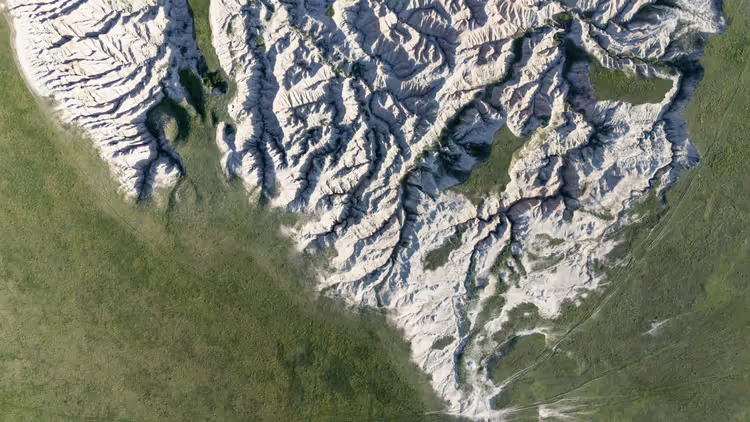
The Badlands in South Dakota appear suddenly. A minute ago, cornfields and green meadows stretched outside the window, and now the road dips between gray and rust-colored walls. This is Badlands National Park, a strip of prairie that water and wind have carved into ridges, cones, and deep ravines.
The park is open 24 hours a day, and entry costs $30 per car for seven days (as of 09/2026, NPS pricing page). Before the trip, you need to decide three things: when to go, where to enter the park, and how much time to allow. Below are answers to each, plus prices, roads, and animals you can see right from the shoulder.
Ad: this article contains affiliate links, we earn a commission if you book through them, at no extra cost to you.
How the Badlands formed
💡 In short:
- The terrain is made of clay, sandstone, volcanic ash, and lignite, which erode at different rates.
- The park's main road is called Badlands Loop Road; it is paved and passable for any car.
- Prices and hours: 09/2026, verified on the official NPS website.
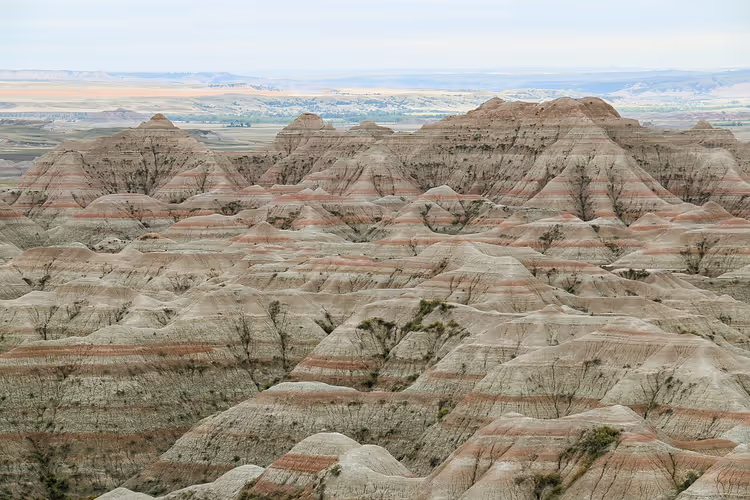
The Badlands are made of soft rock: clay, sandstone, volcanic ash, and layers of lignite. Rain and wind erode them at different rates. Soft layers disappear quickly, hard layers remain as ridges, so the slopes have turned into walls, cones, and ravines. The process is ongoing: after every heavy downpour, the terrain changes slightly, and old maps quickly become outdated.
 © Martin Kraft · CC BY-SAPhoto: Martin Kraft, CC BY-SA (https://creativecommons.org/licenses/by-sa/3.0), Wikimedia Commons
The name was not invented by geologists. The Lakota called this area "Mako Sica," bad land, and French traders translated the words as "lands that are difficult to travel through" (as of 09/2026, National Park Service). People lived here much earlier: archaeologists count twelve thousand years of human presence in the area (same source).
Lignite is also part of the landscape here. Layers of lignite ignite from lightning and smolder underground for years. The heat bakes the adjacent clay and turns it red, which is why the cliffs have a brick-colored tint.
Paleontologists value the park for its fossils. After heavy rains, bones of ancient mammals tens of millions of years old are found on the slopes. Taking them with you is prohibited; this is a protected national park area.
Nature of the Badlands
There is little vegetation in the Badlands. The dry clay soil barely holds moisture, so low grasses, shrubs, and occasional trees in the ravines grow here. This land cannot be farmed: ravines and rocky ridges alternate without any logic.
But light changes the landscape every hour. At sunrise, the tops of the jagged rocks turn rust-colored, at midday the colors fade, and in the evening the shadows in the canyons deepen almost to black. If you want to catch the best light, arrive at sunrise or two hours before sunset.
The Badlands attract those who collect unusual landscapes. The rocks here look like anything: tentacles, a layer cake, ruined walls. Going into the ravines without water and a hat is not advisable even for half an hour: there is almost no shade, and the climb back is steep.
Prairies, bison, and prairie dogs
The northern part of the park transitions into prairie. Bison, bighorn sheep, pronghorn antelope, and prairie dogs live there (as of 09/2026, National Park Service). They are most often seen from the gravel road Sage Creek Rim Road, which runs along the colonies and watering holes.
Prairie dogs resemble large squirrels and got their name from the sharp bark they use to call to each other near their burrows. The burrows go down three to five meters, and a sentry watches over the colony. Rangers ask visitors not to feed the animals and not to approach the burrows closely.
Hours and park entry
Today Badlands National Park is protected by the government; it received national park status in the 1970s. The park is open every day, 24 hours a day, but in winter and bad weather roads are sometimes closed (as of 09/2026, hours on the NPS website). Check road conditions before heading out.
For a passenger car, the entry ticket costs $30 and is valid for seven days (as of 09/2026, National Park Service). A motorcycle pays $25, a pedestrian or cyclist over sixteen pays $15. Cash is not accepted in the park; you need a card. Tickets are purchased online or at one of three entrance stations: Northeast, Pinnacles, and Interior.
If you plan to return, an annual pass for $55 is a better deal. For multiple US parks, America the Beautiful works: $80 for residents and $250 for non-residents (as of 09/2026, pass terms). A few days a year entry is free for US citizens and residents; the nearest such date in 2026 falls on September 17, Constitution Day (same source).
Park maps and brochures are available at the Ben Reifel Visitor Center on the main road (as of 09/2026, park visitor centers). A paleontology lab also operates there, where finds are prepared for exhibits. In the southern part, the White River Visitor Center is open, but there are no through roads across the South Unit, only gravel roads along the edge.
Tours and tickets in Badlands National Park
Guided tours, skip-the-line tickets and activities — most offers can be cancelled free of charge.
See offers on GetYourGuideThe widget loads once you give your consent.
Getting there and routes through the park
The easiest way to arrive is by car on the interstate past Wall and Interior. Entrance stations are located to the northeast, at Pinnacles, and in the center of the park, so you can enter from either side. You cannot manage here without a car: distances are measured not in kilometers but in hours, and there is no public transportation inside.
Badlands Loop Road, highway SD-240, is paved: two lanes, steep climbs, and pullouts for stopping (as of 09/2026, official road overview). It is convenient for driving through the entire park in half a day if you stop only at overlooks.
Sage Creek Rim Road, by contrast, is gravel. It runs along the prairie and is good for watching bison and prairie dogs (as of 09/2026, park road descriptions). After rain, it is best to avoid it, especially in a low-clearance car.
Another gravel road, Sheep Mountain Table Road, starts 4.5 miles south of highway SD-44 near the town of Scenic, and four-wheel drive is recommended here (as of 09/2026, Badlands gravel roads). There are no through roads into the South Unit at all; you can only get there via this gravel road or on foot.
If you are flying, the nearest major airport is in Rapid City, about an hour's drive from the western entrance. Allow at least half a day for the park itself, or better yet a full day starting at sunrise.
Badlands on the map
Your GPS will take you to the Ben Reifel Visitor Center, where park maps and road maps are available. From there, follow the signs to the overlooks.
⁉️🤔 Frequently asked questions
When is the best time to go to the Badlands?
May, June, and September offer mild weather and open roads. In July and August, the plateau is hot, there is almost no shade, and water is only available at the visitor centers. In winter, the park operates, but some roads close due to snow and ice, so check road conditions in advance.
How much does entry cost and how do you pay?
A passenger car with passengers pays $30 for seven days (as of 09/2026, park fees). Payment is by card only, online or at the entrance station.
Can you see the park without a car?
Technically yes, a pedestrian ticket is valid for a week. In practice, without a car you are limited to the area near the visitor center: the overlooks are tens of kilometers apart, and there is no public transportation inside the park. Many people take a day tour from Rapid City.
What should you see first?
The overlooks on Badlands Loop Road, the prairie dog colonies, and the prairie with bison along Sage Creek Rim Road. At the Ben Reifel Visitor Center, check out the paleontology lab where finds are prepared for exhibits. All of this takes a full day if you set out at sunrise.
How much time do you need for the park?
Allow at least half a day, preferably a full one. A single drive along the main road with stops takes several hours, and the gravel roads and prairie add just as much again. If you also want to see the South Unit, plan to stay overnight near the park.
In short: what to book
If you have one day and your own car, start at the Pinnacles entrance, drive Loop Road east, and finish with the prairie on Sage Creek Rim Road. If you are staying overnight, add sunrise at the overlooks and the paleontology lab at the visitor center.
Buy your ticket online in advance so you don't have to wait at the entrance station. Guided tours of the park from Rapid City are easy to find on GetYourGuide.

A small editorial team writing guides for independent travel. We travel ourselves, but we haven’t been everywhere, so we check prices, opening hours and how to get there against official sources.