
















Grand Canyon: entry prices, viewpoints and route to the park
Grand Canyon National Park in Arizona is visited by more than 5 million people every year (as of 09/2026, park data). Many come here for a day trip from Las Vegas. The drive to the South Rim takes about four and a half hours one way. That leaves little time for the canyon itself.
We put together practical information: how much entry costs, how the South and North Rims differ, how to get there from Las Vegas and Phoenix, and what actually works in the park right now. You will also learn about the Skywalk on Hualapai tribal land and Havasu Falls, which you can only visit with a permit.
Ad: this article contains affiliate links, we earn a commission if you book through them, at no extra cost to you.
Grand Canyon: what to know before you go
💡 In short:
- Car entry costs $35 and is valid for seven days (as of 09/2026, US National Park Service).
- The South Rim is open year-round, while services and camping on the North Rim run from mid-May to mid-October.
- Prices and hours of operation: 09/2026, verified on the official park website.
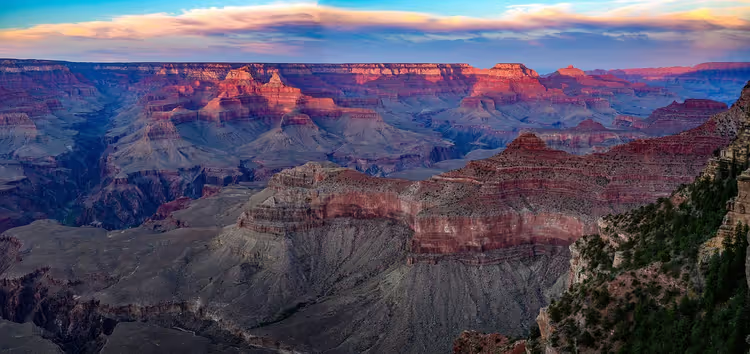
The Grand Canyon in Arizona is not a single gorge but an entire system of canyons carved by the Colorado River. The park is split into two large sections, and you cannot see both in one day. The driving distance between the rims is hundreds of miles, even though the straight-line distance is far shorter.
 © Marek Ślusarczyk ( Tupungato ) Photo portfolio · CC BYPhoto: Marek Ślusarczyk ( Tupungato ) Photo portfolio, CC BY (https://creativecommons.org/licenses/by/3.0), Wikimedia Commons
The most accessible and visited section is called the South Rim. Hotels, campgrounds, restaurants, and free shuttles operate here. This is where most travelers go.
The North Rim is much quieter. Far fewer people visit it each season. The road here is closed in winter, so you need to plan your visit for the warm season.
If you want to see how modern Native Americans live, check out the southwestern part of the gorge. The Havasupai and Hualapai reservations are still here and welcome guests. Attitudes toward visitors vary: some tribes have long earned money from tourism, while others remain wary.
Each section of the gorge differs in terrain, climate, and activities. At the same time, the canyon in Arizona is not the deepest in the world. Deeper gorges exist on the planet, but nowhere else has such a concentration of viewpoints.
History and geology of the canyon
The canyon walls reveal Earth's history with almost no excavation. Dozens of rock layers are visible in them, like a cross-section of a huge museum. The canyon is one of the clearest examples of how erosion changes an entire region.
The lower layers formed at the bottom of an ancient sea that once covered western North America. Later there were sand dunes here, and the climate shifted more than once from wet to dry. The oldest rocks are billions of years old.
The uplift of the earth's crust began tens of millions of years ago. The plateau rose, the rocks stretched and cracked. Then water took over: the Colorado River cut its channel deeper and carved the current shape of the walls.
The Ice Age accelerated erosion. A wet climate and meltwater widened the gorge, and the canyon gradually took its present form. When you stand on the rim and look down, you are seeing the result of millions of years of work by water and wind.
Size, climate, and the two sides of the park
The canyon stretches for hundreds of miles, and its width in places exceeds twelve miles. The average depth is more than a mile. These numbers do not convey the scale well, so it is better to see the rim from above once.
 © Grand Canyon National Park · CC BYPhoto: Grand Canyon National Park, CC BY (https://creativecommons.org/licenses/by/2.0), Wikimedia Commons
The dry climate and almost complete lack of vegetation make the landscape especially stark. It is hot on the rim during the day, and even hotter at the bottom: the temperature difference reaches ten degrees. Bring water and a hat even for a short walk. In late August 2026, some trails to Phantom Ranch and the bridges across the Colorado were closed due to flooding (as of 09/2026, park update). Check trail status before hiking.
The Colorado River divides the park into two sections at different elevations. That is why the climate, vegetation, and landscape differ.
South Rim: the main side of the park
The South Rim operates year-round and does not close even at night. Here you have a choice: camp at Mather Campground, stay at a hotel in Grand Canyon Village, or use the motels in the town of Tusayan. Parking for private vehicles is free.
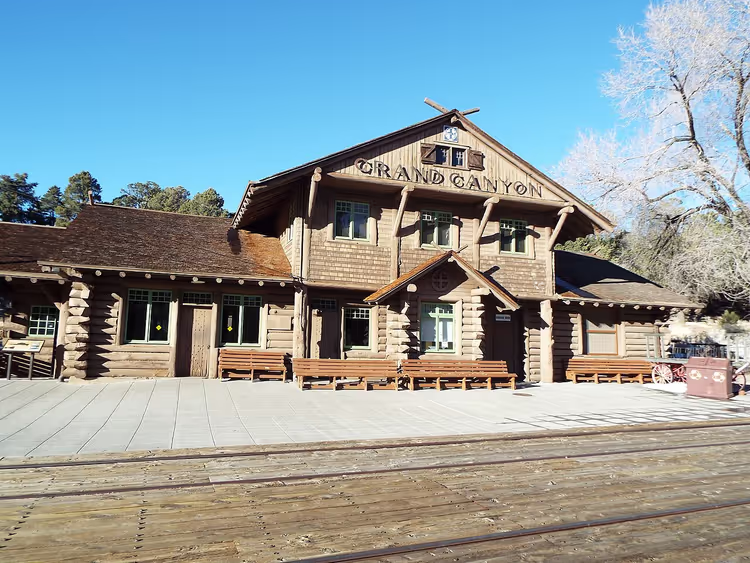 © Marine 69-71 · CC BY-SAPhoto: Marine 69-71, CC BY-SA (https://creativecommons.org/licenses/by-sa/4.0), Wikimedia Commons
Viewpoints are positioned so you can appreciate both the scale and the depth of the gorge. The best time for a scenic drive is early morning or after 2 pm. The entry line is shorter at those times, and there are fewer cars on weekdays than on weekends.
If you want to sleep next to the park, check out hotels near the South Rim on Trip.com. Book your accommodation in advance: during the season, there are almost no rooms left. Mather Campground operates inside the park year-round, and Desert View welcomes guests from mid-May to mid-October.
North Rim: quiet and the aftermath of the fire
The North Rim sits about three hundred meters higher than the South Rim and is far less crowded. Here you will find forest, cool air, and short trails along the cliff edge. Services and the campground operate from mid-May to mid-October. The road remains open until the first snow.
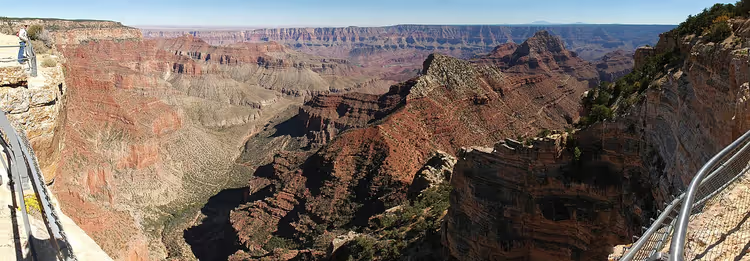 © Grand Canyon National Park · CC BYPhoto: Grand Canyon National Park, CC BY (https://creativecommons.org/licenses/by/2.0), Wikimedia Commons
In the summer of 2025, the North Rim was heavily damaged by the Dragon Bravo fire. The blaze destroyed the historic Grand Canyon Lodge and dozens of buildings, so no overnight stays are offered on this side for the 2026 season (as of 09/2026, North Rim status). Look for lodging outside the park.
Havasupai and Hualapai reservations
In the southwest lives the Havasupai tribe, the smallest of the region's indigenous peoples. People have lived here since the 13th century, and the economy was based on farming at the bottom of the canyon and hunting on the plateau.
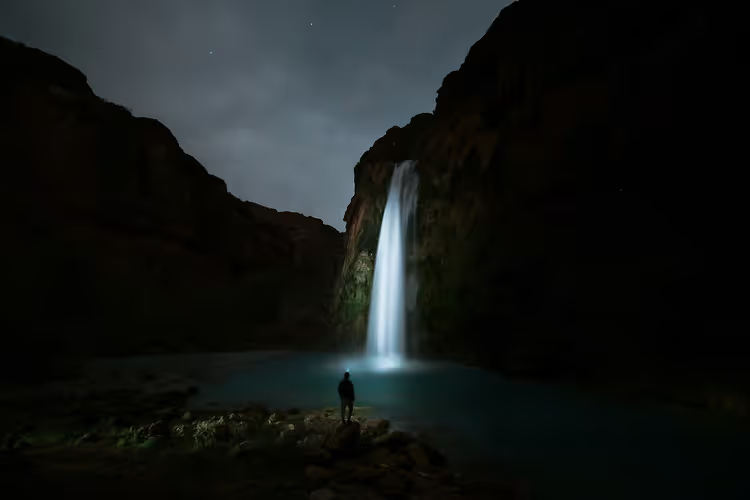
The land was handed over to the government in the late 19th century, and part of the territory was returned to the tribe nearly a hundred years later. Today, visiting Havasu Falls is possible only with a tribal permit, which you must arrange in advance. Without a permit, you will not be allowed onto the land.
The second tribe, the Hualapai, lives on a reservation closer to the western edge of the canyon. In addition to ranching and farming, the people here earn income from tourism services. The Hualapai Ranch was built for visitors, styled after an Old West town.
Here you can ride in a vintage stagecoach, go horseback riding, or take a motorboat down to the Colorado River. The programs are paid and sold on site. Keep in mind that some routes depend on the weather and may be closed.
Skywalk and grand canyon west
Near the Hualapai reservation is the Skywalk observation deck. This is the name given to a horseshoe-shaped glass bridge cantilevered over the chasm. The panels, about ten centimeters thick, withstand heavy loads, and the entire structure is bolted together with no supports beneath the glass.
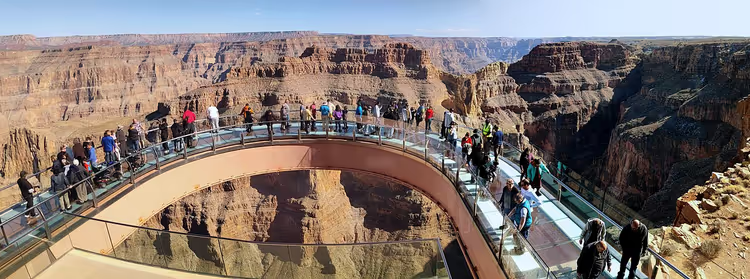 © Krigore · CC BY-SAPhoto: Krigore, CC BY-SA (https://creativecommons.org/licenses/by-sa/4.0), Wikimedia Commons
There is no longer a separate ticket for the bridge only. Skywalk admission is included in the Grand Canyon West package, and the full package price is close to one hundred dollars per person (as of 09/2026, operator's website). Photography is not allowed on the deck: you will have to leave cameras and phones in a locker.
Tickets, hours and rules
Park entry is paid, but you do not need to reserve it in advance: there is no timed entry at the Grand Canyon (as of 09/2026, NPS). The ticket is valid for both rims of the park, South and North. Payment is by card only; cash is not accepted at the entrance.
Prices for September 2026 according to the US National Park Service:
Who is traveling | Price | Validity |
|---|---|---|
Private vehicle with passengers | $35 | 7 days |
Motorcycle | $30 | 7 days |
Pedestrian or cyclist | $20 | 7 days |
An important note for guests from Europe. Non-residents of the US over 16 pay an additional $100 per person on top of the regular ticket if they do not have an annual pass (as of 09/2026, entry rules). This surcharge significantly changes the trip budget.
Annual passes also exist. The Annual Pass for the park itself costs $70, while America the Beautiful costs $80 for US residents and $250 for non-residents (as of 09/2026, price list). If you plan to visit several parks, the second option is a better deal.
Free days in 2026 apply only to US citizens and residents. The dates are: February 16, May 25, June 14, July 3-5, August 25, September 17, October 27, and November 11 (as of 09/2026, free entry days).
Hours depend on the rim. The South Rim and its village are open year-round, 24 hours a day. Mather Campground operates all year, while Desert View and the North Rim campground welcome visitors from mid-May to mid-October (as of 09/2026, hours and campgrounds).
The most convenient way to check canyon tickets and tours is in one place, where you can see the price and available slots at a glance.
Tours and tickets in Grand Canyon
Guided tours, skip-the-line tickets and activities — most offers can be cancelled free of charge.
See offers on GetYourGuideThe widget loads once you give your consent.
How to get to the Grand Canyon
If you do not live in the US, the easiest option is to fly to Las Vegas or Phoenix and then drive or take a bus from there. It is best to book flights to Las Vegas in advance: there are many flights, but prices rise in high season.
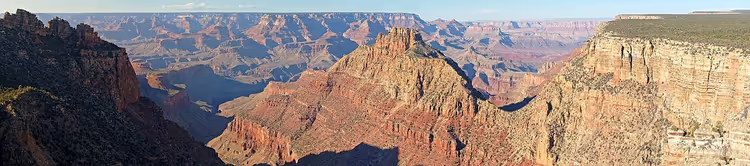 © Grand Canyon National Park · CC BYPhoto: Grand Canyon National Park, CC BY (https://creativecommons.org/licenses/by/2.0), Wikimedia Commons
Right next to the park there is a small airport, Grand Canyon National Park Airport. It sits three kilometers from the entrance, but flights here are expensive and infrequent. So most visitors still fly to Las Vegas or Phoenix.
You can also get there by train, but the trip will take longer than driving. From Las Vegas to the South Rim you will get there in about four and a half hours, from Phoenix a bit faster. In winter, some roads to the North Rim are closed, so check your route in advance.
⁉️🤔 Frequently asked questions
Do I need to reserve park entry in advance?
No. Grand Canyon has no timed entry and no reservation is required to drive in (as of 09/2026, park rules). You simply pull up to the payment station and pay by card. The longest lines are on weekends and holidays. Arrive before ten in the morning or after two in the afternoon.
How is the South Rim different from the North Rim?
The South Rim is open year-round and has more hotels, campgrounds, and overlooks. The North Rim welcomes visitors only in the warm season and stays quiet. By road, the rims are hundreds of kilometers apart.
How many days do you need for the Grand Canyon?
For the South Rim, two days are enough: one for the overlooks, the second for a descent or a drive along the desert road. If you want to see Havasu Falls or the Skywalk, add at least one day for each. The North Rim deserves a separate trip of two or three days.
Can you get to Havasu Falls?
Only with a permit from the Havasupai Tribe. Permits are issued in advance, and in season they sell out quickly. Without a valid permit you will not get onto the land. Also consider the difficulty of the route: the hike to the falls takes several hours on foot in the heat.
Is the Skywalk worth the trip?
The Skywalk is not in the national park but on Hualapai tribal land, so entry is paid separately. Tickets are sold only as part of a Grand Canyon West package (as of 09/2026, Grand Canyon West ticket page). Photography is not allowed on the bridge. From the South Rim to the site is a drive of several hours.
When is the best time to go to the Grand Canyon?
The best months on the South Rim are April, May, September, and October. At that time there is no exhausting heat, and there are fewer tourists. In summer the bottom is very hot, so start your descent early in the morning. North Rim services operate from mid-May to mid-October, and the road is open until the first snow.
In short: what to book
Plan your trip around timing. If you have one day, choose the South Rim and look for lodging in Grand Canyon Village or Tusayan. If you want quiet, pick the North Rim in summer, but remember that you will have to stay overnight outside the park. If you dream of the glass bridge, set aside a separate day for Grand Canyon West.
Tickets and canyon tours are easy to compare on GetYourGuide, where you can see prices and available slots right away.

A small editorial team writing guides for independent travel. We travel ourselves, but we haven’t been everywhere, so we check prices, opening hours and how to get there against official sources.