
















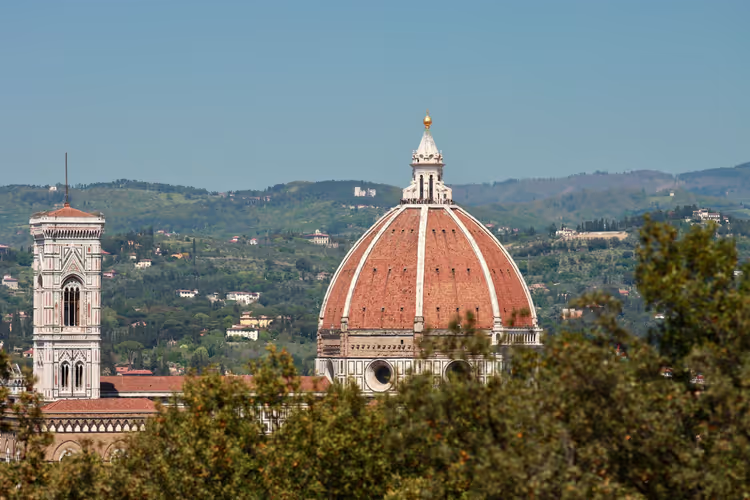
Brunelleschi's dome in Florence: tickets, slots and Duomo hours
The Cathedral of Santa Maria del Fiore has stood in the center of Florence for almost seven centuries. You step out onto Piazza del Duomo and run straight into a live queue at the entrance. Up close, the cathedral seems even larger, and the green and pink marble of the facade looks like a fabric pattern from a distance.
Entry to the cathedral itself is free. You only pay for Brunelleschi's dome, Giotto's bell tower, the baptistery, and the museum. If you want to climb the dome, book your time slot in advance: good times sell out weeks ahead.
Below, we cover the construction history, the architecture, the opening hours, and the route from the train station. We checked all prices and hours against the official website as of 09/2026, so you don't have to rely on outdated guidebooks.
Ad: this article contains affiliate links, we earn a commission if you book through them, at no extra cost to you.
What to know before your visit
💡 In short:
- The cathedral is open Monday through Saturday, 10:15-15:45, entry is free (as of 09/2026, monument schedule).
- Three combined tickets: Brunelleschi Pass 30 €, Giotto Pass 20 €, Ghiberti Pass 15 €, each valid for 3 days (as of 09/2026, Duomo ticket prices).
- Climbing the dome is only possible with a time slot from your ticket.
- Prices and opening hours: 09/2026, verified on the Opera del Duomo pricing page
Construction history
 © Petar Milošević · CC BY-SAPhoto: Petar Milošević, CC BY-SA (https://creativecommons.org/licenses/by-sa/4.0), Wikimedia Commons
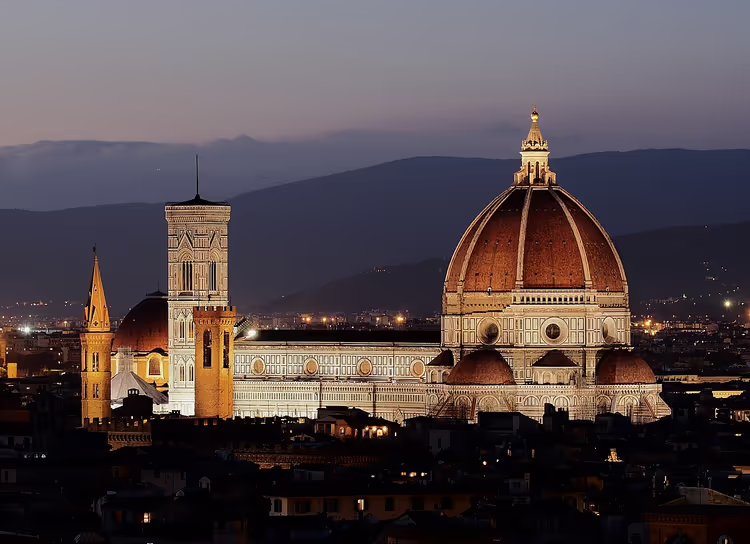
In the late 13th century, Florence was growing very quickly. The old church of Santa Reparata, built back in the 4th century, had fallen into disrepair and could no longer hold the congregation. The city authorities and the church decided to build a temple that would outshine the cathedrals of Siena and Pisa. The new Duomo could hold about 30,000 worshippers, and it took nearly six centuries to build (according to Opera di Santa Maria del Fiore).
The decision to demolish Santa Reparata was made in 1289. A design competition was announced at the same time, and Arnolfo di Cambio won it. The foundation stone was laid in 1296, and the architect began work on the south wall, leaving the date 1310 on it. Construction was frozen several times due to the deaths of architects, epidemics, and contract scandals.
A miracle helped with the money. In the 14th century, a tomb with the relics of Saint Zenobius of Florence was found in the base of the old church. Donations after the discovery allowed work to continue. In total, six architects worked on the construction, but none of them lived to see the dome installed. The cathedral was consecrated in 1436, though the dome's lantern had not yet been added.
After di Cambio's death, construction stalled for almost 30 years. Work resumed under Giotto di Bondone, but instead of completing the cathedral, he began building the bell tower to his own design. By his death in 1337, Giotto had only managed to build the first tier. Then the plague intervened: the epidemic swept through the city and halted the work.
Arnolfo di Cambio's design
Di Cambio's plan was based on combining Gothic with the early Renaissance. The church's form followed a Latin cross with three wide naves. The central nave occupied the footprint of the old Santa Reparata, with two side naves on either side. The naves ended in octagonal choirs with pointed arches, above which an octagonal tower was planned. The plan was completed by a semicircular apse and two side transepts.
Giotto's bell tower
The bell tower was begun next to the cathedral on a foundation laid by di Cambio. The design for the 84.7-meter tower was developed by Giotto, but he did not live to see it fully realized. Andrea Pisano continued the work, and Francesco Talenti completed it. The facades were clad in three-colored marble, and the second tier was decorated with sculptures by Donatello. The originals are now kept in the Duomo museum, with copies standing on the tower. A staircase of 414 steps leads you to the viewing platform (as of 09/2026, Giotto's bell tower page).
Brunelleschi's dome
 © Maëlick · CC BY-SAPhoto: Maëlick, CC BY-SA (https://creativecommons.org/licenses/by-sa/2.0), Wikimedia Commons
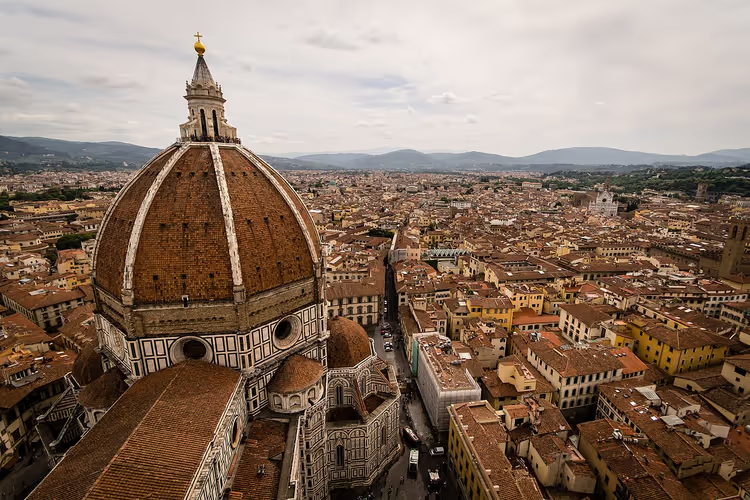
The dome problem was solved by Filippo Brunelleschi. He precisely calculated the octagonal dome and the elongated spire. The frame was assembled from 24 vertical ribs and 6 horizontal rings, and the sections were lifted to a height of 45 meters. At the top, the architect included a stone railing around a 6-meter-diameter opening. The lantern tower gave the dome its stability: it distributed the weight onto the drum. In each of the 8 ribs, 3 windows were cut for light and air (as of 09/2026, official Duomo website).
Completion of construction
The consecration of the Duomo in 1436 did not end the construction. The dome was completed in 1436, but the lantern above it was installed only in 1461. The finishing of the facade and interior was postponed. In the 16th century, a competition for the exterior decoration ended in scandal due to a fight over contracts. Work resumed only in the mid-19th century. It was entrusted to Emilio de Fabris, who finished Santa Maria del Fiore in 1887. His patterns and sculptures gave the cathedral an unusually light appearance.
Architecture
The cathedral stands out on the square for its size and the beauty of its facade. The church covers 8,300 square meters, is 90 meters wide, 153 meters long, and its walls rise 45 meters. The dome, 42 meters in diameter, is crowned by a lantern tower with a cross; together they raise the cathedral to 114 meters from the base (as of 09/2026, section about the cathedral). Despite these dimensions, the church does not feel massive. It seems to float above the ground, and that is the first thing you notice.
Facade
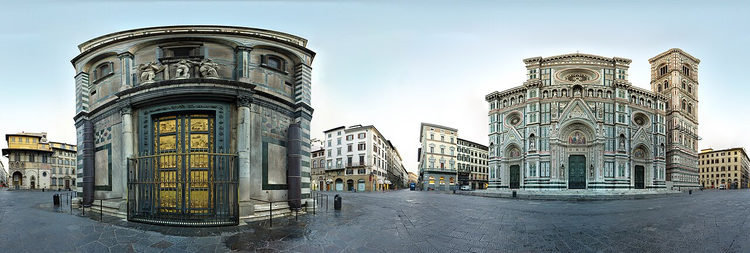
The exterior is clad in vertical and horizontal marble panels. Green marble came from Prato, pink from Maremma, white from Carrara. The combination of three colors evokes associations with the Italian flag. Sculptural groups stand out vividly against this background. Statues and hexagonal medallions with biblical scenes stand in the niches of the bell tower, and frescoes depicting the earthly life of the Virgin Mary survive on the pointed arches of the facade.
 © User:MatthiasKabel · CC BY-SAPhoto: User:MatthiasKabel, CC BY-SA (https://creativecommons.org/licenses/by-sa/3.0), Wikimedia Commons
Central entrance
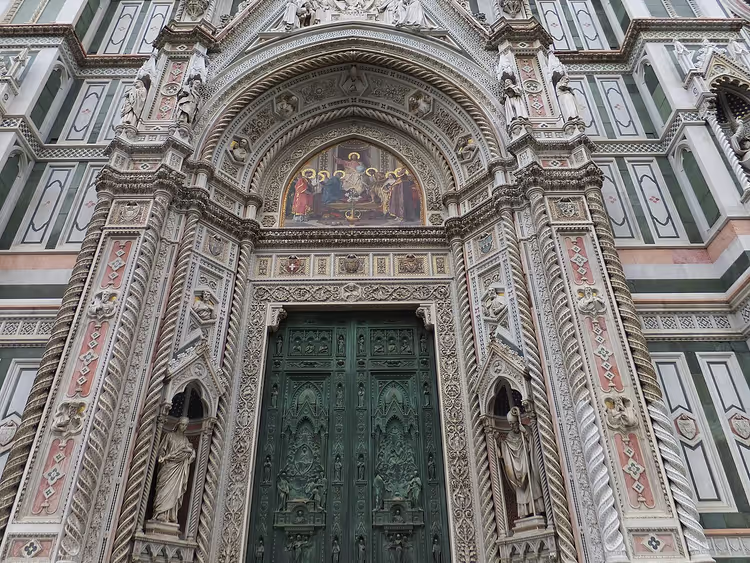 © lienyuan lee · CC BYPhoto: lienyuan lee, CC BY (https://creativecommons.org/licenses/by/3.0), Wikimedia Commons
The central entrance of the main facade is considered a masterpiece of Neo-Gothic. The bronze doors are decorated with high reliefs depicting the life of the Virgin Mary. Above the doors, a bas-relief shows the Virgin Mary enthroned with the infant Jesus and the 12 apostles. Above the portal with statues, a large rose window was placed within relief medallions bearing portraits of honored citizens. The arch above the entrance is decorated with a fresco of the Madonna holding a lily.
Crypt of Santa Reparata
Beneath the cathedral altar lies the crypt of Santa Reparata. Fragments of the destroyed church, remnants of ancient Roman mosaic floors, wall mosaics, and 14th-century frescoes survive here. A model of the old Santa Reparata helps you understand what it looked like. The sarcophagi hold the remains of clergy and the architects of the church: Arnolfo di Cambio, Giotto, and Filippo Brunelleschi. People come here to venerate the relics of Saint Zenobius of Florence in a bronze shrine.
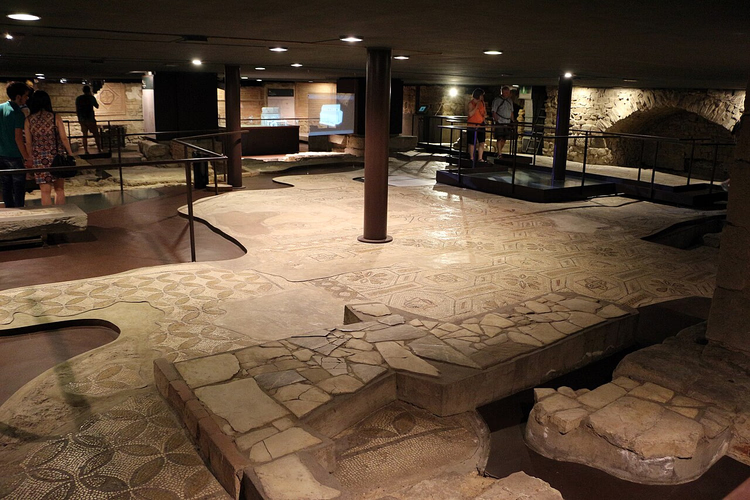 © Sailko · CC BYPhoto: Sailko, CC BY (https://creativecommons.org/licenses/by/3.0), Wikimedia Commons
Interior
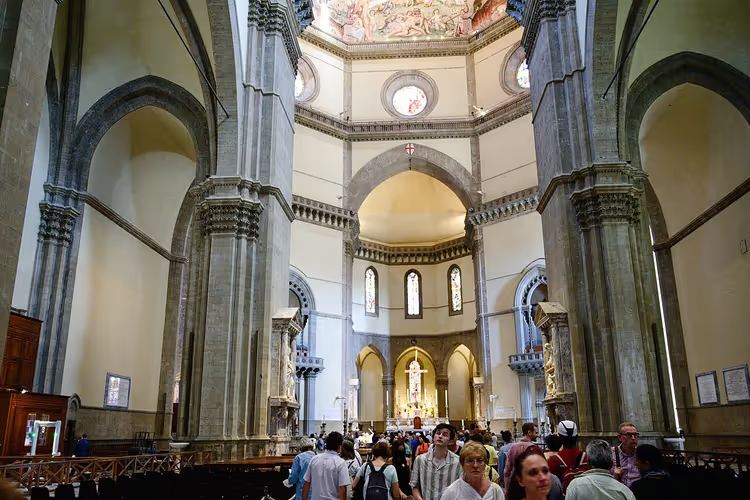 © Zde · CC BY-SAPhoto: Zde, CC BY-SA (https://creativecommons.org/licenses/by-sa/4.0), Wikimedia Commons
The interior follows the traditions of Italian Gothic. Pointed vaults in the naves, numerous arches and galleries, and tall pilasters create a sense of spaciousness. Upon entering, the marble floor catches your attention. Raising your eyes, you see 15th-century frescoes on the vault with portraits of distinguished citizens, among them Dante and Giotto.
Higher still, on the dome, five-tier paintings unfold. At the center is the Last Judgment, surrounded by the lives of Christ and the Virgin Mary, the patron of the frescoes Cosimo I, and the masters who painted the dome. The total painted area is 3,600 square meters, roughly half a football field (as of 09/2026, Opera del Duomo website). You can examine the details up close from the balconies reached by the staircase to the dome.
The stained glass windows on the arches of the naves, transepts, and drum deserve special attention. They depict the deeds of saints and great martyrs. On the wall hangs a huge fresco by Paolo Uccello with an equestrian monument to John Hawkwood. Nearby is the clock that Uccello created in 1443: its hands move in reverse and measure the time until the Last Judgment. For centuries it struck 24 times and told the city that the working day was over.
Architectural complex
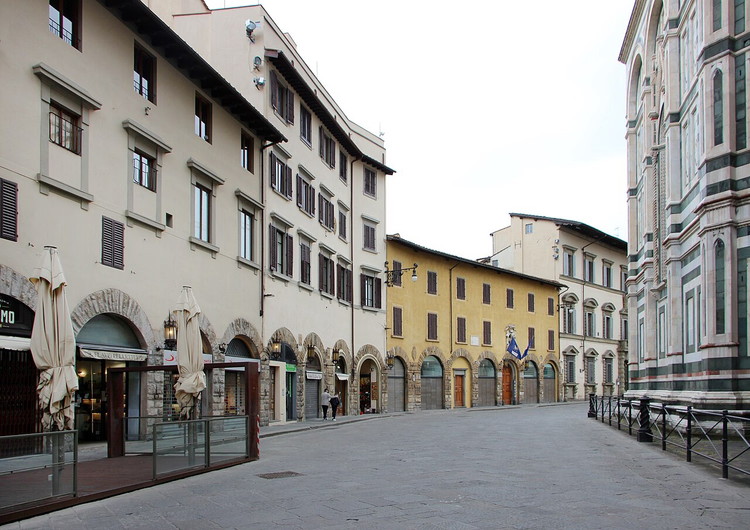 © Francesco Bini · CC BY-SAPhoto: Francesco Bini, CC BY-SA (https://creativecommons.org/licenses/by-sa/4.0), Wikimedia Commons
Santa Maria del Fiore, together with the bell tower and the baptistery, forms a single complex on Piazza del Duomo. It includes the 12th-century Baptistery of San Giovanni and the Duomo Museum. You can see everything with one combined ticket, so you don't waste time at separate ticket offices.
Baptistery of San Giovanni
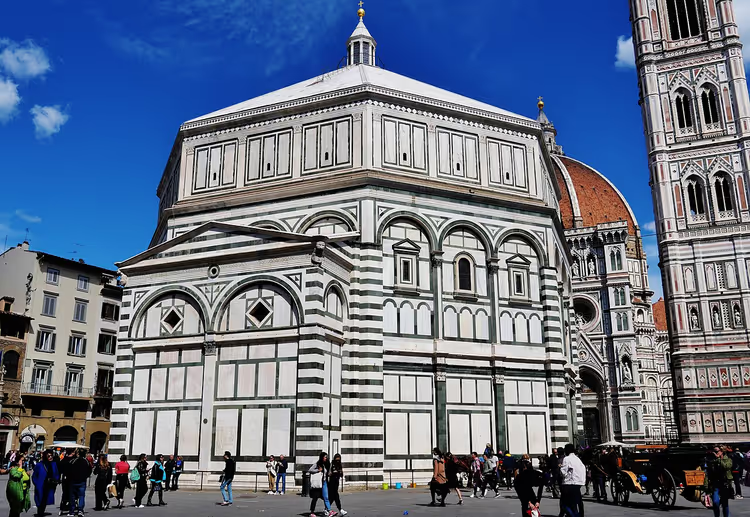 © Zairon · CC BYPhoto: Zairon, CC BY (https://creativecommons.org/licenses/by/4.0), Wikimedia Commons
The Baptistery of San Giovanni stands on Piazza del Duomo next to the cathedral. Until the 19th century, newborn Florentines were baptized under its vaults, including Dante and the future Medici. The low octagonal Romanesque building dates back to the 12th century. Inside, the dome is covered with golden paintings of saints and biblical scenes, and Byzantine mosaics from the 13th and 14th centuries adorn the vaults.
The eastern doors from the mid-15th century are divided into 10 gilded panels with biblical scenes. They are called the Gates of Paradise and are considered a masterpiece of sculpture. The other doors feature bas-reliefs from the 13th to 15th centuries depicting John the Baptist. Note: restoration of the vault mosaics is currently underway in the baptistery, so some of the paintings are covered (as of 09/2026, hours and restoration).
Duomo Museum
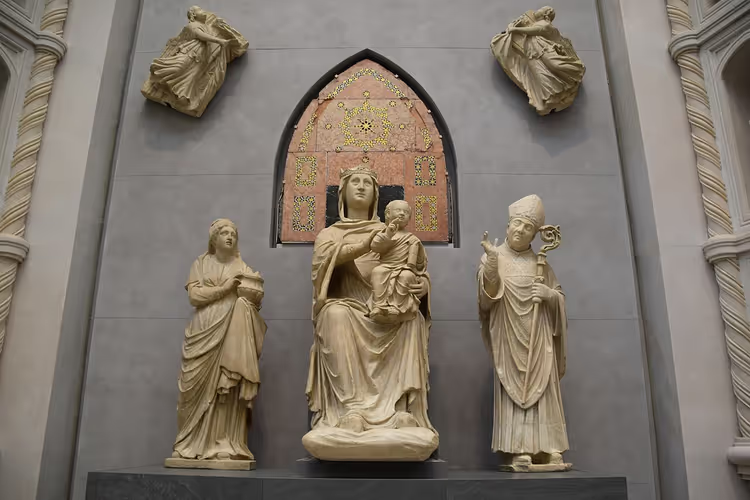 © George M. Groutas · CC BYPhoto: George M. Groutas, CC BY (https://creativecommons.org/licenses/by/2.0), Wikimedia Commons
The Duomo Museum opened in 1891 in the former workshop of Filippo Brunelleschi. The exhibition displays fragments of decoration from the old church, the bell tower, and the baptistery. It houses models and drawings of the dome, a collection of 16th-century sculptures, and items that were not included in the decoration of the new cathedral. Separately exhibited are 15th-century statues: Donatello's "Penitent Mary Magdalene" and "The Prophet Habakkuk." Nearby stands a sculpture of Pope Boniface VIII by di Cambio. The main works in the collection are Donatello's "Mary Magdalene" and Michelangelo's "Lamentation of Christ" Michelangelo.
Tickets and opening hours
Entry to the cathedral is free, but it is closed on Sundays and religious holidays. The other monuments in the complex are covered by three combined tickets. Each is valid for 3 calendar days from the date of your visit to the dome or the selected monument (as of 09/2026, monument tickets).
Ticket | What's included | Adult | 7-14 years |
|---|---|---|---|
Brunelleschi Pass | dome, bell tower, museum, baptistery, Santa Reparata | 30 € | 12 € |
Giotto Pass | bell tower, museum, baptistery, Santa Reparata | 20 € | 7 € |
Ghiberti Pass | museum, baptistery, Santa Reparata | 15 € | 5 € |
Ticket prices are listed on the official website (as of 09/2026, Duomo ticket prices).
Climbing the dome requires a separate timed slot, and these sell out in advance. Without a slot you cannot go up, even with the Brunelleschi Pass. With this ticket, the bell tower is open on any of the three days, while with the Giotto Pass you need the slot you selected at purchase (as of 09/2026, opening hours and slots).
Monument | Hours | Closed |
|---|---|---|
Cathedral | Mon-Sat 10:15-15:45 | Sunday, holidays |
Giotto's Bell Tower | daily 8:15-18:45 | Nov 9-13, 2026, maintenance |
Dome | Mon-Fri 8:15-18:45, Sat until 16:30, Sun 12:45-16:30 | Nov 16-20, 2026, maintenance |
Baptistery | daily 8:30-19:30 | first Sunday of the month until 13:30 |
Duomo Museum | daily 8:30-19:00 | first Tuesday of the month |
Santa Reparata | Mon-Sat 10:15-16:00, Sun 13:30-16:00 | none |
Lines are shorter in the morning and when it rains. It's convenient to buy tickets online and print them in advance (as of 09/2026, Duomo online ticket office). On site, the Centro Arte e Cultura ticket office operates opposite the baptistery. Before entering, leave your luggage in the free storage room at Piazza Duomo 38/R. You cannot enter the cathedral and baptistery in flip-flops or with bare shoulders, and knees must be covered.
Tours and tickets in Florence
Guided tours, skip-the-line tickets and activities — most offers can be cancelled free of charge.
See offers on TiqetsThe widget loads once you give your consent.
Where it is and how to get there
The cathedral stands in the center of Florence on Piazza del Duomo. It is an easy walk from Santa Maria Novella station. Head out onto via Panzani, then turn onto via Cerretani, where the Duomo comes into view and the square opens up. The distance is about 800 meters, a 10-12 minute walk (on the map). City buses from other parts of town also stop at the square.
Florence Cathedral on the map
The cathedral occupies the northern side of Piazza del Duomo, between the baptistery and the bell tower. It is worth opening the map location before your trip so you head straight to the right entrance on your first try.
⁉️🤔 Frequently asked questions
How much does it cost to enter Florence Cathedral?
The cathedral itself is free to enter; you only need a ticket for the dome, bell tower, baptistery, and museum. Combined passes cost from 15 to 30 EUR (as of 09/2026, current prices). The ticket is valid for three days, but each monument can be entered only once.
Do I need to book the dome climb in advance?
Yes. The climb is only available by time slot, and popular times sell out weeks ahead. Book the dome for your first day, so the remaining two days of your ticket are left for the other monuments. Without a time slot you cannot climb, even with the Brunelleschi Pass (as of 09/2026, dome booking rules).
How many steps are there in Giotto's bell tower?
The bell tower has 414 steps and no elevator. The dome climb is also on foot, going up between the two shells of the dome. Wear comfortable shoes and bring water, especially in summer. Separate rules apply for children and people with reduced mobility, so check them on the website (as of 09/2026, official bell tower website).
When is the cathedral closed to tourists?
The cathedral is closed on Sundays and on religious holidays. The Duomo Museum is closed on the first Tuesday of the month, and the bell tower and dome close for maintenance in November. Plan your visit from Monday to Saturday and check the monument calendar before your trip (as of 09/2026, monument calendar).
What is included in the Brunelleschi Pass?
The pass covers all five paid monuments: the dome, Giotto's bell tower, the Duomo Museum, the baptistery, and the Santa Reparata crypt (as of 09/2026, pass descriptions). It is the most expensive option, but it is the only one that includes the dome climb. For the museum, baptistery, and crypt, the Ghiberti Pass at 15 EUR is enough (as of 09/2026, Duomo ticket prices).
In short: what is worth booking
Florence Cathedral brings together the Gothic facade, Brunelleschi's dome, and the best view of Florence from Giotto's bell tower. If you want to climb the dome, get the Brunelleschi Pass and a morning time slot on your first day. If you do not need the climb, the Giotto Pass or Ghiberti Pass is enough for the museum, baptistery, and crypt.
- If panoramas matter to you: get the Brunelleschi Pass with the dome and bell tower climb.
- If you want to save money: the Ghiberti Pass is enough for the museum, baptistery, and Santa Reparata.
- If you are traveling with children: the Giotto Pass includes the bell tower without the dome climb, but choose your bell tower time slot at checkout.
It is better to buy dome and museum tickets online in advance (as of 09/2026, dome tickets online). Choose a morning time slot for the climb, so by midday you still have time for the baptistery and museum.

A small editorial team writing guides for independent travel. We travel ourselves, but we haven’t been everywhere, so we check prices, opening hours and how to get there against official sources.