



Brussels: how much a trip costs and where you can really save
Brussels hits your wallet harder than you expect. The city runs on EU money and business travelers, so everything in the center is inflated: food, museums, taxis. But a budget trip here is realistic. You just need to know where to pay and where not to.
Below we break down the daily budget by category: accommodation, food, transport, and museums, with approximate prices, and museum and transport fares were checked in September 2026. A budget traveler can get by on roughly 60-90 € per day, not counting bars and shopping. Let's go through each category and show where money leaks away for nothing.
Ad: this article contains affiliate links, we earn a commission if you book through them, at no extra cost to you.
How much money to take per day
💡 In short:
- Budget: around 60-65 € per day if you cook for yourself and walk a lot.
- Comfortable minimum: around 80-100 € per day with a hostel, takeout lunch, and one museum.
- Transport is inexpensive: a single ticket is valid for an hour, so you won't spend much on the metro per day.
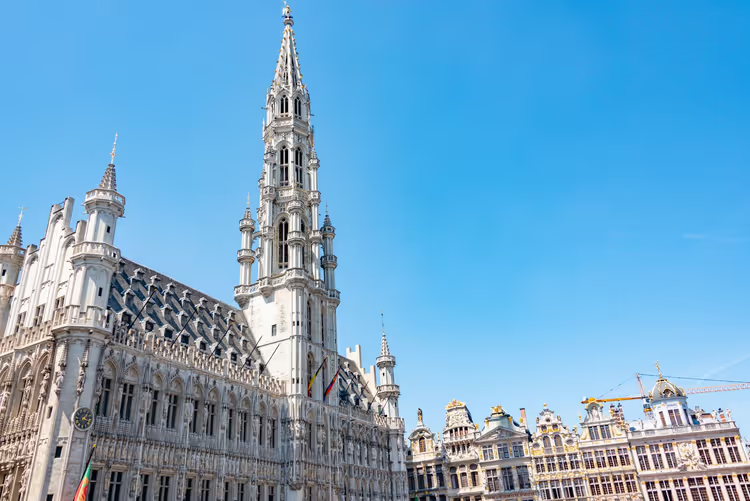
- The center and cafes near Grand-Place are expensive. Look for places a block away.
- Museum prices: 09/2026, check before your visit on official websites (fine arts museums, comics center).
We put together two daily estimates per person. The first is for those who count every euro. The second is for those who want comfort without excess. Both exclude bars, clubs, souvenirs, and tours: budget for those separately.
Category | Budget | Comfortable |
|---|---|---|
Accommodation (hostel bed) | around 35 € | around 42 € |
Food | around 20 € | around 35 € |
Transport | 0-2.40 € | around 2.40 € |
Museums | around 10 € | around 15 € |
Total per day | around 65 € | around 95 € |
The difference between the estimates is almost entirely in food and accommodation. The budget option relies on a free hostel breakfast, a supermarket lunch, and walking. The comfortable option adds a takeout lunch, dinner at a brasserie, and one paid museum.
If you want better accommodation, add roughly 60-110 € per night to the budget, depending on where you stay and the season. And remember: during business congresses, hotels in the center get noticeably more expensive.
Museums and tickets: where to save
There are few free museums in Brussels; admission to most museums in the table costs from 12 to 25 €. We checked the prices below in 09/2026 on official websites. Go on a weekday morning: lines are shorter, and on the first Wednesday of the month from 1:00 PM and the first Sunday of the month, some museums offer free admission.
Museum | Adult ticket | Note |
|---|---|---|
17 € | combo with Mini-Europe 35 € | |
from 21.70 € online | 25 € on site | |
13 € | combo with the Old Masters 20 € | |
13 € | free on the 1st Wednesday of the month from 1:00 PM | |
18 € | audio guide included | |
12 € | family ticket 2+2 around 32 € | |
check the museum website for the price | free on the 1st Sunday of the month |
The Parlamentarium at the European Parliament is free year-round, and the Royal Museum of the Armed Forces and Military History is free on the first Wednesday of the month (as of 09/2026). On those days you don't need to budget money, just time.
Planning to hit three or four museums in one day? Check out the Brussels Card. It is sold for 24, 48 and 72 hours; the 24-hour version starts at 41 €, the 48-hour one at 53 €, the 72-hour one at 59 €, and it gives you access to several dozen museums (as of 09/2026, official card shop). Public transport is not included in the base card; for that you need the +STIB version. Check the current price there before buying. Individual timed tickets are easy to compare and buy in advance so you do not have to wait in line at the ticket office: Brussels museum tickets on Tiqets.
Food: from a fry shack to a restaurant
Food in Brussels is expensive, especially in the center. On a budget you have to deliberately look for good-value places rather than sitting down at the first cafe by the Grand-Place. The rule is simple: the farther you get from the tourist squares, the fairer the price.
Belgium is famous for three things: fries, waffles and chocolate. Among hot dishes, it is worth trying croque-monsieur hot sandwiches, carbonade flamande (beef stewed in beer) and moules-frites (mussels with fries). A pot of mussels usually costs from about 20 €; the price depends on the restaurant, and fries are usually included.
The Grand-Place has plenty of cafes serving chocolate, beer and local dishes, but there you are paying for the view. For the same money on nearby streets you will get a bigger portion. Stop by a brasserie: it is both a pub and a restaurant where traditional cuisine is served with local and imported draft beer.
A cheap and filling lunch option that tourists forget about is the cafeteria in department stores. Ready-made hot food there is inexpensive, and you can sit down comfortably.
Breakfast: free or up to 10 €
Many hostels offer a simple breakfast for free: cereal, bread or a croissant, sometimes coffee and juice. Hotel breakfasts are usually overpriced, so in most cases skip them and grab a pastry at a bakery. A fresh roll at a local boulangerie costs a couple of euros.
Belgian waffles are technically considered a dessert, but nobody is going to stop you from eating them in the morning. A street waffle usually costs from a couple of euros, more with toppings, and stands are all over the center. For the pricier and more famous ones, go to the Maison Dandoy tea room. For inexpensive breakfast spots, try Boulangerie Charli with French pastries or the EXKi chain buffet.
Lunch: 7-15 €
The cheapest lunch is one you put together yourself: bread, ham, cheese and fruit from any supermarket will cost a few euros. A ready-made takeaway lunch usually costs about 8 €. A kebab from a stand usually starts at about 5 € for a sandwich, more with fries and a drink.
Look for a friterie sign (frietkot in Flemish). These are iconic Belgian stands where fries come with fried or grilled meat. A cone of fries with sauce usually costs about 3.50-5 €. For reliable quick-lunch spots, try Fritland with huge portions of fries, Tonton Garby with cheap sandwiches, Bia Mara with fried fish, or L’Express with Lebanese shawarma and falafel.
Dinner: 12-25 €
Many of the lunch options also work in the evening. A plate of moules-frites usually costs from about 20 €; carbonade flamande is a bit cheaper. A traditional dinner at a restaurant in a non-touristy area is realistically available for about 15-20 € per person; prices depend on the neighborhood. A good inexpensive choice for Belgian cuisine is Fin de Siècle; for pizza go to Il Colosseo, and for pasta and local beer head to the De Monk pub.
Drinks and beer
A pint of regular beer at a bar costs about 4-5 € (according to Numbeo, 09/2026). At a supermarket a bottle of beer is several times cheaper, around a euro and a half, and we recommend looking for Belgian craft varieties: they are among the best in the world. A bottle of wine from a store usually costs about 7 €, a cup of coffee about 2-4 €.
For atmospheric beer, go where the locals go: Moeder Lambic with two bars, the old-fashioned A la Mort Subite, operating since 1928, or the touristy but legendary-for-its-selection Delirium Café with hundreds of varieties. Grab one bottle in a park, and the evening will cost less than any bar.
Transport: metro, tram and airport
Public transport in Brussels is cheap and convenient, with metro, trams and buses all using a single ticket from the STIB operator. A single ticket is valid for one hour with transfers and costs 2.40 € from February 1, 2026 (as of 02/2026, La DH/Belga). Buying inside the vehicle costs more than buying in advance. STIB fares are revised regularly, so check the current price in the visit.brussels transport guide.
Tickets come as single rides or multi-ride options, loaded onto a plastic MOBIB card. With contactless payment, you will never be charged more than the daily cap in a day, after which all further rides that day are free. For a short trip, walking is often simpler: the center is compact.
The airport, Zaventem (Brussels Airport), is a separate story. The Airport Line bus (line 12) is noticeably more expensive than a regular city ticket, so check the one-way price before you travel (visit.brussels). A taxi from the center to the airport usually costs from around 45 € per car, depending on traffic. If you are traveling as a group with luggage, a taxi for four can work out cheaper than the bus.
Love cycling? The city bike-share scheme Villo! is inexpensive: day and week passes cost just a few euros, with a surcharge for longer rides. For the flat city center, it is a handy way to beat the traffic.
Where to stay: hostels, hotels, apartments
Accommodation in Brussels is on the expensive side. There are not many hostels in the city, which pushes prices up. Book in advance, especially if your dates coincide with business conferences: prices in the center then spike sharply.
A bed in a decent hostel usually costs around 35-55 € per night depending on the season, so budget about 40 € per person. Many hostels raise prices on weekends. That is the price for a bed in a shared room. If you want a private room, expect to pay roughly 75-110 € for two.
A decent budget hotel in the center usually starts at around 100 € per night, and if you move away from the center, you will find cheaper options. There are plenty of rental apartments in the city, with a night usually starting at around 75 €, depending on the season and neighborhood. An apartment pays off for a larger group and for anyone who needs a kitchen and space. The catch: check-in can be awkward, and there are sometimes extra charges for cleaning and service.
Hotel and hostel prices change every day, so you will save money by comparing options for your dates: see accommodation prices in Brussels. Below is a handy date-based search form.
Find hotels in Brussels
Compare prices across booking sites and filter for rooms with free cancellation.
Compare prices on Trip.comThe widget loads once you give your consent.
⁉️🤔 Frequently asked questions
How much does a day in Brussels cost per person?
A budget day with a hostel, self-catering and walking around costs roughly 60-65 €. A comfortable minimum with a takeaway lunch, dinner in a brasserie and one museum is about 80-100 € per day. Bars, clubs, tours and shopping are extra: they can easily double your spending.
Is the Brussels Card worth buying?
The card pays off if you visit three or four museums in a day. For one or two museums per trip, it is cheaper to pay separately.
What is the cheapest way to get from the airport to the center?
The cheapest option is the Airport Line bus (line 12): it costs more than a regular city ticket, but far less than a taxi. A taxi is worth it for a group with luggage. There is also a train from the airport station, which is fast; check the price and timetable on the operator's website before you travel.
Where can I eat cheaply in Brussels?
Stay well away from the Grand-Place. A cone of fries from a friterie usually costs about 3.50-5 €, a kebab from around 5 €, and a supermarket lunch comes to a couple of euros. For a hot meal, look for brasseries and department-store canteens away from the tourist streets. Portions are bigger there and the bill is fairer.
How much is a single transport ticket?
A single STIB ticket is valid for one hour with transfers and costs 2.40 € from February 1, 2026 (as of 02/2026, La DH/Belga). It is cheaper to buy tickets in advance from a machine.
In short: what to book
Brussels is expensive, but manageable. The biggest savings come from food and accommodation: cook for yourself, eat away from the Grand-Place and book your hostel in advance. Pick museums selectively or work out whether the Brussels Card fits your itinerary.
- If you want a hostel bed: book a hostel or hotel for your dates.
- If you want a guided tour: Brussels walking tours on GetYourGuide.

A small editorial team writing guides for independent travel. We travel ourselves, but we haven’t been everywhere, so we check prices, opening hours and how to get there against official sources.