
















Capitoline Hill in Rome: museum tickets, opening hours and how to climb
Capitoline Hill is the lowest and smallest of Rome's seven hills.
But this is where the Temple of Jupiter stood, where the ancient Senate convened, and where the Capitoline Museums operate today. People come up here for the ancient bronze, the frescoes, and the view of the Roman Forum.
Below you'll find ticket prices with the date they were checked, opening hours for the museums, and the route from Piazza Venezia and from the metro. We'll also cover each of the three palaces and the basilica at the top separately.
History and ancient temples of the Capitoline
💡 In short:
- Capitoline Hill (Campidoglio) is called the heart of ancient Rome: the Temple of Jupiter stood here and the Senate convened here.
- A full ticket to the Capitoline Museums costs 15 €, a reduced ticket 9.50 € (as of 09/2026, official website).
- You can climb the hill and walk across Piazza del Campidoglio for free; you only pay for the museums and the Mamertine Prison.
- Prices and opening hours: 09/2026, verified on the Capitoline Museums website.
According to legend, Romulus climbed up here and saw eagles soaring in the sky. Near this spot he decided to found the city. That is how the hill became the starting point for the Eternal City.
There are two versions of the name. According to the first, it bears the name of Jupiter Capitolinus, whose temple stood here long before Romulus. According to the second, the name comes from the word "caput," meaning head: the Senate convened on the hill, where the fate of the state was decided.
In antiquity, the Temple of Jupiter, Juno, and Minerva stood at the top. People gathered in the square, laws were proclaimed here, and justice was administered. You'll see surviving traces of that era, down to the temple foundations.
The Mamertine Prison (Carcer Tullianum), one of the oldest buildings in Rome, has survived to this day. In its dungeon, both noble officials and ordinary citizens awaited sentencing. According to tradition, the apostles Peter and Paul were held here before their execution, which is why an altar was later placed in the dungeon and a church was built above it.
The old streets of the Capitoline were commercial. On the Silver Street, as the name suggests, silver goods were sold. You can see part of these quarters at the foot of the hill.
At the foot of the Basilica of Santa Maria in Aracoeli stand ancient insulae. These are multi-story rental apartment blocks, which later served as a model for urban inns. The first such buildings appeared as early as the 3rd century BC, and they were built en masse in the 1st century.
Insulae were rented out. The lower the floor, the more expensive the housing and the wealthier the tenants. The ground floors had sewage and running water, while the upper apartments suffered from fires and deteriorated quickly.
Michelangelo and the revival of the Capitoline
 © Kameister · CC BY-SAPhoto: Kameister, CC BY-SA (https://creativecommons.org/licenses/by-sa/4.0), Wikimedia Commons
The ancient buildings required restoration. Pope Paul III entrusted this work to Michelangelo Buonarroti, who by that time was already designing St. Peter's Basilica.
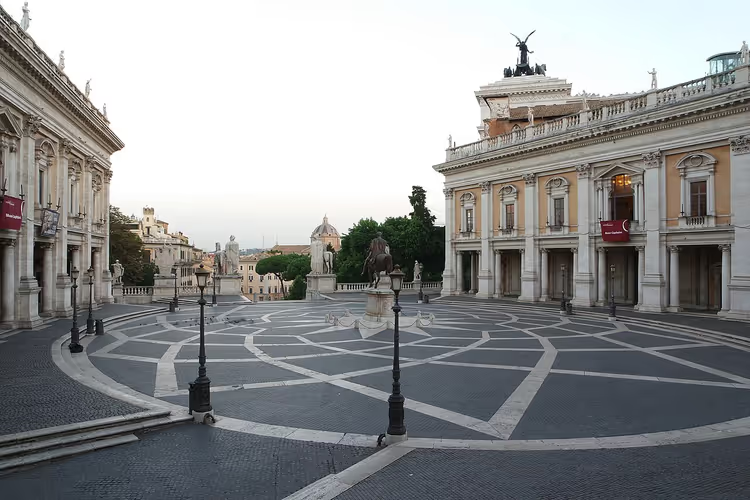
From the late 1530s, the master was rebuilding Piazza del Campidoglio. He conceived it as a unified ensemble: the Senatorial Palace was given the central role, and the other two buildings were given identical facades. Michelangelo did not live to finish everything; his students completed the work.
In the center of the square stands the equestrian statue of the emperor and philosopher Marcus Aurelius. What you see in the square is a copy; the original is kept indoors, in the museum halls.
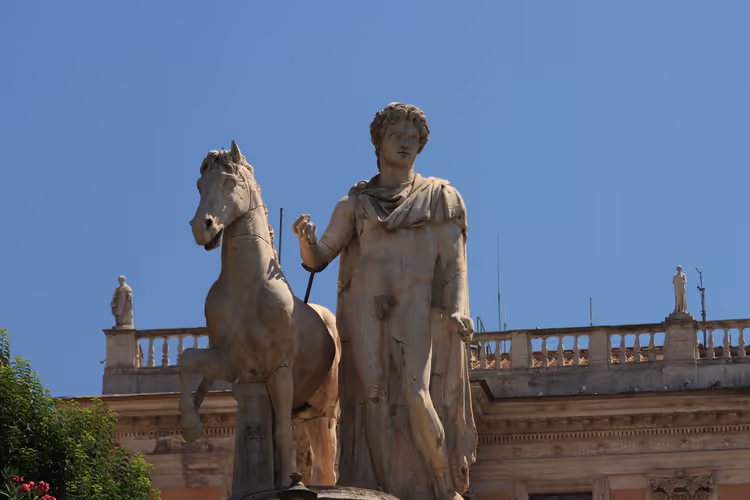
An old staircase, the cordonata, leads down from the square. It is decorated with statues of Egyptian lions and the marble twins Castor and Pollux, found near the Theater of Pompey. At the top, on the balustrade, stand statues of Constantine and milestone columns from the Appian Way.
The square is considered one of the most harmonious urban spaces in Rome. Pay attention to the geometric pattern of the pavement: it hints at where the best view of the entire ensemble opens up from.
Senatorial Palace
 © Diego Delso · CC BY-SAPhoto: Diego Delso, CC BY-SA (https://creativecommons.org/licenses/by-sa/4.0), Wikimedia Commons
The Senatorial Palace (Palazzo Senatorio) is the most notable building on the square. It stands on the site of the ancient Tabularium, the city archive, and grew out of buildings from the 1st century BC.
In the Middle Ages, the palace stood empty and gradually fell into ruin. Its revival began in the 16th century, when Paul III entrusted Michelangelo with rebuilding the entire ensemble. According to the architect's design, the central building was meant to dominate the square.
Since the 19th century, this has been the residence of the mayor of Rome, so most of the rooms are closed to tourists. You can visit the Lapidarium, where ancient stone slabs with inscriptions are displayed. Below, in the old section, the Tabularium is open, with a view of the Roman Forum.
Palazzo dei Conservatori
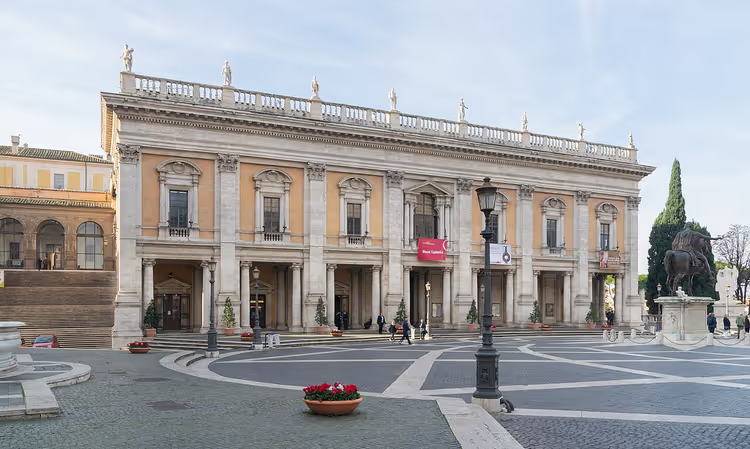
The first building of the Palazzo dei Conservatori (Palazzo dei Conservatori) was erected under Pope Nicholas V in the 15th century. The name translates as "palace of the keepers": senators, magistrates, and judges known as conservatori convened here.
 © Tournasol7 · CC BY-SAPhoto: Tournasol7, CC BY-SA (https://creativecommons.org/licenses/by-sa/4.0), Wikimedia Commons
Over time, papal power grew, the city treasury emptied, and the building fell into disrepair. In the mid-16th century, Michelangelo reconstructed it, along with the entire square.
Today part of the Capitoline Museums is housed here. The first exhibits were donated by Pope Sixtus IV: he gave the city ancient bronze works, including the Capitoline Wolf, which according to legend nursed Romulus and Remus.
The central hall with frescoes displays ancient Roman marble busts. On the second floor, the Pinacoteca features paintings by Caravaggio, Van Dyck, and Tintoretto. In the Castellani Hall you'll see objects from the Greeks and Etruscans and ancient jewelry.
The original equestrian statue of Marcus Aurelius also stands inside, in a separate hall, which is why people photograph the copy in the square. Nearby are displayed fragments of the colossal statue of Constantine: a hand, a foot, and a head.
Palazzo Nuovo
 © Tournasol7 · CC BY-SAPhoto: Tournasol7, CC BY-SA (https://creativecommons.org/licenses/by-sa/4.0), Wikimedia Commons
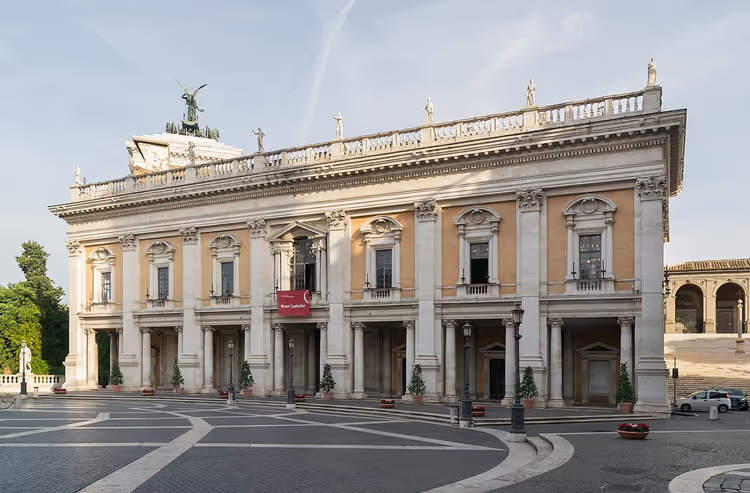
The Palazzo Nuovo is the youngest building in the ensemble. It was built in the 17th century as an exact copy of the Palazzo dei Conservatori, following Michelangelo's design.
The building was originally constructed as a public museum, and in the 18th century it opened for free admission. Today it houses the second part of the Capitoline Museums.
You will see sculptures and vases brought from Greece, paintings by various artists, and ancient mosaics.
A grand staircase, the Scalone, leads to the second floor, decorated with reliefs on classical themes and marble.
Basilica di Santa Maria in Aracoeli
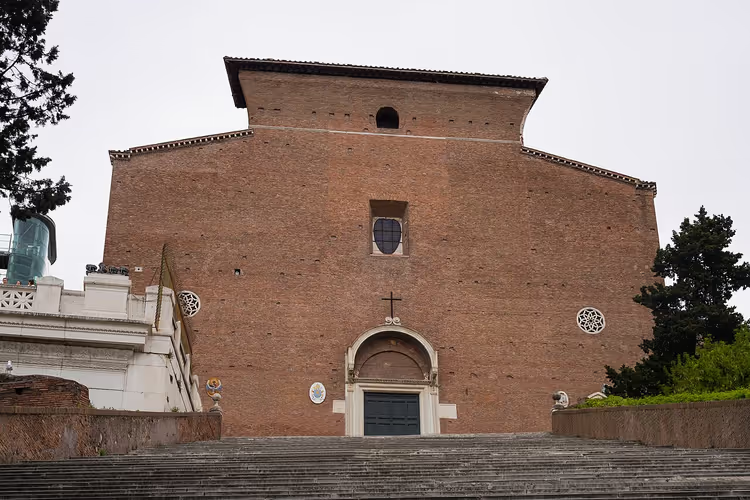 © ThePhotografer · CC BY-SAPhoto: ThePhotografer, CC BY-SA (https://creativecommons.org/licenses/by-sa/4.0), Wikimedia Commons
The Church of the Holy Virgin Mary acquired its current appearance in the 13th century. The Capitoline Hill has two peaks, and the basilica stands on the smaller one.
According to legend, this was the site of the Temple of Juno Moneta, the protector of money. This is where the word "moneta" comes from, which you will find in several European languages.
The history of the earliest structures is known only from legends. One of them tells how Emperor Augustus came to the hill to ask the gods about a future church. On the way, a sibyl, a prophetess, announced that she saw the birth of a God who would soon be worshipped.
Augustus established the Altar of Heaven here. Later, the church of Santa Maria in Aracoeli arose on this site.
The temple changed owners several times. In the 6th century there was a Greek monastery here, then Benedictines built a Catholic church, and in the 13th century it passed to the Franciscans. They carried out the major reconstruction of the building.
In the Middle Ages, the church was not only a place of prayer. Public assemblies were held here, laws were announced, and the city's economic matters were decided.
In the mid-14th century, Cola di Rienzo ordered the construction of a grand staircase from the foot of the hill to the entrance. Today it serves as the ceremonial approach to the basilica, and admission remains free.
In the 15th and 16th centuries, the church was restored, and a sacristy and bell tower were added. In the late 16th century, a carved ceiling was installed here in honor of the Italian fleet's victory over the Turkish fleet. Today the basilica is open to worshippers and tourists who come to see the interior.
Tickets and museum hours
All three palaces are part of a single Capitoline Museums complex. The ticket covers the entire permanent collection, so you don't need to pay separately to enter each palace.
Museum | Full ticket | Reduced | Hours | Closed |
|---|---|---|---|---|
Capitoline Museums | 15 € | 9.50 € | daily 9:30-19:30, last entry 18:30 | none |
Museums with exhibition (September-November) | 16.50 € | 11 € | during museum hours | none |
Mamertine Prison | paid entry | check on site | morning and afternoon | check on site |
Santa Maria in Aracoeli | free | free | during the day | none |
Prices verified on the museum ticket page (as of 09/2026). Online presale adds 1 € to the price, while Rome residents and MIC card holders enter free (as of 09/2026, official website). The city announces free admission days separately, so check the museum website before your trip.
It's best to book an entry slot in advance: Capitoline Museums tickets.
Ad: this text contains affiliate links, we earn a commission from them, the price for you does not change.
Tours and tickets in Capitoline Museums
Guided tours, skip-the-line tickets and activities — most offers can be cancelled free of charge.
See offers on TiqetsThe widget loads once you give your consent.
How to get to the Capitoline Hill
Address of the Capitoline Museums: Piazza del Campidoglio, 1, 00186 Rome (as of 09/2026, official museum website).
The easiest way is to walk up from Piazza Venezia: a cordonata staircase leads to the hill, and the climb takes a few minutes. It's also convenient from the metro: get off at Colosseo station (line B) and walk along Via dei Fori Imperiali past the forum.
By bus and tram, the most convenient stops are near Piazza Venezia and Ara Coeli. If you're walking from the Colosseum, allow about fifteen minutes: the road goes uphill.
Tip: go up in the morning. By midday the square is full of tour groups, and a line builds up at the museum entrance.
Capitoline Hill on the map
Below is a map you can use to check the route in advance.
⁉️🤔 Frequently asked questions
How much does a Capitoline Museums ticket cost?
A full ticket costs 15 €, a reduced one 9.50 €, and online presale adds 1 € (as of 09/2026, official ticket website). Rome residents and MIC card holders enter free. For everyone else, the ticket covers the entire permanent collection.
What are the opening hours and is there a closing day?
The museums are open daily from 9:30 to 19:30, with last entry at 18:30 (as of 09/2026, museum ticket page). The complex has no regular closing day, but check the hours before your trip: they change on holidays and during special exhibitions.
Can you go up the hill for free?
Yes. Piazza del Campidoglio and the cordonata staircase are open around the clock and free. You only pay for the Capitoline Museums and Mamertine Prison, while entry to the Basilica of Santa Maria in Aracoeli is free.
How to get to the Capitoline Hill from the Colosseum?
From Colosseo metro station (line B), walk along Via dei Fori Imperiali past the Roman Forum; it's about fifteen minutes on foot. The second option, from Piazza Venezia, is shorter: the climb up the staircase takes a few minutes.
What should you definitely see in the museums?
The Capitoline Wolf, the original equestrian statue of Marcus Aurelius, and the marble busts of emperors. Also make a separate visit to the Tabularium, which offers one of the best views of the Roman Forum. Allow at least an hour for the Pinacoteca with Caravaggio.
In short: what to book
The Capitoline Hill is worth setting aside half a day for. You'll have time to go through the three palaces, descend into the Mamertine Prison underground, and climb up to the basilica at the top.
If you're short on time, buy a ticket only for the Capitoline Museums and book a time slot online right away. If you're traveling with children, start with the Capitoline Wolf and the equestrian statue of Marcus Aurelius. If you're on a budget, walk around the square for free, and in the evening go up to the basilica.

A small editorial team writing guides for independent travel. We travel ourselves, but we haven’t been everywhere, so we check prices, opening hours and how to get there against official sources.