
















China without a travel agency: visa-free entry, Alipay and trains
Planning a trip to China is harder than planning one to any European country. English barely helps here, the apps you normally use won't open, and foreign cards are accepted only about half the time. The good news: German citizens don't need a visa until the end of 2026, the metro costs less than a euro, and a high-speed train takes you halfway across the country in a few hours. Below are the practical details: visa-free entry and stay limits, paying with Alipay, internet and VPN, train tickets, food, everyday logistics, and a realistic two-week budget.
Ad: this article contains affiliate links, we earn a commission if you book through them, at no extra cost to you.
China today: what to know before you fly
💡 In short:
- No visa needed: German citizens enter without one and can stay up to 30 days.
- Money runs through Alipay or WeChat Pay, keep a small amount of cash as backup.
- Google, WhatsApp, and Instagram only work with a VPN you installed in advance.
- Visa-free entry and stay limit: 09/2026, verified via the extension decision

China has opened up to foreign tourists after the pandemic, but Europeans are still rare here. Most visitors come from neighboring Asian countries, so locals rarely speak English. Without a translator and a working card, the trip turns into a quest, and preparation takes longer than the journey itself.
The visa-free regime for German citizens has been extended until December 31, 2026, with stays of up to 30 days. Your passport must be valid for at least six more months at the time of entry. The decision covers 45 countries and includes tourist, business, and transit trips (announcement from Chinese authorities, as of 09/2026).
The country ranks fourth in the world by area and first by population, so distances here are deceptive. On a map, a trip looks short, but in reality it means hours on a train or plane. The time difference with Germany is six hours in summer and seven in winter, and for the first few days you'll wake up before dawn.
Nobody in China drinks tap water, not even locals; they boil it. Buy bottled water, and use the kettle in your room: almost every hotel has one. No vaccinations are required for entry, but it's worth updating the standard set before you travel.
The yuan hovers around eight per euro: in 2026 it fluctuated between 7.7 and 8.4 yuan (as of 09/2026, exchange rate summary). Calculate prices in an app with an offline rate, because an online converter simply won't open without a VPN. That way you'll quickly realize that a 30-yuan lunch costs less than four euros.

China works differently from what guidebooks promise: rules are strict, order is maintained by cameras, and services are designed primarily for locals. So it's worth planning the trip in detail in advance rather than figuring things out on the ground.
Blocked apps and what works instead
The state filtering system, known here as the Great Firewall, blocks almost the entire set of services you're used to. WhatsApp, Instagram, TikTok, YouTube, and Google Maps don't work inside the country, and installing a VPN after you land is difficult: the service websites are also blocked. Install and test everything you need while still in Germany.
Messaging runs through WeChat, video is replaced by Douyin, and maps work in two versions. Apple Maps in China shows addresses, transfers, and metro schedules correctly. Google Maps is useless without a VPN, and even with one it still gets addresses wrong, because locals don't use it and the map points are outdated.
The translator becomes the main tool of your trip. Google Translate can translate text with the camera: point your phone at a menu, sign, or ticket machine and get readable text. An app with an offline currency rate is just as essential, because prices here are unfamiliar and the internet is unstable.
Also check that your phone supports Chinese networks and that you have a second payment method. Without apps you can't even buy a metro ticket, so a working phone matters more than any guidebook.
Plan your access in advance. Nothing will install once you're there. Banks, weather, and local services live in Chinese apps, and download sites are blocked. Download everything at home while access is open.
Save several things offline. Download your hotel address in Chinese characters. Take a photo of the metro map. Write down the hotel name in Latin letters and in Chinese characters. These small things save you on the first day.
Chinese apps are almost always Chinese on the inside. Baidu Maps replaces Google Maps. Trip.com and Alipay have English interfaces, which is why tourists use them.
VPN and eSIM: how to get internet
Without a VPN in China, not only social networks are blocked, but also some of the sites you use every day. Install the client and test the connection before you fly: you won't be able to download it inside the country. Among the well-known services for China, Astrill is the one most often mentioned: a subscription costs in the lower double-digit euro range per month, and you should check the exact rate on the service's own website before buying. VPN prices change often, so go by the order of magnitude rather than a specific number.

A local SIM card is needed so your phone has internet outside the hotel Wi-Fi. A tourist eSIM solves the same problem, and two-week plans often come with a built-in VPN. A roaming eSIM from Hong Kong bypasses the firewall by default, and that's the easiest path for a beginner.
Set up the eSIM the day before and activate it when you board the plane: otherwise the plan days will burn up before you arrive. A tourist eSIM has no local number, it's internet only, and you're unlikely to need it for calls.
A package with a large data allowance and built-in VPN costs a few dozen euros; check the exact price before you fly. From our travel experience: internet tested in advance saves you an entire evening on the ground.
VPN works on a simple scheme. Install the app at home. Buy a one-month plan. Connect to a server outside China. After that, apps open as usual.
Choose a German or American server. In the evening, speed will drop. But email, maps, and messengers work without surprises.
Among tourist eSIMs, people choose Airalo, Holafly, or Mobimatter. The first two sell ready-made plans for 10-20 days. Mobimatter is better on data volume and validity period. A local SIM is only needed for calls.
It's easier to compare eSIM plans for China in one place: compare eSIM and roaming. Buy before you fly, because options inside the country are limited.
Money: Alipay, WeChat Pay, and cash
China has almost given up on cash: even for water from a street vendor, you pay by phone. The main app here is Alipay, accepted everywhere, in cafes, taxis, the metro, and by small vendors. Set up Alipay before you leave home, link your card, and check that the payment goes through.
WeChat reads like a messenger, but its payment side, WeChat Pay, works just as well. There is one catch: the account is verified by another user who scans your code, and you may not know anyone in China. So make WeChat Pay your backup option and keep Alipay as your primary.
Foreign cards are rarely accepted directly, and where they are, the bank adds a fee. Plan on using your phone, and keep your card as a backup for large purchases. If a payment does not go through, show the code again or pay with small change.
Cash is still necessary, because there are almost no ATMs outside major cities. Withdraw your first amount at the start of the trip at a Bank of China branch or another major bank that has a counter for foreign cards. Keep a couple of days' worth on you, and that will be enough.
Payment method | Where it works | Catch |
|---|---|---|
Alipay | everywhere, including the metro and markets | link your card in advance |
WeChat Pay | cafes, shops, hotels | account is verified by another user |
Cash yuan | almost everywhere | small change helps in the provinces |
Foreign card | major hotels and banks | fees and frequent declines |
At the airport, the exchange rate and fees are usually worse.
A wad of banknotes takes up little space, and in a small provincial town it becomes the only reliable option. You will get change without any problem, and small bills come in handy on buses and at street cafes.
City transport: metro, taxi, and DiDi
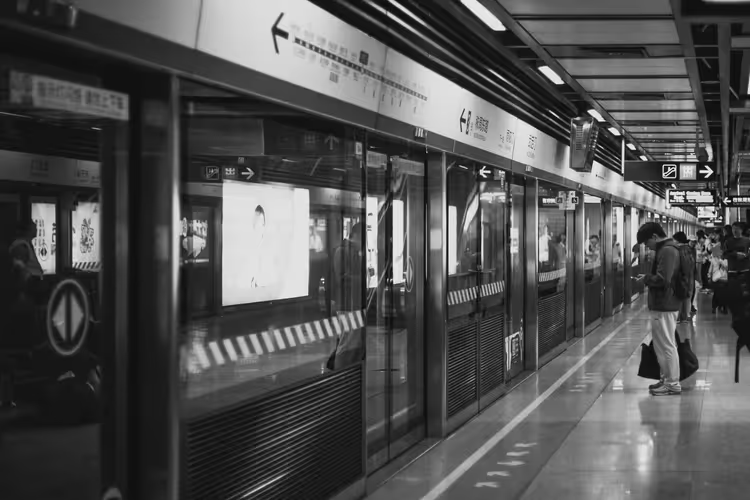
The metro in major cities is simple to use and costs less than one euro per ride. Ticket machines at stations accept Alipay, and lines are distinguished by colors and numbers, so you can figure it out without knowing the language. Keep your ticket or card until you exit: at the exit, the turnstile will ask for the same ticket.
Bags are checked at the entrance, but the inspection takes only a few seconds. Schedules, transfers, and travel times are easiest to check in Apple Maps, which works correctly in China. During rush hour, cars fill up tightly, so plan trips for the morning or after eight in the evening.
Taxis in China are inexpensive, but drivers do not speak English and do not read the Latin alphabet. Show the driver the address in Chinese characters or a photo of the hotel, otherwise you will end up at a similar building in a neighboring district. Make sure the meter is on, or agree on a fixed price before you start moving.
 © SCJiang · CC BY-SAPhoto: SCJiang, CC BY-SA (https://creativecommons.org/licenses/by-sa/4.0), Wikimedia Commons
DiDi replaces Uber and costs less than a regular car, and you order through the app. Downloading DiDi from Germany is difficult, but the service button is on the main screen of Alipay, and it works through your payment method. You see the car on the map, and the money is deducted automatically.
From the airport to the center, you can take the metro if you have no luggage, or a taxi if you are traveling with suitcases. A night arrival almost always means a transfer: the metro is already closed, and a line forms at the taxi stand. Book a car in advance and give the exact hotel address, and the driver will meet you in the arrivals hall.
The rules for taxis are simple.
- Keep the address in Chinese.
- Ask the hotel to send the address in Chinese characters.
- Show a photo of the hotel or entrance.
- Pay via Alipay.
- Check the meter or the fixed price.
A short taxi ride costs a few euros, noticeably cheaper than European prices. The metro runs until late evening, but not around the clock. At night, taxis and DiDi remain.
Tours and tickets in Shanghai
Guided tours, skip-the-line tickets and activities — most offers can be cancelled free of charge.
See offers on KiwitaxiThe widget loads once you give your consent.
Trains: tickets, passport, and checks
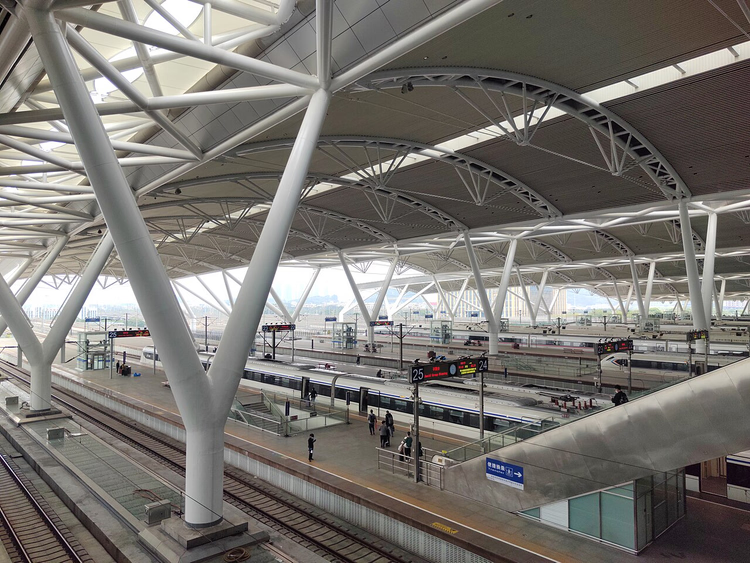
High-speed trains in China are more convenient than flying over medium distances and run at speeds up to 350 km/h. The trip between Shanghai and Beijing takes about five hours, meaning you cover that distance in half a day (guidebook data, 09/2026).
Tickets are sold in advance, and popular routes sell out several days ahead. Buy them through an app with an English interface or at a counter, where a foreign passport is accepted without any issue. There are no physical tickets: the trip is linked to your passport, which you scan at the entrance.
Arrive at the station early, because first comes baggage screening, then passport control, and only then boarding. Aerosols larger than 150 ml will not be allowed on the train and will be taken at the entrance. Inside the car, documents are not checked again, so you can put your passport away.
Buying a ticket does not require a trip to the station. The Trip.com app shows schedules in English. Payment works by card or via PayPal. The ticket is stored in your passport, and there is nothing to print.
The counter at the station works too, but the language and the line make things harder. Buy online a few days ahead. Sales open about two weeks in advance, and popular routes disappear within a day.
A long leg of five to nine hours costs a few dozen euros per person. A short trip costs noticeably less, and the train runs smoothly and without traffic. The car is clean, and every seat has a power outlet, so the journey is not tiring.
Schedules, available seats, and prices are easy to compare in advance: train schedules and tickets. Booking early saves you from overcrowded trains.
Two-week route: three cities without rushing
In two weeks, it is realistic to cover three cities without turning the trip into a race. The Beijing, Luoyang, and Shanghai route follows the high-speed rail line, so transfers take hours, not days. Between cities, you travel by train: it is faster than a bus and cheaper than a plane.
City | Days in the plan | How the day is spent |
|---|---|---|
Beijing | 4-5 | center, museums, walks through old neighborhoods |
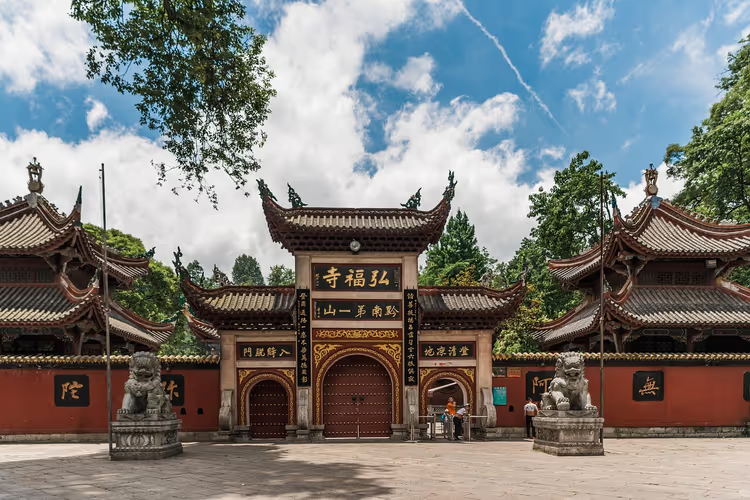
Luoyang | 3-4 | ancient temples and city markets |
Shanghai | 4-5 | waterfront, museums, evening city |
Plan three to four days per city. The first day goes to travel and the time difference. Leave the second and third for the main sights. Take the fourth as a buffer: lines, weather, and traffic eat up time.
Count transfers separately. Getting to the station, screening, and waiting together take half a day. So schedule the transfer for the morning, and leave the evening for getting to know the new city.
Buy train tickets right after your flights. Choose hotels near a metro station, and transfers take minutes. This plan covers the essentials, and you add the details on the ground.
Cars and licenses: why it is better without a car
Renting a car in China is almost closed to tourists: neither national nor international licenses are valid here. You can legally drive only with a Chinese license, and the exam is taken in Chinese. For a short trip, this path is pointless, so the question answers itself.
A rental car is also unnecessary for another reason. Trains run between cities, and within a city, a taxi or DiDi gets you around. Parking in the center is paid and scarce, and navigation is only in Chinese. For a standard route, a car adds hassle, not freedom.
Traffic in cities is dense, drivers honk actively and change lanes, and outside the city it is noticeably calmer. If you still plan a route by car, keep the railway as your main transport and take a car only for a short stretch.
Food: spicy, regional, and no English menu
Chinese cuisine changes a lot from province to province, and in Shanghai you will still find familiar dishes like rice with vegetables or beef noodles. The farther you get from the coast, the spicier and more heavily seasoned the food becomes, and the fewer familiar options remain. Order by pictures or by the ingredients, which an app can translate for you.
Clarify the spice level in advance: even simple noodle dishes can turn out to be impossible to eat. Translate the name of the dish and show the translation to the waiter, it is more reliable than any explanations or gestures. Practice using chopsticks at home, you will definitely need them at the table.
Vegetarians have a harder time: there is a lot of meat on menus, and the word "vegetarian" is not understood everywhere, although vegetable dishes and rice can be found almost anywhere. Look for tofu and vegetable dishes. Meat broth ends up even in vegetable soups, so it is better to clarify the ingredients in advance.
A meal of several plates is inexpensive. You pay the most in tourist districts of large cities. Street food costs pennies: dumplings come to a couple of euros, and noodles are even cheaper.
There is almost no dessert on menus, but McDonald's and KFC are available if you want something familiar. It is better to skip ice in street drinks. For the first week, choose simple dishes, hearty food here is inexpensive.
Safety, health, and smog
China feels like a safe country: streets are under cameras, a points-based penalty system applies to violations, and theft is almost a non-issue for tourists. Keep your documents and phone safe, and evening walks in city centers remain calm. Public order here is maintained through strict rules and high fines, so even in a crowd you feel at ease.
Bring your own medications: familiar drugs have different names here, and you will not be able to read the instructions. You will find a pharmacy in a large city, but explaining symptoms without a translator is difficult.
In winter, the air in Beijing and Shanghai is heavily polluted, and smog sometimes hides buildings a couple of hundred meters away. During the cold season, check the air quality index forecast and keep a mask for bad days. In summer the situation is noticeably better, and on such days it is better to keep the windows in your room closed.
Mobile network coverage works almost everywhere in the country. Coverage is good even on highways between cities. Wi-Fi in hotels is slow and blocked, so do not rely on it.
Everyday details: toilets, tips, and outlets
Public toilets in China usually have no seats: there is a squat toilet on the floor, no paper, and stalls are not always available. Keep a pack of tissues in your bag, and you will avoid an awkward situation. Look for a proper toilet with paper in shopping malls, cafes, and train stations.
Hotels sometimes have glass walls in the bathroom. There is always paper in the room. Hot water runs around the clock, and almost every room has a kettle.
Tipping is not customary here: not in taxis, not in restaurants, not for help with luggage. Pay exactly the amount on the bill, and no one will be offended. There is no need to thank people excessively either, it looks strange here.
Hotel outlets come in two types, and a German plug usually fits without an adapter. Still, pack a universal adapter in your suitcase: in older hotels you will only find a Type I socket, like in Australia. A power bank will come in handy on long journeys, because your phone works all day.
How much the trip costs: two-week benchmarks
A two-week trip through China fits into a four-figure sum in euros per person, if you count the flight with checked baggage. The plane ticket takes the biggest share, followed by trains and accommodation, while entrance tickets look modest compared to the flight. We deliberately do not give exact figures: plane tickets, hotels, and taxis change depending on the season and booking date, so calculate your budget based on current prices before the trip.
Item | Per-person benchmark |
|---|---|
Round-trip flight with checked baggage | the largest budget item |
Trains between cities | the second-largest expense |
Accommodation for 16 nights | comparable to train expenses |
Taxis and DiDi | noticeably less than accommodation |
Entrance tickets and museums | the most modest item on the list |
Total for 16 days | a four-figure sum in euros |
Food costs the least: noodles or dumplings come to a couple of euros, and lunch at an ordinary cafe rarely exceeds ten euros. Book accommodation with free cancellation, so you can easily change cities along your route: hotels in Chinese cities on Trip.com.
Three things help you save. Accommodation near the metro on the outskirts costs less than in the center. Food at street cafes costs several times less than restaurants. A night train also saves you a night in a hotel.
You will have to carry cash: a reserve of a few hundred euros for two weeks is enough for taxis, entrance tickets, and small purchases. Everything else goes through Alipay without any trouble.
Set aside money separately for transfers and timed-entry tickets, because these expenses appear only after you buy your plane ticket. It is worth comparing travel insurance options in advance, especially if you plan domestic trips within the country.
People photograph you: what to expect
Fair-skinned Europeans are rarely seen in China, so you become an attraction yourself. Strangers ask for photos, and sometimes they take pictures of you without permission, even if you refuse. On trains and the metro this rarely happens, but in public squares you may not be able to walk through undisturbed.
Behave neutrally and do not get into long explanations if the filming bothers you. Cover your face, step aside, or change your route, you definitely do not need public conflicts. In large cities people are used to foreigners, so this almost never happens there.
Tickets and tours: what to book in advance
Entrance tickets to major attractions are sold in advance and by time slots, so during peak season spots run out days ahead. Trains, excursions, and local tours should also be booked before the trip, otherwise you will lose a day to queues and sorting things out. A morning slot is better: the crowd arrives by midday, when you are already leaving.
It is more convenient to compare tours and tickets in advance: tours and tickets on GetYourGuide. For a late-night arrival, book a transfer separately so you do not have to look for a car in the queue with your suitcases.
Popular sites stop selling tickets on the spot. Morning slots run out first. Some museums are closed on Mondays, and photography is not allowed in certain halls. Check access rules before the trip, otherwise you will lose a day.
⁉️🤔 Frequently asked questions
Do I need a visa for a trip to China?
No. German citizens can enter visa-free until December 31, 2026 and stay in the country for up to 30 days. The extension covers 45 countries and includes tourist, business, and transit trips, and your passport must be valid for at least six months. For work or study, you need to apply for a visa in advance at a consulate.
Does WhatsApp work in China?
No, without a VPN, Google apps, WhatsApp, Instagram, and YouTube won't open. Install and test a VPN before you fly, because the service websites are blocked inside the country. Tourist eSIMs with roaming through Hong Kong often bypass the firewall without a separate VPN, and Apple Maps is more convenient for maps and metro schedules.
Can I pay with a bank card in China?
Direct payment with a foreign card works almost nowhere, but Alipay and WeChat Pay linked to your card are accepted. Set up Alipay at home and keep some cash on hand, because ATMs are rare. It's easier to withdraw money in large cities at Bank of China branches.
Is a tourist eSIM enough instead of a local SIM card?
Yes, an eSIM covers almost everything: tourist plans include more data than you'll use in two weeks. Activate it when you board the plane, otherwise the plan days will start counting earlier. Keep in mind that an eSIM doesn't come with a local number, and some apps require one for registration.
How much money should I take to China for two weeks?
Budget a four-figure amount in euros per person, including the flight. The plane ticket takes the biggest chunk, followed by trains and accommodation. A few hundred euros in cash is enough as a reserve; Alipay covers the rest. The range is wide: hostels and street food save almost half the amount, so calculate based on your dates.
Is it really necessary to drink only bottled water?
Yes. Even locals don't drink tap water in China; they boil it. Buy bottles in stores, use the kettle in hotels, and it's better to skip ice in street drinks. Bring your own medications, because familiar drugs have different names here.
In short: what's worth booking
What to book first: train tickets between cities, entry tickets with a morning time slot, and accommodation with free cancellation. If you have two weeks and a route covering Beijing, Shanghai, and Luoyang, take high-speed trains and book them right after your flights. If you're flying in winter and with suitcases, add an airport transfer for a late-night arrival, and put a smog mask in your carry-on. Keep your money in Alipay, and set aside a little cash in case of a glitch. Choose a hotel near the metro with free cancellation: hotel options in Beijing and Shanghai.

A small editorial team writing guides for independent travel. We travel ourselves, but we haven’t been everywhere, so we check prices, opening hours and how to get there against official sources.