
















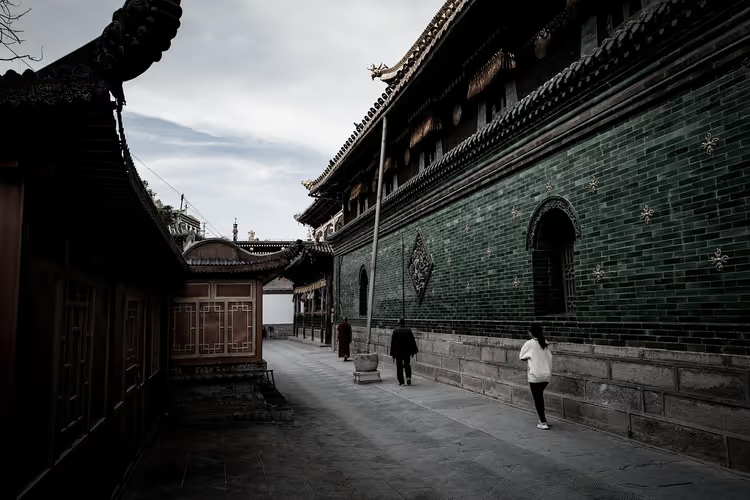
China without a visa in 2026: route, budget and top places
China is letting tourists in visa-free again. A visa used to be expensive and took a long time to process. Now the window is open, and it would be a shame to miss it.
Below you will find a route, a realistic budget, eight key places, and a breakdown of how to use your phone in a country with a closed internet.
Ad: this article contains affiliate links, we earn a commission if you book through them, at no extra cost to you.
China can now be seen without a visa
💡 In short:
- Best time: April to June and September to mid-November. Avoid Chinese New Year and the "golden weeks."
- Almost everywhere you pay by phone via Alipay or WeChat. Keep cash as a backup.
- The internet is censored: Google, WhatsApp, and Instagram do not work without an eSIM or VPN.
- Plan at least two weeks: the flight is long, and distances within the country are large.
Products labeled "made in China" sit in almost every home. But far fewer people have thought about what the country looks like through a tourist's eyes. For years, the visa was a deterrent: strict rules, paperwork, money. Now entry has been simplified, and the Middle Kingdom can be seen with almost no bureaucracy.
This guide takes you through the practical side, not the history. Key places, working logistics, an honest budget. We will also cover internet censorship separately: many familiar apps simply do not open in China, and you need to prepare for that in advance.
What you need to know before the trip
China is huge, and the climate varies greatly. But for most regions, the best months are spring and early summer, from April to June, as well as autumn, from September to mid-November. Three periods are best avoided. These are Chinese New Year in late January or February, the first week of May, and the first week of October.
During these days, Chinese people themselves travel. Hotels, trains, and planes get booked out weeks in advance, and attractions are crowded even by local standards. Plan your trip in a quiet season, and you will save both money and nerves.
The climate varies greatly across the country, and this affects your route. The south, like Guilin and Yunnan, is mild almost year-round. The north with Beijing knows freezing winters, while the west is highlands and deserts with sharp temperature swings. In summer, the east is hot and humid, so many people choose the shoulder season. Pack a different set of clothes for each region and always allow for rain.
No visa is needed for a short trip. German citizens can enter visa-free for up to 30 days (as of 09/2026, entry rules of the German Federal Foreign Office). The only condition: your passport must be valid for at least six more months after your return. The rule has been extended until December 31, 2026.
Want to stay longer? You can briefly leave China, for example to Macau or Hong Kong, and come back. Then the 30 days start over, and the total stay stretches to almost two months. Even a short stop makes sense if you are already traveling in Asia.
One rule is often overlooked. When staying in private accommodation, you are required to register with the local police, while hotels do this for you at the front desk (as of 09/2026, recommendations of the German Federal Foreign Office). Keep your passport handy: it is asked for at check-in, at train stations, and when buying tickets. Save a copy of the main page separately on your phone.
The official currency is the yuan, also known as the renminbi (RMB). The exchange rate is around 8 RMB per 1 € (as of 09/2026). China is very modern when it comes to payments: in cities, people pay by smartphone via Alipay or WeChat. How to install them and link a card is covered in the section on internet and apps.
You should not rely entirely on cash, but traveling without a reserve of banknotes is risky. Alipay is accepted almost everywhere, but travelers note in reviews that in some places only cash worked. Take a small amount of yuan for the first day and for small purchases.
Modern megacities like Shanghai are noticeably more expensive than rural regions and small towns. A detailed breakdown of accommodation, food, transport, and tickets is below in the budget section.
A separate topic is the internet. Access is heavily restricted: Google services, including search, YouTube, and maps, do not work. WhatsApp, Instagram, and many familiar apps are also unavailable. Bypassing the blocks is possible with a VPN or eSIM.
Set up a set of apps in advance. The minimum is Alipay for payments, WeChat for communication, Trip.com for booking accommodation and trains, a translator, and at least one map for navigation. Without them, it will be hard in a country with a closed internet. A detailed list awaits you in the "Internet and apps" section.
Where China is located and how to get there
China calls itself the "Middle Kingdom." It is the fourth-largest country in the world by area, about 27 times larger than Germany. Over 1.4 billion people live here, the second-largest population in the world after India. Landscapes range from deserts and steppes in the west through the Himalayas in the south to subtropics on the east coast.
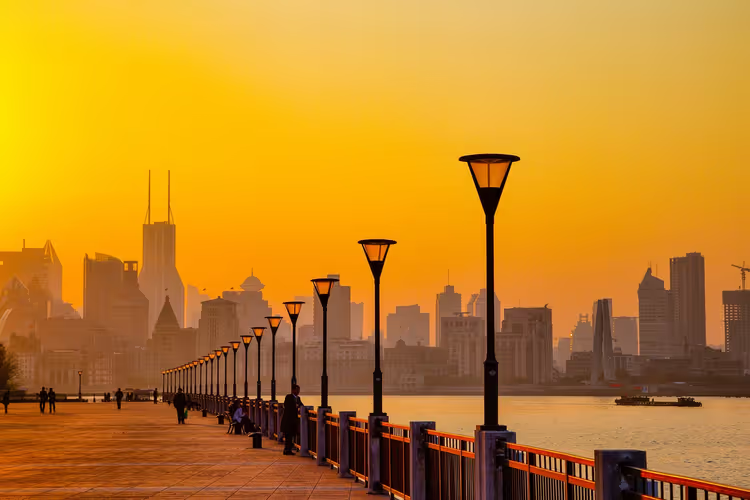
It is in the east that the largest cities stand. Here you will find Shanghai with its huge container port and the Pudong business district, as well as the tech hubs of Guangzhou and Shenzhen. The capital Beijing lies in the northeast, not far from the Great Wall of China, and remains the cultural and historical heart of the country.
People usually fly to China. Three major airports are well connected to the world: Shanghai Pudong (PVG) and Beijing's two international airports (PKX and PEK). There are direct flights from Germany, for example from Frankfurt, Munich, and Berlin, as well as from Amsterdam or Paris. There are also many connecting options via Gulf countries or Asia.
Besides Beijing and Shanghai, flights from Europe also go to other Chinese cities. Sometimes it is cheaper to look for unconventional connections: for example, China Southern opened a direct flight from Frankfurt to Shenyang in late April 2024. Comparing prices is easy via Skyscanner and flight partners.
For domestic flights, keep one restriction in mind. Power banks on Chinese flights are only allowed with the "CCC" marking. Major local airlines are China Southern, Air China, and China Eastern, as well as low-cost carriers like Spring Airlines. On long distances, the plane often beats the train in terms of time.
Eight places worth going to China for
The country is enormous, and there are countless attractions. We have put together eight landmarks from which you can build your own route. Cities, mountains, the wall, and ancient monuments: choose what speaks to you.
All eight are connected by high-speed trains or short flights, so the route comes together like building blocks. Start with two or three points if you have little time, and add the rest at your own pace. Below, for each place we give a short summary and a rough entry price where one applies.
Shanghai: the country's most futuristic city
Shanghai is not only one of the world's financial centers but also the most modern city in China. About 29 million people live here. In the Pudong district, there are almost more skyscrapers per square kilometer than anywhere else.
This is also where Shanghai Tower stands, the third-tallest building in the world. High-speed elevators take you to the observation deck in a matter of seconds. A ticket costs roughly from 180 RMB, about 22 € (as of 09/2026, myShanghaiGuide). Check the exact price and time slot before your visit.
 © Stefan Fussan · CC BY-SAPhoto: Stefan Fussan, CC BY-SA (https://creativecommons.org/licenses/by-sa/3.0), Wikimedia Commons
Beijing: a capital with a thousand-year history
You can't skip Beijing. This metropolis of 22 million people has been the country's capital and cultural center for 800 years. Palaces, squares, and temples come one after another here.
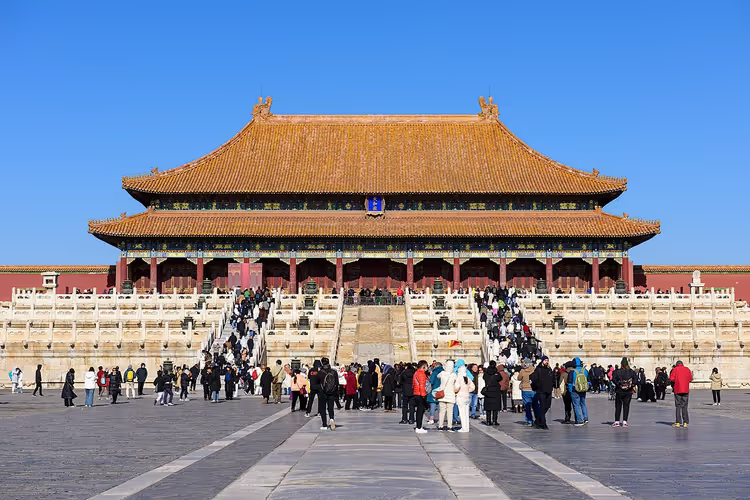
The main sights are the Forbidden City, the former imperial residence, and Tiananmen Square with Mao Zedong's mausoleum. Modern skyscrapers and socialist-era buildings sit right next to the history. It's an unusual mix, and that's exactly what makes Beijing interesting.
Plan at least two to three days for the city. The Forbidden City is enormous, and you can't rush through it. Set aside separate days for park complexes like the Temple of Heaven and the Summer Palace. Beijing is also the most convenient starting point for trips to the Great Wall: the Mutianyu section is about one and a half to two hours away.
 © N509FZ · CC BY-SAPhoto: N509FZ, CC BY-SA (https://creativecommons.org/licenses/by-sa/4.0), Wikimedia Commons
The great wall of China: Mutianyu is the best section
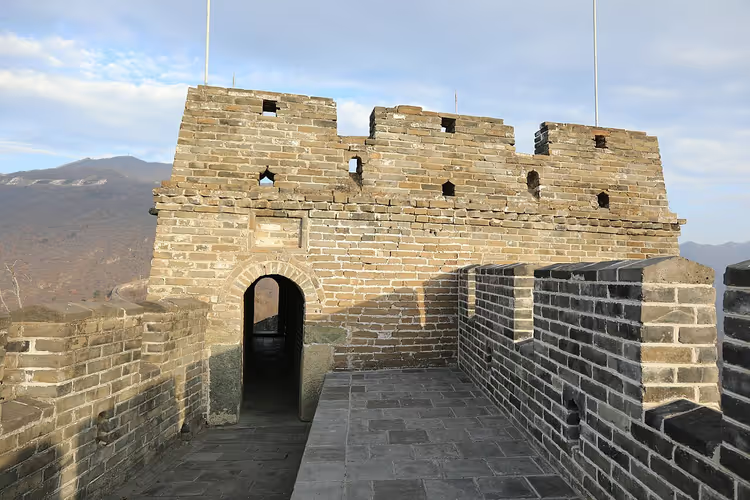
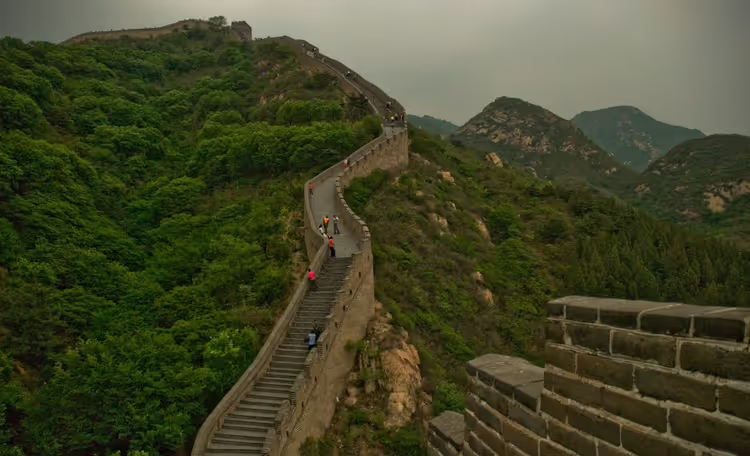
The wall stretches an incredible 22,000 kilometers through mountain ranges. That is half the length of the equator. One of the seven new wonders of the world, the wall is on almost every China traveler's list.
 © Francesco Bini · CC BY-SAPhoto: Francesco Bini, CC BY-SA (https://creativecommons.org/licenses/by-sa/4.0), Wikimedia Commons
Walking along it on your own is entirely doable without an expensive tour. Organizing a trip from Beijing is easy and inexpensive. We recommend the Mutianyu section: it is well preserved and far less crowded than the famous Badaling. Entry costs 45 RMB, and the round-trip cable car is about 140 RMB (as of 09/2026, TravelChinaGuide).
If you would rather not deal with your own transportation, a ready-made trip is convenient. You can compare day tours to the Great Wall on GetYourGuide in advance so you do not waste your morning on logistics.
Zhangjiajie: the mountains from Avatar
You will definitely recognize the Zhangjiajie cliffs. They inspired the creators of the movie Avatar. The national park is a UNESCO site and is famous for its sandstone pillars that rise whimsically into the sky.
 © Yoo Chung · CC BY-SAPhoto: Yoo Chung, CC BY-SA (https://creativecommons.org/licenses/by-sa/2.5), Wikimedia Commons
The park is huge, but getting around is easy: cable cars, escalators, and elevators are available. A combined ticket costs 236 RMB and is valid for four consecutive days (as of 09/2026, China Discovery). Cable cars and the Bailong elevator are paid separately.
The park's highlight is Yuanjiajie with Hallelujah Mountain and the Bailong elevator, the world's tallest outdoor elevator. Tianmen Mountain also deserves a visit, with its cable car and the "Heaven's Gate," a massive opening carved right into the cliff.
Chengdu and the giant Buddha in Leshan
Chengdu, together with Chongqing, is one of the largest cities in Western China and is known as the "panda capital." The Chengdu Research Base of Giant Panda Breeding in the city center raises these rare bamboo-eating bears, the country's national symbol.
 © xiquinhosilva · CC BYPhoto: xiquinhosilva, CC BY (https://creativecommons.org/licenses/by/2.0), Wikimedia Commons
A couple of hours from Chengdu stands one of the most significant monuments: the Giant Buddha in Leshan. The statue was carved into the cliff during the Tang dynasty. At 71 meters tall and 28 meters wide, it is the largest seated Buddha statue in the world, and it is over a thousand years old.
Yunnan: mountain landscapes and old Lijiang
Yunnan is a province in the southwest of the country, roughly the size of Germany. The largest city is Kunming, but Yunnan is famous above all for its mountains: the province lies at the foothills of the Himalayas.
 © chensiyuan · CC BY-SAPhoto: chensiyuan, CC BY-SA (https://creativecommons.org/licenses/by-sa/4.0), Wikimedia Commons
Among these mountains lies Lijiang, whose old town is a UNESCO heritage site for its narrow streets and traditional houses. Nearby is Black Dragon Pool with views of snow-capped peaks. Other highlights include Tiger Leaping Gorge, the Yuanyang rice terraces, and the Stone Forest in Shilin.
Xi'an: the Terracotta Army and the city wall
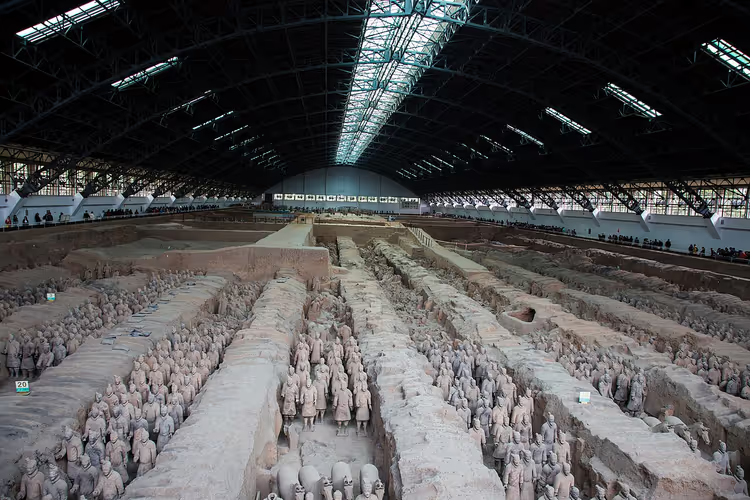
Xi'an lies in the center of the country and is considered the eastern point of the Great Silk Road. The city is best known for the Terracotta Army. These are thousands of life-size clay warriors that guarded the tomb of the first emperor, Qin Shi Huang.
The burial site was only discovered in 1974, and the find was a sensation: the army is over 2,000 years old. Entry costs 120 RMB in the low season and 150 RMB in the high season (as of 09/2026, China Discovery). Xi'an itself is also known for its massive city wall, which is great to explore by bicycle. Tickets and tours in Xi'an on GetYourGuide are best booked in advance: in high season, spots sell out days ahead.
 © Jmhullot · CC BYPhoto: Jmhullot, CC BY (https://creativecommons.org/licenses/by/3.0), Wikimedia Commons
Guilin: karst cliffs along the Li River
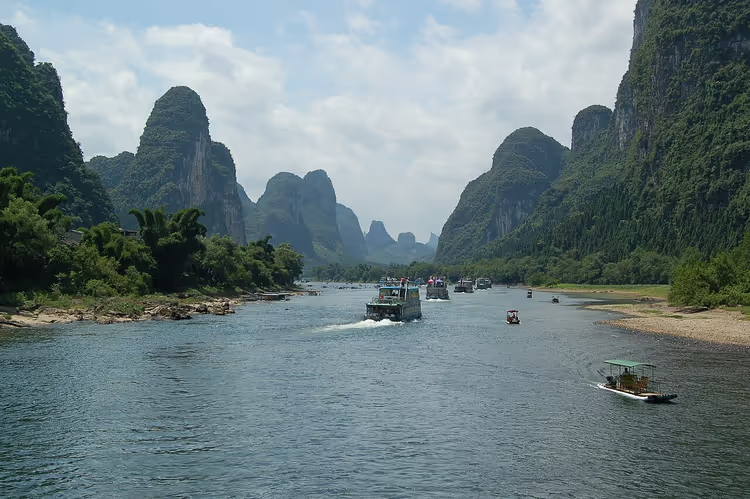
Guilin in the south of the country resembles Laos or Vietnam. Karst cliffs along the Li River, green terraces near Longsheng, pagodas on Shanhu Lake in the sunset light: the landscapes here are of rare beauty.
But beauty comes at a price. You'll have to share it with crowds: more than 4 million people live in the Guilin metropolitan area. The town of Yangshuo, with 300,000 residents, and the Yulong River tributary are considered calmer, though "calmer" is a relative concept here.
The classic way to see Guilin is a leisurely boat trip down the Li River to Yangshuo. From the water, the karst peaks are at their best. In Yangshuo itself, rent a bicycle and head out to the villages along the Yulong, away from the main viewpoints. Sunrises and sunsets here are noticeably gentler than the daytime crowds, so get up early.
 © Halaston · CC BY-SAPhoto: Halaston, CC BY-SA (https://creativecommons.org/licenses/by-sa/4.0), Wikimedia Commons
What else is worth seeing in China
The list could go on for a long time. Among the well-known options are autonomous Tibet in the Himalayas with Lhasa, the former residence of the Dalai Lama, the historic old town of Pingyao, Chongqing, and a Yangtze River cruise.
 © Ondřej Žváček · CC BYPhoto: Ondřej Žváček, CC BY (https://creativecommons.org/licenses/by/2.5), Wikimedia Commons
In a broader sense, gambling hub Macau and Hong Kong can be added here. Formally, these are two special administrative regions of the PRC, but for a traveler they're also convenient as a way to reset the 30-day visa-free period.
A separate question is what to pack. What to put in your backpack for a long trip depends on the season and region, but the basic kit for China is the same: a passport with sufficient validity, copies of bookings, a power bank, and apps downloaded in advance.
Want to quickly figure out what to see in a specific city? Below is a selection of current tours and tickets, and it will adjust to the places mentioned in this article.
Tours and tickets
Guided tours, skip-the-line tickets and activities — most offers can be cancelled free of charge.
See offers on GetYourGuideThe widget loads once you give your consent.
Route and transport
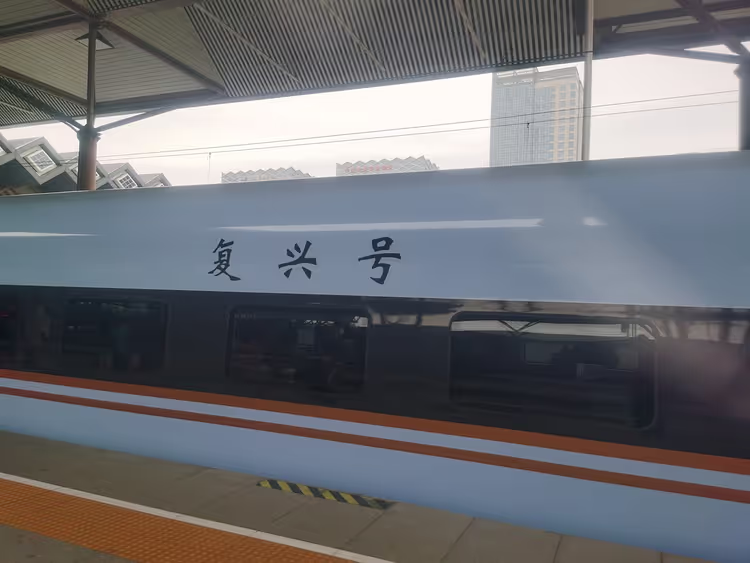
There is no single perfect route through China. It all depends on how much time you have and what you want to combine. The good news up front: the country is covered by a modern network of high-speed trains that connects all major cities.
The logic of putting it together is simple. Link neighboring points by train, and cover long jumps by plane. Short transfers within one region often take just one or two hours. Buy tickets for popular routes a few days in advance: during high season, convenient departure times sell out quickly.
 © Shwangtianyuan · CC BY-SAPhoto: Shwangtianyuan, CC BY-SA (https://creativecommons.org/licenses/by-sa/4.0), Wikimedia Commons
But don't underestimate the distances. From Shanghai to Beijing looks close on the map, but in reality it's more than 1,200 kilometers. That's like Frankfurt to Rome. A high-speed train covers this route in 4.5 to 6 hours, and a second-class ticket costs roughly 576 to 697 RMB, about 75 to 90 EUR (as of 09/2026, TravelChinaGuide).
Tickets are easiest to buy through the Trip.com app. It shows all available departures, and you need to enter your passport number when purchasing. There are no e-tickets in China: your passport number is linked to the booking, and at the gate your passport is scanned instead of a ticket. It's worth comparing schedules and prices for trains in China via Trip.com in advance.
Train stations in China are more like airports, and security screening is very strict. Sharp objects such as a folding knife or pressurized containers larger than 150 ml are not allowed. Allow time for the queue and checks, especially at rush hour.
When distances are too great, a plane comes to the rescue. Domestic flights can be booked through the same Trip.com or searched via flight aggregators.
Within cities, the best transport is the metro. A ride costs very little, usually within a couple of yuan, and you can pay in cash or via Alipay. Schedules are translated into English and easy to follow. Buses also work well, but change isn't always given.
Alipay has a built-in "Transport" section: it generates QR codes for the metro and buses, and the fare is deducted from the linked card. Google Maps is useless in China, so for metro navigation travelers recommend Apple Maps, where routes display reliably. Taxis are also available, and the most convenient way to hail one is through the Didi service built into Alipay.
How much a trip to China costs
China is generally cheaper than many countries in Europe, the US, Japan, or Australia. But the range is wide. Well-known cities like Shanghai and Beijing are noticeably more expensive than the rest of the country. The total depends on your travel style: accommodation class, number of activities, transportation.
In expensive regions and on short trips, the daily budget per person easily approaches European levels, because expenses don't get spread out over weeks. In quieter provinces, it works out noticeably cheaper. The flight is usually not included in this amount; count it separately.
Accommodation takes up a significant part of the budget. A double room in quieter regions costs far less than in central Shanghai or Beijing. Hostels and dorms are less common than in Southeast Asia, and most options are classic hotels. Prices and neighborhood tips are collected below in the accommodation section.
Transportation within cities is almost invisible in expenses: the metro and buses cost pennies. A major line item is long-distance trains. The same Shanghai-Beijing route will cost 75-90 € per person for more than 1,200 kilometers (as of 09/2026, TravelChinaGuide).
Saving on food is easy. Breakfast from a mini-market of pastries, yogurt, and coffee comes out inexpensive, and hot dishes in simple cafes cost little. For vegetarians, the selection is modest, which is covered in more detail in the food section.
The final amount depends heavily on activities. Entrance tickets to top sights and cable cars add up quickly, so set aside a separate line for attractions. A simple rule helps. Move through expensive cities faster, and spend more days in quieter regions, where both accommodation and food are noticeably cheaper.
Useful services for the trip
Three things are worth preparing before you leave home: a card with no fees, insurance, and mobile internet. Let's go through them in order.
Bank card
A good travel card is the foundation. In China, you will mostly pay through Alipay or WeChat, but you need to link a bank card to them. Choose a card with no foreign transaction fees and no fees for cash withdrawals abroad. Keep a small reserve of yuan in cash: in some places, paying by phone won't work.
Check in advance that the card supports Visa or Mastercard. Those are what Alipay and WeChat accept for foreigners. Withdrawing cash is easier at ATMs of major banks: they more often work with foreign cards. And notify your bank about the trip so payments from China don't get blocked as suspicious.
Insurance
No trip without insurance. A scooter accident or stomach problems happen on the road more often than you'd think. Take out a policy in advance and compare travel insurance terms to choose the right coverage.
SIM card and internet
A regular local SIM won't get around censorship. A working solution is an eSIM from Hong Kong: it works in mainland China and opens all services without a VPN. A 15 GB plan costs from ~15 € per package, with the exact price depending on the provider. For an active user, it lasts about a week; after that, it's easier to top up with another package. Find an eSIM for China before your flight so you have connectivity from day one.
Check that your phone supports eSIM. Most recent models do. You can also buy a physical SIM at the airport on arrival, but you'll spend time on registration with your passport. Just in case, keep a backup VPN enabled: networks sometimes act up, and a second connection channel saves the day.
Where to stay in China
The familiar Booking and Airbnb work poorly or not at all in China. So it's more convenient to book accommodation through hotels in Shanghai and Beijing on Trip.com. The service works both as a website and as an app. The selection in major cities and tourist areas is large, but prices vary widely.
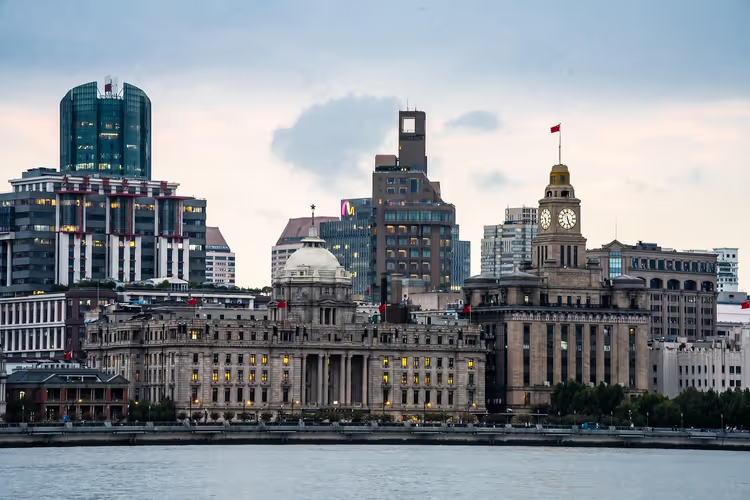
Shanghai and Beijing are noticeably more expensive than the rest of the country, especially in the center. In Chengdu, Xi'an, or Kunming, accommodation costs far less, and a dorm bed can realistically be found for symbolic money. Shanghai does have cheap private rooms, but with caveats: no window, shared bathroom, outskirts.
Book in advance, two to three weeks ahead. On a short trip, it's better to pay extra for the center and save time on commuting. In Shanghai, a convenient example is One Forest Youth Hostel: it's within walking distance (about 10 minutes) of The Bund waterfront and East Nanjing Road metro station, and across the street there's a 7-Eleven and a coffee shop. The price stays in the mid-range for the center.
In Beijing, a decent base is Ibis Beijing Tiantan East Gate. The hotel sits right by the Temple of Heaven, with metro access, so it's fairly central. The catch: there are few places to eat nearby, and it's about a 20-minute walk to a large supermarket. Don't expect luxury here, but for a basic budget it's a solid option.
A couple of practical rules for booking. Check that the hotel has a license to host foreigners: some budget options only accommodate Chinese citizens, and you can see this through a filter on Trip.com. Look at proximity to the metro, not just the neighborhood. The city is huge, and an extra 20 minutes on foot to the station hits your whole day. Read reviews by recent dates, and save the address in Chinese to show a taxi driver.
Food and drinks
Fans of fish and meat have it easy in China. Hot pot in all its variations, Peking duck, chop suey, and dim sum await you. Vegetarian cuisine is harder, and for many travelers China turns out to be the most difficult country in this regard.
The problem is the menu. From a dish description, it's often impossible to tell whether it contains fish or meat, and communicating in English doesn't always work. One piece of advice: prepare several phrases in Chinese in advance that explain in different ways that you don't eat meat or fish.
Showing such a phrase in a restaurant works better than explaining in words. It's easier to order vegetable rice, egg with rice and vegetables, or marinated tofu. To find vegetarian and vegan places, look for them in the Happycow app.
Delivery is ordered through the Sherpa's app, an analog of Lieferando. It's in English, with filters by cuisine, and you can order food straight to your hotel. Mini-markets like 7-Eleven and Family Mart also exist, though there are fewer of them than in other Asian countries.
To check ingredients, a camera translator like Google Lens comes in handy. Ready-made vegetarian dishes are almost nonexistent in mini-markets, but breakfast won't be a problem: pastries, yogurts, and sandwiches are available. Bakeries are often located in shopping centers near metro stations. Chain fast food like Burger King, McDonald's, and Subway is plentiful, but the vegetarian selection is very limited.
Among safe orders, fried vegetables, tofu, noodles, and rice with egg most often come to the rescue. Specify that the dish is prepared without meat broth: it ends up even in vegetable soups. Meat eaters have it easier, and regional cuisines differ greatly. The spicy Sichuan cuisine of Chengdu is nothing like the mild Cantonese dim sum of the south. Drink bottled or boiled water, and hot tea in cafes is usually free.
Customs and language
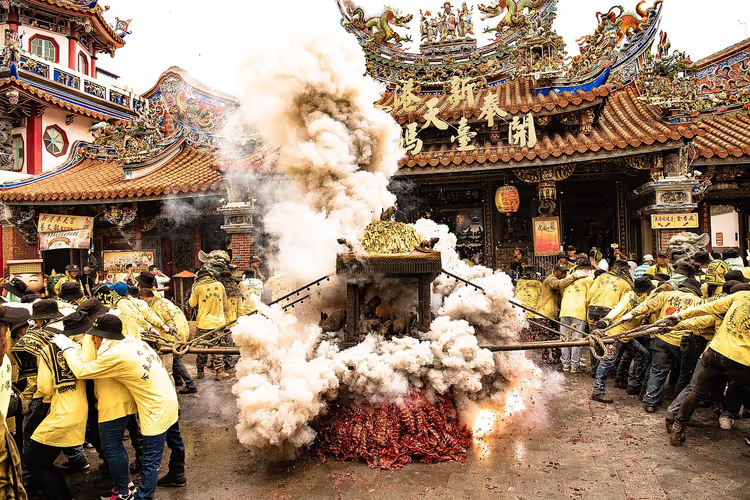
It is easy to get culture shock in China. Even people who have traveled a lot around Asia do not get used to local habits right away. The first thing you will encounter is crowds. The country has more than 1.4 billion people, and train stations, the metro, and especially tourist attractions will be packed.
 © Celineliu119 · CC BY-SAPhoto: Celineliu119, CC BY-SA (https://creativecommons.org/licenses/by-sa/4.0), Wikimedia Commons
Pushing and shoving is normal here, and you should not expect the delicacy that is common in Japan. The noise level is also different: people talk loudly, take calls on the metro, and watch videos without headphones. Smoking is widespread, and bans are not always followed, even in hotel lobbies. You will also have to get used to people loudly clearing their throats on the street.
Do not exaggerate all of this: a tourist only sees a surface slice. But it is useful to know what awaits you. As a foreigner, you always attract attention, and do not be surprised if someone takes your photo without asking. English is not widely spoken, so do not count on it. At the same time, locals often help even across the language barrier: they help you buy a metro ticket or find food. And one important point: there are cameras and police everywhere, your passport is checked often, and you should completely avoid talking about politics.
A few more everyday details. Tipping is not customary in China, and you do not need to leave it almost anywhere. In lines, be ready to defend your spot: the concept of personal space is different here. Toilets are often squat toilets, so carry tissues and hand sanitizer with you. Keep an offline translator handy: signs are not always duplicated in English, especially outside tourist centers.
Internet and apps in China
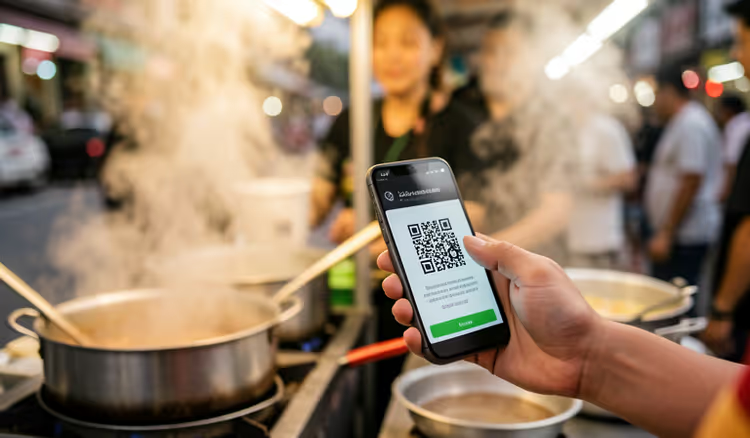
The internet in China is heavily restricted. WhatsApp, Google Maps, Instagram, and YouTube will not open without preparation. Censorship is bypassed with the right eSIM or VPN, but internet alone is not enough: without the right apps, the country will be difficult.
 AIIllustrative image: AI-generated
The basic set is this: Alipay for payments, WeChat for messaging, a translator, and at least one map for navigation. Alipay also covers transport and taxi rides through Didi. Install and set everything up at home, while the services are still accessible without bypassing blocks.
Get an eSIM for your trip to China in advance so you have connectivity as soon as you land.
Is China worth visiting
Many people initially do not include China in their Asia travel plans. But the visa-free window has changed the equation, and it would be a shame to miss such an opportunity. Even Shanghai, Beijing, and the Great Wall give you a strong first impression of a huge country, one that makes you want to come back for longer.
Let us be honest about the other side too. Crowds and some local habits take time to get used to. China is not a country for relaxing in the style of Thailand or Indonesia, it is an adventure in a completely foreign culture. But that is exactly its strength: China's history and development are genuinely captivating. While the visa-free regime is in effect, the country remains an excellent travel option.
One last piece of advice: do not try to cover everything in one trip. Pick one region and a couple of cities, and leave the rest for next time. That way China turns from an exhausting marathon into a trip you want to come back from.
⁉️🤔 Frequently asked questions
Do German citizens need a visa for China?
Not for a short trip. Until December 31, 2026, German citizens can enter visa-free for up to 30 days (as of 09/2026, German Federal Foreign Office entry information). There is one condition: your passport must be valid for at least six more months after your return.
When is the best time to visit China?
Spring and early summer, from April to June, and autumn, from September to mid-November, are optimal. Avoid Chinese New Year, the first week of May, and the first week of October. During these days, Chinese people themselves travel, prices rise, and tourist attractions are overcrowded.
How do you pay in China without cash?
Almost everywhere accepts phone payments through Alipay or WeChat, to which you need to link a bank card. Set up the apps in advance. Still keep a small reserve of yuan: in some places you will not be able to pay by phone.
Do Google, WhatsApp, and Instagram work in China?
Not without preparation, the internet is censored. The easiest option is to buy an eSIM from Hong Kong: it works on the mainland and opens all services without a VPN. As a backup, use a VPN installed before you leave home.
How much time should you plan for the trip?
Because of the long flight, a reasonable minimum is two weeks. If you want more than 30 days, you can briefly leave for Macau or Hong Kong and come back: then the visa-free period starts over, and you can realistically stretch the trip to almost two months.
How do you get between cities in China?
The backbone is the high-speed rail network between major cities. Tickets are bought through Trip.com by linking your passport number, and at the entrance your passport is scanned instead of a ticket. For the longest distances, a domestic flight is more cost-effective.
In short: what to book
Build your trip from three blocks: flights, accommodation in a convenient location, and tickets to top sights bought in advance. This will save you time and stress during the busiest season.
- If you have two weeks: Shanghai, Beijing, and the Great Wall give you a balanced first introduction to the country.
- If you have more time: add Xi'an, Chengdu with pandas, or the Zhangjiajie mountains and Yunnan.
- If you are traveling in high season: book accommodation and tickets in advance, spots sell out weeks ahead.
Ready to plan? Compare flights to China and choose hotels on Trip.com in a location that suits you.
You can also check out tickets to top sights on GetYourGuide in advance: that way you will not have to stand in lines during high season.

A small editorial team writing guides for independent travel. We travel ourselves, but we haven’t been everywhere, so we check prices, opening hours and how to get there against official sources.