
















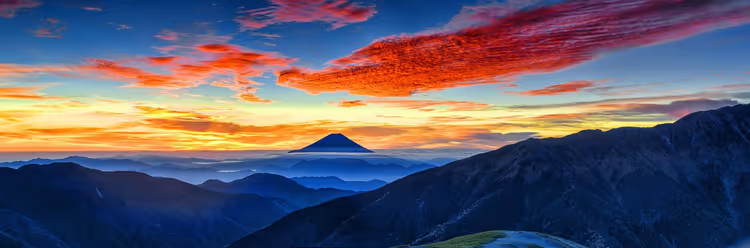
Climbing Fuji: Yoshida Trail route, overnight stay and mandatory fee
Fuji looks unreachable only on postcards. In reality, tens of thousands of ordinary tourists climb the 3,776 m summit every season (as of 09/2026, official Mount Fuji climbing website). You won't need ice axes or mountaineering training.
The challenge lies elsewhere. The season is short, and the Yoshida Trail has a daily limit. Those who show up spontaneously often end up stuck at the foot of the mountain. We've broken down the route by day, the bus and climbing fee costs, the overnight option, and the gear that actually comes in handy at altitude.
Ad: this article contains affiliate links, we earn a commission if you book through them, at no extra cost to you.
Climbing Mount Fuji: the essentials
💡 In short:
- 2026 season: July 1 to September 10 (as of 09/2026, official Mount Fuji climbing website).
- The ascent takes 5 to 10 hours, the descent is faster (as of 09/2026, official Mount Fuji climbing website).
- At night, entry is closed from 2:00 PM to 3:00 AM without a mountain hut reservation (as of 09/2026, official Mount Fuji climbing website).
- Bring warm layers, a rain jacket, a headlamp, and water: it's cold at the top even in summer.
- Season, fees, and rules: as of 09/2026, verified on the Mount Fuji climbing portal.
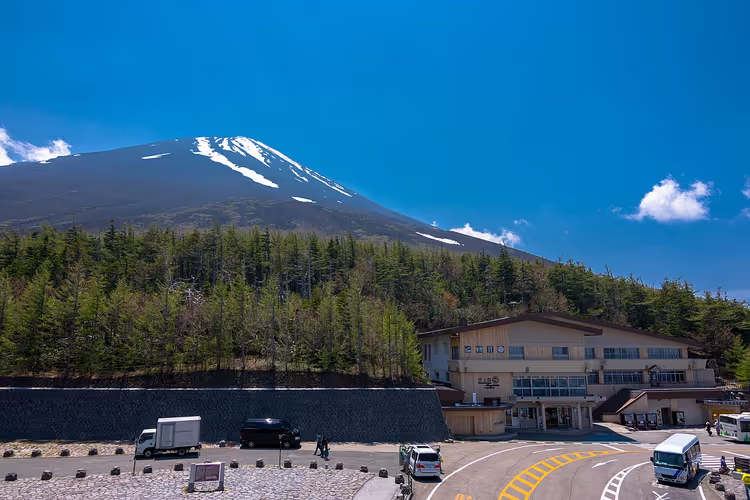
Almost all beginners take the Yoshida Trail. It starts at the 5th station, at about 2,300 m, where the bus drops you off. Beyond that point the roads end, and you continue on foot up a trail with rope railings. You don't need marathon-level fitness, but you do need time and patience: in July and August the trail is crowded.
Fuji sits on the island of Honshu near Tokyo, and it's the highest point in the country. Four official trails lead to the summit, but beginners almost always choose Yoshida. It starts higher than the others and has easy terrain. That's exactly why it has the most people, especially on weekends.
How to get to Fuji
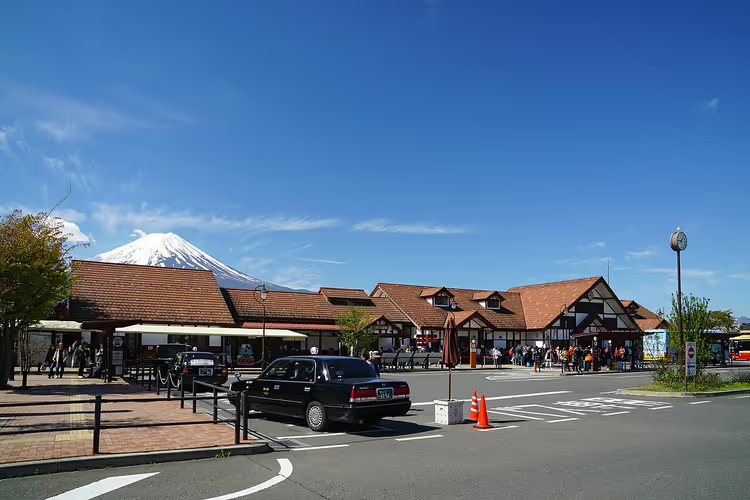
The journey starts in Tokyo. From the Shinjuku bus terminal or Tokyo Station, you take a direct bus to the town of Kawaguchiko at the northern foot of the mountain. The trip has no transfers and takes about two hours (as of 09/2026, Fujikyu buses). It's best to book tickets for the season in advance: in July and August, seats sell out quickly.
 © 663highland · CC BY-SAPhoto: 663highland, CC BY-SA (https://creativecommons.org/licenses/by-sa/4.0), Wikimedia Commons
From Kawaguchiko to the 5th station, a shuttle takes you along the toll road Fuji-Subaru Line. You can't drive there in your own car during the season, so the bus remains the main option. If you're still choosing a flight to Japan, flights to Tokyo on Kiwi.com will help you compare routes.
Along the way you'll see how densely built up Japan is. Every meter of land is occupied by a house or a road, which makes the rare places where nature has been preserved all the more valuable. Outside the city, the plain gives way to hills, and the country's main mountain is just a short distance away.
It seems as though these hills have been untouched by humans. That impression is deceptive: the Japanese take great care of their slopes. Here and there you'll see elderly people in green armbands who volunteer to pick up litter left behind by tourist groups. The cleanup is done mostly by older people, and it's a noticeable part of the local culture.
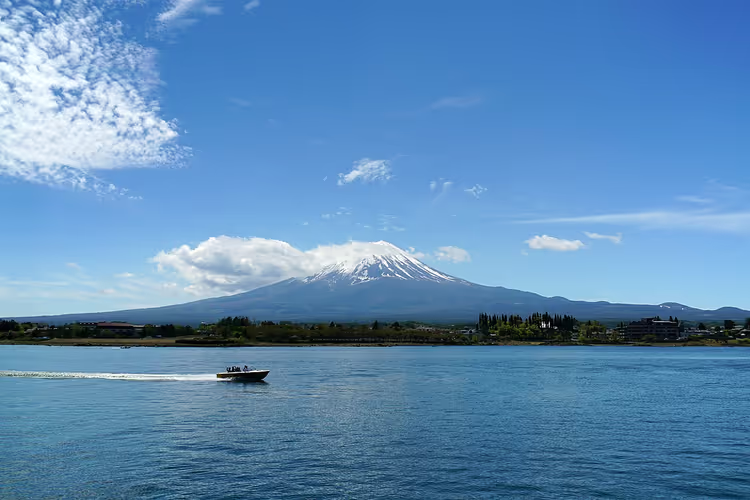
On the north side of the mountain lie several deep lakes with clean, cool water. One of them shares its name with the town of Kawaguchiko, and it's the most convenient place to spend your first day. The road to the 5th station is a toll road, so plan your shuttle expenses in advance.
First stop at Lake Kawaguchiko
The first night is best spent right by Lake Kawaguchiko. There's a campsite here where you can pitch a tent and gather your strength before the climb. Bringing your own tent is the cheapest option, while renting one of the cabins costs extra. Exact rates depend on the season, so check them on the campsite's website before your trip.
 © 663highland · CC BY-SAPhoto: 663highland, CC BY-SA (https://creativecommons.org/licenses/by-sa/4.0), Wikimedia Commons
Plan separately for water, showers, and toilets. Experienced travelers come to the lake with their own camp stove, folding furniture, and a compact cooking kit. The Japanese set up tents with electricity and continue enjoying the comforts of civilization even far from the city. You don't need all that gear, but water and snacks will save you money up top.
Drinking water and other beverages are best bought in advance. You'll come across vending machines and shops along the trail, and the higher you climb, the more expensive each bottle gets. At the very foot of the mountain, water is noticeably cheaper, while closer to the summit the price rises several times over. Bring enough fluids the evening before so you don't overpay on the way.
Day two: bus to the 5th station
In the morning you return to the bus and grab a comfortable seat. This is the transport that takes you over the last stretch of road before the climb. In the past, the ascent was considered a test for strong samurai, who walked to the summit from the farthest corners of the country. Today it's much simpler.
From the foot to the summit there are ten stations, and five of them are easily reached by bus. Beyond that, transport doesn't go any further, and you cover the remaining distance on foot along a special staircase. If you want to hike the entire route from the plain, be prepared for dense forests and steep cliffs.
By bus, the climb to the 5th station takes no more than an hour. On foot, the same stretch takes several hours and requires good fitness. Many tourists choose the bus and save their energy for the main part of the route above the clouds.
Fifth station: market and guides
At the 5th station, lively commerce begins. Everywhere you look, vendors call tourists into souvenir tents, and restaurants and snack bars operate on every corner. Most gifts are bought at the local market, so don't put off your shopping until the summit.
 © Mattias Hill · CC BY-SAPhoto: Mattias Hill, CC BY-SA (https://creativecommons.org/licenses/by-sa/3.0), Wikimedia Commons
Here you'll also easily find a guide. They climb to the summit almost every day, and you can recognize them by the blue armbands and small flags. Organized groups walk in matching uniforms, while tourists in street clothes and flip-flops bustle around them. That's the best proof that climbing the mountain requires no superpowers.
Another local tradition involves a walking stick. Many pilgrims carry a wooden staff with small bells, and the shaft bears stamps. You can buy a stick right here for a small sum, and stamps are applied at each station along the way. By the number of marks at the bottom, it's easy to tell who is just setting out and who has already reached the summit.
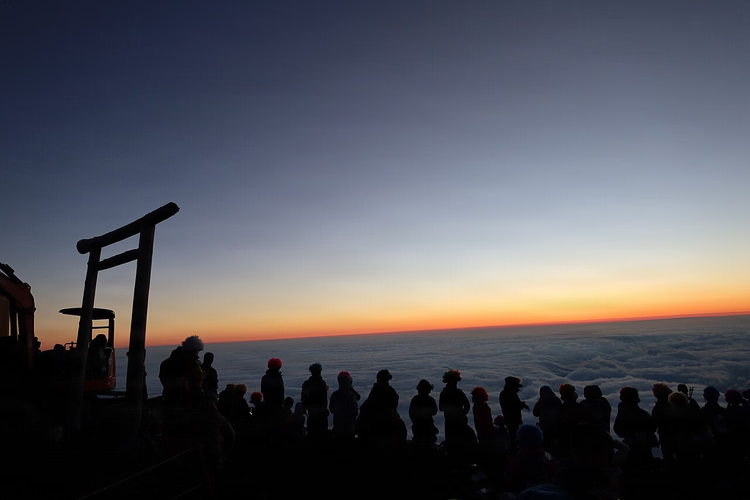
A comfortable option for a beginner: an overnight stay in a mountain hut at one of the upper stations. You climb during the day, rest, and then head to the summit by dawn without a nighttime push. Huts are booked in advance, and weekend spots during the season sell out within the first few days.
The path to the summit of Fuji
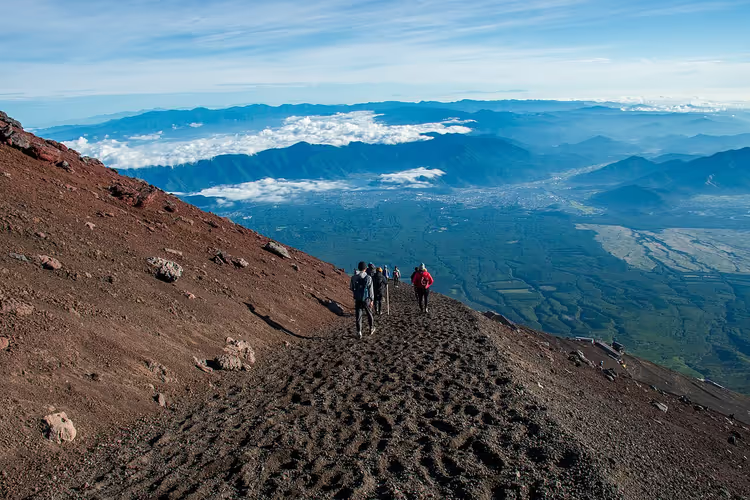
The entire route resembles a huge staircase with rope railings. Along the whole way you'll see signs in Japanese and English. Periodically you'll come across platforms made of bags filled with volcanic rock: they're convenient for resting and catching your breath.
It's always crowded here. You'd think you'd wandered into a big fair rather than a mountain trail. If you're in a group, you rest on the guide's command. Nearby, tourists sit down on volcanic ledges, drink water, and breathe oxygen from canisters.
Oxygen deserves a separate mention. At higher altitudes there's less of it in the air, and canisters help those who struggle with the exertion. You can buy them at the 5th station or in shops along the way. Dozens of huts line the trail where you can rest and eat something hot. One of them is a convenient place to spend the night and set out by dawn.
The best views open up from the summit itself. You'll see the ocean, tiny villages, and the lights of Tokyo. Anyone who wants to feel like a conqueror of mountains should make time for this climb.
The summit resembles the surface of Mars as shown in NASA images. A weather station stands on the crater's edge, and nearby a whole little town has grown up with shelters and food. Prices for everything here are higher than at the foot, and that's worth factoring into your budget.
The way back
After sunrise, it is time to head down. The descent is easier than the climb, but it is easy to slip on rocks and dust. It is best to start early in the morning or at dusk, when the trail empties out and hikers disperse to the huts.
Once you reach the familiar campsite by the lake, you can rest a little more by the water. Then the road back to Tokyo awaits. Plan your descent with extra time to spare: fatigue after a night at altitude makes itself felt.
What you need to know
You can only climb to the summit during the season. In 2026, the Yoshida Trail is open from July 1 to September 10 (as of 09/2026, official Mount Fuji climbing site). During this time, huts and rescue stations are open, and the weather remains the most predictable. In winter and spring, the climb is closed, and trying to get around the ban is life-threatening.
Since 2025, a mandatory fee applies on all four trails. It costs 4,000 yen per person and goes toward trail maintenance and tourist safety (as of 09/2026, official Mount Fuji climbing site). At night, the gates on the Yoshida Trail are closed: from 2:00 PM to 3:00 AM you cannot pass without a mountain hut reservation. Plan to start during the day.
Expense item | Price |
|---|---|
Mandatory fee | 4,000 yen (as of 09/2026, official Mount Fuji climbing site) |
Shuttle to the 5th station, round trip | 3,400 yen (as of 07/2026, Fujikyu Bus) |
Shuttle to the 5th station, one way | 2,000 yen (as of 07/2026, Fujikyu Bus) |
The average climb takes 5 to 10 hours, and that is one way only (as of 09/2026, official Mount Fuji climbing site). If you are traveling with children, choose an easy trail and an overnight stay in a hut. The entire route is equipped with ladders and cables, so an unprepared hiker can manage too, as long as they take their time.
Before the trip, get medical insurance that covers active recreation. You can compare terms and rates from different companies through insurance comparison. Keep your phone charged: reception at the top is unreliable, and there is no ATM at the 5th station, so bring cash in advance.
Gear
Pack your backpack ahead of time, as the weather at the top changes quickly. The basic kit includes warm layers, a waterproof jacket, a hat and gloves, a headlamp, water, and food. Also bring sunscreen, sunglasses, and a trash bag: you are expected to carry your own waste out.
Choose closed shoes with a thick sole and ankle support. Sneakers will also work in dry weather, but rocks and dust on the descent quickly tire your feet. An oxygen canister and trekking poles make the climb easier, although you can manage without them.
For communication and maps, set up an eSIM for Japan in advance. Local SIM cards are harder for a tourist to arrange, and navigation and weather forecasts on your phone are genuinely useful on the trail.
How much a guided climb costs
If you do not want to plan everything yourself, you can book the climb through organizers. One-day group tours without an overnight stay and options with an overnight stay in a mountain hut are available. The price depends on the format, group size, and included gear, so check it when booking.
Mount Fuji tours on GetYourGuide
The guide handles tickets, pace, and safety, leaving you to pack your personal items. For a first climb, this is a sensible option: in a group, it is easier to cope with the altitude and the night ascent. Experienced hikers often go on their own and save a significant portion of the cost.
Tours and tickets in Mount Fuji
Guided tours, skip-the-line tickets and activities — most offers can be cancelled free of charge.
See offers on GetYourGuideThe widget loads once you give your consent.
⁉️🤔 Frequently asked questions
Can you climb Fuji without a guide and without training?
Yes, the Yoshida Trail is designed for beginners. Stairs and rope railings run along the entire route, and there are huts and shops at the 5th station. The main things you need are time and warm clothing. If you have heart or blood pressure issues, check with a doctor first.
How much does the climb cost in 2026?
The mandatory fee is 4,000 yen per person (as of 09/2026, official Fuji climbing site), plus the bus to the 5th station. A round-trip shuttle ticket costs 3,400 yen, and a one-way ticket costs 2,000 yen (as of 07/2026, Fujikyu Bus). Budget separately for an overnight stay in a hut and food on the mountain.
When is the best time to go to avoid the crowds?
The official season runs from July 1 to September 10 (as of 09/2026, official Fuji climbing site), but the busiest weeks are late July and all of August. Choose the start of the season or the first days of September, and skip weekends and holidays if possible. On weekdays the trail is noticeably less crowded.
Do you need to book a mountain hut in advance?
Yes, if you want to spend the night on the slope. Booking opens in spring, and spots in popular huts for weekends sell out within the first few days. Without a reservation you will not get through the night gates on the Yoshida Trail. Plan your overnight stay as soon as you have picked your dates.
What should you do if you get altitude sickness?
Climb slowly and take rest breaks. At the first symptoms, headache or nausea, do not keep going up: descend to a lower elevation instead. An oxygen canister and water can ease the symptoms, but they are not a substitute for descending. If symptoms are severe, contact rescuers at the station.
In short: what to book
Fuji forgives beginners for a lot, but not for carelessness. Stick to one trail and one plan, and lock in your reservations and tickets in advance. If you are short on time, take the bus to the 5th station and allow a day for the climb. If you want sunrise at the summit, book a hut and warm layers. If you are traveling with kids, choose the start of the season and an overnight stay in a hut.

A small editorial team writing guides for independent travel. We travel ourselves, but we haven’t been everywhere, so we check prices, opening hours and how to get there against official sources.